EVALUATION SACHA INCHI MEAL (Plukenetia volubilis) AS DEFATTED SOYBEAN REPLACEMENT ON DIGESTIBILITY AND THE GROWTH PERFORMANCE OF CATFISH

Downloads
ARTICLE HIGHLIGHTS
- The increasing scale of catfish aquaculture is expected to raise the overall demand for fish feed
- Catfish feed remains expensive due to the dominance of imported protein ingredients
- Sacha inchi meal offers a promising plant-based protein alternative for aquaculture diets
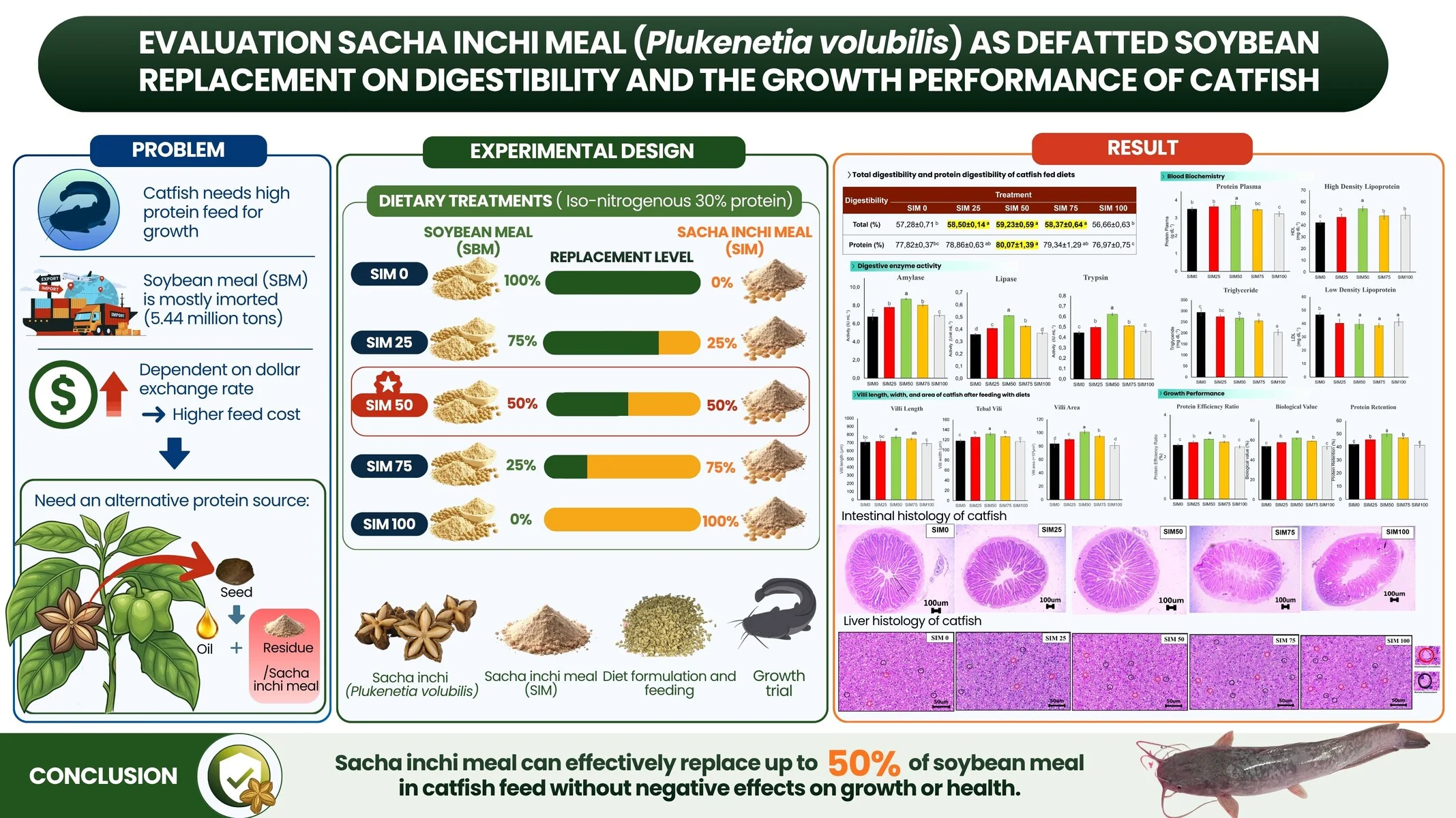
- Replacing 50% of soybean meal with sacha inchi meal improves digestibility, fish growth, and feed efficiency
ABSTRACT
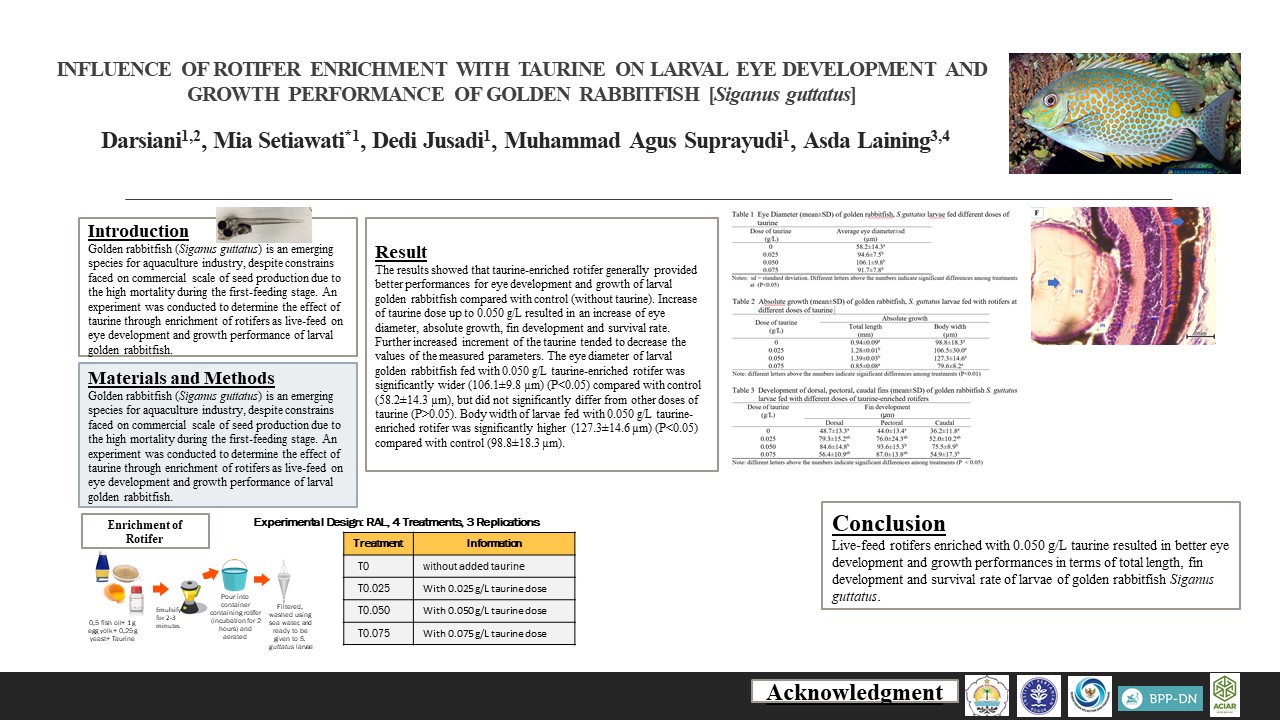
Catfish (Clarias gariepinus) production has increased, necessitating adequate nutritional support through feed. However, the expensive price of feed, primarily due to reliance on imported ingredients such as soybean meal (SBM), remains a major challenge. Sacha inchi meal (SIM), derived as a by-product from the oil extraction of Plukenetia volubilis, is rich in protein and essential amino acids, making it a promising local alternative. This study aimed to determine the feasibility of SIM as a substitute for defatted soybean meal (SBM) in catfish feed. Fifteen juvenile catfish (11.01 ± 0.01 g) were reared in 15 aquariums measuring 90 cm × 45 cm × 45 cm for 60 days, with three replicates for each of five isonitrogenous (30% crude protein) feed formulations containing 0%, 25%, 50%, 75%, and 100% replacement levels of SBM with SIM. Chromium III oxide (Cr2O3) was added as an indicator for digestibility analysis. Feces and blood were collected, and fish samples were analyzed to assess growth performance, digestive enzyme activity, and histological characteristics of the intestine and liver. The 50% replacement SBM by SIM demonstrated the highest total digestibility, digestive enzyme activity, and plasma total protein levels, followed by high protein retention and a protein efficiency ratio. Enhanced protein utilization in the 50% replacement SBM by SIM resulted in the highest average final weight, specific growth rate, and optimal feed conversion ratio.
[AOAC] Association of Official Analytical of Chemist. 2012. Association of Official Method of Analysis. Arlington (US): The Association of Official Analytical Chemist, Inc.
Bai SC, Hardy RW, Hamidoghli A. 2022. Diet analysis and evaluation. In: Hardy RW, Kaushik SJ (Editors), Fish Nutrition. Fourth Edition. Cambridge (US): Academic Press. p. 709–743.
Borlongan IG. 1990. Studies on the digestive lipases of milkfish (Chanos chanos). Aquaculture. 89(3):315–325.
Bradford M. 1976. A rapid and sensitive method for the quantification of microgram quantities of protein utilizing the principle of protein-dye binding. Anal Biochem 72: 248–254.
Chura AO, Puma RMP, Huanca FHR, Cucchi MEC, Araníbar MJA. 2018. Apparent digestibility of dry matter, organic matter, protein and energy of native Peruvian feedstuffs in juvenile rainbow trout (Oncorhynchus mykiss). Fish Aquatic Sci 21(1):1–7. DOI:10.1186/s41240-018-0111-2
Dawood MAO, Eweedah NM, Khalafalla MM, Khalid A. 2020. Evaluation of fermented date palm seed meal with Aspergillus oryzae on the growth, digestion capacity and immune response of nile tilapia (Oreochromis niloticus). Aquac Nutr 26(3):828–841. DOI:10.1111/anu.13042
Elesho FE, Krockel S, Sutter DAH, Nuraini R, Chen IJ, Verreth JAJ, Schrama JW. 2021. Effect of feeding level on the digestibility of alternative protein-rich ingredients for African catfish (Clarias gariepinus). Aquaculture 544:1–12. DOI:10.1016/j.aquaculture.2021.737108
Elvy JE, Symonds JE, Hilton Z, Walker SP, Tremblay LA, Casanovas P, Herbert NA. 2022. The relationship of feed intake, growth, nutrient retention, and oxygen consumption to feed conversion ratio of farmed saltwater chinook salmon (Oncorhynchus tshawytscha). Aquaculture 554. DOI:10.1016/j.aquaculture.2022.738184
Erlanger BF, Kokorsky N, Cohen W. 1961. The preparation and properties of two new chromogenic substrates of trypsin. Arch Biochem Biophys 96:271–278.
Gadri AF Al, Susilo U, Priyanto S. 2014. Protease and amylase activities in the hepatopancreas and intestine of nilem Osteochilus hasselti. Scripta Biologica 1(1):43–48.
Goddard S. 1996. Feed management in intensive aquaculture. New York (US): Chapman and Hall. 194 p.
Goyal A, Tanwar B, Kumar SM, Sharma V. 2022. Sacha inchi (Plukenetia volubilis L.): An emerging source of nutrients, omega-3 fatty acid and phytochemicals. Food Chem 373:1–18. DOI:10.1016/j.foodchem.2021.131459
Hardy RW, Kaushik SJ. 2022. Fish nutrition. Fourth Edition. Cambridge (US): Academic Press.
Hekmatpour F, Nazemroaya S, Mousavi SM, Amiri F, Feshalami MY, Sadr AS, …, Sharifan M. 2023. Digestive function and serum biochemical parameters of juvenile Cyprinus carpio in response to substitution of dietary soybean meal with sesame seed (Sesamum indicum) cake. Aquac Rep 28:101438. DOI:10.1016/j.aqrep.2022.101438
Hepher B.1998. Nutrition of pond fishes. Cambridge (UK): Cambridge University Press.
Hildayanti W, Setiawati M, Jusadi D. 2016. Utilization of Portulaca oleracea seed oil as a source of essential fatty acids in common carp feed, Cyprinus carpio Linnaeus 1758. Jurnal Ikhtiologi Indonesia 16(2):145–157.
Iheanacho S, Ogueji E, Igberi C, Avwemoya F, Amadi-Eke A, Yaji A, Mbah C. 2019. Suitability of discarded cashewnut (Anacardium occidentale) meal as replacement of soybean meal (Glycine max) in the diet of juvenile African catfish Clarias gariepinus (Burchell, 1822). Indian J Fish 66(3):16–24. DOI:10.21077/ijf.2019.66.3.89214-10
Jiao F, Zhang L, Limbu SM, Yin H, Xie Y, Yang Z, …, Rong H. 2023. A comparison of digestive strategies for fishes with different feeding habits: Digestive enzyme activities, intestinal morphology, and gut microbiota. Ecol Evol 13(9):1–14. DOI:10.1002/ece3.10499
Kaushik SJ, Schrama JW. 2022. Bioenergetics. In: Hardy RW, Kaushik SJ (Editors), Fish Nutrition. Fourth Edition. Cambridge (US): Academic Press. p. 17–55.
Khieokhajonkhet A, Aeksiri N, Rojtinnakorn J, Van Doan H, Kaneko G. 2022. Sacha inchi meal as a fish-meal replacer in red hybrid tilapia (Oreochromis niloticus × O. mossambicus) feeds: Effects on dietary digestibility, growth metrics, hematology, and liver and intestinal histology. Aquac Int 30(2):677–698. DOI:10.1007/s10499-022-00833-7
Khieokhajonkhet A, Muichanta S, Aeksiri N, Ruttarattanamongkol K, Rojtinnakorn J, Kaneko G. 2021. Evaluation of sacha inchi meal as a novel alternative plant protein ingredient for red hybrid tilapia (Oreochromis niloticus×O. mossambicus): Growth performance, feed utilization, blood biochemistry, and histological changes. Anim Feed Sci Technol 278:1–14. DOI:10.1016/j.anifeedsci.2021.115004
Krogdahl A, Kortner TM, Hardy RW. 2022. Antinutrients and Adventitious Toxins. In: Hardy RW, Kaushik SJ (Editors), Fish Nutrition. Fourth Edition. Cambridge (US): Academic Press. p. 775–821.
Ministry of Marine Affairs and Fisheries. 2024. National Production of Catfish Farming. Jakarta (ID): Directorate General of Aquaculture.
Muichanta S, Khieokhajonkhet A, Wuthijaree K. 2020. Effect of air dry with different heating temperature in sacha inchi on growth performance in nile tilapia (Oreochromis niloticus). Proceedings of the 21st National Graduate Research Conference. Khon Kaen (TH):, Khon Kaen University. p. 1–11
Munglue P, Rattana K, Sangchanjiradet S, Jankam A, Dasri K. 2019. growth performance and intestinal morphology of hybrid catfish (Clarias macrocephalus × Clarias Gariepinus) fed diet supplemented with rice paddy herb (Limnophila Aromatica) extract. Asia Pac J Sci Technol 24(2):1-12.
National Research Council. 2011. Nutrient requirements of fish. Washington DC (US): National Academy Press.
Nikmaram N, Leong SY, Koubaa M, Zhu Z, Barba FJ, Greiner R, …, Roohinejad S. 2017. Effect of extrusion on the anti-nutritional factors of food products: An overview. Food Control 79:62–73. DOI:10.1016/j.foodcont.2017.03.027
Pradhan C, Divi BG, Dileep N, Peter N, Sankar T V. 2020. Replacement of soya bean meal with cashew nut meal as an alternative protein source in the diet of tilapia, Oreochromis mossambicus. Aquac Res 51(4):1660–1672. DOI:10.1111/are.14512
Renteria P, Vizcaíno AJ, Sánchez-Muros MJ, Santacruz-Reyes RA, Saez MI, Fabrikov D, …, Vargas-García M del C. 2022. Effect of replacing fishmeal with s cake on growth, digestive enzymes, and body composition in whiteleg shrimp (Litopenaeus vannamei). Fishes 7(5):1–12. DOI:10.3390/fishes7050244
Rohmah M, Rahmadi A, Saragih B. 2023. Lipophilic bioactive technology. Bogor (ID): IPB Press.
Saraiva A, Costa J, Serrão J, Cruz C, Eiras JC. 2015. A histology-based fish health assessment of farmed seabass (Dicentrarchus labrax L.). Aquaculture 448:375–381. DOI:10.1016/j.aquaculture.2015.06.028
Scorletti E, Byrne CD. 2013. Omega-3 fatty acids, hepatic lipid metabolism, and nonalcoholic fatty liver disease. Annu Rev Nutr 33:231–248. DOI:10.1146/annurev-nutr-071812-161230
Shimul TJT, Kallem P, Nandi SK, Afrin S, Suma AY, Kari ZA, …, Kabir MA. 2024. Fermented Aquatic Weed Meal (FAWM) as a protein source in Asian catfish Clarias batrachus diets: Impacts on growth, blood chemistry profile, liver and gut morphology and economic efficiency. Aquac Rep 38:102305. DOI:10.1016/j.aqrep.2024.102305
Simawan J, Klahan R, Tola S, Yuangsoi B. 2023. Influence of methanol-soaked treatment on the nutritional quality, antinutritional factors and nutrient digestibility of sacha inchi (Plukenetia Volubilis) meal as protein ingredients in the diet of juvenile nile tilapia (Oreochromis niloticus). AACL Bioflux 16(1):226–241.
Simon CJ, Salini MJ, Irvin S, Blyth D, Bourne N, Smullen R. 2019. The effect of poultry protein concentrate and phosphorus supplementation on growth, digestibility and nutrient retention efficiency in barramundi Lates calcarifer. Aquaculture 498:305–314. DOI:10.1016/j.aquaculture.2018.08.069
Singto N, Khieokhajonkhet A, Tatsapong P, Klangpetch W. 2021. Sacha inchi meal as a novel plant protein source in common carp diet (Cyprinus carpio). Khon Kaen Agric J 49(2):442–451. DOI:10.14456/kaj.2021.38
Slaoui M, Fiette L. 2011. Histopathology procedures: From tissue sampling to histopathological evaluation. Methods Mol Biol 691:69–82. DOI: 10.1007/978-1-60761-849-2_4
Statistics Indonesia. 2023. Foreign Trade Statistics Bulletin Import December 2023. Jakarta (ID): Badan Pusat Statistik Republik Indonesia. p. 377.
Suprayudi MA, Jusadi D, Setiawati M, Ekasari J, Fauzi IA. 2023. Increasing the efficiency of protein and feed of aquatic organism. Bogor (ID): IPB Press.
Supriyanto S, Imran Z, Ardiansyah R, Auliyai B, Pratama A, Kadha F. 2022. The effect of cultivation conditions on sacha inchi (Plukenetia volubilis) seed production and oil quality (Omega 3, 6, 9). Agronomy 12(636):1–13. DOI:10.3390/agronomy
Takeuchi T. 1988. Laboratory work chemical evaluation of dietary nutrients. Tokyo (JP): Japan Kanagawa International Fisheries Training Center. p. 179−233.
Watanabe T. 1988. Fish nutrition and mariculture. Tokyo (JP): The General Aquaculture Course, Department of Agriculture Bioscience, Tokyo University.
Worthington V. 1993. Worthington enzyme manual: Enzymes and related biochemicals. New Jersey (US): Worthington Biochemical Corporation.
Yusra, Mawardati, Zahara H, Nasruddin, Tanjung AF, Hidayahsyah A, Salmah S. 2022. Socialization of plant sacha inchi as an animal feed ingredient in Reuleut Timur Gampong Aceh Utara District. Upritage 2(3):154–161.
Zonneveld NZA, Huisman EA, Bonn JH. 1991. Principles of fish culture. Jakarta (ID): PT Gramedia Pustaka Utama. 318 p.
Copyright (c) 2026 Endah Setyo Rini, Mia Setiawati, Muhammad Agus Suprayudi, Ichsan Ahmad Fauzi

This work is licensed under a Creative Commons Attribution-NonCommercial-NoDerivatives 4.0 International License.
Authors who publish with this journal agree with the following terms:
- Authors retain copyright and grant the journal right of first publication, with the work 1 year after publication simultaneously licensed under a Creative Commons attribution-noncommerical-noderivates 4.0 International License that allows others to share, copy and redistribute the work in any medium or format, but only where the use is for non-commercial purposes and an acknowledgement of the work's authorship and initial publication in this journal is mentioned.
- Authors are able to enter into separate, additional contractual arrangements for the non-exclusive distribution of the journal's published version of the work (e.g., post it to an institutional repository or publish it in a book), with an acknowledgement of its initial publication in this journal.
- Authors are permitted and encouraged to post their work online (e.g., in institutional repositories or on their website) prior to and during the submission process, as it can lead to productive exchanges, as well as earlier and greater citation of published work (See The Effect of Open Access).