HERPETOFAUNA DIVERSITY IN MID-SUCCESSIONAL FORESTS OF MT. BANAHAW DE LUCBAN, PHILIPPINES
Herpetofauna in Mid-successional forests of Mt. Banahaw de Lucban

Downloads
ARTICLE HIGHLIGHTS
- Active forest restoration via reforestation hastens forest cover re-establishment and recovers ecosystem health.
- Due to the sensitivity of herpetofauna to environmental changes, they are a good indicator of ecosystem health.
- This study compares herpetofauna diversity in reforestation areas and natural secondary growth mid-successional forests to determine the impacts of active forest restoration and conservation initiatives in promoting ecosystem recovery and health.
- The results can assist decision makers in formulating sustainable forest and ecosystem health restoration strategies.
ABSTRACT
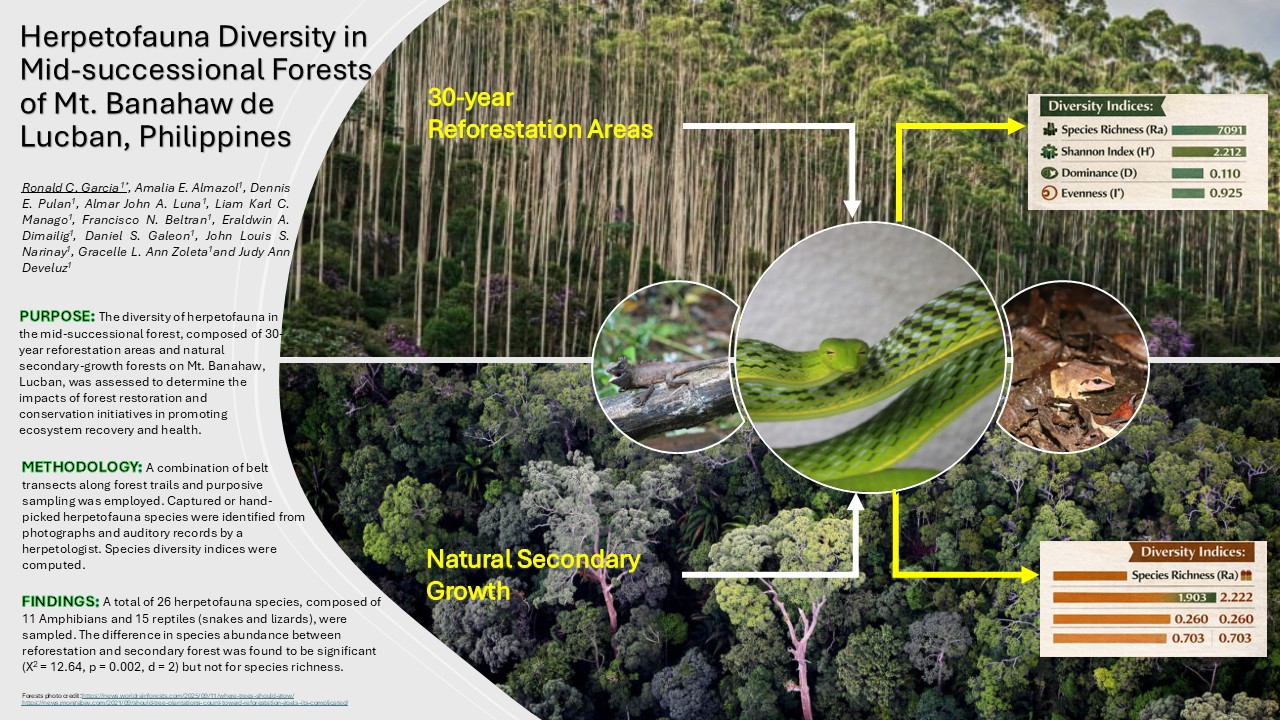
Herpetofauna are sensitive to environmental changes, making them good indicators of ecosystem health. This study assessed the diversity of herpetofauna species in the mid-successional forest consisting of 30-year reforestation areas and natural secondary-growth forests of Mount Banahaw de Lucban (MBdL) to determine the impacts of forest restoration and conservation initiatives in promoting ecosystem recovery and health. A combination of belt transects following forest trails and purposive sampling was employed where samples were captured via net or hand-picked. Results revealed 26 herpetofauna species composed of 11 amphibians and 15 reptiles, including snakes and lizards. These findings are significantly higher than previously reported. Herpetofauna had moderate diversity at 2.219 and 1.903 in the Shannon Diversity Index (H’) for amphibians and reptiles, respectively. Species richness (Ra) was 7.091 for amphibians and 3.533 for reptiles, with dominance (D) values of 0.110 and 0.260 and evenness (J’) values of 0.925 and 0.703, respectively. Using the Chi-square test for Independence, however, these differences between reforestation and secondary forest were found significant (X2 = 12.64, P = 0.002, d = 2) for species abundance but not for species richness. Platymantis banahao, P. luzonensis, Gonocephalus semperi, Boiga angulata, Ptyas luzonensis, and Malayopython reticulatus were threatened species. Results imply that the reforestation, forest protection, and conservation efforts for more than 30 years have increased forest cover, and improved ecosystem health favoring herpetofauna species.
Andriantsimanarilafy RR, Randrianantoandro JC, Rakotoarisoa J, Rakotondrina AJV, Kelly R, Cameron A. 2024. Effects of swidden agriculture on chameleon diversity and abundance in eastern tropical rainforest in Madagascar. Sustain Biodivers Conserv 3(2):99–118. DOI: 10.5281/zenodo.13861065
Atienza RR, Pabico LA, Samaniego EG. 2015. Herpetofaunal diversity of Mt. Banahaw de Lucban. Tilamsik 8(1):61–68.
Aureo W, Bande M. 2019. Impact of anthropogenic disturbance on Anurans habitat and species richness in Silago, Southern Leyte, Philippines. J Biodivers Environ Sci 15(1):38–45
Bełcik M, Klimaszewski K. 2021. The value of forest ecosystems in the conservation of amphibians revealed by predictive mapping. Folia Biol (Kraków) 69(3):147–158.
Caballero-Gini A, Vera-Jiménez M, Silla F. 2019. Composition of terrestrial anurans in areas with different degrees of alteration in San Rafael National Park (Paraguay). South Am J Herpetol 14(1):48–57.
Clores MA, Bautista JB, Fernandez JB, Cuesta MA, Brown RM. 2021. Diversity and distribution of amphibians and reptiles in the Caramoan Island Group, Maqueda Channel, Southern Luzon, Philippines. J Asia-Pac Biodivers 14(1):1–14.
Costa WP, Trevelin CC. 2020. Unsuccessful predation attempts by snakes on anuran amphibians: How successful are snakes? Herpetology Notes 13:649–660.
Díaz-García JM, López-Barrera F, Pineda E, Toledo-Aceves T, Andresen E. 2020. Comparing the success of active and passive restoration in a tropical cloud forest landscape: A multi-taxa fauna approach. PloSone 15(11):e0242020.
Diesmos AC, Brown RM, Alcala AC, Sison RV, Afuang LE, Gee GVA. 2002. Philippine amphibians and reptiles: An overview of species diversity, biogeography, and conservation. In Ong RSB, Afuang LE, Rossell-Ambal RB (Editors), Philippine biodiversity conservation priorities: A second iteration of the national biodiversity strategy and action plan. p. 26–44. Quezon City (PH): Department of the Environment and Natural Resources–Protected Areas and Wildlife Bureau, Conservation International Philippines, Biodiversity Conservation Program–University of the Philippines Center for Integrative and Developmental Studies, and Foundation for the Philippine Environment.
Endozo MCA, Marasigan MJD, Yabut AMO, Escobar MIJ, Diesmos MLL. 2017. A preliminary assessment of herpetofaunal diversity in the Taal Volcano Protected Landscape (TVPL) Luzon Island, Philippines. Philipp J Syst Biol 11(1):51–56.
Erawan TS, Jauhan J, Husodo T, Wulandari I, Fauzi DA, Megantara EN, Shanida SS. 2021. Herpetofauna diversity and distribution based on the elevational range in West Java, Indonesia. Biodiversitas 22(10):4308–4319. DOI: 10.13057/biodiv/d221023
Fernando ES, Suh MH, Lee J, Lee DK. 2008. Forest formations of the Philippines. Seoul (KR): ASEAN-Korea Environmental Cooperation Unit.
Garey MV, Zanetti MC, Hartmann PA, Hartmann MT. 2024. Effects of secondary forest succession on the richness and composition of frog species in humid tropical forest. Stud Neotrop Fauna Environ 59(2):412–424. DOI: 10.1080/01650521.2023.2165005
Gidiş M, Başkale E. 2020. The herpetofauna of Honaz Mountain National Park (Denizli Province, Turkey) and threatening factors. Amphib Reptile Conserv 14(1):147–155.
Gojo-Cruz PHPG, Afuang LE, Gonzalez JCT, Gruezo WS. 2019. Distribution and diversity patterns of herpetofauna in the Pantabangan-Carranglan Watershed, Nueva Ecija, Caraballo Mountain Range, Philippines. Biodivers Data J 7:e31638. DOI: 10.3897/BDJ.7.e31638
Griffin RK, Lewis TR, Tzanopoulos J, Griffiths RA. 2025. Natural history traits influence winners and losers for herpetological communities in disturbed tropical habitats. Oecologia 207(3):52. DOI: 10.1007/s00442-025-05691-7
He X, Wei H. 2023. Biodiversity conservation and ecological value of protected areas: A review of current situation and future prospects. Front Ecol Evol 11:1261265. DOI: 10.3389/fevo.2023.1261265
Hilje B, Aide TM. 2012. Recovery of amphibian species richness and composition in a chronosequence of secondary forests, northeastern Costa Rica. Biol Conserv 146(1):170–176. DOI: 10.1016/j.biocon.2011.12.008
Iglesias-Carrasco M, Medina I, Ord TJ. 2023. Global effects of forest modification on herpetofauna communities. Conserv Biol 37(1):e13998. DOI: 10.1111/cobi.13998
Kadafi AM, Fathoni M, Fauzi MA, Firmansyah R, Priambodo B, Kurniawan N. 2020. Study of species richness and structure community of herpetofauna on Kondang Merak Forest, Malang, Indonesia. In: Wuragil DK, Wardhani EE, Novitasari F, Febriani S (Editors), Proceedings of the 6th International Conference on Advanced Molecular Bioscience and Biomedical Engineering (ICAMBBE 2019)-Bio-Prospecting Natural Biological Compounds for Seeds Vaccine and Drug Discovery. p. 89–95. DOI: 10.5220/0009586100890095
Kovacs T. 2019. Herpetological assemblages in tropical dry forests of the Azuero Peninsula, Panama: An evaluation of reforestation. [Master’s Thesis]. Harrisonburg (US): Department of Biology, James Madison University. [Internet]. Available from: https://commons.lib.jmu.edu/master201019/636
López-Bedoya PA, Cardona-Galvis EA, Urbina-Cardona JN, Edwards FA, Edwards DP. 2022. Impacts of pastures and forestry plantations on herpetofauna: A global meta-analysis. J Appl Ecol 59(12):3038–3048. DOI: 10.1111/1365-2664.14299
MacKinnon K, Smith R, Dudley N, Figgis P, Hockings M, Keenleyside K, ... Wong M. 2020. Strengthening the global system of protected areas post-2020: A perspective from the IUCN World Commission on Protected Areas. Parks Stew Forum 36(2):281–296. DOI: 10.5070/P536248273
Martins J, Magalhães A, Cruz A, Corrêa M, Pires MR. 2022. Anuran fauna of reforested riparian forests: Is microhabitat the decisive factor for colonization?. Amphib Reptil 43(2):203–208. DOI: 10.1163/15685381‑bja10085
Maulidi A, Purnaningsih T, Maulina A, Gunawan YE, Rizki M. 2020 . Short Communication: Herpetofauna diversity at the University of Palangka Raya, Indonesia. Biodiversitas 21(10):4509–4514. DOI: 10.13057/biodiv/d211006
Megantara EN, Jauhan J, Shanida SS, Husodo T, Fauzi DA, Hendrawan R, ..., Yuansah Y. 2022. Herpetofauna distribution in different land cover types of West Java, Indonesia. Biodiversitas 23(6):2990–2999. DOI: 10.13057/biodiv/d230626
Musah Y, Ofori BY, Attuquayefio DK. 2019. Herpetofauna community diversity and composition of a changing coastal wetland in Ghana. West Afr J Appl Ecol 27(1):52–65.
Priambodo B, Permana H, Akhsani F, Indriwati SE, Wangkulangkul S, Lestari SR, Rohman F. 2019. Characteristic of water sources in Malang, based on the diversity, community structure, and the role of herpetofauna as bioindicator. EurAsian J BioSci 13(2):2279–2283.
Rawat YB, Bhattarai S, Poudyal LP, Subedi N. 2020. Herpetofauna of Shuklaphanta National Park, Nepal. J Threat Taxa 12(5):15587–15611. DOI: 10.11609/jott.5611.12.5.15587-15611
Rincón-Aranguri M, Toro-Cardona FA, Galeano SP, Roa-Fuentes L, Urbina-Cardona N. 2023. Functional diversity of snakes is explained by the landscape composition at multiple areas of influence. Ecol Evol 13(7):e10352. DOI: 10.1002/ece3.10352
Rohman F, Priambodo B, Akhsani F, Rahayu SE, Wangkulangkul S, Kundariati M. 2022. Revealing herpetofauna diversity at Brantas River, East Java Indonesia: Evidence of decreasing populations. Biodiversitas 23(3):1475–1481.DOI: 10.13057/biodiv/d230335
Rosales A, Suhian JP, Gamalinda E, Paz S, Solania-Naling C. 2023a. Herpetofauna of forest fragments within the Agata Mining Ventures Incorporated (AMVI), Agusan del Norte, Caraga Region, Philippines. J Ecosyst Sci Eco Gov 5(2):54–65. DOI: 10.54610/jeseg.v5i2.79
Rosales JR, Yu JAG, Nanual BJ, Ponce AG. 2023b. Inventory of herpetofauna in the buffer zone of Mt. Hamiguitan Range Wildlife Sanctuary, San Isidro, Davao Oriental, Philippines. Davao Res J 14(2):50–65. DOI: 10.59120/drj.v14i2.45
Saccol SDSA, Bolzan AMR, dos Santos TG. 2017. In the shadow of trees: Does eucalyptus afforestation reduce herpetofaunal diversity in Southern Brazil? South Am J Herpetol 12(1):42–56. DOI: 10.2994/SAJH-D-16-00028.1
Samitra D, Rozi ZF. 2020. Short Communication: The herpetofauna around human settlements in Lubuklinggau City, South Sumatra, Indonesia: Composition and diversity. Biodiversitas 21:1432–1437. DOI: 10.13057/biodiv/d210422
Sanguila MB, Plaza JL, Mahinay MY, Edma RC Jr., Brown RM. 2020. Herpetological assemblages in tropical forests of the Taguibo Watershed, Butuan City, eastern Mindanao, Philippines. Philipp J Sci 150:415–431. DOI: 10.56899/150.S1.31
Schivo F, Grimson R, Aquino D, Quintana RD. 2023. Difficult times for amphibians: Effects of land-use change at the local and landscape scales in the Iberá Wetlands. Acta Oecol 120:103931. DOI: 10.1016/j.actao.2023.103931
Siler CD, Welton LJ, Siler JM, Brown J, Bucol A, Diesmos AC, Brown RM. 2011. Amphibians and reptiles, Luzon Island, Aurora Province and Aurora Memorial National Park, Northern Philippines: New island distribution records. Check List 7(2):182–195. DOI: 10.15560/7.2.182
Sung YH, Karraker NE, Hau BC. 2012. Terrestrial herpetofaunal assemblages in secondary forests and exotic Lophostemon confertus plantations in South China. For Ecol Manage 270:71–77. DOI: 10.1016/j.foreco.2012.01.011
Supsup CE, Puna NM, Asis AA, Redoblado BR, Panaguinit MFG, Guinto FM, ..., Mallari NAD. 2016. Amphibians and reptiles of Cebu, Philippines: The poorly understood herpetofauna of an island with very little remaining natural habitat. Asian Herpetological Research, 7(3):151– 179. DOI: 10.16373/j.cnki.ahr.150049
Venturina REL, Diesmos MLL, Maglangit EPT, del Prado YLC, Ordas JAD, Fernandez JB, ..., Diesmos AC. 2023. Herpetofauna of Mount Capistrano, a Fragmented Limestone Karst Forest in Central Mindanao, Philippines. Philipp J Sci 152(6A):2031–2048. DOI: 10.56899/152.6A.01
Vidal KC, Macusi ED, Ponce AG. 2018. Inventory and morphometrics of anuran species found in Mt. Kilala of the Mt. Hamiguitan range wildlife sanctuary, Governor Generoso, Davao Oriental, Philippines. Philipp J Sci 147(4):629–638.
Yates JR, McBride D, Harding SF, Rodriguez D, Mullin SJ. 2023. Changes in the community composition of riverine snakes (Squamata: Serpentes) over five decades. Herpetological Conservation and Biology 18(2):326–336.
Zipkin EF, DiRenzo GV, Ray JM, Rossman S, Lips KR. 2020. Tropical snake diversity collapses after widespread amphibian loss. Science 367(6479):814–816. DOI: 10.1126/science.aay5733
Copyright (c) 2026 Ronald C. Garcia, Amalia E. Almazol, Dennis E. Pulan, Almar John A. Luna, Liam Karl C. Manago, Francisco N. Beltran, Eraldwin A. Dimailig, Daniel S. Galeon, John Louis S. Narinay, Gracelle L. Ann Zoleta, Judy Ann Develuz

This work is licensed under a Creative Commons Attribution-NonCommercial-NoDerivatives 4.0 International License.
Authors who publish with this journal agree with the following terms:
- Authors retain copyright and grant the journal right of first publication, with the work 1 year after publication simultaneously licensed under a Creative Commons attribution-noncommerical-noderivates 4.0 International License that allows others to share, copy and redistribute the work in any medium or format, but only where the use is for non-commercial purposes and an acknowledgement of the work's authorship and initial publication in this journal is mentioned.
- Authors are able to enter into separate, additional contractual arrangements for the non-exclusive distribution of the journal's published version of the work (e.g., post it to an institutional repository or publish it in a book), with an acknowledgement of its initial publication in this journal.
- Authors are permitted and encouraged to post their work online (e.g., in institutional repositories or on their website) prior to and during the submission process, as it can lead to productive exchanges, as well as earlier and greater citation of published work (See The Effect of Open Access).