OCCURRENCE OF POWDERY MILDEW CAUSED BY Podosphaera sp. ON INVASIVE WEED Ageratum houstonianum IN NEPAL

Downloads
ARTICLE HIGHLIGHTS
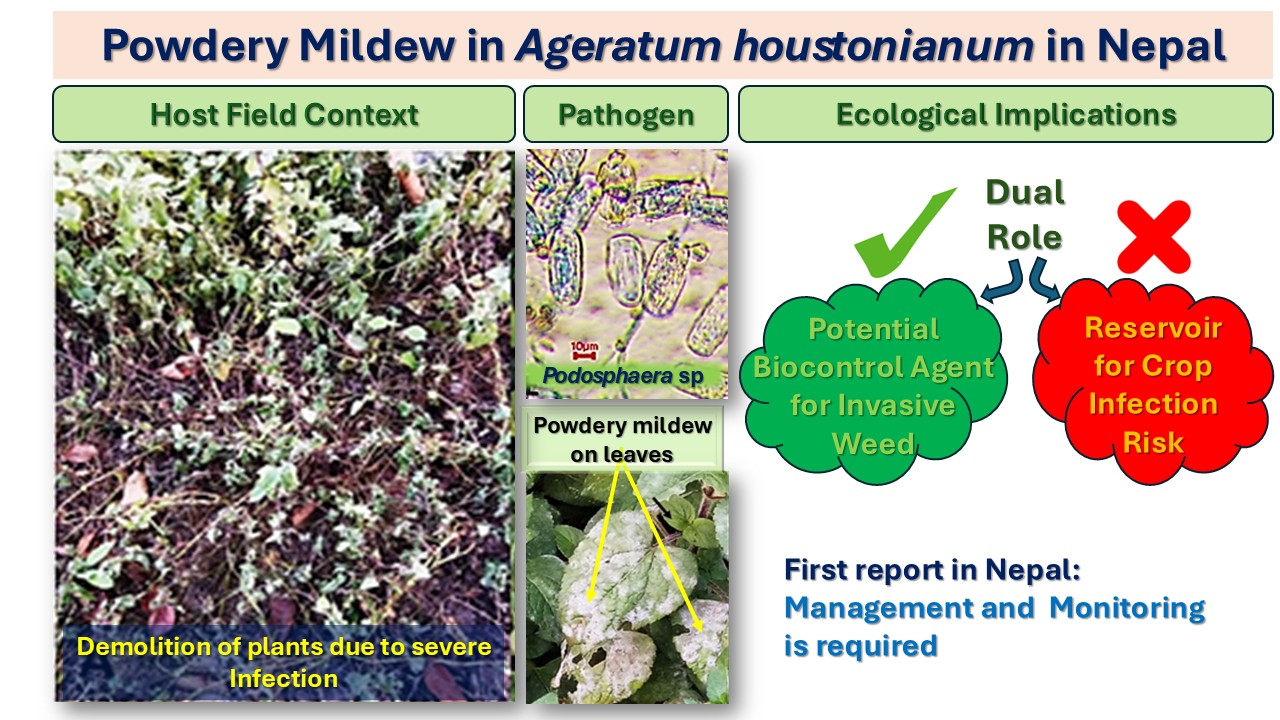
- First report of Podosphaera sp. on invasive Ageratum houstonianum in Nepal.
- Pathogen identified by unique cask-shaped conidia, chasmothecia and fibrosin bodies.
- Potential biocontrol agent discovered for managing this invasive weed.
- This weed can act as a pathogen reservoir; monitoring is essential to protect nearby crops.
ABSTRACT
Ageratum houstonianum is an invasive annual weed in Nepal that grows in diverse habitats such as fallow areas, crop fields, and roadsides. This study reported a powdery mildew disease on this weed species, which causal agent was identified as Podosphaera sp. Pathogen identification was based on symptomatology and micromorphological observations. The pathogen was characterized by slightly dark, branched and septate hyphae with nipple-like appressoria; straight and unbranched conidiophore; hyaline and cask-shaped conidia with fibrosin-like bodies. Immature chasmothecia with mycelium-like appendages were also observed. The asci were ellipsoidal with a thin oculus. Based on the literature, the fungus was first reported in Nepal on Ageratum houstonianum. This report expands the known geographical distribution and host range of this powdery mildew pathogen in South Asia and highlights the pathogen as a potential biocontrol agent for this invasive weed. Additionally, A. houstonianum is common in agroecosystem, thus, it can serve as a reservoir of Podosphaera sp. facilitating spread to crop plants. Therefore, careful utilization, monitoring, and management of the pathogen are essential both to control the host weed and to limit the spread of pathogen to crops.
Adhikari MK. 2022. Revised checklist of powdery mildews (Fungi: Erysiphales) from Nepal. J Pl Reso 20(1): 1–13. DOI: 10.3126/bdpr.v20i01.56505
Amano K. 1986. Host range and geographical distribution of the powdery mildew fungi. Tokyo (JP): Japan Scientific Societies Press. p. 67–73.
Aumentado HDR, Guerrero JJG, Balendres MAO. 2023. Powdery mildew in Southeast Asia: Host range, impact, and sources of resistance. Technol Agron 3:9. DOI: 10.48130/TIA-2023-0009
Baiswar P, Chandra S, Ngachan SV. 2008. First report of powdery mildew of Ageratum houstonianum in India. Australas Plant Dis Notes 3(1):48–49. DOI: 10.1007/BF03211235
Bhatta R, Sharma P, Pal P. 2022. Clinical evaluation of Ageratum houstonianum Mill intoxicated goats. JAFU 5(1):277–283. DOI: 10.3126/jafu.v5i1.48475
Bose R, Bansal N, Thakur O, Pandey S. 2025. First report of Podosphaera xanthii infecting Ageratum houstonianum in India with taxonomic clarification from Podosphaera fusca. Physiol Mol Plant Pathol 140:102869. DOI: 10.1016/j.pmpp.2025.102869
Braun U, Cook RTA. 2012. Taxonomic manual of Erysiphales (powdery mildews). CBS Biodiversity series, 11. Utrecht (NL): CBS-KNAW Fungal Biodiversity Centre.
[CABI] Centre for Agriculture and Bioscience International. 2022. CABI Compendium, CABI International, Ageratum houstonianum (Blue billy goat weed). DOI: 10.1079/cabicompendium.3573
[CAES] The Connecticut Agricultural Experiment Station. 2022. Ageratum. [Internet]. [Accessed on 13 April 2024]. Available from: https://portal.ct.gov/caes/plant-pest-handbook/ppha/ageratum-ageratum
Choi IY, Abasova L, Choi JH, Lee CK, Shin HD. 2022. Morphological and molecular characterization of Podosphaera powdery mildew on Fatoua villosa in Korea. Kor J Mycol 50(3):243–248. DOI: 10.4489/KJM.20220025
Johnson MF. 1971. A monograph of the genus Ageratum L. (Compositae-Eupatorieae). Ann Missouri Bot Gard 58:6–88. DOI: 10.2307/2394925
Larone DH. 1995. Medically important fungi: A guide to identification. Third edition. Washington, DC (US): ASM Press.
Meeboon J, Kokaew J, Takamatsu S. 2018. Notes on powdery mildews (Erysiphales) in Thailand V. Golovinomyces. Trop Plant Pathol 43:202–217. DOI: 10.1007/s40858-017-0201-1
Mukhtar I, Khokhar I, Mushtaq S. 2013. New record of Podosphaera xanthii on Ageratum conyzoides L. Pakistan. Pak J Weed Sci Res 19(4):475–479.
Mukhtar I, van Peer AF. 2017. First report of Podosphaera xanthii causing powdery mildew on Ageratum conyzoides in China. Plant Dis 101(8):1553–1553. DOI: 10.1094/PDIS-03-17-0448-PDN
Nadeem H, Akhter G, Khan TA. 2018. Studies on powdery mildew disease caused by Podosphaera xanthii on Ageratum conyzoides: A new report of Telomorph of P. xanthii. Ann Plant Prot Sci 26(1):107–112. DOI: 10.5958/0974-0163.2018.00024.1
Pal PB, Singh DK, Stegelmeier BL. 2011. Buffalo calves intoxicated with Ageratum houstonianum Mill. In: Riet-Correa F, Pfister J, Schild AL, Wierenga T (Editors), Poisoning by plants, mycotoxins and related toxins. Wallingford (UK): Centre for Agriculture and Bioscience International (CABI). p. 186–189. DOI: 10.1079/9781845938338.0186
Panstruga R. 2003. Establishing compatibility between plants and obligate biotrophic pathogens. Curr Opin Plant Biol 6(4):320–326. DOI: 10.1016/s1369-5266(03)00043-8
Pisani C, Patel PC, Rosskopf EN, Abbasi M, Aime MC. 2019. First report of downy mildew caused by Plasmopara halstedii on Ageratum houstonianum in the United States. Plant Dis 103(11):2968–2968. DOI: 10.1094/PDIS-06-19-1331-PDN
Polonio Á, Seoane P, Claros MG, Pérez-García A. 2019. The haustorial transcriptome of the cucurbit pathogen Podosphaera xanthii reveals new insights into the biotrophy and pathogenesis of powdery mildew fungi. BMC Genomics 20(1):543. DOI: 10.1186/s12864-019-5938-0
Reeves ER, Henson MS, Sharpe SR, Meadows IM. 2022. Evaluation of annual and herbaceous perennial plants for susceptibility to Phytophthora root and crown rot in the Southeastern United States. J Environ Hortic 40(4):154–163. DOI: 10.24266/2573-5586-40.4.154
Shrestha BB, Joshi S, Bisht N, Yi S, Kotru R, Chaudhary RP, Wu N. 2018. Inventory and impact assessment of invasive alien plant species in Kailash Sacred Landscape. ICIMOD Working Paper 2018/2. Kathmandu (NP): International Centre for Integrated Mountain Development (ICIMOD).
Shrestha BB, Shrestha UB, Sharma KP, Thapa-Parajuli RB, Devkota A, Siwakoti M. 2019. Community perception and prioritization of invasive alien plants in Chitwan-Annapurna Landscape, Nepal. J Environ Manage 229:38–47. DOI: 10.1016/j.jenvman.2018.06.034
Singh PK, Vishwakarma RC, Kaur J, Singh R. 2023. Growth and survival of plant pathogens. In: Mishra RC, Singh R (Editors), Principles of Plant Pathology. Chapter 4. Noida (IN): BlueRoseOne Publisher. p. 72–88.
Strickland DA, Hodge KT, Cox KD. 2021. An examination of apple powdery mildew and the biology of Podosphaera leucotricha from past to present. Plant Health Prog 22(4):421–432. DOI: 10.1094/PHP-03-21-0064-RV
Thines M, Seebens H, Aime MC, Shivas RG, Kiss L, Essl F, Schertler A. 2023. Host switching and geographic expansions in (hemi) biotrophic plant pathogens. In: Pöggeler S, James T (Editors), Evolution of fungi and fungal-like organisms. Cham (CH): Springer International Publishing. p. 123–148. DOI: 10.1007/978-3-031-29199-9_6
Thite SV, Kore BA, Camacho-Tapia M, Tovar-Pedraza JM. 2017. First report of Podosphaera xanthii causing powdery mildew on Ageratum conyzoides in India. J Plant Pathol 99(2):533–543.
Yeh YW, Wu TY, Wen HL, Jair HW, Lee MZ, Kirschner R. 2021. Host plants of the powdery mildew fungus Podosphaera xanthii in Taiwan. Trop Plant Pathol 46(1):44–61. DOI: 10.1007/s40858-020-00393-2
Copyright (c) 2026 Hari Sharan Adhikari, Lal Bahadur Thapa, Sanjay Kumar Jha

This work is licensed under a Creative Commons Attribution-NonCommercial-NoDerivatives 4.0 International License.
Authors who publish with this journal agree with the following terms:
- Authors retain copyright and grant the journal right of first publication, with the work 1 year after publication simultaneously licensed under a Creative Commons attribution-noncommerical-noderivates 4.0 International License that allows others to share, copy and redistribute the work in any medium or format, but only where the use is for non-commercial purposes and an acknowledgement of the work's authorship and initial publication in this journal is mentioned.
- Authors are able to enter into separate, additional contractual arrangements for the non-exclusive distribution of the journal's published version of the work (e.g., post it to an institutional repository or publish it in a book), with an acknowledgement of its initial publication in this journal.
- Authors are permitted and encouraged to post their work online (e.g., in institutional repositories or on their website) prior to and during the submission process, as it can lead to productive exchanges, as well as earlier and greater citation of published work (See The Effect of Open Access).