A NEW RECORD OF THE CREEPING CUCUMBER, Melothria pendula L. (Cucurbitaceae) FROM HALMAHERA, NORTH MALUKU, INDONESIA

Article Highlights
- Botanical inventory in Halmahera island, North Maluku has found the species Melothria pendula for the first time.
- In Indonesia, the species Melothria pendula is previously known only from Java, Sumatra, Sulawesi, and Lesser Sunda Island.
- DNA barcodes for the species Melothria pendula from Indonesia firstly deposited in NCBI GenBank.
Abstract
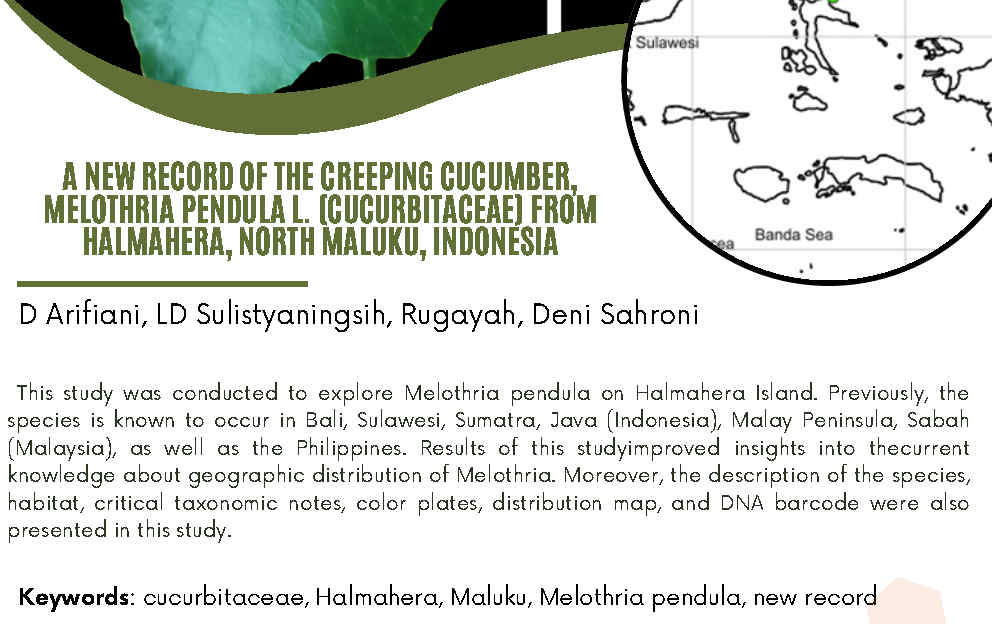
This study was conducted to explore Melothria pendula on Halmahera Island. Previously, the species is known to occur in Bali, Sulawesi, Sumatra, Java (Indonesia), Malay Peninsula, Sabah (Malaysia), as well as the Philippines. Results of this study improved insights into the current knowledge about geographic distribution of Melothria. Moreover, the description of the species, habitat, critical taxonomic notes, color plates, distribution map, and DNA barcode were also presented in this study.
INTRODUCTION
The genus Melothria is part of the tribe Benincaseae in the Cucurbitaceae, a family of vines, shrubs, and herbs. This genus, commonly known as "melonettes" or "mouse melons," was first described by Linnaeus in 1753. Melothria species are small to medium-sized herbaceous climbers, with simple leaves, usually small, yellow or white flowers, and berry fruits having smooth surface. The fruits contain a large number of highly compressed seeds, and the testa is typically smooth, white, and often covered with long, appressed hairs(Wilde WJJO & BEE, 2010). These plants require warm weather to thrive and are typically grown as annual crops. Due to rapid growth and spreading habit, the plants are well suited for use on trellises or in hanging baskets. Furthermore, the abundant fruit production throughout the growing season makes the plants to be favored by horticulturists (Sinha et al., 1996) (Mahr, 2014).
Approximately 10 Melothria species have been found in the New World, including M. pendula L. This species is considered a weed and indigenous to the Caribbean, Mexico, Central America, and was reported as locally invasive in West Africa and tropical Asia (Wilde WJJO & BEE, 2010). Melothria pendula has been reported as widely distributed in the Malesian region, including Indonesia (Bali, Java, Sumatra, Sulawesi), Sabah (Borneo), Peninsular Malaysia, the Philippines (Wilde WJJO & BEE, 2006), (Wilde WJJO & BEE, 2010); (Mustaqim & Putra, 2020); (Husaini et al., 2024).
Melothria pendula occurs in a variety of habitats, including moist and seasonal dry tropical woodlands, oak woodlands, cloud woodlands, scrub/thicket, and disturbed areas, at altitudes from 0 to 2,050 m. This species blooms and bears fruits throughout the year (Guerrero-Torres et al., 2022) and in the Philippines, the herb has been traditionally used in treatments of several ailments, including inflammation, constipation, burns, and wounds. In Mexico, the plant has been used for treating anemia, headaches, gonorrhea, and hemorrhoids, as well as for the relief of heart pain. Additionally, the fruits and leaves are edible and can be used in the preparation of a variety of sauces. The medicinal properties of the species are attributed to the phytochemical content, such as alkaloids, anthraquinones, quinones, saponins, steroids, terpenes, and xanthoproteins (, 2021).
Halmahera is the largest island of the Maluku Islands, covering an area of 17,780 km² and a part of North Maluku Province. From a biogeographical stand point, Halmahera is also part of Wallacea, which is known for unique flora and fauna. Wallacea region is rich in minerals, including nickel, cobalt, copper, gold, and silver elements (Konopka et al., 2022). Currently, there are numerous mining projects underway in Halmahera that pose a serious threat to the biodiversity of the island (, 2021), underscoring the need for botanical surveys to understand the species at risk (, 2022). This study was conducted to explore and enumerate the species present at Aketajawe Lolobata National Park and adjacent areas. Furthermore, distribution of Melothria pendula was evaluated to update the geographic distribution range. Selected taxa were also barcoded to provide the sequences in the GenBank.
A total of three specimens of small vines belonging to the Cucurbitaceae family were discovered and collected during a botanical survey in Halmahera Island, North Maluku Province. These vines have small yellow flowers and hanging elliptic fruits resembling small pickles. Locals refer to this plant as timun tikus in Halmahera language, which means mouse cucumber. These collections were gathered from two sites, namely an open, disturbed forest in the area of Geltoli Village, Maba Regency, and a roadside scrub in the area of Saramaake Village, South Wasile Regency, East Halmahera Regency. The plants were subsequently identified as Melothria pendula L. Comparison with literature and herbarium databases, including the Herbarium Bogoriense (BO), GDC, K, L, M, and S (retrieved from GBIF and JSTOR Global Plants), shows that Melothria pendula has not been previously identified. Therefore, this is the first record of the species from Halmahera Island, North Maluku Province.
MATERIALS AND METHODS
Fieldwork was carried out in October 2022 and using the standard herbarium technique described by (Djarwaningsih et al., 2002). The flowering and fruiting specimens were collected, examined, preserved, as well as deposited in Herbarium Bogoriense (BO). The morphological description of this species was determined based on the examination of the fresh plant, the voucher specimen, and the literature. To barcode this species, the internal transcribed spacer (ITS) region was used. Plant Genomic DNA Mini Kit from Geneaid was used to extract the DNA genome from silica gel dried leaves. A pair of ITS-5 (5’-GGA AGT AAA AGT CGT AAC AAG G-3’) as forward primer and ITS-4 (5’-TCC TCC GCT TAT TGA TAT GC-3’) as reverse primer was used for amplification of ITS regions according to White et al. (1990). Heat shock at 95 ºC for 3 minutes was used to start the PCR process and amplification was performed for 35 cycles in three steps. DNA was denatured at 95 ºC for 30 seconds and annealing was performed at 55 ºC for 30 seconds. Furthermore, DNA extension was conducted at 72 ºC for 90 seconds and the final extension occurred at 72 ºC for 5 minutes. Purification and Sanger sequencing were performed by a company, 1stBase-Singapore, and sequences were deposited in GenBank.
RESULTS AND DISCUSSION
Melothria pendula L. — Figure 1&Figure 2.
Melothria pendula L., Species Plantarum Ed. 1 (1753) 35; de Wilde & Duyfjes, Flora Malesiana I, 19 (2010) 107. — Type: Herb. LINN No. 51.1 (lecto LINN n.v., designated by Wunderlin (1978). — Melothria guadalupensis (Spreng.) Cogn. in A.L.P.P.de Candolle & A.C.P.de Candolle, Monogr. Phan. 3: 580 (1881). — Melothria fluminensis Gardner in London J. Bot. 1: 173 (1842). — Cucumis glaber Walter in Fl. Carol.: 240 (1788).
Description. Monoecious, perennial herb with fibrous roots and often a short woody taproot, trailing to procumbent, multi-stemmed at base, tendril on the upper side next to petiole, on fertile shoot next to pistillate flower and later staminate raceme in axil, unbranched, cylindrical, sparsely short-haired, aging glabrous. The stems are 5-ridged with rounded ridges, 2 mm in diameter but swollen at nodes, weak and flexible, striped, have internodes mostly 35-80 mm long, short-hairy aging glabrescent, and lack stipules absent. Furthermore, the leaves are alternate, entire, or with 3 or 5-shallowly lobed, petiolate has petiole 2-ridged with deep groove on upper side, a petiole shorter than blade, 1-1.7 cm long, striped light green, and dark green or reddish, often strongly bent at base and twisted, scabrous with short hairs, the hard hairs with persistent; blade suborbicular, ovate to broadly ovate in outline, 1.1-4.7 x 2.0-6.5 cm, cordate to deeply cordate at base, acuminate apex; margin remotely dentate or shallowly undulate. Male inflorescences have petiole pubescent, peduncle 1-1.5 cm, 7-8 dense flowers forming raceme, yellow color. Male flowers have pedicels 1-2.7 mm, perianth ca. 3 mm in diameter, receptacle tube ca. 1.5 × 1 mm, sparsely hairy on the outside, sepals ca. 0.3 mm long, petals glossy, yellow, diameter ca. 5 mm wide, lobes 1-1.3 × 2-2.8 mm, recurved at the tip, stamens 3, glandular filaments ca. 0.3 mm long, anthers ca. 0.8 mm long, and disk ca. 0.5 mm in diameter. Furthermore, female flowers are solitary, pedicel sparsely hairy, ca. 18 mm long, corolla ca. 6.5 mm in diameter, lobes ca. 2 × 3 mm, apex obtuse, shallowly recurved, ovary ca. 5 mm long, with ca. 1 mm neck, style ca. 1.2 mm long, stigmas about 1.2 mm long, with 3-lobes, and disk ca. 0.3 mm. Fruit berry, ellipsoid, ca. 1.5 × 1 cm, greenish when immature, purplish-black when ripe, sweet taste, while seeds are 15-24, obovate in shape, ca. 5 × 3 mm.
Figure 1.Melothria pendula in Halmahera, North Maluku Province
Figure 2.Distribution of M. pendula in Halmahera, North Maluku Province
Distribution. Melothria pendula grows naturally in America, from Texas up to Argentina. This species has been introduced, grown wildly, and then naturalized in other regions, such as Asia and West Africa. The plants were previously recorded in Bali, Sulawesi, Sumatra (Indonesia), Peninsular Malaysia, Sabah (Malaysia), and the Philippines (Wilde WJJO & BEE, 2010); (Mustaqim & Putra, 2020). This study confirmed that the species was present in Halmahera, North Maluku Province as shown in Figure 2. Considering Melothria pendula was not yet used by the local people at the time, it was postulated that the creeping cucumber was naturally dispersed from Sulawesi to Maluku Islands through birds, animals, or ocean currents. The species is also found growing in Bogor Botanical Garden and in Cibinong Science Center Botanical Garden as well as in adjacent areas of Bogor Regency, West Java (Husaini et al., 2024).
Habitat and Phenology. Melothria pendula is typically found in disturbed areas, such as fields or roadsides as the native range. In Halmahera, this species grows on roadsides in open areas among shrubs, approximately 20 m above sea level (masl). Flowering and fruiting plants can be found at the same time (in October), throughout the year. In Cibinong, Bogor, the species grows well in open areas, but not in the shade.
Vernacular Name. Indonesia, Halmahera: timun tikus (mouse cucumber).
Uses. Melothria pendula is known to have medicinal properties, especially for diabetes. In Halmahera, this species is still being neglected.
Specimens Examined. Indonesia, Halmahera Island, North Maluku Province: East Halmahera Regency, Maba District, Geltoli Village, 0°55'36.7" N, 128°18'23.0" E, c. 20 m altitude, 19 X 2022, Arifiani et al. DA 2288; South Wasile District, Saramaake Village, 0°59'32.0" N, 127°57'19.5" E, c. 20 m altitude, 21 X 2022, Sulistyaningsih et al. LDS 631; Arifiani et al. DA 2319 (BO).
Notes. Melothria pendula, known to thrive in favorable growing conditions, has the potential to become an alien invasive species when the plants lack natural predators or competitors that would keep the population in check. In Indonesia, the name timun tikus or mouse cucumber is also applied to another species, namely Coccinia grandis (L.) Voight. The two species are similar in fruit shape, but differ in flower color and size, as well as the tips of the corolla lobes (yellow and small flowers with obtuse-shallow retuse corolla lobe tips in Melothria pendula vs. white and larger flowers with acute corolla lobe tips in C. grandis). In addition, the fruit of both species are ellipsoid and differ only on size, color (in mature), and surface pattern. Melothria pendula has a smaller fruit (0.8-1.5 × 1 cm), no longitudinal pattern, purple-black when ripe, while the fruit of C. grandis is more elongated 5-10 ×1.5-3.0 cm) with white longitudinal stripes and purple-red when ripe. The seed size is almost the same for both species, but differ in color. Melothria pendula is 5 × 3 mm in diameter, and a silvery color, while C. grandis 5-6 × 2-3 mm, creamy or light brown color.
Blasting Results
| Collection number | Species | Max score | Total score |
Query cover (%) |
Percentage of identification (%) |
Accession number |
|---|---|---|---|---|---|---|
| DA 73 | Melothria pendula | 1,083 | 1,083 | 100 | 99 | AM981162.1 |
| Melothria scabra | 1,068 | 1,068 | 100 | 98.67 | GU799500.1 | |
| Melothria pendula | 1,050 | 1,050 | 100 | 97.85 | AM981163.1 | |
| DA 74 | Melothria pendula | 1,057 | 1,057 | 100 | 98.98 | AM981162.1 |
| Melothria scabra | 1,042 | 1,042 | 100 | 98.64 | GU799500.1 | |
| Melothria pendula | 1,024 | 1,024 | 100 | 97.80 | AM981163.1 | |
| LDS 631 | Melothria pendula | 1,075 | 1,075 | 100 | 98.84 | AM981162.1 |
| Melothria scabra | 1,061 | 1,061 | 100 | 98.50 | GU799500.1 | |
| Melothria pendula | 1,042 | 1,042 | 100 | 97.68 | AM981163.1 |
Accession Number
| No | Collection Number | Primer | Accession Number |
|---|---|---|---|
| 1 | DA 73 | ITS 4-5 | PP993840 |
| 2 | DA 74 | ITS 4-5 | PP993853 |
| 3 | LDS 631 | ITS 4-5 | PP993858 |
CONCLUSION
The distribution of non-native alien species, Melothria pendula in Indonesia was recorded in Halmahera, North Maluku Province. This result broadened the distribution range from previous studies that have reported the occurrence of Melothria pendula in Sumatra, Sulawesi, Lesser Sunda Island, and Java. The study also improved the knowledge on geographic distribution of the genus, Melothria.
References
- Wilde WJJOBEE Duyfjes. Redefinition of Zehneria and four new related genera (Cucurbitaceae), with an enumeration of the Australasian and Pacific species. Blumea. 2006; 51:1-88.
- Wilde WJJOBEE Duyfjes. Cucurbitaceae. Flora Malesiana Cucurbitaceae Series. 2010; 1
- Djarwaningsih T., Sunarti S., Kramadibrata K.. Panduan pengolahan dan pengelolaan material herbarium serta pengendalian hama terpadu di Herbarium Bogoriense. Herbarium Bogoriense-Bidang Botani, Pusat Penelitian Biologi, Lembaga Ilmu Pengetahuan Indonesia. [Guide to processing and managing herbarium materials and integrated pest control at the Herbarium Bogoriense. Herbarium Bogoriense-Botany Division. 2002.
- Guerrero-Torres P., Hernández-Sandoval L., Casas A., Mart. Crov Melothria. Springer: Cham (CH; 2022. DOI
- Husaini I.P.A., Widjaya A.H., Saripudin Yuliyanto, P Latifah, D Irsyam, ASDHariri M.R.. Melothria pendula L. (Cucurbitaceae): first report from Java and range extension in Sumatra, Indonesia. Check List. 2024; 20(2):553-8. DOI
- Konopka G., Szamałek K., Zglinicki K.. Ni-Co Bearing Laterites from Halmahera Island (Indonesia. Appl Sci. 2022; 12(15)
- Mahr S.. Mouse melon or Mexican sour cucumber: Melothria scabra. A horticulture information. 2014. Publisher Full Text
- Mustaqim W.A., Putra H.F.. Melothria (Cucurbitaceae): A new genus record of naturalized cucumber in Sumatra. Floribunda. 2020; 6(5):183-7.
- Phytochemical analysis of three common medicinal plants (Gliricidia sepium, Melothria pendula, and Pithecellobium dulce) in the Philippines. Sch Acad J Biosci. 2021; 3:84-8.
- Sinha B.N., Thanigavelan J., Basu S.P., Sukumar E.. 1996.
- Safeguarding imperiled biodiversity and evolutionary process in the Wallace center of endemism. Bioscience. 2022; 72(11):1118-30. DOI
- Emerging threats from deforestation and forest fragmentation in the Wallace centre of endemism. Environ Res Lett. 2021; 16(9)DOI
- White T.J., Bruns T., Lee S., Taylor J.. PCR Protocols: A guide to methods and applications. Academic Press: Academic Press; 1990:315-22.
de Wilde WJJO, Duyfjes BEE. 2006. Redefinition of Zehneria and four new related genera (Cucurbitaceae), with an enumeration of the Australasian and Pacific species. Blumea 51:1-88. DOI: https://doi.org/10.3767/000651906X622346
de Wilde WJJO, Duyfjes BEE. 2010. Cucurbitaceae. Flora Malesiana Cucurbitaceae Series 1 Vol. 19. Leiden (NL): Netherlands Centre for Biodiversity Naturalis, Leiden University.
Djarwaningsih T, Sunarti S, Kramadibrata K. 2002. Panduan pengolahan dan pengelolaan material herbarium serta pengendalian hama terpadu di Herbarium Bogoriense. Herbarium Bogoriense-Bidang Botani, Pusat Penelitian Biologi, Lembaga Ilmu Pengetahuan Indonesia. [Guide to processing and managing herbarium materials and integrated pest control at the Herbarium Bogoriense. Herbarium Bogoriense-Botany Division, Research Center for Biology, Indonesian Institute of Sciences]. Bogor (ID): CV Media Aksara. 83 pp.
Guerrero-Torres P, Hernández-Sandoval L, Casas A. 2022. Melothria pendula L. Melothria pringlei (S. Watson) Mart. Crov. Melothria trilobata Cogn. CUCURBITACEAE. In: Casas A, Blancas Vázquez JJ (Editors). Ethnobotany of the Mountain Regions of Mexico. Ethnobotany of Mountain Regions. Cham (CH): Springer. DOI: 10.1007/978-3-319-77089-5_42-1 DOI: https://doi.org/10.1007/978-3-319-77089-5_42-1
Husaini IPA, Widjaya AH, Saripudin, Yuliyanto P, Latifah D, Irsyam ASD, …, Hariri MR. 2024. Melothria pendula L. (Cucurbitaceae): first report from Java and range extension in Sumatra, Indonesia. Check List 20(2):553-8. DOI: 10.15560/20.2.553 DOI: https://doi.org/10.15560/20.2.553
Konopka G, Szamałek K, Zglinicki K. 2022. Ni-Co Bearing Laterites from Halmahera Island (Indonesia). Appl Sci 12(15):7586. DOI: https://doi.org/10.3390/app12157586
Mahr S. 2014. Mouse melon or Mexican sour cucumber: Melothria scabra. A horticulture information. Wisconsin Master Garderner. Available from: https://mastergardener.extension.wisc.edu/files/2015/12/Melothria_scabra.pdf
Mustaqim WA, Putra HF. 2020. Melothria (Cucurbitaceae): A new genus record of naturalized cucumber in Sumatra. Floribunda 6(5):183-7. DOI: https://doi.org/10.32556/floribunda.v6i5.2020.318
Raju R, Prakash T, Rahul R, Poonangadu SS, Kumar SS, Sonaimuthu P, …, Capili JT. 2021. Phytochemical analysis of three common medicinal plants (Gliricidia sepium, Melothria pendula, and Pithecellobium dulce) in the Philippines. Sch Acad J Biosci 3:84-8. DOI: https://doi.org/10.36347/sajb.2021.v09i03.004
Sinha BN, Thanigavelan J, Basu SP, Sukumar E. 1996. Studies on Melothria maderasapatana (Linn.) Cogn. Ancient Science of Life XV:238-40.
Struebig MJ, Anita SG, Beger M, Bani A, Barus H, Brace S, …, Supriatna J. 2022. Safeguarding imperiled biodiversity and evolutionary process in the Wallace center of endemism. Bioscience 72(11):1118-30. DOI: 10.1093/biosci/biac085 DOI: https://doi.org/10.1093/biosci/biac085
Voigt M, Supriatna J, Deere NJ, Kastanya A, Mitchell SL, Rosa IMD, …, Widyanto A. 2021. Emerging threats from deforestation and forest fragmentation in the Wallace centre of endemism. Environ Res Lett 16(9):094048. DOI: 10.1089/1748-9326/ac15cd DOI: https://doi.org/10.1088/1748-9326/ac15cd
White TJ, Bruns T, Lee S, Taylor J. 1990. Amplification and direct sequencing of fungal ribosomal RNA genes for phylogenetics. In: PCR Protocols: A guide to methods and applications. Innis MA, Gelfand DH, Sninsky JJ, White TJ (Editors). New York (US): Academic Press. p. 315-22. DOI: https://doi.org/10.1016/B978-0-12-372180-8.50042-1
Copyright (c) 2024 Deby Arifiani, Lulut Dwi Sulistyaningsih, Rugayah, Deni Sahroni

This work is licensed under a Creative Commons Attribution-NonCommercial-NoDerivatives 4.0 International License.
Authors who publish with this journal agree with the following terms:
- Authors retain copyright and grant the journal right of first publication, with the work 1 year after publication simultaneously licensed under a Creative Commons attribution-noncommerical-noderivates 4.0 International License that allows others to share, copy and redistribute the work in any medium or format, but only where the use is for non-commercial purposes and an acknowledgement of the work's authorship and initial publication in this journal is mentioned.
- Authors are able to enter into separate, additional contractual arrangements for the non-exclusive distribution of the journal's published version of the work (e.g., post it to an institutional repository or publish it in a book), with an acknowledgement of its initial publication in this journal.
- Authors are permitted and encouraged to post their work online (e.g., in institutional repositories or on their website) prior to and during the submission process, as it can lead to productive exchanges, as well as earlier and greater citation of published work (See The Effect of Open Access).