HERPETOFAUNAL COMMUNITIES IN BUTUAN CITY, PHILIPPINES: A SATOYAMA-SATOUMI APPROACH TO BIODIVERSITY ASSESSMENT

Downloads
ARTICLE HIGHLIGHTS
- Community-managed landscapes and seascapes support endemic and native amphibian and reptile species
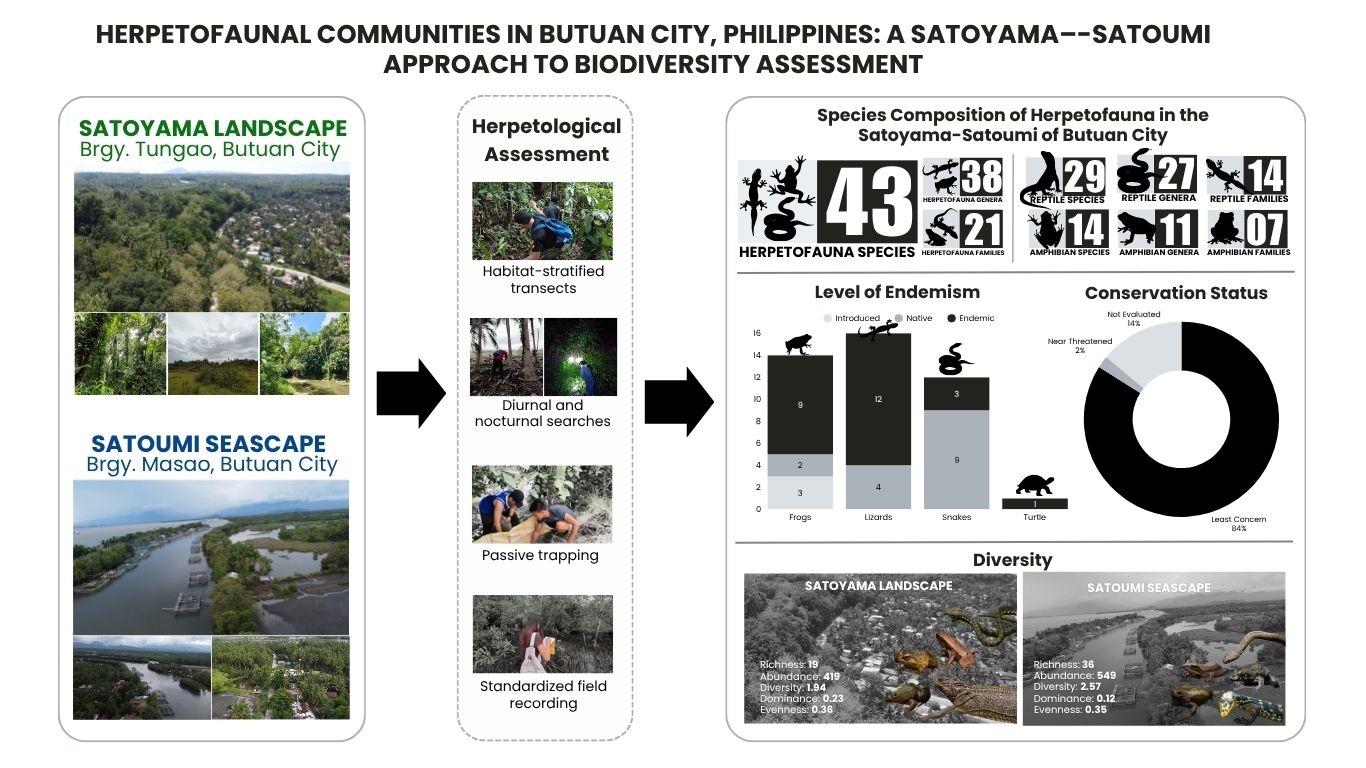
- Forty-three amphibian and reptile species were recorded in Butuan City.
- The landscape and seascape are dominated by lowland amphibian and reptile species.
- This study provides baseline data for biodiversity conservation and monitoring.
ABSTRACT
This study provides the first systematic assessment of amphibians and reptiles within the Satoyama-Satoumi landscape-seascape mosaic of Butuan City, Agusan del Norte, Philippines. Herpetofaunal surveys were conducted across six habitat types in Barangays Tungao (agroforest, grassland-agroecosystem, riparian) and Masao (landward, middleward, and seaward mangroves) using habitat-stratified transects, diurnal and nocturnal searches, passive trapping, and standardized field recording. A total of 43 species were documented, comprising 14 amphibians and 29 reptiles, including 24 Philippine endemics, of which 13 species are Mindanao Faunal Region endemics. Three invasive amphibians were also recorded. Species diversity was higher in Tungao (H′ = 2.57) than in Masao (H′ = 1.94), reflecting contrasts in habitat condition and disturbance intensity. Most species were classified as Least Concern (n = 36). However, the presence of Near Threatened (n = 1) and nationally recognized Other Threatened Species (n = 11) highlights the conservation importance of the area. Distinct microhabitat associations from forest floors and riparian zones to mangroves and human-modified areas emphasize the ecological heterogeneity supporting these assemblages. This baseline inventory demonstrates that community-managed Satoyama–Satoumi habitats serve as important secondary refugia for herpetofauna and highlights the need for sustained monitoring and habitat protection in Butuan City.
Abdullah SS, Dela Cruz KC, Casim LF, Agduma AR, Tanalgo KC. 2023. Leaping forward or crawling backward? Efforts and biases in amphibian and reptile research on a megadiverse faunal region in the Philippines. Conservation 3:363–378. DOI: 10.3390/ conservation3030025 DOI: https://doi.org/10.3390/conservation3030025
Alcala AC. 1986. Guide to Philippine flora and fauna. Amphibians and reptiles. Manila (PH): Natural Resources Management Center, Ministry of Natural Resources and University of the Philippines.
Alcala AC, Brown, WC. 1998. Philippine amphibians: An illustrated guide. Makati City (PH): Bookmark Incorporated.
Alcala AC, Bucol AA, Diesmos AC, Brown RM. 2012. Vulnerability of Philippine amphibians to climate change. Philipp J Sci 141:77–87.
Aureo WA. 2025. Amphibians and reptiles of Bohol Island, the Philippines: The herpetofauna of Rajah Sikatuna Protected Landscape. J Biodivers Conserv Bioresour Manag 10(2):31–48. DOI: 10.3329/jbcbm.v10i2.82267 DOI: https://doi.org/10.3329/jbcbm.v10i2.82267
Brown RM, Diesmos AC. 2002. Application of lineage-based speciesconcepts to oceanic island frog populations: The effects of differing taxonomic philosophies on the estimation of Philippine biodiversity. Silliman J 42:231.
Brown RM, Diesmos A, Alcala A. 2000. The state of Philippine herpetology and the challenges for the next decade. Silliman J 42(1):228.
Brown RM, Diesmos AC, Oliveros C. 2011. A new flap-legged forest gecko (genus Luperosaurus) from the northeastern Philippines. Journal of Herpetology 45:202–210 DOI: https://doi.org/10.1670/10-123.1
Brown RM, Oliveros CH, Siler CD, Diesmos AC. 2008. A new Gekko from the Babuyan Islands, northern Philippines. Herpetologica 64:305–320. DOI: https://doi.org/10.1655/07-078.1
Brown RM, Oliveros CH, Siler CD, Fernandez JB, Welton LJ, Buenavente PAC, …, Diesmos AC. 2012. Amphibians and reptiles of Luzon Island (Philippines), VII: Herpetofauna of Ilocos Norte Province, northern Cordillera Mountain Range. Check List, 8:469–490. DOI: 10.15560/8.3.469 DOI: https://doi.org/10.15560/8.3.469
Brown RM, Siler CD, Diesmos AC, Alcala AC. 2009. Philippine frogs of the genus Leptobrachium (Anura: Megophryidae): Phylogeny-based species delimitation, taxonomic review, and descriptions of three new species. Herpetol Monogr 23:1–44. DOI: https://doi.org/10.1655/09-037.1
Brown RM, Siler CD, Oliveros CA, Esselstyn JA, Diesmos AC, Hosner PA, …, Alcala AC. 2013. Evolutionary processes of diversification in a model island archipelago. Annu Rev Ecol Evol Syst 44:24.1–24.5. DOI: https://doi.org/10.1146/annurev-ecolsys-110411-160323
Brown WC, Alcala AC. 1980. Philippine lizards of the Family Scincidae. 1st Edition. Dumaguete City (PH): Silliman University.
Buhay AFV, Jumawan JH, Ruales JJJ, Buot Jr IE. 2024. Local uses of mangrove species in the Masao Village Satoumi, a socioecological production landscape and seascape of Butuan, Agusan del Norte, Philippines. In Mistar J, Mardani RM, Sari IN, Nurdiyanto H (Editors), Proceedings of the 2nd International Conference on Multidisciplinary Sciences for Humanity 811:436–450. DOI: 10.2991/978-2-38476-204-0_38. DOI: https://doi.org/10.2991/978-2-38476-204-0_38
Cruz PHGP, Afuang LE, Gonzalez JCT, Gruezo WSM. 2021. Amphibians and reptiles of Luzon Island, Philippines: The herpetofauna of Pantabangan-Carranglan Watershed, Nueva Ecija Province, Caraballo Mountain Range. Asian Herpetol Res 9(4):201–223. DOI: 10.16373/j.cnki.ahr.180050
Cruz RV, Tamayo-Zafaralla M, Gruezo W, Zamora P, Dolom P, Gonzales JCT, …, Tabayag AC. 2017. Manual on biodiversity assessment and monitoring system for terrestrial ecosystems: How-To Guidelines. Biodiversity Management Bureau, Department of Environment and Natural Resources (DENR) and Deutsche Gesellschaft für Internationale Zusammenarbeit (GIZ) GmbH. ISBN 978-621-8096-03-7.
[DENR] Department of Environment and Natural Resources. 2019. DAO 2019–09. Internet References. Retrieved from h t t p s : / / b m b . g o v . p h / d o w n l o a d s / W R D / W C / W C 2 0 2 0 /stat_and_lists_of_wildlife/fauna/dao-2019–09.pdf 3/18/2026.
Diesmos A, Venturina RE, del Prado YL. 2020. A revised checklist of amphibians and reptiles in Camiguin Sur, Misamis Oriental, Mindanao, Philippines. Asian Herpetol Res 11:28–43. DOI: 10.16373/j.cnki.ahr.190036
Diesmos AC, Brown RM. 2011. Diversity, biogeography, and conservation of Philippine amphibians. In Das I, Haas A, Tuen AA (Editors), Biology and conservation of tropical asian amphibians. Proceedings of the Conference “Biology of the Amphibians in the Sunda Region, Southeast Asia.” Kota Samarahan (MY): Institute of Biodiversity and Environmental Conservation, Universiti Malaysia Sarawak. p.26–49.
Diesmos AC, Diesmos ML, Brown RM. 2006. Status and distribution of alien invasive frogs in the Philippines. J Environ Sci Manage 9:41–53.
Diesmos AC, Watters JL, Huron NA, Davis DR, Alcala AC, Crombie RI, …, Siler CD. 2015. Amphibians of the Philippines, Part I: Checklist of the species. Proceedings of the California Academy of Sciences 62 (20):457–539.
Grismer L, Onn C, Grismer J, Wood P, Norhayati A. 2010. A checklist of the herpetofauna of the Banjaran Bintang, Peninsular Malaysia. Russ J Herpetol 17(2):147–160.
Harisena NV, Grêt-Regamey A, Van Strien MJ. 2025. A novel method to assess spatio-temporal habitat availability for a generalist indicator species group in human-modified landscapes. Landsc Ecol 40:103. DOI: 10.1007/s10980-025-02124-x DOI: https://doi.org/10.1007/s10980-025-02124-x
Huey RB, Deutsch CA, Tewksbury JJ, Vitt LJ, Hertz PE, Perez HJA, Garland T. 2009. Why tropical forest lizards are vulnerable toclimate warming. P Roy Soc B-Biol Sci 276(1664):1939–1948 DOI: https://doi.org/10.1098/rspb.2008.1957
[IUCN] International Union for Conservation of Nature. 2026. The IUCN red list of threatened species. Version 2025-2. Available from: https://www.iucnredlist.org
Janiawati IAA, Kusrini MD, Mardiastuti A. 2016. Structure and composition of reptile communities in human modified landscape in Gianyar Regency, Bali. HAYATI 23(2):85–91. DOI: 10.4308/hjb.23.2.85 DOI: https://doi.org/10.1016/j.hjb.2016.06.006
Jins VJ, Mukherjee A, Arun PR, Michael DR, Bhupathy S. 2022. Microhabitat preferences and guild structure of a tropical reptilecommunity from the Western Ghats of India: Implications for conservation. J Trop Ecol 38(5):295–303. DOI: https://doi.org/10.1017/S0266467422000190
Kennedi UF, Zainudin PS, Jakaria M, Kusrini MD, Prabowo OJ, Yanto AV, Maddock ST. 2024. Amphibians and reptiles diversity in Bukit Baka Bukit Raya National Park, West Kalimantan. Media Konservasi 29(1):1–12. DOI: 10.29244/medkon.29.1.1‑12 DOI: https://doi.org/10.29244/medkon.29.1.1-12
Khoerunisa I, Kusrini MD, Mardiasturi A. 2021. Diversity of snake rescued from residential areas in Greater Jakarta Metropolitan Area, Indonesia. Media Konservasi 26(3):231–238. DOI: 10.29244/medkon.26.3.231-238 DOI: https://doi.org/10.29244/medkon.26.3.231-238
Maglangit EPT, Nuñeza OM, Coritico FP, Medecilo-Guiang MMP, Mohagan AB, Patano Jr. RR, Amoroso VB. 2022. Richness and distribution of reptiles and amphibians in the tropical lowlandhabitats of Mt. Agad-Agad, Iligan City, southern Philippines. Reptiles Amphib 29(1):413–425. DOI: 10.17161/randa.v29i1.18130 DOI: https://doi.org/10.17161/randa.v29i1.18130
Maulahila HZ, Rianti P, Rahman DA. 2025. Crucial habitats for the spangled ebony langur: The role of former production forests in Alas Purwo National Park. HAYATI 32(6):1485–1506. DOI: 10.4308/hjb.32.6.1485-1506 DOI: https://doi.org/10.4308/hjb.32.6.1485-1506
Maulida R, Kirnanda CC, Kusrini MD, Mardiastuti A. 2025. Wildlife in disturbed forests: Reptile and Amphibian diversity in South Papua. Media Konservasi 30(4):490. DOI: 10.29244/medkon.30.4.490 DOI: https://doi.org/10.29244/medkon.30.4.490
McGuire JA, Alcala AC. 2000. A taxonomic revision of the flying lizards (Iguania: Agamidae: Draco) of the Philippine Islands, with a description of a new species. Herpetol Monogr 14:81–138. DOI: https://doi.org/10.2307/1467046
McLeod DS, Siler CD, Diesmos AC, Diesmos ML, Garcia VS, Arkonceo AO, …, Yarra EC. 2011. Amphibians and reptiles of Luzon Island, V: The herpetofauna of Angat Dam Watershed, Bulacan Province, Luzon Island, Philippines. Asian Herpetol Res 2(4):177–198. DOI: https://doi.org/10.3724/SP.J.1245.2011.00177
Meneses CG, Pitogo KM, Supsup CE, Brown RM. 2024. Philippine herpetology (Amphibia, Reptilia), 20 years on: Two decades of progress towards an increasingly collaborative, equitable, and inclusive approach to the study of the archipelago’s amphibians and reptiles. ZooKeys 1190:213–257. DOI: https://doi.org/10.3897/zookeys.1190.109586
Milto KD. 2025. Underestimated herpetodiversity of Gunung Gede Pangrango National Park, West Java, Indonesia. Russ J Herpetol 32(1):60–72. DOI: 10.30906/1026-2296-2025-32-1-60-72 DOI: https://doi.org/10.30906/1026-2296-2025-32-1-60-72
Pastor PJB, Susi CGO, Quidet JJ, Ladesma JIA, Estaño LA. 2024. Species diversity and spatial distribution of bats in Butuan City, Philippines. Biodiversitas 25:2791–2799. DOI: 10.13057/biodiv/d250853 DOI: https://doi.org/10.13057/biodiv/d250853
Pilliod DS, McCaffery RM, Arkle RS, Scherer RD, Cupples JB, Eby LA, …, Van Horne R. 2022. Importance of local weather and environmental gradients on demography of a broadly distributed temperate frog. Ecol Indic 136:108648. DOI: 10.1016/j.ecolind.2022.108648 DOI: https://doi.org/10.1016/j.ecolind.2022.108648
Plaza JL, Sanguila MB. 2015. Preliminary report on the anurans of Mount Hilong-hilong, Agusan del Norte, Eastern Mindanao, Philippines. Asian Herpetol Res 6:18–33.
Plaza JL, Seronay RA, Ruales JJJ, Bantilan JC, Abucayon AA, Naling CS, Gamalinda EF. 2025. New distribution records of amphibians and reptiles in Tinuy-an FallsProtected Landscape, Southeastern Mindanao, Philippines. Asian Herpetol Res 16(4):331–359 DOI: https://doi.org/10.3724/ahr.2095-0357.2024.0025
Ramli FF, Munian K, Mahyudin NAA, Othman N, Haris H, Abdullah-Fauzi NAF, …, Abdul-Latiff MAB. 2024. First documentation on herpetofauna diversity in Gunung Belumut Amenity Forest, Peninsular Malaysia: Implications for conservation in an Environmentally Sensitive Area (ESA). Biodivers Data J 12:e108476. DOI: 10.3897/BDJ.12.e108476 DOI: https://doi.org/10.3897/BDJ.12.e108476
Ruales JJJ, Demetillo MT, Along AA, Mohagan AB, Jumawan. 2023. Diversity and status of true butterflies (Lepidoptera: Papilionoidea) in two ecological parks of Butuan City, Agusan del Norte, Philippines with new locality record. Species 24:e46s1539 DOI: 10.54905/disssi/v24i73/e46s1539 DOI: https://doi.org/10.54905/disssi/v24i73/e46s1539
Saito O, Subramanian SM, Hashimoto S, Takeuchi K. 2020. Introduction: Socio-ecological production landscapes and seascapes. In Saito O, Subramanian SM, Hashimoto S, Takeuchi K (Editors), Managing socio-ecological production landscapes and seascapes for sustainable communities in Asia: Mapping and navigating stakeholders, policy and action. DOI: 10.1007/978-981-15-1133-2_1 DOI: https://doi.org/10.1007/978-981-15-1133-2
Sanguila M, Cobb K, Siler C, Diesmos A, Alcala A, Brown R. 2016. The amphibians and reptiles of Mindanao Island, southern Philippines, II: The herpetofauna of northeast Mindanao and adjacent islands. ZooKeys 624:1–132. 10.3897/zookeys.624.9814. DOI: https://doi.org/10.3897/zookeys.624.9814
Sanguila MB, Labaja ACO, Bernstein JM, Brown RM. 2026. An updated herpetological inventory of the Agusan Marsh Wildlife Sanctuary, eastern Mindanao Island, Philippines. ZooKeys 1272:203–251. DOI: 10.3897/zookeys.1272.167304 DOI: https://doi.org/10.3897/zookeys.1272.167304
Sanguila MB, Plaza JL, Mahinay MY, Edma Jr. RC, Brown RM. 2021. Herpetological assemblages in tropical forests of the Taguibo Watershed, Butuan City, eastern Mindanao, Philippines. Philipp J Sci 150:415–431. DOI: https://doi.org/10.56899/150.S1.31
Sawaki MWL, Kusrini MD, Prasetyo LB, Manurung R. 2025. Short-term movements of the Pig-Nosed Turtle (Carrettochelys insculpta) in the Kao River, South Papua, Indonesia. Jurnal Pengelolaan Sumberdaya Alam dan Lingkungan 15(4):554. DOI: 10.29244/jpsl.15.4.554 DOI: https://doi.org/10.29244/jpsl.15.4.554
Scheffers BR, Brunner RM, Ramirez SD, Shoo LP, Diesmos A,Williams SE. 2013. Thermal buffering of microhabitats is a critical factor mediating warming vulnerability of frogs in the Philippine biodiversity hotspot. Biotropica 45(5):628–635 DOI: https://doi.org/10.1111/btp.12042
Scheffers BR, Edwards DP, Diesmos A, Williams SE, Evans TA. 2014. Microhabitats reduce animal’s exposure to climate extremes. Glob Change Biol 20:495–503 DOI: https://doi.org/10.1111/gcb.12439
Scheffers BR, Furman BL S, Evans JP. 2013. Salamanders continue to breed in ephemeral ponds following the removal of surrounding terrestrial habitat. Herpetol Conserv Biol 8(3):499–503.
Slavenko A, Dror L, Camaiti M, Farquhar JE, Shea GM, Chapple DG, Meiri S. 2022. Evolution of diel activity patterns in skinks (Squamata: Scincidae), the world’s second-largest family of terrestrial vertebrates. Evolution 76(6):1195–1208. DOI: https://doi.org/10.1111/evo.14482
Solania CL, de Venancio SPR, Sarco NJP, Gamalinda EF. 2020. A preliminary study of herpetofauna and their microhabitats in Pagatpatan Wetland Center, Caraga Region, Philippines. J Ecosyst Sci Eco-Governance 2(1):1–12
Supsup CE, Asis AA, Edaño JWB, Mallari NAD. 2022. Anuran assemblages in western Philippines: Unraveling the effects of habitat types, water availability, and elevation. Acta Oecol 117:103869. DOI: https://doi.org/10.1016/j.actao.2022.103869
Supsup CE, Puna NM, Asis AA, Redoblado BR, Panaguinit MF, Guinto FM, …, Mallar NAD. 2016. Amphibians and reptiles of Cebu, Philippines: The poorly understood herpetofauna of an island with very little remaining natural habitat. Asian Herpetol Res 7(3):151–179.
Sy E. 2014. Checklist of exotic species in the Philippine Pet Trade, I. Amphibians. J Nat Stud 13(1):48-57.
Torralba CAV, Gamalinda EF, Estaño LA. 2022. Dietary preference of alien invasive anurans (Rhinella marina, Hoplobatrachus rugulosus, and Kaloula pulchra) in Butuan City, Northeastern Mindanao, Philippines, J Ecosyst Sci EcoGovernance 4(2):20–28. DOI: 10.54610/jeseg/4.2.2022.003 DOI: https://doi.org/10.54610/jeseg/4.2.2022.003
Torralba CAV, Gamalinda EF, Estaño LA. 2023. Parasitic helminths of alien invasive anurans in Butuan City, Northeastern Mindanao, Philippines.” Helminthol 60(4):385–392. DOI: 10.2478/helm-2023-0040 DOI: https://doi.org/10.2478/helm-2023-0040
Valencia-Aguilar A, Cortés-Gómez A, Ruiz-Agudelo CA. 2013. Ecosystem services provided by amphibians and reptiles in neotropical ecosystems. Int J Biodivers Sci Ecosyst Serv Manag 9(3):257–272. DOI: https://doi.org/10.1080/21513732.2013.821168
Villantes YL, Hingco JT, Manapsal MAM. 2015. Species richness and endemism of herpetofauna in Kapatagan Watershed, Philippines. J Multidiscip Stud 4(2):153–175. DOI: 10.7828/jmds.v4i1.862 DOI: https://doi.org/10.7828/jmds.v4i1.862
Wallach V, Williams KL, Boundy J. 2015. Snakes of the world: A catalogue of living and extinct species. Florida (US): CRC Press. 1227 p. DOI: https://doi.org/10.1201/b16901
Wong A, Makbul NS, Yambun P. 2021. Diversity of herpetofauna in Kadamaian, Kota Belud, Sabah, Malaysia. J Trop Biol Conserv 18:31–42. DOI: 10.51200/jtbc.v18i.3441 DOI: https://doi.org/10.51200/jtbc.v18i.3441
Copyright (c) 2026 Leonardo Estano, Jela Rensulat, Jeco Jed Ruales, Inocencio E. Buot Jr., Jess H. Jumawan

This work is licensed under a Creative Commons Attribution-NonCommercial-NoDerivatives 4.0 International License.
Authors who publish with this journal agree with the following terms:
- Authors retain copyright and grant the journal right of first publication, with the work 1 year after publication simultaneously licensed under a Creative Commons attribution-noncommerical-noderivates 4.0 International License that allows others to share, copy and redistribute the work in any medium or format, but only where the use is for non-commercial purposes and an acknowledgement of the work's authorship and initial publication in this journal is mentioned.
- Authors are able to enter into separate, additional contractual arrangements for the non-exclusive distribution of the journal's published version of the work (e.g., post it to an institutional repository or publish it in a book), with an acknowledgement of its initial publication in this journal.
- Authors are permitted and encouraged to post their work online (e.g., in institutional repositories or on their website) prior to and during the submission process, as it can lead to productive exchanges, as well as earlier and greater citation of published work (See The Effect of Open Access).