The Ecological Mangrove Health Through Bioassessment Approaches for Coastal Resilience in Kulon Progo Yogyakarta

Downloads
ARTICLE HIGLIGHTS
- This research is the first integrated bioassessment of mangroves in Kulon Progo combining vegetation and carbon.
- Reveals dominance of R. mucronata with low species diversity, indicating ecosystem degradation.
- Demonstrates high carbon storage in large-diameter species (Avicennia, Sonneratia).
- Fills research gap on site-specific carbon stock estimation in southern Java mangroves.
- Conservation strategy requires species diversification and eco-hydrology-based restoration can provide policy-relevant conservation strategies aligned with Indonesia’s FOLU Net Sink 2030.
ABSTRACT
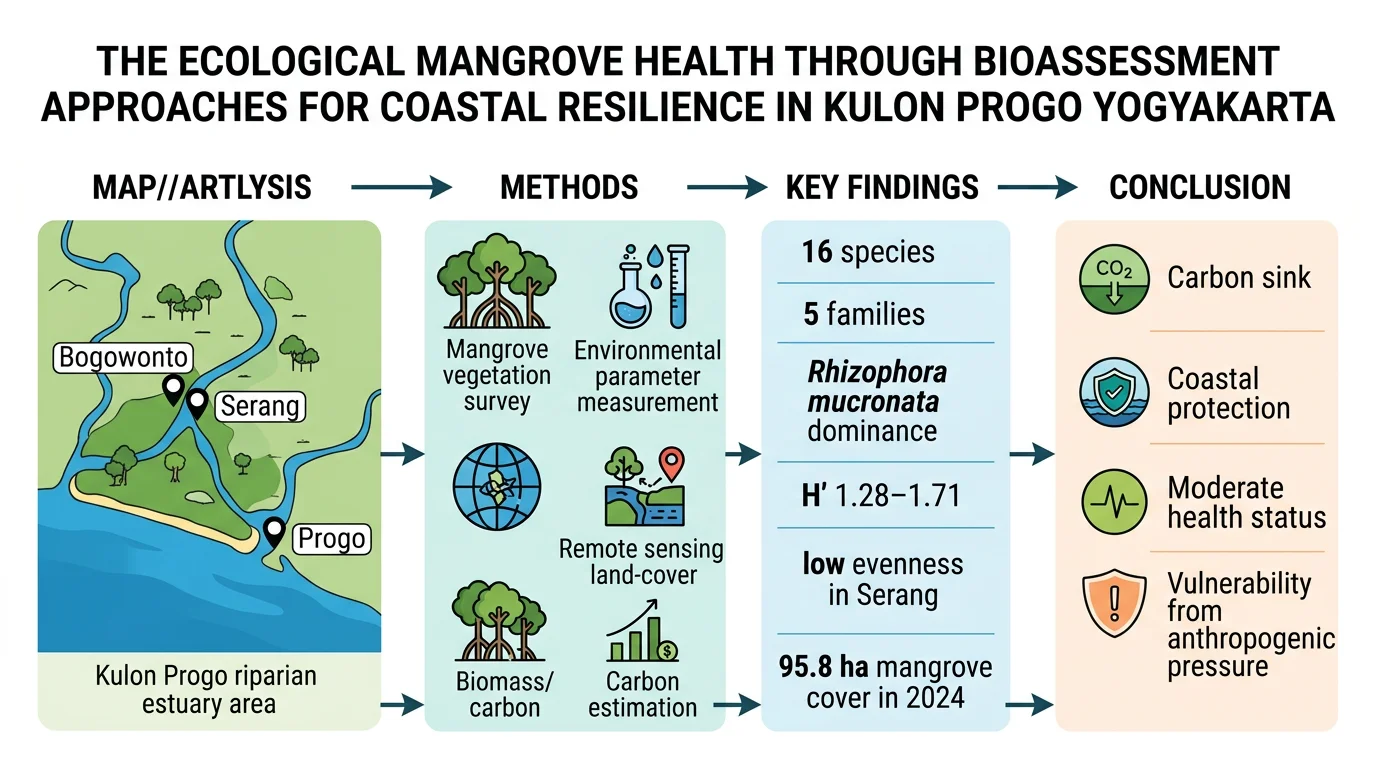
Bioassessment of the mangrove ecosystem in the riparian estuary of Kulon Progo can be used as a scientific basis to support coastal conservation. This study focused on ecological conditions of the riparian estuary. The study was conducted using a descriptive-quantitative approach through the collection of biological indicator data in the form of mangrove vegetation data and physical-chemical environmental parameters. This study showed that changes in mangrove land cover reached a peak of 98.7 ha in 2016 and stabilized at around 95.8 ha in 2024. This study also showed the discovery of 16 species from 5 families with the dominance of Rhizophora mucronata, low to moderate diversity index values (H' = 1.28 – 1.71), and low uniformity (E), especially in Serang River. Estimates of biomass and carbon stocks showed that R. mucronata contributed the most overall, but large-diameter species such as Avicennia marina and Sonneratia alba had higher carbon reserves per tree (700 – 900 Mg C/ha). Analysis of physical-chemical parameters showed that conditions are still suitable for supporting mangrove growth, although they are strongly influenced by freshwater flow. According to MHI, the bioassessment results were in the moderate category, meaning that the mangroves still functioned as carbon sinks and coastal protection, but were vulnerable due to low diversity and anthropogenic pressure. This study emphasized the importance of conservation strategies based on species diversification, restoration of former pond areas using an eco-hydrology approach, regulation of ecotourism carrying capacity, and periodic bioassessment monitoring to strengthen the stability of mangrove ecosystems. These findings are relevant to Indonesia's FOLU Net Sink 2030 target and REDD+ program, while also providing a scientific basis for sustainable mangrove management in Kulon Progo.
Akram H, Hussain S, Mazumdar P, Chua KO, Butt TE, Harikrishna, JA. 2023. Mangrove health: A review of functions, threats, and challenges associated with mangrove management practices. Forests 14(9):1–38. DOI: 10.3390/f14091698
Alongi DM. 2002. Present state and future of the world’s mangrove forests. Environ Conserv 29(3): 331–349. DOI: 10.1017/S0376892902000231
Arifanti VB, Basyuni M, Suharti S, Slamet B, Karlina E, Sidik F, …, Ali HM. 2025. Assessing the environmental and socioeconomic impacts of mangrove loss in Indonesia: A synthesis for science-based policy. For Sci Technol 0(0):1–17. DOI: 10.1080/21580103.2025.2536595
Arifanti VB, Novita N, Subarno, Tosiani A. 2021. Mangrove deforestation and CO2 emissions in Indonesia. IOP Conf Ser: Earth Environ Sci 874(1). DOI: 10.1088/1755-1315/874/1/012006
Blanton A, Ewane EB, McTavish F, Watt MS, Rogers K, Daneil R, …, Mohan M. 2024. Ecotourism and mangrove conservation in Southeast Asia: Current trends and perspectives. J Environ Manag 365(June). DOI: 10.1016/j.jenvman.2024.121529
Donato DC, Kauffman JB, Murdiyarso D, Kurnianto S, Stidham M, Kanninen, M. 2011. Mangroves among the most carbon-rich forests in the tropics. Nat Geosci 4(5):293–297. DOI: 10.1038/ngeo1123
Eddy S, Dahlianah I, Mashito C, Oktavia M, Utomo B. 2022. Anthropogenic implications for land cover changes and vegetation structure in coastal protected forest. Biodiversitas 23(9):4473–4481. DOI: 10.13057/biodiv/d230913
Firaswan A, Aryandari R, Reza A, Faizah N, Rachman N, Fitri RA, Sulthon AM. 2017. Isolation hope and threat of mangrove restoration program in Bogowonto Lagoon, Yogyakarta- Indonesia 2002-2014. KnE Life Sci 3(4):1. DOI: 10.18502/kls.v3i4.680
Giesen W, Wulffraat S, Zieren M, Scholten L. 2007. Mangrove guidebook for Southeast Asia. Bangkok (TH): FAO Thailand.
Hanca N, Putri D, Nurul F, Betris N, Mushandi R , Setiawan C, Kusumawati L. 2023. Optimizing the mangrove ecosystem to prevent coastal erosion on Tidung Island. Jurnal Borneo Saintek 6(1):1–6. DOI: 10.35334/borneo_saintek.v6i1.4196
Herawati OS, Budiyanto G, Utama NA. 2019. Potensi dan zonasi kawasan wisata muara Sungai Progo. Sustainability 11(1):1–14. DOI: 10.1016/j.regsciurbeco.2008.06.005
Ibrahim FH, Yusoff, FM, Fitrianto A, Nuruddin AA, Gandaseca S, Samdin Z, …, Nik ZHAR. 2019. How to develop a comprehensive Mangrove Quality Index? MethodsX 6:1591–1599. DOI: 10.1016/j.mex.2019.06.014
Kurniawan MHS, Fauzy A, Muhajir M. 2020. Analyzing the factors which influence the development of mangrove forest in Kulon Progo using binary logistic regression and remote sensing method. Proceedings of the 2nd ISSTEC 474(Isstec 2019). p. 30–35. DOI: 10.2991/assehr.k.201010.006
Montgomery JM, Bryan KR, Coco G. 2022. The role of mangroves in coastal flood protection: The importance of channelization. Cont Shelf Res 243:104762. DOI: 10.1016/j.csr.2022.104762
Mucharomah N. 2015. Evaluation of resource suitability and area carrying capacity for mangrove ecotourism in Jangkaran Village, Temon Sub-District, Kulon Progo Regency, Special Region of Yogyakarta. Yogyakarta (ID): UPN Veteran Yogyakarta.
Needham LL.2008. Introduction to biomonitoring. J Chem Health Saf 15(6):5–7. DOI: 10.1016/j.jchas.2008.06.002
Nurrofik A, Burhanuddin AD, Fitriana L, Hakim L, Kurniawan N. 2021. Assessment of the various type of mangrove areas by avifaunal diversity and community in Tamban Beach, Sumbermanjing Wetan, East Java. Biotropika 9(3):218–228. DOI: 10.21776/ub.biotropika.2021.009.03.06
Prasetya JD, Maharani YN, Rahatmawati I. 2018. Mangrove ecotourism management at local community in Jangkaran, Kulonprogo, using hierarchy analysis. IOP Conf Ser: Earth Environ Sci 212(1). DOI: 10.1088/1755-1315/212/1/012006
Pratiwi D, Hartoko A, Febrianto S. 2023. Carbon absorption potential of mangrove forests, Kulon Progo, Yogyakarta. Jurnal Kelautan Nasional 18(2):99. DOI: 10.15578/jkn.v18i2.10465
Pramudji. 2017. Mangrove in Indonesia. Bogor (ID): Lembaga Ilmu Pengetahuan Indonesia.
Rahayu TH, Nugroho AP. 2020. Integrated assessment of biomarker responses in algae chlorella sorokiniana exposed to copper and cadmium. Biodiversitas 21(8):3569–3575. DOI: 10.13057/biodiv/d210820
Rivaldi M, Frediansyah A, Aziz SAA, Nugroho AP. 2025. Active biomonitoring of stream ecosystems: untargeted metabolomic and proteomic responses and free radical scavenging activities in mussels. Ecotoxicology. DOI: 10.1007/s10646-024-02846-9
Rombe KH, Arafat Y, Surachmat A, Andhini FA. 2022. Vegetation study of the Wana Tirta mangrove forest area in Kulon Progo Daerah Istimewa Yogyakarta. Jurnal Salamata 3(1):1. DOI: 10.15578/salamata.v3i1.11256
Sahputra E, Harahap RH, Wahyuningsih, Utomo B. 2022. Assessing the sustainability status of mangrove forest ecosystem management by coastal community in Jaring Halus Village, North Sumatra, Indonesia. Biodiversitas 23(1):1–9. DOI: 10.13057/biodiv/d230101
Setyawan AD, Indrowuryatno I, Wiryanto W, Winarno K, Susilowati A. 2005. Mangrove plants in coastal area of Central Java: 2. Floristic composition and vegetation structure. Biodiversitas J Biol Divers 6(3):194–198. DOI: 10.13057/biodiv/d060312
Syam PDR, Ramdini AN, Putri BM. 2025. The role of mangrove ecosystems in erosion mitigation: a multitemporal analysis of coastal vulnerability in coastal area Bantul. IOP Conf Ser: Earth Environ Sci 1496(1). DOI: 10.1088/1755-1315/1496/1/012018
Twilley RR. 2019. Mangrove Wetlands. Encyclopedia of Ecology: Volume 1-4, Second Edition, 2, p. 546–556. DOI: 10.1016/B978-0-444-63768-0.00346-2
Yani RA, Naharuddin N, Toknok B, Malik A, Akhbar A, Massiri SD, Suleman SM. 2024. Analysis of changes and criticality level of mangrove forest ecosystem as a basis for rehabilitation downstream of Poso Watershed Area, Central Sulawesi, Indonesia. Biodiversitas 25(9):3179–3188. DOI: 10.13057/biodiv/d250940
Copyright (c) 2026 Kuntum Febriyantiningrum, Andhika Puspito Nugroho, Diah Rachmawati, Abdul Razaq Chasani

This work is licensed under a Creative Commons Attribution-NonCommercial-NoDerivatives 4.0 International License.
Authors who publish with this journal agree with the following terms:
- Authors retain copyright and grant the journal right of first publication, with the work 1 year after publication simultaneously licensed under a Creative Commons attribution-noncommerical-noderivates 4.0 International License that allows others to share, copy and redistribute the work in any medium or format, but only where the use is for non-commercial purposes and an acknowledgement of the work's authorship and initial publication in this journal is mentioned.
- Authors are able to enter into separate, additional contractual arrangements for the non-exclusive distribution of the journal's published version of the work (e.g., post it to an institutional repository or publish it in a book), with an acknowledgement of its initial publication in this journal.
- Authors are permitted and encouraged to post their work online (e.g., in institutional repositories or on their website) prior to and during the submission process, as it can lead to productive exchanges, as well as earlier and greater citation of published work (See The Effect of Open Access).