PHYSICO-MECHANICAL PROPERTIES OF THAILAND AND YELLOW BAMBOO PLANTED IN LAGUNA AND BENGUET, PHILIPPINES


Downloads
ARTICLE HIGLIGHTS
- Thailand bamboo showed higher density and strength for structural use
- Yellow bamboo suited for composites, crafts, and fiber boards
- Species, site, and culm height influence bamboo performance
ABSTRACT
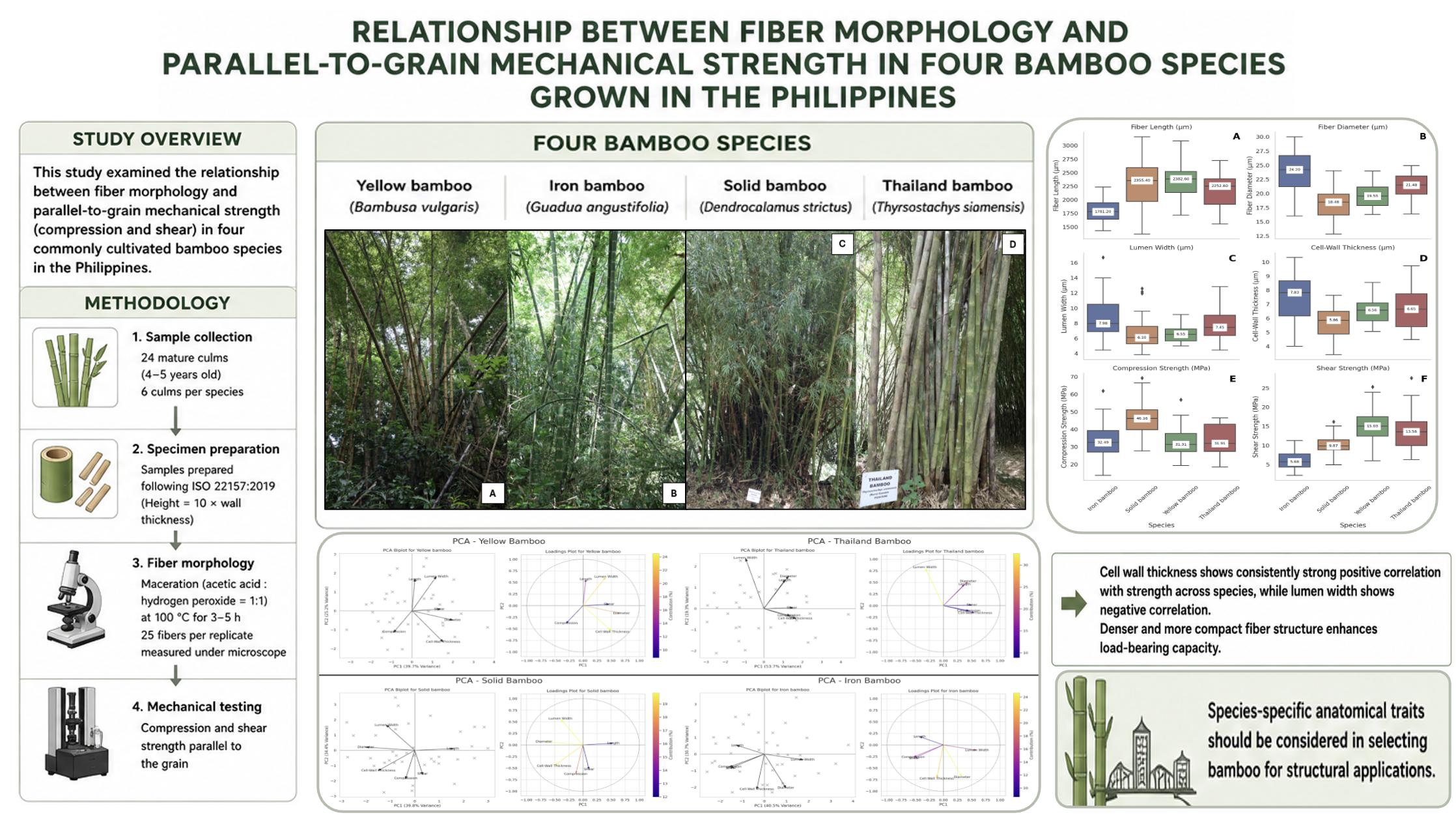
Bamboo is gaining recognition as a sustainable construction material, but data on the physico-mechanical properties of species grown in the Philippines remain limited. This study assessed Thailand bamboo (Thyrsostachys siamensis Gamble) and yellow bamboo (Bambusa vulgaris Schrad. ex J.C. Wendl.) planted in Laguna and Benguet. Tests were conducted following ASTM D143 (2019) and ISO 22157 (2019) standards, focusing on moisture content (MC), basic relative density (RD), shrinkage, static bending, compression (CPG), and shear strength parallel to the grain (SS). Significant interspecies differences were observed. Yellow bamboo exhibited higher MC (34%), radial (32%), tangential (92%), and volumetric shrinkage (53%), while Thailand bamboo had 29% higher RD, indicating better mechanical performance. Location influenced several properties, i.e., yellow bamboo from Laguna showed 46% higher MC, while Benguet samples showed higher modulus of elasticity and stress at the proportional limit. Thailand bamboo from Laguna had a 7% higher modulus of rupture, while yellow bamboo from Benguet showed 42% increase compared to Laguna. Thailand bamboo from Benguet showed higher CPG and SS, though yellow bamboo from Laguna outperformed in these properties. Axial position affected MC, shrinkage, CPG, and SS, but node presence did not influence CPG and SS. The higher density and strength of Thailand bamboo make it ideal for structural applications, whereas the larger culm and softer fibers of yellow bamboo are ideal for handicrafts, composites boards, and bioenergy.
Anwar UMK, Zaidon A, Hamdan H, Mohd. Tamizi M. 2005. Physical and mechanical properties of Gigantochloa scortechinii bamboo splits and strips. J Trop For Sci 17(1):1–12.
Appiah-Kubi E, Awotwe-Mensah M, Mitchual SJ. 2023. Assessment of physical and mechanical properties of juvenile and matured Bambusa vulgaris glue-laminated bamboo for structural application in Ghana. Sustain Struct 3(2):000026. DOI:10.54113/j.sust.2023.000026 DOI: https://doi.org/10.54113/j.sust.2023.000026
Aribal LG, Parlucha JA, Gelaga JN, Aguinsatan RG. 2022. Influence of abiotic factors on growth and development of giant bamboo (Dendrocalamus asper) in Bukidnon, Philippines. J Trop For Sci 34(1):63–73. DOI: 10.26525/jtfs2022.34.1.63 DOI: https://doi.org/10.26525/jtfs2022.34.1.63
[ASTM] American Society for Testing Materials. 2019. Methods of testing small clear specimens of timber - ASTM designation: D143-52. In: Book of ASTM Standards, Part 16. Philadelphia (US): ASTM. p. 1–30.
Azmy HM. 2000. Preliminary observation on the growth of Thyrsostachys siamensis in Johore, Peninsular Malaysia. J Trop For Sci 12(4):821–23.
Baja-Lapis AC, Palijon AM, Tesoro FO, Virtucio FD. 2016. Bamboo: the grass of hope. Makati City (PH): Philippine Bamboo Foundation. p. 1–319.
Chaowana K, Wisadsatorn S, Chaowana P. 2021. Bamboo as a sustainable building material-culm characteristics and properties. Sustainability 13(13):7376. DOI:10.3390/su13137376 DOI: https://doi.org/10.3390/su13137376
[DOST-PTRI] Department of Science and Technology–Philippine Textile Research Institute 2021. DOST-PTRI’s Bamboo Textile PH brand develops bamboo fibers for textile use. [Internet]. [cited 20 Apr 2025]. Available from: https://www.ptri.dost.gov.ph/9-transparency-seal/323-dost-ptri-s-bambootextilesph-brand-develops-bamboo-fibers-for-textile-use.
Emamverdian A, Ding Y, Ranaei F, Ahmad Z. 2020. Application of bamboo plants in nine aspects. Sci World J 2020:7284203. DOI:10.1155/2020/7284203 DOI: https://doi.org/10.1155/2020/7284203
Espiloy ZB, Espiloy EB. 1992. Properties of six erect bamboo species grown in the Philippines. FPRDI Journal 21(3–4):79–88.
[FAO] Food and Agriculture Organization of the United Nations. 2020. Global forest resources assessment 2020: Main report. [Internet] [cited 20 Apr 2025]. Available from: http://www.fao.org/forest-resources-assessment/2020/en/.
Gnanaharan R, Janssen JJA, Arce O. 1994. Bending strength of Guadua bamboo: Comparison of different testing procedures. INBAR Working Paper No. 3. Kerala Forest Research Institute and International Development Research Centre.
Hartono R, Purba FVA, Iswanto A, Priadi T, Sutiawan J. 2022. Fiber quality of yellow bamboo (Bambusa vulgaris vitata) from Forest Area with Special Purpose Pondok, Buluh, Simalungun Regency, North Sumatera Province. IOP Conf Ser Earth Environ Sci 1115(1):012084. DOI:10.1088/1755-1315/1115/1/012084 DOI: https://doi.org/10.1088/1755-1315/1115/1/012084
Hillary A, Fred K, Isaac K, Christine M, Michael M, Theodros G, …, Durai J. 2022. Bamboo site - species matching study in Uganda. INBAR Working Paper. Beijing (CN): International Network for Bamboo and Rattan.
Hong TTK, Mai TH, Hien NTT. 2022. Mould resistance of the bamboo Thyrsostachys siamensis treated with oleoresin heat. J For Sci Technol 13:103–108. DOI: 10.55250/jo.vnuf.2022.13.103-108 DOI: https://doi.org/10.55250/jo.vnuf.2022.13.103-108
[ISO] International Organization for Standardization. 2019. Bamboo structures—Determination of physical and mechanical properties of bamboo culms - Test methods [ISO 22157-2019]. In: International Standards. Geneva (CH): International Organization for Standardization.
Javadian A, Smith IFC, Saeidi N, Hebel DE. 2019. Mechanical properties of bamboo through measurement of culm physical properties for composite fabrication of structural concrete reinforcement. Front Mater 6:15. DOI:10.3389/fmats.2019.00015 DOI: https://doi.org/10.3389/fmats.2019.00015
Jimenez JP, Macalinao MGM, Sapin GN. 2021. Physico-mechanical properties of two Philippine bamboo thermally modified in a steam environment. Philipp J Sci 150(1):171–182. DOI: https://doi.org/10.56899/150.01.14
[JIRCAS] Japan International Research Center for Agricultural Sciences. 2025. Vegetables of Thailand No. 100. [Internet] [cited 20 Apr 2025]. Available from: https://www.jircas.go.jp/en/database/thaivege/100.
Kaminski S, Laurence A, Trujillo D. 2016. Structural use of bamboo: Part 1: Introduction to bamboo. Struct Eng 94(8):40–43. DOI:10.56330/PNSC8891 DOI: https://doi.org/10.56330/PNSC8891
Khabir MF, Bhattacharjee DK, Sattar MA. 1995. Physical properties of node and internode of culm and branch of Dendrocalamus hamiltoni. In: Rao IVR, Sastry CB (Editors), Proceedings of the IV International Bamboo Congress. Bali, Indonesia: People and the Environment. p. 19–22.
Leoncio MCA. 2017. Comparative mechanical properties of selected bamboo species. Int J Precious Eng Res Appl. 2(1):1–8.
Liese W, Kohl M. 2015. Bamboo: The plant and its uses. Cham (CH): Springer International Publishing. DOI:10.1007/978-3-319-14133-6 DOI: https://doi.org/10.1007/978-3-319-14133-6
Natividad RA, Jimenez JP. 2015. Development of laminated Buho [Schizostachyum lumampao (Blanco) Merr.] lumber. Phil For Prod J 6(1):78–89.
Nordahlia AS, Anwar UMK, Hamdan H, Ab-Dlatif M, Mahanim SMA. 2011. Anatomical, physical, and strength properties of Shizostachyum brachycladum (buluh lemang). J Bamboo Rattan 10(3–4):111–122.
Nugroho N, Kartini, Bahtir ET. 2021. Cross-species bamboo grading based on flexural properties. IOP Conf Ser Earth Environ Sci 891(1):012008. DOI: https://doi.org/10.1088/1755-1315/891/1/012008
Omaliko IK, Ubani OU. 2021. Evaluation of the compressive strength of bamboo culms under node and internode condition. Saudi J Civil Eng 5(8):251–258. DOI: 10.36348/sjce.2021.v05i08.001
Razak W, Mohamed A, Mustafa MT, Hassan A. 2009. Physical characteristics and anatomical properties of cultivated bamboo (Bambusa vulgaris Schrad.) culms. J Biol Sci 9(7):753–759. DOI: 10.3923/jbs.2009.753.759 DOI: https://doi.org/10.3923/jbs.2009.753.759
Razak W, Mustafa MT, Rahman S, Salam MA, Sulaiman O, Sudin M, Rasat MSM. 2012. Relationship between physical, anatomical, and strength properties of 3-year-old cultivated tropical bamboo Gigantochloa scortechinii. ARPN J Agric Biol Sci 7(10):782–791.
Razak W, Mustapa MT, Sulaiman O, Mohamed A, Hassan A, Khalid I. 2010. Anatomical and physical properties of cultivated two- and four-year-old Bambusa vulgaris. Sains Malaysiana 39(4):571–579.
Razal RA, Dolom PC, Palacpac AB, Villanueva MB, Camacho SC, Alipon MA, …, Malab SC. 2012. Mainstreaming engineered bamboo products for construction and furniture. Los Baños (PH): PCAARRD and FDC. p. 1–139.
R Core Team [Computer software]. 2022. R: A language and environment for statistical computing. Vienna, Austria: R Foundation for Statistical Computing. [cited 1 Nov 2024]. Available from: https://www.R-project.org/
Roxas CA. 2012. Handbook on erect bamboo species found in the Philippines. Laguna (PH): ERDB–DENR. p. 1–108.
Roxas CA, Tangan FT, Virtucio FD. 2000. DENR Recommends Vol. 9: Ornamental bamboos for urban parks. Laguna, (PH): ERDB–DENR. p. 1–21.
Shao ZP, Fang CH, Huang SX, Tian GL. 2010. Tensile properties of Moso bamboo (Phyllostachys pubescens) and its components with respect to its fiber-reinforced composite structure. Wood Sci Technol 44(4):655–666. DOI:10.1007/s00226-009-0290-1 DOI: https://doi.org/10.1007/s00226-009-0290-1
Shasmin HN, Abu Osman NA, Abd Latif L, Usman J, Wan Abas WAB. 2007. A new pylon material in transtibial prosthesis: A preliminary study. J Biomech 40(2):297. DOI: 10.1016/S0021-9290(07)70293-2 DOI: https://doi.org/10.1016/S0021-9290(07)70293-2
Siam NA, Uyup MKA, Husain H, Mohmod AL, Awalludin MF. 2019. Anatomical, physical, and mechanical properties of thirteen Malaysian bamboo species. Bioresources 14(2):3925–3943. DOI: https://doi.org/10.15376/biores.14.2.3925-3943
Villareal JF, Marasigan OS, Mendoza RC, Alipon MA, Abasolo WP. 2020. Morphological, anatomical, and physical properties of iron bamboo (Guadua angustifolia Kunt.) grown in the Philippines. Philipp J Sci 149(3A):1005–1013. DOI: 10.56899/149.3A.25 DOI: https://doi.org/10.56899/149.3A.25
Wei F, Feng Z, Wang Z, Liu J. 1999. Association between environmental factors and growth of bamboo species, Bashania spanostachya, the food of giant and red pandas. Acta Ecol Sin 19(5):710–714.
Copyright (c) 2026 Oliver S. Marasigan, Mario Angelo M. Mundin, Shereyl A. Daguinod, Jayric F. Villareal

This work is licensed under a Creative Commons Attribution-NonCommercial-NoDerivatives 4.0 International License.
Authors who publish with this journal agree with the following terms:
- Authors retain copyright and grant the journal right of first publication, with the work 1 year after publication simultaneously licensed under a Creative Commons attribution-noncommerical-noderivates 4.0 International License that allows others to share, copy and redistribute the work in any medium or format, but only where the use is for non-commercial purposes and an acknowledgement of the work's authorship and initial publication in this journal is mentioned.
- Authors are able to enter into separate, additional contractual arrangements for the non-exclusive distribution of the journal's published version of the work (e.g., post it to an institutional repository or publish it in a book), with an acknowledgement of its initial publication in this journal.
- Authors are permitted and encouraged to post their work online (e.g., in institutional repositories or on their website) prior to and during the submission process, as it can lead to productive exchanges, as well as earlier and greater citation of published work (See The Effect of Open Access).