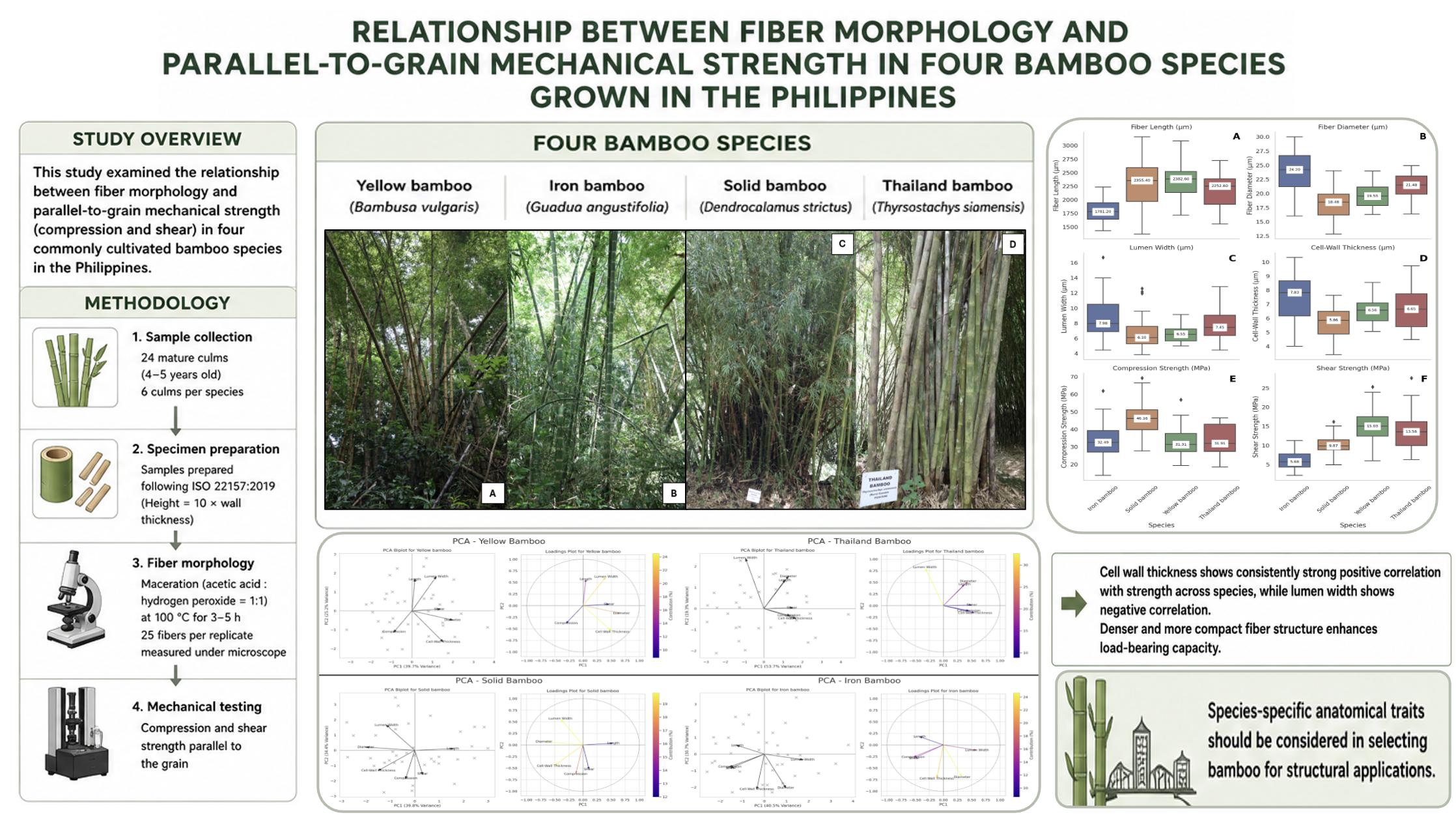
RELATIONSHIP BETWEEN FIBER MORPHOLOGY AND PARALLEL-TO-GRAIN MECHANICAL STRENGTH IN FOUR BAMBOO SPECIES GROWNIN THE PHILIPPINES

Downloads
ARTICLE HIGLIGHTS
The study evaluated the fiber morphology and mechanical properties of four bamboo species, revealing the species-specific relationships of fiber traits and mechanical performance.
Cell wall thickness and lumen width influenced bamboo’s mechanical strength.
Solid bamboo exhibits the highest compression despite weak fiber links; Yellow bamboo displays the highest shear with the longest fibers; Thailand bamboo demonstrates the strongest fiber traits-strength correlations.
ABSTRACT
The compression and shear strength parallel to the grain of four bamboo species namely Yellow bamboo (Bambusa vulgaris Schrad. ex J.C.Wendl.), Iron bamboo (Guadua angustifolia Kunt.), Solid bamboo [Dendrocalamus strictus (Roxb.) Nees], and Thailand bamboo (Thyrsostachys siamensis Gamble) were evaluated in relation to their fiber morphology. Results revealed distinct species-specific patterns. Thailand bamboo exhibited the strongest positive correlations, particularly between fiber length, fiber diameter, cell wall thickness, and both strength properties. Yellow bamboo recorded the longest fibers and the highest shear strength, with strong associations to cell wall thickness. In contrast, Solid bamboo showed the highest compression strength but weak correlations with fiber characteristics, while Iron bamboo demonstrated moderate associations between fiber morphology and mechanical properties. Among all fiber characteristics, cell wall thickness consistently showed a strong positive correlation with strength across species, whereas lumen width was negatively correlated, indicating that denser, more compact fiber structures enhance load-bearing capacity. Principal Component Analysis further confirmed the dominant influence of cell wall thickness, with variable contributions from fiber length and diameter depending on species. These findings highlight the anatomical basis of bamboo’s mechanical performance and emphasize the need for species-specific approaches in its structural utilization.
Augustina S, Anggraini R, Yuliandari I, Marpaung AFB, Charisma FS, Ridho MR, …, Fatriasari W. 2025. Comparative analysis of fiber characteristics and chemical, physical, and mechanical properties of six indigenous bamboo species from Indonesia. BioResources 20(4):8493–8514. DOI: 10.15376/biores.20.4.8493-8514 DOI: https://doi.org/10.15376/biores.20.4.8493-8514
Baja-Lapis AC, Palijon AM, Tesoro FO, Virtucio FD. 2016. Bamboo: The grass of hope. Makati City(PH): Philippine Bamboo Foundation. p. 1–319.
Bhonde D, Nagarnaik PB, Parbat DK, Waghe UP. 2014. Physical and mechanical properties of bamboo (Dendrocalamus strictus). Int J Sci Eng Res 5(1):455–459.
Bornoma AH, Faruq M, Samuel M. 2016. Properties and classifications of bamboo for construction. J Appl Sci Environ Sustain 2(4):105–114.
Darwis A, Hadiyane A, Sulistyawati E, Sumardi I. 2023. Effect of vascular bundles and fiber sheaths in nodes and internodes of Gigantochloa apus bamboo strips on tensile strength. J Korean Wood Sci Technol 51(4):309–319. DOI: 10.5658/WOOD.2023.51.4.309 DOI: https://doi.org/10.5658/WOOD.2023.51.4.309
Espiloy Z, Ella A, Floresca A. 1986. Physico-mechanical properties and anatomical structure relationships for some Philippine bamboos. Philippine Lumberman 32(4–5):25–7, 32–6.
Espiloy ZB, Espiloy EB, Moran SR. 1999. Basic properties of two- lesser used bamboo species: Laak (Bambusa sp. 2) and Kayali (Gigantochloa atter). FPRDI J 25 (1&2):1–18.
Hamid NH, Jawaid M, Abdullah UH, Alomar TS. 2023. Monopodial and sympodial bamboos grown in tropic and sub-tropic countries: A review. BioResources 18(3):6499–6560. DOI: 10.15376/biores.18.3.Hamid DOI: https://doi.org/10.15376/biores.18.3.Hamid
Hillary A, Fred K, Isaac K, Christine M, Michael M, Theodros G, …, Durai J. 2022. Bamboo site-species matching study in Uganda (INBAR Working Paper). Beijing (CN): International Bamboo and Rattan Organization (INBAR).
[INBAR] International Bamboo and Rattan Organisation. 2023. BRU-Bamboo & rattan update. Food and Agriculture Organization 4(2):1–23. Available from: https://www.inbar.int/wp-content/uploads/2023/07/BRU_4-2_EN-Rehabilitating-Land-with-Bamboo.pdf
Iswanto AH, Nabila N, Elfina R, Hakim L, Sucipto T, Aristri MA, …, Antov P. 2025. Characteristics of three bamboo species and their potential as raw materials for oriented strand board production. J Renew Mater 13(11):2253-2279. DOI: 10.32604/jrm.2025.02025-0058 DOI: https://doi.org/10.32604/jrm.2025.02025-0058
Londoño X. 2001. La Guadua un bambú importante de América [Guadua: An important bamboo of the Americas. In Proceedings of the First Bamboo Seminar, Ecuador. p.12–18.
Manandhar R, Kim JH, Kim JT. 2019. Environmental, social, and economic sustainability of bamboo and bamboo-based construction materials in buildings. J Asian Archit Build Eng 18(2):49–59. DPO: 10.1080/13467581.2019.1595629 DOI: https://doi.org/10.1080/13467581.2019.1595629
Marasigan O, Daguinod SA. 2025. Characterization and potential utilization of string bamboo (Gigantochloa apus). BIOTROPIA 32(3):363–372. DOI: 10.11598/btb.2025.32.3.2506 DOI: https://doi.org/10.11598/btb.2025.32.3.2506
Maviton MN, Kalanzi F, Malinga M, Reza S, Jayaraman D. 2023. Exotic bamboo species in Uganda: Identification and assessment (INBAR Working Paper). Kampala (UG): International Bamboo and Rattan Organization (INBAR).
Mohmod AL, Amin AH, Kasim J, Jusuh MZ. 1993. Effects of anatomical characteristics on the physical and mechanical properties of Bambusa blumeana. J Trop For Sci 6(2):159–170.
Mohmod AL, Wan Ariffin WT, Ahmad F. 1990. Anatomical features and mechanical properties of three Malaysian bamboos. J Trop For Sci 2(3):227–234.
Nfornkah BN, Kaam R, Zapfack L, Tchamba M, Djomo CC. 2020. Bamboo diversity and carbon stocks of dominant species in different agro-ecological zones in Cameroon. Afr J Environ Sci Technol 14(10):290–300. DOI: 10.5897/AJEST2020.2871 DOI: https://doi.org/10.5897/AJEST2020.2871
R Core Team. 2022. R: A language and environment for statistical computing. Vienna (AT): R
Foundation for Statistical Computing. Available from: https://www.R-project.org.
Roxas CA. 2012. Handbook on erect bamboo species found in the Philippines. Laguna (PH): Ecosystems Research and Development Bureau, Department of Environment and Natural Resources (ERDB–DENR). p. 1–108.
Santos G. 2018. Bamboo propagation and plantation establishment. Paper presented during the 5-daynational trainer’s training on bamboo propagation, plantation development, and clump management; 23–26 Jan 2018; Los Banos, the Philippines.
Suzuki Y. 1948. Distribution of specific gravity and bending strength along the culm. Bull Tokyo Univy For 36:188.
Villareal JF, Marasigan OS, Mendoza RC, Alipon MA, Abasolo WP. 2020. Morphological, anatomical, and physical properties of Iron Bamboo (Guadua angustifolia Kunt.) grown in the Philippines. Philipp J Sci 149 (3-a):1005–1013. DOI: 10.56899/149.3A.25 DOI: https://doi.org/10.56899/149.3A.25
Wahab R, Mustafa MT, Fauzi N, Ghani RSM, Sulaiman MS, Mohktar N, Sem TK. 2018. The effects of anatomy and physical properties on the strength of cultivated four-year-old Bambusa vulgaris. Int J Curr Res 10(2):65439–65448.
Wahab R, Mustafa MT, Rahman S, Salam MA, Sulaiman O, Sudin M, Rasat MSM. 2012. Relationship between physical, anatomical and strength properties of 3-year-old cultivated tropical bamboo Gigantochloa scortechinii. ARPN J Agric Biol Sci 7(10):782–792.
Wang X, Yu S, Deng S, Xu R, Chen Q, Xu P. 2024. Effect of bamboo nodes on the mechanical properties of Phyllostachys iridescens. Forests 15(10):1740. DOI: 10.3390/f15101740 DOI: https://doi.org/10.3390/f15101740
Wheeler EA, Baas P, Gasson PE. 1989. IAWA list of microscopic features for hardwood identification. IAWA Bull 10(3):219–332. DOI: https://doi.org/10.1163/22941932-90000496
Zhu J, Chen K, Zhao W, Tan Y, Sun F, Peng H, …, Zhan T. 2025. Structural adaptations of curved-stem moso bamboo: tissue specialization for resilience under mechanical stress. Acta Biomater 202:365–376. DOI: 10.1016/j.actbio.2025.07.020 DOI: https://doi.org/10.1016/j.actbio.2025.07.020
Copyright (c) 2026 Oliver S. Marasigan, Mario Angelo M. Mundn, Shereyl A. Daguinod, Emmanuel P. Domingo, Jayric F. Villareal

This work is licensed under a Creative Commons Attribution-NonCommercial-NoDerivatives 4.0 International License.
Authors who publish with this journal agree with the following terms:
- Authors retain copyright and grant the journal right of first publication, with the work 1 year after publication simultaneously licensed under a Creative Commons attribution-noncommerical-noderivates 4.0 International License that allows others to share, copy and redistribute the work in any medium or format, but only where the use is for non-commercial purposes and an acknowledgement of the work's authorship and initial publication in this journal is mentioned.
- Authors are able to enter into separate, additional contractual arrangements for the non-exclusive distribution of the journal's published version of the work (e.g., post it to an institutional repository or publish it in a book), with an acknowledgement of its initial publication in this journal.
- Authors are permitted and encouraged to post their work online (e.g., in institutional repositories or on their website) prior to and during the submission process, as it can lead to productive exchanges, as well as earlier and greater citation of published work (See The Effect of Open Access).