
From Kitchen Waste to Medical Hope:
The Onion Peel Discovery
Keywords:
Dengue Hemorrhagic FeverAbstract
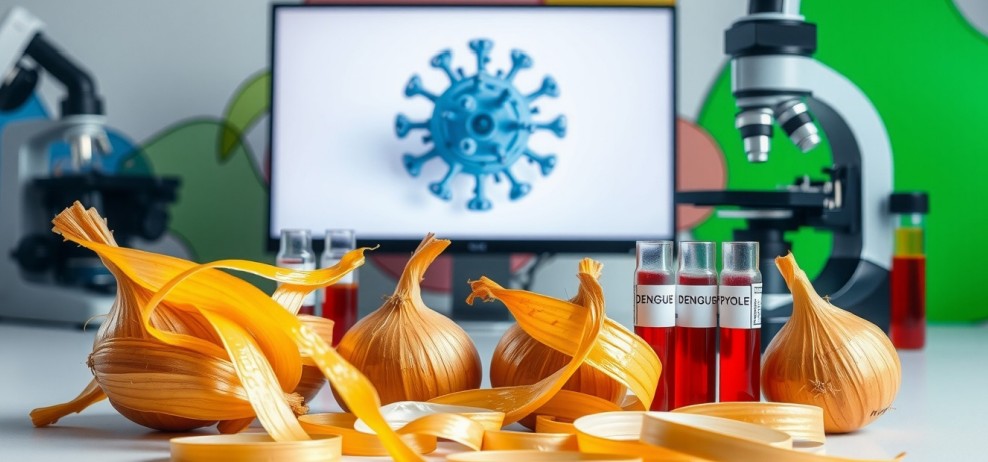
Dengue Hemorrhagic Fever (DHF), a severe and sometimes life-threatening disease spread by Aedes mosquitoes, often leads to a sharp drop in platelet counts and triggers intense immune reactions called cytokine storms. There has been no specific cure; a reality that triggers us to explore natural remedies that might help, one of which comes from an unexpected source: yellow onion peels. How do the yellow onion peels work against dengue virus? Let’s continue reading.
References
Alomair, L., Almsned, F., Ullah, A., & Jafri, M.S. 2021. In silico prediction of the phosphorylation of NS3 as an essential mechanism for dengue virus replication and the antiviral activity of quercetin. Biology, 10, 1067.
Jasamai, M., Yap, W. B., Sakulpanich, A., & Jaleel, A. 2019. Current prevention and potential treatment options for dengue infection. Journal of Pharmacy and Pharmaceutical Sciences, 22(1), 440-56.
Mallapaty, S. 2022. Dengue vaccine poised for roll out-but concerns linger. Nature, 6(11), 434-35.
Moektiwardoyo, M., Tjitraresmi, A., Susilawati, Y., Iskandar, Y., Halimah, E.,& Zahryanti, D. 2014. The potential of dewa leaf (Gynura pseudochina (L) D.C) and temu ireng rhizomes (Curcuma aeruginosa Roxb.) as medical herbs for dengue fever treatment. Procedia Chemistry, 12, 134-41.
Oh, T. W., Do, H. J., Jeon, J. H., & Kim, K. 2021. Quercitrin inhibits platelet activation in arterial thrombosis. Phytomedicine, 80, 1-12.
Pamungkas, K. M. N., & Dewi, P. I. S. L. 2020. Potensi quercetin dalam ekstrak daun Psidium guajava dan papain dalam ekstrak daun Carica papaya Linn. sebagai terapi demam berdarah dengue [The potential of quercetin in Psidium guajava leaf extract and papain in Carica papaya Linn. leaf extract as dengue fever therapy]. Essential, 17(2), 22-8.
Piechowiak, T., Blaszczyk, K. G., Bonikowski, R.,& Balawejder, M. 2020. Optimization of extraction process of antioxidant compounds
from yellow onion skin and their use in functional bread production. Food Science and Technology, 117, 1-7.
Rokom. 2022. Kasus DBD meningkat, Kemenkes galakkan gerakan 1 rumah 1 jumantik (G1R1J) [Dengue fever cases are increasing, the Ministry of Health is promoting the “1 house, 1 mosquito larvae” movement]. [Internet]. Accessed on 20 January 2023.
Sundaryono, A., Firdaus, M. L., Firdaus, S., & Karyadi, B. 2016. Potensi ekstrak daun tanaman betadin untuk meningkatkan jumlah trombosit penderita DBD melalui uji terhadap Mus musculus. [The potential of betadine plant leaf extract to increase the number of platelets in dengue fever sufferers through testing on Mus musculus]. Prosiding Seminar Nasional Pendidikan Sains (SNPS) 2016, 403-10.
Teixeira, A. C. Q., Andrade, F. B., Pinheiro, M. B. M., Rozini, S. V., & Hottz, E. D. 2021. Platelets in dengue infection: More than a numbers game. Platelets, 33(2), 176-83.
Wang, W. H., Urbina, A. N., Chang, M. R., Assavalapsakul, W., Lu, P. L., Chen, Y. H., & Wang, S. F. 2020. Dengue hemorrhagic fever-a systemic literature review of current perspectives on pathogenic, prevention and control. Journal of Microbiology, Immunology, and Infection, 53(6), 963-78.
Downloads
Published
Issue
Section
License
Copyright (c) 2025 Marlita Sekarwangi, Nisa Abidah, Fani Nur Maftukhah, Almayra Khanza Fahrani, Ratna Mustika Sari

This work is licensed under a Creative Commons Attribution-NonCommercial-NoDerivatives 4.0 International License.
Authors who publish with this journal agree with the following terms:
- Authors retain copyright and grant the journal right of first publication, with the work 1 year after publication simultaneously licensed under a Creative Commons attribution-noncommerical-noderivates 4.0 International License that allows others to share, copy and redistribute the work in any medium or format, but only where the use is for non-commercial purposes and an acknowledgement of the work's authorship and initial publication in this journal is mentioned.
- Authors are able to enter into separate, additional contractual arrangements for the non-exclusive distribution of the journal's published version of the work (e.g., post it to an institutional repository or publish it in a book), with an acknowledgement of its initial publication in this journal.
- Authors are permitted and encouraged to post their work online (e.g., in institutional repositories or on their website) prior to and during the submission process, as it can lead to productive exchanges, as well as earlier and greater citation of published work (See The Effect of Open Access).