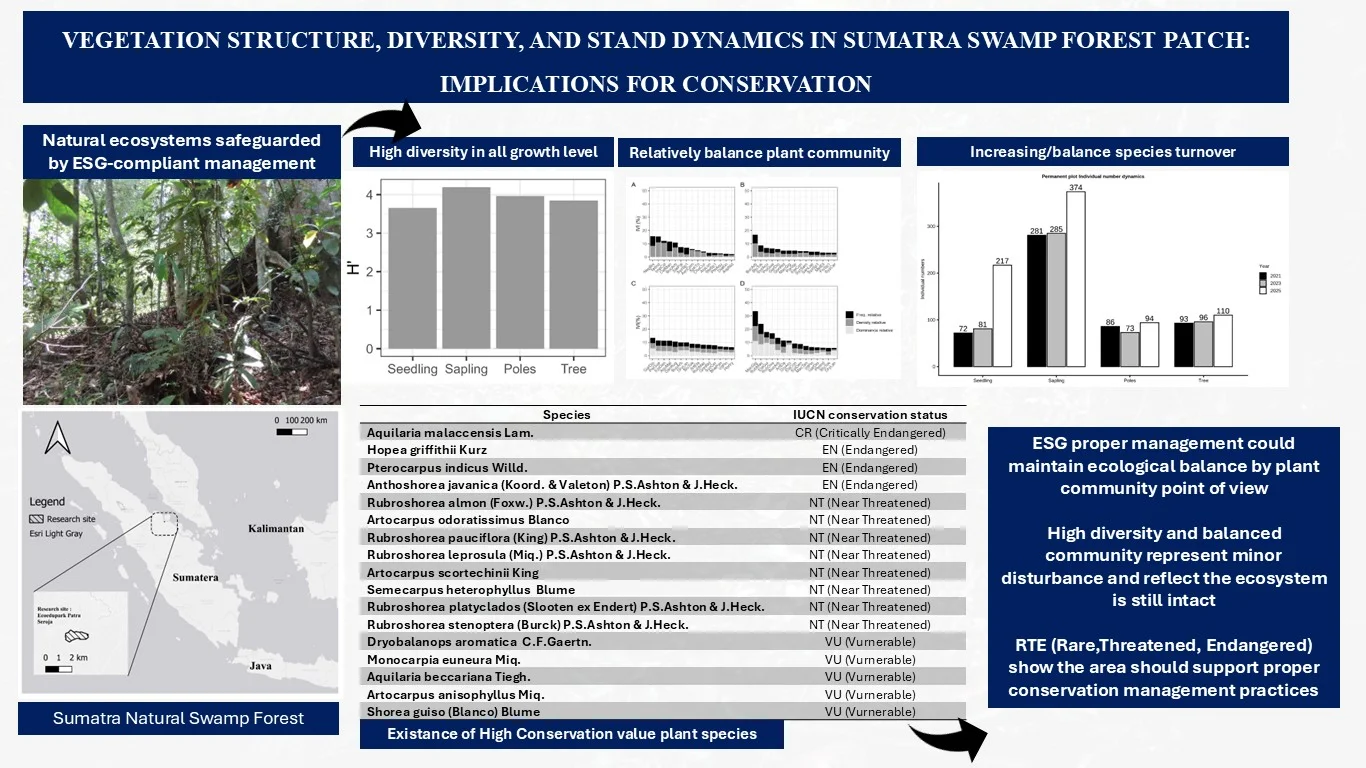
VEGETATION STRUCTURE, DIVERSITY, AND STAND DYNAMICS IN AN ESG-MANAGED SUMATRAN SWAMP FOREST PATCH: IMPLICATIONS FOR CONSERVATION

Downloads
ARTICLE HIGLIGHTS
- Small peat swamp forest patch retained high plant diversity across life stages
- Surveys recorded 231 plant species, including many threatened tree species
- Species abundances were relatively even, with little dominance in regeneration
- Permanent plot monitoring showed more new recruits than deaths over four years
- Basal area gains after canopy gaps suggest active recovery in managed forest patch
ABSTRACT
Habitat fragmentation driven by agricultural expansion and urbanization, accelerated biodiversity loss across tropical landscapes. Small forest patches within production and concession matrices function as important refugia and stepping-stones for plant survival. In Indonesia, the conservation relevance of such patches is linked to corporate Environmental, Social, and Governance (ESG) commitments, where natural resource-based company should comply to ecological sustainability. This study evaluated vegetation structure, species diversity, and stand dynamics in a corporate-managed peat swamp forest patch. Vegetation surveys were conducted using systematic nested plots, while stand dynamics were assessed using a 1-ha permanent measurement plot monitored in 4 years. Analyses included the Importance Value Index (IVI), Shannon-Wiener diversity index (H′), species turnover, and basal area change over time. A total of 231 plant species representing 138 genera and 67 families were recorded, including 17 species categorized by the IUCN red list. Species diversity was high and relatively even across all growth stages, indicating the absence of strong dominance. Permanent plot revealed positive turnover with emergence generally exceeding mortality, and net basal area gains during the periods, suggesting active regeneration associated with canopy gap dynamics. Overall, these findings demonstrate that small peat swamp forest patches can retain high biodiversity and dynamic stand recovery, supporting their integration into landscape-scale conservation planning and ESG-oriented forest management in Sumatra.
Alghifari MK, Mardiastuti A, Mulyani YA. 2021. Patch size does not always indicate bird species diversity: Case in Peri-urban tropical habitat in Riau, Indonesia. IOP Conf Ser: Earth Environ Sci 948:012028. DOI: 10.1088/1755-1315/948/1/012028
Andren H. 1999. Effects of habitat fragmentation on birds and mammals in landscapes with different proportions of suitable habitat: A review. NCASI Technical Bulletin 781 (I):12–13.
Arroyo-Rodríguez V, Pineda E, Escobar F, Benítez-Malvido J. 2009. Value of small patches in the conservation of plant-species diversity in highly fragmented rainforest. Conserv Biol 23(3):729–739. DOI: 10.1111/j.1523-1739.2008.01120.x
Austin KG, Schwantes A, Gu Y, Kasibhatla PS. 2019. What causes deforestation in Indonesia? Environ Res Lett 14(2):24007. DOI: 10.1088/1748-9326/aaf6db
Benedick S, Hill JK, Mustaffa N, Chey VK, Maryati M, Searle JB, … Hamer KC. 2006. Impacts of rain forest fragmentation on butterflies in northern Borneo: species richness, turnover and the value of small fragments. J Appl Ecol 43(5):967–977. DOI: 10.1111/j.1365-2664.2006.01209.x
Craven D, Filotas E, Angers VA, Messier C. 2016. Evaluating resilience of tree communities in fragmented landscapes: Linking functional response diversity with landscape connectivity. Divers Distrib 22(5):505–518. DOI: 10.1111/ddi.12423.
Davis SD, Heywood VH, Hamilton AC. 1995. Centres of plant diversity: A guide and strategy for their conservation. Volume 2. Asia, Australasia and the Pacific.
Dunning JB, Danielson BJ, Pulliam HR. 1992. Ecological processes that affect populations in complex landscapes. Oikos 65(1):169–175. DOI: 10.2307/3544901
Estrada A, Coates-Estrada R. 2002. Dung beetles in continuous forest, forest fragments and in an agricultural mosaic habitat island at Los Tuxtlas, Mexico. Biodivers Conserv 11(11):1903–1918. DOI: 10.1023/A:1020896928578
Fahrig L. 2017. Ecological responses to habitat fragmentation per se. Annu Rev Ecol Evol Syst 48:1–23. DOI: 10.1146/annurev-ecolsys-110316-022612
Fan K, Liu P, Mao P, Yao J, Zang R. 2023. The turnover dynamics of woody plants in a tropical lowland rain forest during recovery following anthropogenic disturbances. J Environ Manag 342:118371. DOI: 10.1016/j.jenvman.2023.118371
Fiala B. 1996. Ants benefit pioneer trees: The genus Macaranga as an example of ant-plant associations in dipterocarp forest ecosystems. Dipterocarp forest ecosystems. Towards sustainable management. Singapore (SG): World Scientific. p. 102–123. DOI: 10.1142/9789814261043_0005
Fischer J, Sherren K, Stott J, Zerger A, Warren G, Stein J. 2010. Toward landscape-wide conservation outcomes in Australia’s temperate grazing region. Front Ecol Environ 8(2):69–74. DOI: 10.1890/080170
Fischer J, Lindenmayer DB. 2007. Landscape modification and habitat fragmentation: A synthesis. Glob Ecol Biogeogr 16(3):265–280. DOI: 10.1111/j.1466-8238.2007.00287.x
Grieg-Gran M. 2008. The cost of avoiding deforestation. Update of the Report prepared for the Stern Review of the Economics of Climate Change. Available at https://www.iied.org/g02489
Hansen MC, Potapov PV, Moore R, Hancher M, Turubanova SA, Tyukavina A, ..., Townshend JRG. 2013. High-resolution global maps of 21st-century forest cover change. Science 342(6160):850–853. DOI: 10.1126/science.1244693
Hernández-Ruedas MA, Arroyo-Rodríguez V, Meave JA, Martínez-Ramos M, Ibarra-Manríquez G, Martínez E, ..., Santos BA. 2014. Conserving tropical tree diversity and forest structure: The value of small rainforest patches in moderately-managed landscapes. PloSOne 9(6):e98931. DOI: 10.1371/journal.pone.0098931
Herrera LP, Sabatino MC, Jaimes FR, Saura S. 2017. Landscape connectivity and the role of small habitat patches as stepping stones: An assessment of the grassland biome in South America. Biodivers Conserv 26(14):3465–3479. DOI: 10.1007/s10531-017-1416-7
[IUCN] International Union for Conservation of Nature. 2025. IUCN Red List of Threatened Species [Online]. [Accessed: 5 February 2026]. Available at: https://www.iucnredlist.org/about/citationinfo
Jaureguiberry P, Titeux N, Wiemers M, Bowler DE, Coscieme L, Golden AS, …, Purvis A. 2022. The direct drivers of recent global anthropogenic biodiversity loss. Sci Adv 8(45):eabm9982. DOI: 10.1126/sciadv.abm9982
Johansson J, and H. Keskitalo, E.C. 2014. Coordinating and implementing multiple systems for forest management: implications of the regulatory framework for sustainable forestry in Sweden. J Nat Resour Policy Res 6(2–3):117–133. DOI: 10.1080/19390459.2014.913363
John A. 1989. Recovery of a Peninsular Malaysia rainforest avifauna following selective timber logging: The first twelve years. Forktail 4:89–105.
Kopnina H, Zhang SR, Anthony S, Hassan A, Maroun W. 2024. The inclusion of biodiversity into Environmental, Social, and Governance (ESG) framework: A strategic integration of ecocentric extinction accounting. J Environ Manage 351:119808. DOI: 10.1016/j.jenvman.2023.119808
Kukkala AS, Moilanen A. 2013. Core concepts of spatial prioritisation in systematic conservation planning. Biol Rev 88(2):443-464. DOI: 10.1111/brv.12008
Latiff A. 2018. Biodiversity in Malaysia. In: Global biodiversity. Burlington (CA): Apple Academic Press. p. 307–349. DOI: 10.1201/9780429487743-10
Laumonier Y. 1990. Search for phytogeographic provinces in Sumatra. In: Baas P, Kalkman K, Geesink R (Editors), The plant diversity of Malesia. Dordrecht (NL): Springer Dordrecht. p. 193–211. DOI: 10.1007/978-94-009-2107-8_17
Laumonier Y. 1997. The Vegetation and Physiography of Sumatra. Dordrecht (NL): Springer Dordrecht. DOI: 10.1007/978-94-009-0031-8
Laurance WF, Sayer J, Cassman KG. 2014. Agricultural expansion and its impacts on tropical nature. Trends Ecol Evol 29(2):107–116. DOI: 10.1016/j.tree.2013.12.001
Laurance WF, Yensen E. 1991. Predicting the impacts of edge effects in fragmented habitats. Biol Conserv 55(1):77–92. DOI: 10.1016/0006-3207(91)90006-U
Margono BA, Turubanova S, Zhuravleva I, Potapov P, Tyukavina A, Baccini A, ..., Hansen SJ. 2012. Mapping and monitoring deforestation and forest degradation in Sumatra (Indonesia) using Landsat time series data sets from 1990 to 2010. Environ Res Lett 7(3):34010. DOI: 10.1088/1748-9326/7/3/034010
Myers N. 1988. Threatened biotas:" hot spots" in tropical forests. Environmentalist 8(3):187–208. DOI: 10.1007/BF02240252
Newbold T, Hudson LN, Hill SLL, Contu S, Lysenko I, Senior RA, …, Purvis A. 2015. Global effects of land use on local terrestrial biodiversity. Nature 520(7545):45–50. DOI: 10.1038/nature14324
POWO. 2021. Plants of the World Online. Available at: http://www.plantsoftheworldonline.org/.
Rojas IM, Radeloff VC, McCabe JD, Ibarra JT, Pidgeon AM. 2024. Riparian forest patches are critical for forest affiliated birds in farmlands of temperate Chile. Biol Conserv 296:110727. DOI: 10.1016/j.biocon.2024.110727
Sanderson EW. Jaiteh M, Levy MA, Redford KH, Wannebo AV, Woolmer G. 2002. The human footprint and the last of the wild. BioScience 52(10):891–904. DOI: 10.1641/0006-3568(2002)052[0891:THFATL]2.0.CO;2
Saravia LA, Balza U, Momo F. 2025. Why there are more species in several small patches versus few large patches: A multispecies modelling approach. Funct Ecol 39(1):103–113. DOI: 10.1111/1365-2435.14695
Saura S, Bastin L, Battistella L, Mandrici A, Dubois G. 2017. Protected areas in the world’s ecoregions: How well connected are they? Ecol Indic 76:144–158. DOI: 10.1016/j.ecolind.2016.12.047
Senanayake M, Putra FKG, Gregory RP, Harymawan I, Rhee JH, Ok YS. 2026. From biodiversity to ESG: Evaluating disclosure approaches of companies operating in Indonesia. Front Sustain 6:1668560. DOI: 10.3389/frsus.2025.1668560
Shannon CE, Weaver W. 1948. A mathematic theory of communication. Bell Syst Tech J 27(3): 379 –423. DOI: 10.1002/j.1538-7305.1948.tb01338.x
Shono K, Cadaweng EA, Durst PB. 2007. Application of assisted natural regeneration to restore degraded tropical forestlands. Restor Ecol 15(4):620–626. DOI: 10.1111/j.1526-100X.2007.00274.x
Solfiyeni S, Winata F, Mildawati M, Marisa H. 2024. Vegetation composition, structure and association at site invaded by Calliandra houstoniana in Bung Hatta Grand Forest Park, West Sumatra, Indonesia. Biodiversitas 25(10):3608–3616. DOI: 10.13057/biodiv/d251022
Statistic Department of Dumai, 2024. Kota Dumai Dalam Angka [Dumai in Numbers]. Dumai (ID): Statistics Department of Dumai.
Stibig HJ, Achard F, Carboni S, Raši R, Miettinen J. 2014. Change in tropical forest cover of Southeast Asia from 1990 to 2010. Biogeosciences 11(2):247–258. DOI: 10.5194/bg-11-247-2014
Stobbe T, Eagle AJ, van Kooten GC. 2008. Hobby farms and protection of farmland in British Columbia. Victoria (CA): University of Victoria, Department of Economics.
Sunders DA, Hobbs RJ, Margules CR. 1991. Biological consequences of ecosystem fragmentation: A review. Conserv Biol 5(1):18–32. DOI: 10.1111/j.1523-1739.1991.tb00384.x
Talaat WIAW, Tahir NM, Husain ML. 2012. Sustainable management of forest biodiversity and the present Malaysian policy and legal framework. J Sustain Dev 5(3):76. DOI: 10.5539/jsd.v5n3p76
Ulfa M, Harahap MM, Rambey R, Ritonga YE, Zahirah A, Silalahi RR, Sitinjak AR. 2022. Composition and diversity of tropical forest vegetation at Sibolangit tourism park, North Sumatra, Indonesia. Conf Ser: Earth Environ Sci 1115(1):012011. DOI: 10.1088/1755-1315/1115/1/012011
Watling JI, Arroyo-Rodriguez V, Pfeifer M, Baeten L, Banks-Leite C, Cisneros LM, …, Fahrig L. 2020. Support for the habitat amount hypothesis from a global synthesis of species density studies. Ecol Lett 23(4):674–681. DOI: 10.1111/ele.13471
Watson JEM, Dudley N, Segan DB, Hockings M. 2014. The performance and potential of protected areas. Nature 515(7525):67–73. DOI: 10.1038/nature13947
Wilcove DS, Giam X, Edwards DP, Fisher B, Koh LP. 2013. Navjot’s nightmare revisited: Logging, agriculture, and biodiversity in Southeast Asia. Trends Ecol Evol 28(9):531–540. DOI: 10.1016/j.tree.2013.04.005
Copyright (c) 2026 Dwi Tyaningsih Adriyanti, Alnus Meinata, Subeno, Frita Kusumawardani, Zyqro Milid Formandes, Syahrial Okzani

This work is licensed under a Creative Commons Attribution-NonCommercial-NoDerivatives 4.0 International License.
Authors who publish with this journal agree with the following terms:
- Authors retain copyright and grant the journal right of first publication, with the work 1 year after publication simultaneously licensed under a Creative Commons attribution-noncommerical-noderivates 4.0 International License that allows others to share, copy and redistribute the work in any medium or format, but only where the use is for non-commercial purposes and an acknowledgement of the work's authorship and initial publication in this journal is mentioned.
- Authors are able to enter into separate, additional contractual arrangements for the non-exclusive distribution of the journal's published version of the work (e.g., post it to an institutional repository or publish it in a book), with an acknowledgement of its initial publication in this journal.
- Authors are permitted and encouraged to post their work online (e.g., in institutional repositories or on their website) prior to and during the submission process, as it can lead to productive exchanges, as well as earlier and greater citation of published work (See The Effect of Open Access).