NATURE-BASED SOLUTIONS FOR RESILIENT RICE AGRO-ECOSYSTEMS
A Review of Ecological Insect Pest Management and Biodiversity Conservation

Downloads
Additional Files
ARTICLE HIGHLIGHTS
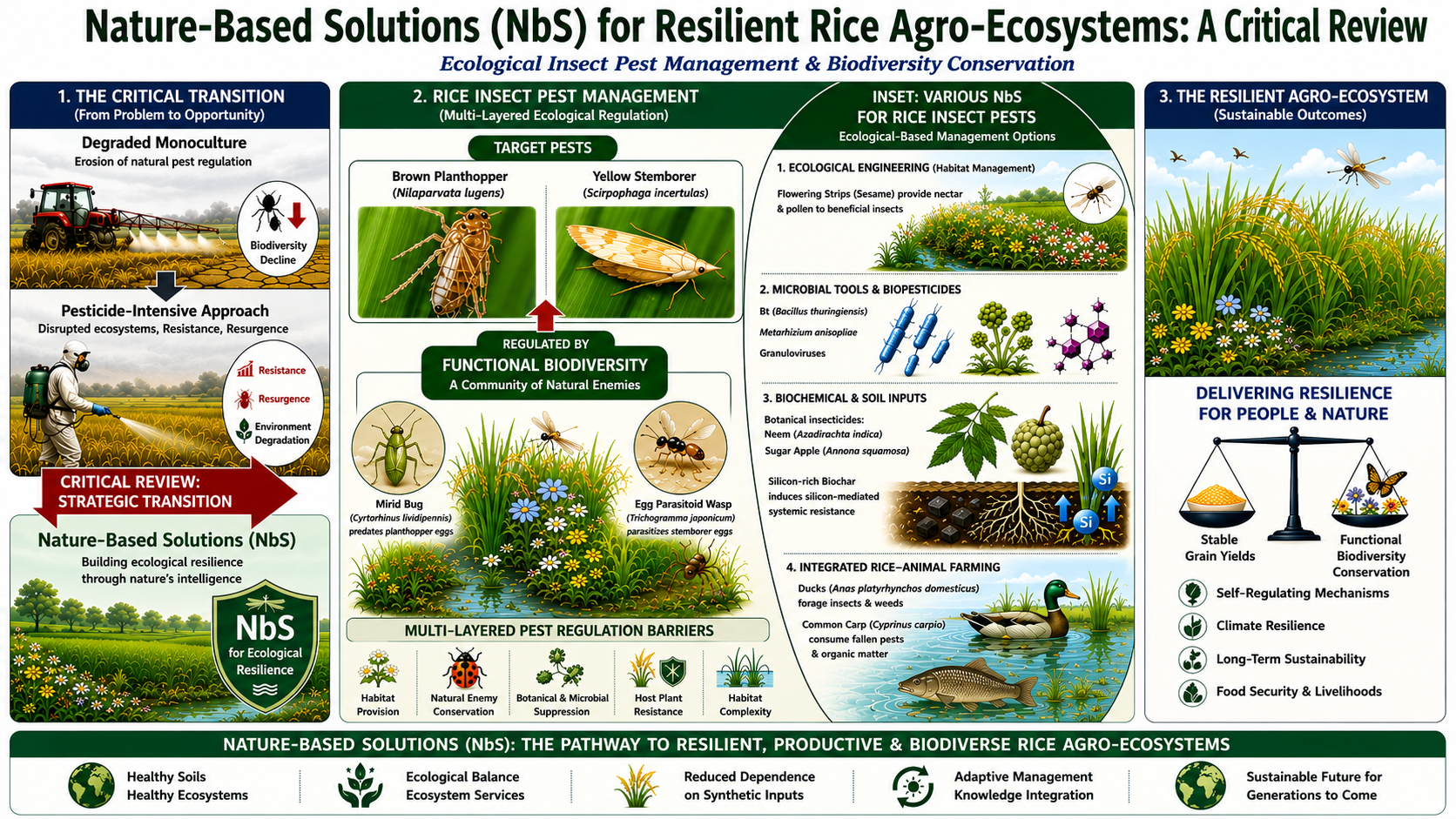
- Nature-based tools restore biodiversity and self-regulating pest control.
- Flowering strips and border crops boost beneficial predator populations.
- Neem and custard apple biopesticides disrupt pests without toxicity.
- Soil biochar and silicon build strong physical barriers in rice plants.
- Integrated duck and fish farming suppresses pests while cutting chemical use.
ABSTRACT
The Green Revolution expanded global rice production but introduced systemic environmental vulnerabilities by eroding biodiversity and natural pest regulation. This critical review examines the strategic transition from pesticide-intensive cultivation to nature-based solutions (NbS) that prioritize ecological resilience. We synthesize diverse strategies, including ecological engineering, microbial tools, and integrated rice-animal farming, to demonstrate their collective efficacy in maintaining stable yields. Environmental manipulation through flowering strips supports a robust natural enemy complex, including the mirid bug (Cyrtorhinus lividipennis (Reuter)) and the egg parasitoid wasp (Trichogramma japonicum Ashmead). Furthermore, we evaluate the pivotal role of botanical insecticides from the neem tree (Azadirachta indica A. Juss.) and the sugar apple (Annona squamosa L)., alongside soil amendments like biochar, to induce systemic host resistance via silicon-mediated defenses. Crucially, we highlight how microbial biopesticides, including the entomopathogens Bt (Bacillus thuringiensis Berliner), green muscardine fungus (Metarhizium anisopliae (Metschn.) Sorokīn), and specialized granuloviruses, work in synergy with animal co-cultures involving the domestic duck (Anas platyrhynchos domesticus L.) and the common carp (Cyprinus carpio L.). Together, these synchronized interventions establish multi-layered barriers against major pests like the brown planthopper (Nilaparvata lugens (Stål)) and the yellow stemborer (Scirpophaga incertulas (Walker)). By aligning cultural, biochemical, and biological practices, these solutions foster functional biodiversity and self-regulating mechanisms, providing a resilient framework for the long-term sustainability of global rice agriculture amidst shifting climatic challenges.
Aguda RM, Litsinger JA, Roberts DW. 1984. Pathogenicity of Beauveria bassiana on brown planthopper (BPH), whitebacked planthopper (WBPH), and green leafhopper (GLH). Int Rice Res New 9(6):20. Available from: https://delphacid.s3.amazonaws.com/5760.pdf
Alam MZ. 1962. Use of Bacillus thuringiensis Berliner for the control of rice ear-cutting and swarming caterpillars in East Pakistan. Pak J Sci Res 14(3):123–129. Available from: https://www.kgf.org.bd/uploads/research-abstract/1738816423.pdf
Altieri MA. 1995. Agroecology: The science of sustainable agriculture. Boulder (US): Westview Press.
Altieri MA, Nicholls CI. 2004. Biodiversity and pest management in agroecosystems. 2nd ed. Binghamton (US): Food Products Press.
Amandeep GS, Verma PK, Varma A. 2021. Evaluation of indigenous plant extracts with cow urine against rice stem borer and rice leaf folder in basmati rice. Pharma Innovation J 10(10):354–359. Available from: https://www.thepharmajournal.com/archives/2021/vol10issue10S/ PartE/S-10-9-182-587.pdf
Amoabeng BW, Gurr GM, Gitau CW, Nicol HI, Munyakazi L, Stevenson PC. 2013. Tri-trophic insecticidal effects of African plants against cabbage pests. PLoS One 8(10):e78651. DOI: 10.1371/journal.pone.0078651 DOI: https://doi.org/10.1371/journal.pone.0078651
Appel HM. 1993. Phenolics in ecological interactions: the importance of oxidation. J Chem Ecol. 19(7):1521–1552. DOI: 10.1007/BF00984895 DOI: https://doi.org/10.1007/BF00984895
Arnason JT, Sims SR, Scott IM. 2012. Natural products from plants as insecticides. Oxford (UK): Eolss Publishers. Available from: http://www.eolss.net/Sample-Chapters/C06/E6-151-13.pdf
Assabgui R, Lorenzetti F, Terradot L, Regnault-Roger C, Malo N, Wiriyachitra P, …, Arnason JT. 1997. Efficacy of botanicals from the Meliaceae and Piperaceae. In: Hedin PA, Hollingworth RM, Masler EP, Miyamoto J, Thompson DG (Editors), Phytochemicals for pest control. ACS Symposium Series No. 658. Washington (DC): American Chemical Society. p. 38–48. DOI: 10.1021/bk-1997-0658.ch004 DOI: https://doi.org/10.1021/bk-1997-0658.ch004
Athulya R, Maheswari TU, Padmakumari A, Madhav MS, Devi GU. 2022. Reaction of rice varieties to yellow stem borer, Scirpophaga incertulas (Walker) populations. J Integr Pest Manag 3:155–160.
Babendreier D, Hou M, Tang R, Zhang F, Vongsabouth T, Win KK, …, Horgan FG. 2020. Biological control of lepidopteran pests in rice: A multi-nation case study from Asia. J Integr Pest Manag 11(1):5. DOI: 10.1093/jipm/pmaa002 DOI: https://doi.org/10.1093/jipm/pmaa002
Balagurunathan R, Rabindra RJ. 2001. Field evaluation of Trichogramma sp. and Bacillus thuringiensis against rice stem borer and leaf folder. In: National symposium on “Emerging Trends in Pests and Their Management”; Coimbatore (India): Tamil Nadu Agricultural University. p. 18–19.
Balamurugan S, Kannan R. 2023. Evaluation of toxicity of Sargassum wightii with pungam oil against Cnaphalocrocis medinalis. Int J Entomol Res 8(12):11–14. Available from: https://www.entomologyjournals.com/assets/archives/2023/vol8issue12/8-12-1-100.pdf
Banerjee S. 1964. Ecology of the rice yellow stem borer Tryporyza incertulas (Walker) in West Bengal. In: The major insect pests of the rice plant: proceedings of a symposium at the International Rice Research Institute. Baltimore (US): Johns Hopkins Press. p. 92–104.
Barrion AT, Pantua PC, Litsinger JA. 1981. Gryon nixoni Masner (Hymenoptera: Scelionidae): A new egg parasite of Leptocorisa oratorius in the Philippines. Int Rice Res New 6(3):19–20. DOI: 10.5281/zenodo.6880264
Basavaraj Ashokappa HT. 2011. Bioecology and management of rice earhead bug, Leptocorisa oratorius Fabricius (Hemiptera: Alydidae) in rainfed ecosystem of Uttara Kannada district [Master’s thesis]. Dharwad (IN): University of Agricultural Sciences. Available from: https://krishikosh.egranth.ac.in/server/api/core/bitstreams/41264b12-f924-4b75-a2ff-69216ef5646e/content
Benelli G, Canale A, Toniolo C, Higuchi A, Murugan K, Pavela R, Nicoletti M. 2017. Neem (Azadirachta indica): towards the ideal insecticide? Nat Prod Res 31(4):369–386. DOI: 10.1080/14786419.2016.1214834 DOI: https://doi.org/10.1080/14786419.2016.1214834
Bentur JS, Kalode MB, Rajenderan B, Patel VS. 1994. Field evaluation of the egg parasitoids, Trichogramma japonicum Ash. (Hym., Trichogrammatidae) against the rice leaf folder, Cnaphalocrocis medinalis (Guenée) (Lep., Pyralidae) in India. J Appl Entomol 117(1–5):257–261. DOI: 10.1111/j.1439-0418.1994.tb00733.x DOI: https://doi.org/10.1111/j.1439-0418.1994.tb00733.x
Bhojane SN, Desai VS, Wade PS, Jalgaonkar VN, Wankhede SM, Desai SD. 2020. Management of major pests infesting rice (Oryza sativa L.) using botanicals. J Entomol Zool Stud 8(4):1962–1964. Available from: https://www.researchgate.net/publication/353821160_ Management_of_major_pests_infesting_rice_Oryza_sativa_L_using_botanicals
Biswas K, Chattopadhyay I, Banerjee RK, Bandyopadhyay U. 2002. Biological activities and medicinal properties of neem (Azadirachta indica). Curr Sci 82(11):1336–1345. Available from: http://www.jstor.org/stable/24106000
Borah M, Basit A, Nath RK. 2001. Effect of certain insecticides on the parasitisation and emergence of the egg parasitoid, Trichogramma japonicum Ashmead. Crop Res 22(1):138–140.
Bosly HA. 2013. Evaluation of insecticidal activities of Mentha piperita and Lavandula angustifolia essential oils against house fly, Musca domestica L. (Diptera: Muscidae). J Entomol Nematol 5(4):50–54. DOI: 10.5897/JEN2013.007 DOI: https://doi.org/10.5897/JEN2013.0073
Cai BX, Yang FL, Xu GP, et al. 2014. Control of rice-turtle mode on the migratory insect pests in rice. China Plant Prot 34(9):35–37. (In Chinese with English abstract).
Campos P, Miller AZ, Knicker H, Costa-Pereira MF, Merino A, Rosa JM. 2020. Chemical, physical and morphological properties of biochars produced from agricultural residues: implications for their use as soil amendment. Waste Manag 105:256–267. DOI: 10.1016/j.wasman.2020.02.013 DOI: https://doi.org/10.1016/j.wasman.2020.02.013
Chander S. 2022. Integrated pest management of field crops. Indian J Entomol 84(Special Issue):29–39. DOI: 10.55446/IJE.2022.912 DOI: https://doi.org/10.55446/IJE.2022.912
Chandra R, Singh N, Rai S. 2024. Banker plant concepts for biological control in Indian rice ecosystems. J Biol Control 38(4):315–325.
Chandrakar HK, Pophaly DJ, Gupta R, Kaushik UK. 1991. Naturally occurring biological control of rice gall midge at Raipur, India. RAE A 79(3):2513.
Chatterjee S, Mondal P. 2014. Management of rice yellow stem borer, Scirpophaga incertulas Walker using some biorational insecticides. J Biopestic 7(Suppl):143–147. Available from: https://jbiopestic.com/journals/vol_7_0_143-147.pdf DOI: https://doi.org/10.57182/jbiopestic.7.0.143-147
Chaudhari BN, Dhepe VR, Panchbhai PR, Tambe VJ. 2023. Field demonstrations of Trichogramma japonicum against stem borer and Metarhizium anisopliae against plant hopper in rice crop. Pharma Innovation J 12(11S):2276–2278. Available from: https://www.thepharmajournal.com/archives/2023/vol12issue11S/PartZ/S-12-8-89-540.pdf
Chen B, Zuo Y, Lv Y, Zhang H, Yang J, Gu Y, …, Yang K. 2025. Revealing the potential transmission route of Cnaphalocrocis medinalis granulovirus capable of persistently causing granulosis epidemics. Virus Evol 11(1):veaf055. DOI: 10.1093/ve/veaf055 DOI: https://doi.org/10.1093/ve/veaf055
Chen BY. 2021. Overview of integrated application of green control technology for rice “two migratory pests” during the 13th Five-Year Plan period in Guilin. China Plant Prot 41(10):91–95. (In Chinese with English abstract).
Chen Y, Shen Y, Li B, Meng L. 2019. The effect of biochar amendment to soils on Cnaphalocrocis medinalis Guenée (Lepidoptera: Pyralidae) on rice. Crop Prot 124:104842. DOI: 10.1016/j.cropro.2019.06.002 DOI: https://doi.org/10.1016/j.cropro.2019.06.002
Cheng X, Zhu L, He G. 2013. Towards understanding of molecular interactions between rice and the brown planthopper. Mol Plant 6(3):621–634. DOI: 10.1093/mp/sst030 DOI: https://doi.org/10.1093/mp/sst030
Chhavi, Sharma PK, Srivastava A. 2019. Field efficacy of Trichogramma chilonis against rice leaf folder, Cnaphalocrocis medinalis in Kangra Valley of Himachal Pradesh. J Entomol Zool Stud 7(1):600–603. Available from: https://www.entomoljournal.com/archives/2019/vol7issue1/ PartI/7-1-41-291.pdf
Cui J, Liu H, Wang H, Wu S, Bashir MA, Reis S, …, Gu B. 2023. Rice–animal co-culture systems benefit global sustainable intensification. Earths Future. 11(2):e2022EF002984. DOI: 10.1029/2022EF002984 DOI: https://doi.org/10.1029/2022EF002984
Dan JG, Chen CM. 1990. The effects of feeding condition on the growth, development, and reproduction of rice leaf roller. J Plant Prot 17(3):193–199. (In Chinese with English abstract).
Danna C, Malaspina P, Cornara L, Smeriglio A, Trombetta D, De Feo V, Vanin S. 2024. Eucalyptus essential oils in pest control: A review of chemical composition and applications against insects and mites. Crop Prot 176:106319. DOI: 10.1016/j.cropro.2023.106319 DOI: https://doi.org/10.1016/j.cropro.2023.106319
Das J, Sagar Behera K, Adhya TK, Dangar TK, Panigrahy M. 2026. Characterization of rice rhizospheric Bacillus thuringiensis as biocide against leaf folder (Cnaphalocrocis medinalis), stripe stem borer (Chilo suppressalis), plant pathogens, and plant growth promotion traits. J Gen Appl Microbiol. Advance online publication. DOI: 10.2323/jgam.2025.12.001 DOI: https://doi.org/10.2323/jgam.2025.12.001
Das KK, Yadav SS. 2024. Utilizing plants based insecticides as fundamental ingredient for insect pest management. Just Agric Multidiscip e-New 4(6):335–339.
Davies TG, Field LM, Usherwood PNR, Williamson MS. 2007. DDT, pyrethrins, pyrethroids and insect sodium channels. IUBMB Life 59(3):151–162. DOI: 10.1080/15216540701352042 DOI: https://doi.org/10.1080/15216540701352042
de Albuquerque RDDG, Leon-Vargas FR, del Aguila CC, Garcia-Perez V, Ramos-Rivas YVS. 2025. Botanic products as a sustainable alternative in the control of rice and grape pests in South America. Online J Biol Sci 25(2):323–332. DOI: 10.3844/ojbsci.2025.323.332 DOI: https://doi.org/10.3844/ojbsci.2025.323.332
De Bon H, Temple L, Malézieux E, Bendjebbar P, Fouilleux E, Silvie P. 2018. Organic agriculture in Africa: A source of innovation for agricultural development. Perspect 48:1–4. DOI: 10.19182/agritrop/00036 DOI: https://doi.org/10.19182/agritrop/00036
de Kraker J, Rabbinge R, van Huis A, van Lenteren JC, Heong KL. 2000. Impact of nitrogenous fertilization on the population dynamics and natural control of rice leaffolders (Lep.: Pyralidae). Int J Pest Mana. 46(3):225–235. DOI: 10.1080/096708700415571 DOI: https://doi.org/10.1080/096708700415571
De Schutter O. 2012. Agroecology, a tool for the realization of the right to food. In: Lichtfouse E (Editor), Agroecology and strategies for climate change. Sustainable Agriculture Reviews. Vol. 8. Dordrecht (NL): Springer. p. 1–17. DOI: 10.1007/978-94-007-1905-7_1 DOI: https://doi.org/10.1007/978-94-007-1905-7_1
Deolall MD, Singh D, Srikishen A, Da Silva PNB. 2022. Investigating insecticidal and repellent activity of Momordica charantia, Calotropis gigantea and Cordia curassavica against Oebalus poecilus. GSC Biol Pharm Sci 20(2):80–86. DOI: 10.30574/gscbps.2022.20.2.0305 DOI: https://doi.org/10.30574/gscbps.2022.20.2.0305
Desai SD, Swaminathan R, Desai VS. 2017. Effect of habitat manipulation on infestation of paddy leaf folder, Cnaphalocrocis medinalis (Guenée). Int J Curr Microbiol Appl Sci 6(10):1469–1477. DOI: 10.20546/ijcmas.2017.610.174 DOI: https://doi.org/10.20546/ijcmas.2017.610.174
Devi MR, Bawari M, Paul SB, Sharma GD. 2011. Neurotoxic and medicinal properties of Datura stramonium L.—review. Assam Univ J Sci Technol Biol Environ Sci 7(1):139–144.
Devi MS, Sowndarya P. 2022. Management of rice yellow stem borer and gall midge. Biotica Res Today 4(4):221–223. Available from: https://bioticapublications.com/journal-backend/articlePdf/76ff3df3ae.pdf
Dhar A, Chatterjee S, Biswas B, Sengupta K, Sarkar S. 2023. Agronomic management of insect-pests of rice: A sustainable approach to bring down pest population. Vigyan Varta 4(10):185–188. Available from: https://www.academia.edu/116518712/Agronomic_Management_of_ Insect_pests_of_Rice_A_Sustainable_Approach_to_Bring_down_Pest_Population
Dhuyo AR, Soomro NM. 2008. Pathogenicity of Beauveria bassiana (Deuteromycota: Hyphomycetes) against the yellow rice stem borer, Scirpophaga incertulas (Lepidoptera: Pyralidae) under laboratory conditions. Pak Entomol 30(1):37–42.
Dileep Kumar NT, Manjunatha KL, Rakshitha TN, Hadimani BN, Reddy P. 2024. A review: phytoliths for insect pest management. Int J Adv Biochem Res 8(8S):664–670. DOI: 10.33545/26174693.2024.v8.i8Sj.1895 DOI: https://doi.org/10.33545/26174693.2024.v8.i8Sj.1895
Directorate of Rice Research. 2008. Progress report 2007–08. Vol. 2, Crop protection (Entomology and Plant Pathology). Hyderabad (India): All India Coordinated Rice Improvement Programme, Indian Council of Agricultural Research. Available from: https://www.icar-iirr.org/AICRIP/Progress%20Report%20Volume%20II-%202018.pdf
Divekar PA, Rani V, Majumder S, Karkute SG, Molla KA, Pandey KK, …, Govindharaj GPP. 2023. Protease inhibitors: An induced plant defense mechanism against herbivores. J Plant Growth Regul 42(10):6057–6073. DOI: 10.1007/s00344-022-10767-2 DOI: https://doi.org/10.1007/s00344-022-10767-2
Divya J, Kalleshwaraswamy CM, Mallikarjuna HB, Deshmukh SS. 2021. Does recently invaded fall armyworm, Spodoptera frugiperda, displace native lepidopteran pests of maize in India? Curr Sci. 120(8):1358–1367. DOI: https://doi.org/10.18520/cs/v120/i8/1358-1367
Durairaj C, Venugopal MS. 1993. Effects of neem and nochi on rice bug, Leptocorisa acuta. Int Rice Res Notes 18(3):34.
Elisa GPL, Laura P, Graciela BZ, Víctor M, Velázquez H. 2012. Current status: Mexican medicinal plants with insecticidal potential. In: Rai MCJ (Editor), Bioactive compounds in phytomedicine. Rijeka (HR): IntechOpen. p. 185–216. DOI: 10.5772/27013 DOI: https://doi.org/10.5772/27013
Emimal Victoria E. 2010. Pest infestation on the biochemical modulation of Adhatoda vasica. J Biopestic 3(2):413–419. DOI: 10.57182/jbiopestic.3.2.413-419 DOI: https://doi.org/10.57182/jbiopestic.3.2.413-419
Fahad S, Saud S, Akhter A, Bajwa AA, Hassan S, Battaglia M, …, Irshad I. 2021. Bio-based integrated pest management in rice: An agro-ecosystems friendly approach for agricultural sustainability. J Saudi Soc Agric Sci 20(2):94–102. DOI: 10.1016/j.jssas.2020.12.004 DOI: https://doi.org/10.1016/j.jssas.2020.12.004
Fang W, Cao A, Yan D, Han D, Huang B, Li J, …, Wang Q. 2017. The effect of two types of biochars on the efficacy, emission, degradation, and adsorption of the fumigant methyl isothiocyanate. Energies 10(1):16. DOI: 10.3390/en10010016 DOI: https://doi.org/10.3390/en10010016
[FAO] Food and Agriculture Organization. 2024a. Ecological engineering and biodiversity enhancement in rice-based cropping systems. Rome (IT): Food and Agriculture Organization.
[FAO] Food and Agriculture Organization. 2024b. Sustainable rice production and pest management strategies in South Asia. Rome (IT): Food and Agriculture Organization.
Fawe A, Abou-Zaid M, Menzies JG, Bélanger RR. 1998. Silicon-mediated accumulation of flavonoid phytoalexins in cucumber. Phytopathology 88(5):396–401. DOI: 10.1094/PHYTO.1998.88.5.396 DOI: https://doi.org/10.1094/PHYTO.1998.88.5.396
Fischer D, Imholt C, Pelz HJ, Wink M, Prokop A, Jacob J. 2013. The repelling effect of plant secondary metabolites on water voles, Arvicola amphibius. Pest Manag Sci 69(3):437–443. DOI: 10.1002/ps.3438 DOI: https://doi.org/10.1002/ps.3438
Francis CA, Jordan N, Porter P, Breland TA, Lieblein G, Salomonsson L, …, Langer V. 2011. Innovative education in agroecology: Experiential learning for a sustainable agriculture. Crit Rev Plant Sci. 30(1–2):226–237. DOI: 10.1080/07352689.2011.554498 DOI: https://doi.org/10.1080/07352689.2011.554497
Fu Q, Li BP, Ma L. 2018. Effects of biochar amendment to soil on life history traits of Laodelphax striatellus (Hemiptera: Delphacidae) on rice plants. China J Rice Sci 32(2):200–206. DOI: 10.16819/j.1001-7216.2018.7113
Furuno T. 2001. The power of duck. Tasmania (AU): Tagari Publications. p. 21–28.
Fyllas N, Chrysafi D, Avtzis D, Moreira X. 2022. Photosynthetic and defensive responses of two Mediterranean oaks to insect leaf herbivory. Tree Physiol 42(11):2282–2293. DOI: 10.1093/treephys/tpac067 DOI: https://doi.org/10.1093/treephys/tpac067
Ganesan K, Anil Kumar B, Soundararajan RP, Suganthy M, Venugopal S, Manivannan V, …, Murugan M. 2025. Botanicals for managing insect pests in rice: An eco-friendly strategy for sustainable rice production. Plant Sci Today 12(1):1–10. DOI: 10.14719/pst.6006 DOI: https://doi.org/10.14719/pst.6006
Ganesan K, Soundararajan RP, Sanbagavalli S. 2014. Indigenous technical knowledge (ITK) in pest management. In: Kennedy JS, Ganesan K, Senguttuvan K, Rajabaskar D, Kuttalam S (Editors), Functional insect pest management. p. 191–198.
Ge LQ, Jiang YP, Xia T, Song QS, Stanley D, Kuai P…, Wu JC. 2015. Silencing a sugar transporter gene reduces growth and fecundity in the brown planthopper, Nilaparvata lugens (Stål) (Hemiptera: Delphacidae). Sci Rep 5:12194. DOI: 10.1038/srep12194 DOI: https://doi.org/10.1038/srep12194
Ghisman V, Muresan AC, Bogatu NL, Herbei EE, Buruiana DL. 2025. Recent advances in the remediation of degraded and contaminated soils: A review of sustainable and applied strategies. Agronomy 15(8):1920. DOI: 10.3390/agronomy15081920 DOI: https://doi.org/10.3390/agronomy15081920
Gliessman S. 2016. Transforming food systems with agroecology. Agroecol Sustain Food Syst 40(3):187–189. DOI: 10.1080/21683565.2015.1130765 DOI: https://doi.org/10.1080/21683565.2015.1130765
Golec AFC. 2007. Effect of neem (Azadirachta indica A. Juss.) insecticides on parasitoids. Rev Peru Biol. 14(1):69–74. Available from: http://www.scielo.org.pe/scielo.php?pid=S1727-99332007000200016&script=sci_arttext&tlng=en
Gomes FB, Moraes JCD, Santos CDD, Goussain MM. 2005. Resistance induction in wheat plants by silicon and aphids. Sci Agric 62(6):547–551. DOI: 10.1590/S0103-90162005000600006 DOI: https://doi.org/10.1590/S0103-90162005000600006
Guleria S, Tiku AK. 2009. Botanicals in pest management: current status and future perspectives. In: Peshin R, Dhawan AK (Editors), Integrated pest management: innovation-development process. Vol. 1. Dordrecht (NL): Springer. p. 317–329. DOI: 10.1007/978-1-4020-8992-3_12 DOI: https://doi.org/10.1007/978-1-4020-8992-3_12
Gunasena H. 2007. Indigenous vegetables and legumes in Sri Lanka. Acta Hortic 752:111–114. DOI: 10.17660/ActaHortic.2007.752.14 DOI: https://doi.org/10.17660/ActaHortic.2007.752.14
Guo CL, Gao FD, Huang XC, Zhao SS, Zhu JH. 2019. Screening and effect evaluation of sex pheromone traps on rice leaffolder. Shandong Agric Sci 51(1):124–127. (In Chinese with English abstract).
Gurr GM. 2009. Prospects for ecological engineering for planthoppers and other arthropod pests in rice. In: Heong KL, Hardy B (Editors), Planthoppers: New threats to the sustainability of intensive rice production systems in Asia. 15th ed. Los Baños (PH): International Rice Research Institute. p. 371–388.
Gurr GM, Wratten SD, Altieri MA, editors. 2004. Ecological engineering for pest management: Habitat manipulation for arthropods. Collingwood (AU): CSIRO Publishing. DOI: https://doi.org/10.1071/9780643098411
Gurr GM, You M. 2016. Conservation biological control of pests in the molecular era: New opportunities to address old constraints. Front Plant Sci 6:1255. DOI: 10.3389/fpls.2015.01255 DOI: https://doi.org/10.3389/fpls.2015.01255
Hajjar MJ, Ahmed N, Alhudaib KA, Ullah H. 2023. Integrated insect pest management techniques for rice. Sustainability 15(5):4499. DOI: 10.3390/su15054499 DOI: https://doi.org/10.3390/su15054499
Hall CR, Dagg V, Waterman JM, Johnson SN. 2020. Silicon alters leaf surface morphology and suppresses insect herbivory in a model grass species. Plants 9(5):643. DOI: 10.3390/plants9050643 DOI: https://doi.org/10.3390/plants9050643
Halwart M. 1994. The impact of fish on arthropod communities in irrigated rice in the Philippines. In: Dela Cruz CR (Editor), Role of fish in enhancing ricefield ecology and in integrated pest management. ICLARM Conference Proceedings 43. p. 32. Available from: https://assets.publishing.service.gov.uk/media/57a09df240f0b64974001b40/Pub-CP6-43.pdf
Halwart M, Gupta MV, editors. 2004. Culture of fish in rice fields. Rome (IT): FAO and World Fish Center. Available from: https://www.fao.org/4/a0823e/a0823e.pdf
Han YQ, Lei WB, Wen LZ, Hou M. 2015. Silicon-mediated resistance in a susceptible rice variety to the rice leaf folder, Cnaphalocrocis medinalis Guenée (Lepidoptera: Pyralidae). PLoS One 10(3):e0120557. DOI: 10.1371/journal.pone.0120557 DOI: https://doi.org/10.1371/journal.pone.0120557
Hartley SE, Fitt RN, McLarnon EL, Wade RN. 2015. Defending the leaf surface: Intra- and inter-specific differences in silicon deposition in grasses in response to damage and silicon supply. Front Plant Sci 6:35. DOI: 10.3389/fpls.2015.00035 DOI: https://doi.org/10.3389/fpls.2015.00035
Hassan SA. 1994. Strategies to select Trichogramma species for use in biological control. In: Wajnberg E, Hassan SA (Editors), Biological control with egg parasitoids. Wallingford (UK): CAB International. p. 55–71.
Hendarsih S, Suriapermana S, Fagi A, Wan IM. 1994. Potential of fish in rice-fish culture as a biological control agent of rice pests. In: Dela Cruz CR (Editor), Role of fish in enhancing ricefield ecology and in integrated pest management. ICLARM Conference Proceedings 43. p. 32–33. Available from: https://assets.publishing.service.gov.uk/media/ 57a09df240f0b64974001b40/Pub-CP6-43.pdf
Heong KL, Aquino GB, Barrion AT. 1991. Arthropod community structures of rice ecosystems in the Philippines. Bull Entomol Res 81(4):407–416. DOI: 10.1017/S0007485300031977 DOI: https://doi.org/10.1017/S0007485300031977
Heong KL, Lu ZX, Chien HV, Escalada M, Settele J, Zhu ZR, Cheng JA. 2021. Ecological engineering for rice insect pest management: the need to communicate widely, improve farmers’ ecological literacy and policy reforms to sustain adoption. Agronomy 11(11):2208. DOI: 10.3390/agronomy11112208 DOI: https://doi.org/10.3390/agronomy11112208
[HLPE] High Level Panel of Experts on Food Security and Nutrition. 2019. Agroecological and other innovative approaches for sustainable agriculture and food systems that enhance food security and nutrition. Report no. 14. Rome (IT): Committee on World Food Security. Available from: https://www.fao.org/3/ca5602en/ca5602en.pdf
Holka M, Kowalska J, Jakubowska M. 2022. Reducing carbon footprint of agriculture—can organic farming help to mitigate climate change? Agriculture 12(9):1383. DOI: 10.3390/agriculture12091383 DOI: https://doi.org/10.3390/agriculture12091383
Horgan FG. 2012. Diversity and defence: Plant–herbivore interactions at multiple scales and trophic levels. In: Gurr GM, Wratten SD, Snyder WE, Read DMY (Editors), Biodiversity and insect pests: key issues for sustainable management. Chichester (UK): John Wiley & Sons. p. 250–273. DOI: 10.1002/9781118231838.ch15 DOI: https://doi.org/10.1002/9781118231838.ch15
Horgan FG. 2017. Insect herbivores of rice: Their natural regulation and ecologically based management. In: Chauhan BS, Jabran K, Mahajan G (Editors), Rice production worldwide. Cham (CH): Springer. p. 279–302. DOI: 10.1007/978-3-319-47516-5_12 DOI: https://doi.org/10.1007/978-3-319-47516-5_12
Horgan FG, Kudavidanage EP. 2020. Use and avoidance of insecticides as responses by farmers to change impacts in rice ecosystems of southern Sri Lanka. Environ Manag 65(6):787–803. DOI: 10.1007/s00267-020-01272-x DOI: https://doi.org/10.1007/s00267-020-01272-x
Horgan FG, Ramal AF, Villegas JM, Almazan MLP, Bernal CC, Jamoralin A, …, Arroyo C. 2017. Ecological engineering with high diversity vegetation patches enhances bird activity and ecosystem services in Philippine rice fields. Reg Environ Change 17(5):1355–1367. DOI: 10.1007/s10113-016-0984-5 DOI: https://doi.org/10.1007/s10113-016-0984-5
Hossain ST, Ahmed GJU, Islam MR, Mahabub AA. 2002. Role of ducks in controlling weeds and insects in integrated rice-duck farming. Bangladesh J Environ Sci 6(2):424–427.
Hossain ST, Sugimoto H, Ahmed GJU, Islam MR. 2005. Effect of integrated rice-duck farming on rice yield, farm productivity, and rice-provisioning ability of farmers. Asian J Agric Dev 2(1–2):79–86. DOI: 10.37801/ajad2005.2.1-2.7 DOI: https://doi.org/10.37801/ajad2005.2.1-2.7
Hou X, Meng L, Li L, Pan G, Li B. 2015. Biochar amendment to soils impairs developmental and reproductive performances of a major rice pest Nilaparvata lugens (Homoptera: Delphacidae). J Appl Entomol 139(10):727–733. DOI: 10.1111/jen.12218 DOI: https://doi.org/10.1111/jen.12218
Huang DW, Noyes JS. 1994. A revision of the Indo-Pacific species of Ooencyrtus (Hymenoptera: Encyrtidae), parasitoids of the immature stages of economically important insect species (mainly Hemiptera and Lepidoptera). Bull Nat Hist Mus Entomol Ser 63(1):1–136. Available from: https://biostor.org/reference/113515
Huang FD, Li B, Wang GR. 2017. Control effect of ducks on rice diseases, pests and weeds. J Zhejiang Agric Sci 58(7):1214–1216. (In Chinese with English abstract).
[IAASTD] International Assessment of Agricultural Knowledge, Science and Technology for Development. 2009. In MacIntyre BD, Herren HR, Wakhungu J, Watson RT (Editors). Agriculture at a crossroads: Global report. Washington DC (US): Island Press. Available from: https://www.fao.org/fileadmin/templates/est/Investment/Agriculture_at_a_Crossroads_Global_Report_IAASTD.pdf
[ICAR-IARI] Indian Council of Agricultural Research-Indian Agricultural Research Institute. 2025. Southern rice black-streaked dwarf virus (SRBSDV): Disease status and management strategies in India. Extension bulletin. New Delhi (IN): ICAR-IARI.
[ICAR-NRRI] Indian Council of Agricultural Research-National Rice Research Institute. 2024. Integrated pest management package for rice in India. Cuttack (IN): ICAR-NRRI.
[IPES] International Panel of Experts on Sustainable Food Systems. 2016. From uniformity to diversity: A paradigm shift from industrial agriculture to diversified agroecological systems. Available from: https://www.ipes-food.org/_img/upload/files/UniformityToDiversity_ FullReport.pdf
Iqbal S. 2020. Insect, pest and disease management in rice. In: Rice production knowledge and practices for ensuring food security. p. 61–76. Austin (US): Austin Publishing Group. Available from: https://austinpublishinggroup.com/ebooks/food-security/chapters/Rice-Production-1006.pdf
Ishii-Eiteman MJ, Power AG. 1997. Response of green rice leafhoppers to rice-planting practices in northern Thailand. Ecol Appl 7(1):194–208. DOI: 10.1890/1051-0761(1997)007[0194:ROGRLT]2.0.CO;2 DOI: https://doi.org/10.1890/1051-0761(1997)007[0194:ROGRLT]2.0.CO;2
Islam MS, Das S, Islam KS, Rahman A, Huda MN, Dash PK. 2013. Evaluation of different insecticides and botanical extracts against yellow stem borer, Scirpophaga incertulas in rice field. Int J Biosci 3(10):117–125. DOI: 10.12692/ijb/3.10.117-125 DOI: https://doi.org/10.12692/ijb/3.10.117-125
Isman MB. 2006. Botanical insecticides, deterrents, and repellents in modern agriculture and an increasingly regulated world. Annu Rev Entomol 51:45–66. DOI: 10.1146/annurev.ento.51.110104.151146 DOI: https://doi.org/10.1146/annurev.ento.51.110104.151146
Jan U. 2023. Evaluation of botanicals against grasshopper infesting rice. J Rice Res 11(1):1–7. Available from: https://www.omicsonline.org/open-access-pdfs/evaluation-of-botanicals-against-grasshopper-infesting-rice.pdf
January B, Rwegasira GM, Tefera T. 2018. Efficacy of selected biopesticides and botanical extracts in managing rice stem borer, Chilo partellus (Swinhoe) (Lepidoptera: Crambidae) in Tanzania. J Agric Ecol Res Int 15(4):1–16. DOI: 10.9734/JAERI/2018/44015 DOI: https://doi.org/10.9734/JAERI/2018/44015
Jeer M, Suman K, Maheswari TU, Voleti SR, Padmakumari AP. 2018. Rice husk ash and imidazole application enhances silicon availability to rice plants and reduces yellow stem borer damage. Field Crops Res 224:60–66. DOI: 10.1016/j.fcr.2018.05.002 DOI: https://doi.org/10.1016/j.fcr.2018.05.002
Jena M. 2005. Integrated pest management with botanical pesticides in rice with emphasis on neem products. Oryza 42(2):124–128. Available from: https://www.researchgate.net/ publication/307886842_Mayabini_Jena_2005_Integrated_pest_management_with_botanical_pesticides_in_rice_with_emphasis_on_neem_products_Oryza_422_124-128
Jhansilakshmi V, Katti G, Krishnaiah NV. 1997a. Safety of neem formulations and insecticides to Microvelia douglasi atrolineata Bergroth (Heteroptera: Veliidae), a predator of planthoppers in rice ecosystem. J Biol Control 11(1–2):33–36.
Jhansilakshmi V, Katti G, Krishnaiah NV, Lingaiah T. 1997b. Laboratory evaluation of commercial neem formulations vis-a-vis insecticides against egg parasitoid, Trichogramma japonicum Ashmead (Hymenoptera: Trichogrammatidae). J Biol Control 11(1–2):29–32.
Jhansilakshmi V, Katti G, Krishnaiah NV, Mahesh Kumar K. 1998. Safety of neem formulations vis-a-vis insecticides to Cyrtorhinus lividipennis Reuter (Hemiptera: Miridae), a predator of brown planthoppers, Nilaparvata lugens (Stål) in rice crop. J Biol Control 12(2):119–122.
Ji WL, Chen S. 2015. Preliminary report on the green control of insect pests and diseases in the single-season rice. Inner Mongolia Agric Sci Technol 43(2):59. (In Chinese with English abstract).
Joseph B, George J, Jeevitha MV, Charles S. 2013. Pharmacological and biological overview on Calotropis gigantea: A comprehensive review. Int Res J Pharm Appl Sci 3(5):219–223. Available from: https://www.researchgate.net/publication/ 312320554_Pharmacological_And_Biological_Overview_On_Calotropis_Gigantean_A_Comprehensive_Review
Jung M, Bang SW, Lee JE, Kim JE, Park IK. 2025. Antibacterial mode of action of thyme white (Thymus vulgaris L.) essential oil and its constituents, thymol and carvacrol against Agrobacterium tumefaciens via down-regulation of manganese transport genes, sitABCD and mntH. Pest Biochem Physiol 214:106601. DOI: 10.1016/j.pestbp.2025.106601 DOI: https://doi.org/10.1016/j.pestbp.2025.106601
Kardinan A, Wahyono TE, Tarigan N. 2017. Persistence of botanical insecticide residue of pyrethrum and neem in rice plant. Bul Penelit Tanam Rempah Obat 28(2):191–198. DOI: 10.21082/bullittro.v28n2.2017.191-198 DOI: https://doi.org/10.21082/bullittro.v28n2.2017.191-198
Karthikeyan K, Jacob S, Beevi P, Purushothaman SM. 2010. Evaluation of different integrated pest management modules for the management of major pests of rice (Oryza sativa). Indian J Agric Sci 80(1):59–62.
Katti G. 2013. Biopesticides for insect pest management in rice – present status and future scope. J Rice Res 6(1):1–15. Available from: https://sarr.co.in/wp-content/uploads/Biopesticides.pdf
Kaur R, Virk JS, Joshi N. 2008. Bio-efficacy of DOR Bt, a Bacillus thuringiensis formulation against rice leaf folder, Cnaphalocrocis medinalis (Guenée) in Punjab. J Biol Control 22(2):475–477. DOI: 10.18311/jbc/2008/3787
Khan BV, Harrison DG, Olbrych MT, Alexander RW, Medford RM. 1996. Nitric oxide regulates vascular cell adhesion molecule 1 gene expression and redox-sensitive transcriptional events in human vascular endothelial cells. Proc Natl Acad Sci USA 93(17):9114–9119. DOI: 10.1073/pnas.93.17.9114 DOI: https://doi.org/10.1073/pnas.93.17.9114
Khan ZR, Pickett JA. 2004. The “push-pull” strategy for stemborer management: a case study in exploiting biodiversity and chemical ecology. In: Gurr GM, Wratten SD, Altieri MA (Editors), Ecological engineering for pest management: advances in habitat manipulation for arthropods. Collingwood (AU): CSIRO Publishing; Wallingford (UK): CABI Publishing. p. 155–164. DOI: https://doi.org/10.1071/9780643098411.ch10
Khatiwada JR, Ghimire S, Paudel Khatiwada S, Paudel B, Bischof R, Jiang J, Haugaasen T. 2016. Frogs as potential biological control agents in the rice fields of Chitwan, Nepal. Agric Ecosyst Environ 230:307–314. DOI: 10.1016/j.agee.2016.06.025 DOI: https://doi.org/10.1016/j.agee.2016.06.025
Khetnon P, Busarakam K, Sukhaket W, Niwaspragrit C, Kamolsukyeunyong W, Kamata N, Sanguansub S. 2022. Mechanisms of trichomes and terpene compounds in indigenous and commercial Thai rice varieties against brown planthopper. Insects 13(5):427. DOI: 10.3390/insects13050427 DOI: https://doi.org/10.3390/insects13050427
Khetrapal M, Vodwal L. 2016. Botanical pesticides: an upcoming tool for plant protection. Int J Adv Res 4(10):1778–1784. DOI: 10.21474/IJAR01/1986 DOI: https://doi.org/10.21474/IJAR01/1986
Kiparissis Y, Hughes R, Metcalfe C, Ternes T. 2001. Identification of the isoflavonoid genistein in bleached kraft mill effluent. Environ Sci Technol 35(12):2423–2427. DOI: 10.1021/es001679+ DOI: https://doi.org/10.1021/es001679+
Kiran R, Veernna R. 2012. Evaluation of biopesticide Metarhizium anisopliae against brown plant hopper (Nilaparvatha lugens) and its efficiency on the improvement of the productivity of paddy. Int J Plant Prot 5(1):81–83. Available from: https://researchjournal.co.in/upload/assignments/5_81-83.pdf
Kobayashi M, Nugaliyadde L, Kudagamage C. 1990. Natural enemies of the rice gall midge, Orseolia oryzae (Wood-Mason) observed in Yala season in Sri Lanka. ARQ 23(4):323–328.
Kookana RS. 2010. The role of biochar in modifying the environmental fate, bioavailability, and efficacy of pesticides in soils: A review. Aust J Soil Res 48(7):627–637. DOI: 10.1071/SR10007 DOI: https://doi.org/10.1071/SR10007
Krishnaiah NV, Kalode MB. 1984. Evaluation of neem oil, neem cake and other non-edible oil cakes against rice pests. Indian J Plant Prot 12(2):101–107.
Krishnaiah NV, Kalode MB. 1988. Recent research on botanical pesticides at DRR. Paper presented at: Trial Workshop, IRRI-ADB-EWC Project on Botanical Pest Control in Rice Based Cropping Systems; 1988 Dec 12–16; Manila (PH): International Rice Research Institute.
Krishnaiah NV, Pasalu IC, Katti G, Kondala Rao Y, Mahesh Kumar K, Lingaiah T. 2000. Effect of neem formulations on resurgence of brown planthopper, Nilaparvata lugens (Stål) under field conditions. Indian J Plant Prot 28(2):143–147.
Krishnan M, Sreeja P, Karthikeyan K, Revi S. 2026. Floral resources as ecological tools to enhance natural enemies for pest management in rice ecosystem. Plant Sci Today 13(1):1–8. DOI: 10.14719/pst.11319 DOI: https://doi.org/10.14719/pst.11319
Kumar A, Singh B, Singh M, Jaglan MS. 2013. Population dynamics of rice leaf folder Cnaphalocrocis medinalis (Guenée) under agroclimatic conditions of Haryana. Res Plant Biol 3(4):40–45. Available from: https://updatepublishing.com/journal/index.php/ ripb/article/view/2506
Kumar S, Khan MA. 2005. Bioefficacy of Trichogramma spp. against yellow stem borer and leaf folder in rice ecosystem. Ann Plant Prot Sci 13(1):97–99.
Kumar V, Chandrashekar K, Sidhu OP. 2006. Efficacy of karanjin and different extracts of Pongamia pinnata against selected insect pests. J Entomol Res 30(2):103–108. Available from: https://www.researchgate.net/publication/235950313_Efficacy_of_karanjin_and_ different_extracts_of_Pongamia_pinnata_against_selected_insect_pests
Kumar V, Goswami TN. 2020. Report on diversity of Leptocorisa spp. and their egg parasitoids in rice at Sabour, Bihar. Int J Sci Environ Technol 9(5):741–751. Available from: https://mplk.politanikoe.ac.id/images/pdf/REPORT_ON_DIVERSITY_OF_LEPTOCORISA_SPP._AND_THEIR_EGG.pdf
Kumari A, Kaushik N. 2016. Oviposition deterrents in herbivorous insects and their potential use in integrated pest management. Indian J Exp Biol 54(3):163–174. Available from: https://pubmed.ncbi.nlm.nih.gov/27145629/
Kvedaras OL, An M, Choi YS, Gurr GM. 2010. Silicon enhances natural enemy attraction and biological control through induced plant defences. Bull Entomol Res 100(3):367–371. DOI: 10.1017/S0007485309990265 DOI: https://doi.org/10.1017/S0007485309990265
Ladja FT, Santoso T, Nurhayati E. 2011. Potensi cendawan entomopatogen Verticillium lecanii dan Beauveria bassiana dalam mengendalikan wereng hijau dan menekan intensitas penyakit tungro [Potential of Entomopathogenic Fungi Verticillium lecanii and Beauveria bassiana for Green Leafhopper Control and Tungro Disease Suppression]. J Penelit Pertan Tanam Pangan 30(3):139–146.
Lakshmi VJ, Katti G, Krishnaiah NV. 2001. Safety of neem formulations and insecticides to Microvelia douglasi atrolineata Bergroth (Heteroptera: Veliidae), a predator of planthoppers in rice ecosystem. J Biol Control 15(1):33–36.
Lalita, Saini S, Kumar P, Gandhi V, Singh M, Jain A, …, Meenu. 2026. Ecologically based non-chemical strategies for sustainable management of rice insect-pests. Int J Agric Ext Soc Dev 9(SP-1):47–55. Available from: https://www.extensionjournal.com/uploads/archives/S-8-12-23-822.pdf DOI: https://doi.org/10.33545/26180723.2026.v9.i1Sa.2894
Landis DA, Wratten SD, Gurr GM. 2000. Habitat management to conserve natural enemies of arthropod pests in agriculture. Annu Rev Entomol 45:175–201. DOI: 10.1146/annurev.ento.45.1.175 DOI: https://doi.org/10.1146/annurev.ento.45.1.175
Langhu W. 1995. Methods of rice-fish culture and their ecological efficiency. In: Mackay KT (Editor), Rice-fish culture in China. Ottawa (CA): International Development Research Centre. p. 91–96. Available from: https://idrc-crdi.ca/sites/default/files/openebooks/313-5/index.html
Laskowski W, Gorska-Warsewicz H, Rejman K, Czeczotko M, Zwolinska J. 2019. How important are cereals and cereal products in the average Polish diet? Nutrients 11(3):679. DOI: 10.3390/nu11030679 DOI: https://doi.org/10.3390/nu11030679
Leroy N, Tombeur F, Walgraffe Y, Cornélis JT, Verheggen FJ. 2019. Silicon and plant natural defenses against insect pests: Impact on plant volatile organic compounds and cascade effects on multitrophic interactions. Plants 8(11):444. DOI: 10.3390/plants8110444 DOI: https://doi.org/10.3390/plants8110444
Li CS, Chiu SF. 1951. A study of the rice gall midge, Pachydiplosis oryzae Wood-Mason. J Agric Res Taiwan 24(4):1–13.
Li M, Li R, Zhang J, Liu S, Hei Z, Qiu S. 2019. A combination of rice cultivar mixed-cropping and duck co-culture suppressed weeds and pests in paddy fields. Basic Appl Ecol 40:67–77. DOI: 10.1016/j.baae.2019.09.003 DOI: https://doi.org/10.1016/j.baae.2019.09.003
Li MY, Lin HF, Li SG, Chen PR, Jin L, Yang J. 2012. Virulence of entomopathogenic fungi to adults and eggs of Nilaparvata lugens Stål (Homoptera: Delphacidae). Afr J Agric Res 7(14):2183–2190. DOI: 10.5897/AJAR12.422
Li Y, Liu XG, Wu XH, Dong FS, Xu J, Pan XL, Zheng YQ. 2018. Effects of biochars on the fate of acetochlor in soil and on its uptake in maize seedling. Environ Pollut 241:710–719. DOI: 10.1016/j.envpol.2018.05.079 DOI: https://doi.org/10.1016/j.envpol.2018.05.079
Liang Y, Nikolic M, Bélanger R, Gong H, Song A. 2015. Silicon and insect pest resistance. In: Liang Y, Nikolic M, Bélanger R, Gong H, Song A (Editors), Silicon in agriculture: from theory to practice. Dordrecht (NL): Springer. p. 197–207. DOI: 10.1007/978-94-017-9978-2 DOI: https://doi.org/10.1007/978-94-017-9978-2_10
Lim GS, Bottrell DG. 1994. Neem pesticides in rice: potential and limitations. Manila (PH): International Rice Research Institute. 66 p.
Litsinger JA, Alviola AL, Cruz CG, Canapi BL, Batay-an EH III, Barrion AT. 2006. Rice white stemborer Scirpophaga innotata (Walker) in southern Mindanao, Philippines. I. Supplantation of yellow stemborer S. incertulas (Walker) and pest status. Int J Pest Manag 52(1):11–21. DOI: 10.1080/09670870600552497 DOI: https://doi.org/10.1080/09670870600552497
Litsinger JA, Bandong JP, Canapi BL, Dela Cruz CG, Pantua PC, Alviola AL, Batay-an EH III. 2005. Evaluation of action thresholds for chronic rice insect pests in the Philippines: I. Less frequently occurring pests and overall assessment. Int J Pest Manag 51(1):45–61. DOI: 10.1080/09670870400028284 DOI: https://doi.org/10.1080/09670870400028284
Liu Q, Xu J, Wang Y, Li CM, Han GJ, Qi JH, …, Ma TB. 2013. Synergism of CnmeGV and Bacillus thuringiensis against larvae of Cnaphalocrocis medinalis Guenée. J Yangzhou Univ Agric Life Sci Ed 34(3):89–93.
Liu X, Zhang A, Ji C, Joseph S, Bian R, Li L, Paz-Ferreiro J. 2013. Biochar’s effect on crop productivity and the dependence on experimental conditions—a meta-analysis of literature data. Plant Soil 373(1–2):583–594. DOI: 10.1007/s11104-013-1806-x DOI: https://doi.org/10.1007/s11104-013-1806-x
Long P, Huang H, Liao X, Fu Z, Zheng H, Chen A, Chen C. 2013. Mechanism and capacities of reducing ecological cost through rice–duck cultivation. J Sci Food Agric 93(12):2881–2891. DOI: 10.1002/jsfa.6223 DOI: https://doi.org/10.1002/jsfa.6223
Lou YG, Zhang GR, Zhang WQ, Hu Y, Zhang J. 2013. Biological control of rice insect pests in China. Biol Control 67(1):8–20. DOI: 10.1016/j.biocontrol.2013.06.011 DOI: https://doi.org/10.1016/j.biocontrol.2013.06.011
Madhawa RML, Kumara DIP, Kaushalya WHU, Kumara HKRS, Atapaththu KSS, Herath SS. 2023. Effect of rice-fish (Tilapia) integration on nutrient dynamics and biodiversity of rice (Oryza sativa) field. In: Proceedings of the International Symposium on Agriculture and Environment. University of Ruhuna. p. 131. Available from: https://ir.lib.ruh.ac.lk/handle/iruor/14611?show=full
Mahal MS, Kajal VK, Kaur R, Singh R. 2006. Integration of chemical and biocontrol approaches for the management of leaf folder, Cnaphalocrocis medinalis Guenée and stem borer, Scirpophaga incertulas (Walker) on Basmati rice. J Biol Control 20(1):1–6. DOI: 10.18311/jbc/2006/3934
Mahalingam L, Reed D. 1987. Bipolar device packaging: Electrical, thermal and mechanical stress considerations. Microelectron J 18(6):5–27. DOI: 10.1016/S0026-2692(87)80465-2 DOI: https://doi.org/10.1016/S0026-2692(87)80465-2
Majidi-Shilsar F. 2017. Pathogenicity of the entomopathogenic fungi Beauveria bassiana and Metarhizium anisopliae to the striped rice stem borer, Chilo suppressalis. Sch J Agric Vet Sci 4(12):552–559. Available from: https://www.saspublishers.com/media/articles/ SJAVS_412552-559.pdf
Malézieux E. 2012. Designing cropping systems from nature. Agron Sustain Dev 32(1):15–29. DOI: 10.1007/s13593-011-0027-z DOI: https://doi.org/10.1007/s13593-011-0027-z
Malézieux E, Rapidel B, Goebel FR, Tixier P. 2019. From natural regulation processes to technical innovation, what agroecological solutions for the countries of the Global South? In: Côte FX, Poirier-Magona E, Perret S, Roudier P, Rapidel B, Thirion MC (Editors), The agroecological transition of agricultural systems in the Global South. Versailles (FR): Quae; Montpellier (FR): Cirad-AFD. p. 199–217. Available from: https://agritrop.cirad.fr/593014/
Mardi G, Pandey AC, Kumar SS. 2009. Occurrence and management of rice gall midge in transplanted rice (Orseolia oryzae Wood-Mason). Ecol Environ Conserv 15(2):361–365. Available from: https://www.researchgate.net/publication/273767407_Occurrence_and_ management_ of_ rice_gall_midge_in_transplanted_rice_Orseolia_oryzae_Wood_Mason
Mariappan V, Jayaraj S, Saxena RC. 1988. Effect of non-edible seed oils on survival of Nephotettix virescens (Homoptera: Cicadellidae) and on transmission of rice tungro virus. J Econ Entomol 81(5):1369–1372. DOI: 10.1093/jee/81.5.1369 DOI: https://doi.org/10.1093/jee/81.5.1369
Mazzoni V, Nieri R, Eriksson A, Virant-Doberlet M, Polajnar J, Anfora G, Lucchi A. 2019. Mating disruption by vibrational signals: state of the field and perspectives. In Hill PSM, Lakes-Harlan R, Mazzoni V, Narins PM, Virant-Doberlet GGJ (Editors), Biotremology: Studying vibrational communication. Cham (CH): Springer Nature. p. 331–354. DOI: 10.1007/978-3-030-22293-2_16 DOI: https://doi.org/10.1007/978-3-030-22293-2_17
Migliorini P, Wezel A. 2017. Converging and diverging principles and practices of organic agriculture regulations and agroecology: A review. Agron Sustain Dev 37(6):63. DOI: 10.1007/s13593-017-0472-4 DOI: https://doi.org/10.1007/s13593-017-0472-4
Mishra DN, Kumar K. 2009. Field efficacy of bio-agent Trichogramma spp. against stem borer and leaf folder in rice crop under mid-western plain zone of U.P. Environ Ecol 27(4A):1885–1887.
Mohan K, Gopalan M, Balasubramanian G. 1991. Studies on the effects of neem products and monocrotophos against major pests of rice and their safety to natural enemies. Indian J Plant Prot 19(1):23–30. Available from: https://indianjournals.com/article/ijpp1-19-1-004
Mohanraj P, Veenakumari K, Mandal AB. 1995. Biocontrol of yellow stem borer using Trichogramma—a parasitoid native to Andamans. Rice Biotechnol Q 23:9–10. Available from: https://www.researchgate.net/profile/Asit-Mandal-2/publication/323377856_ Biocontrol_of_the_yellow_stem_borer_using_Trichogramma_-_a_parasitoid_native_to_the_Andamans/links/5d0cb50a299bf1547c717b0a/Biocontrol-of-the-yellow-stem-borer-using-Trichogramma-a-parasitoid-native-to-the-Andamans.pdf
Mohapatra P, Ponnurasan N, Narayanasamy P. 2009. Tribal pest control practices of Tamil Nadu for sustainable agriculture. Indian J Tradit Knowl 8(2):218–224. Available from: https://nopr.niscpr.res.in/bitstream/123456789/3959/1/IJTK%208%282%29%20218-224.pdf
Mookiah S, Sivasubramaniam B, Thangaraj T, Govindaraj S. 2021. Host plant resistance. In: Omkar, (Editor), Molecular approaches for sustainable insect pest management. Singapore (SG): Springer. p. 1–56. DOI: 10.1007/978-981-16-3591-5_1 DOI: https://doi.org/10.1007/978-981-16-3591-5_1
Morrill WL, Penellee N, Almazan LP. 1990. Effects of weeds on fecundity and survival of Leptocorisa oratorius (Fabricius) (Hemiptera: Alydidae). Environ Entomol 19(5):1469–1472. DOI: 10.1093/ee/19.5.1469 DOI: https://doi.org/10.1093/ee/19.5.1469
Muduli L, Dash M, Das Mohapatra S, Mohapatra KK, Nayak HS, Bastia DN, …, Pradhan SK. 2023. Phenotypic and genotypic assessment of elite rice varieties for brown planthopper (Nilaparvata lugens Stål) resistance. Cereal Res Commun 51(4):821–833. DOI: 10.1007/s42976-023-00352-y DOI: https://doi.org/10.1007/s42976-023-00352-y
Murali-Baskaran RK, Sridhar J, Sharma KC, Jain L, Ghosh PK. 2024. Periodic colonization of Trichogramma japonicum for bio-control of yellow stem borer (Scirpophaga incertulas) in summer low-land rice (Oryza sativa). Indian J Agric Sci 94(5):484–488. DOI: 10.56093/ijas.v94i5.119994 DOI: https://doi.org/10.56093/ijas.v94i5.119994
Muralidharan K, Pasalu IC. 2006. Assessments of crop losses in rice ecosystems due to stem borer damage (Lepidoptera: Pyralidae). Crop Prot 25(5):409–417. DOI: 10.1016/j.cropro.2005.06.007 DOI: https://doi.org/10.1016/j.cropro.2005.06.007
Nandre BN, Bakliwal SR, Rane BR, Pawar SP. 2012. A review on Adhatoda vasica. Pharma Sci Monit Int J Pharm Sci 3(4):3232–3245.
Narasimhan V, Mariappan V. 1988. Effect of plant derivatives on green leafhopper (GLH) and rice tungro (RTV) transmission. Int Rice Res New 13(1):28–29.
Narayan D, Yadav E. 2015. Possible use of plant products in the management of insect pests. J Exp Zool India 18(Suppl 1):23–30. Available from: https://connectjournals.com/ file_full_text/2417500H_23-30.pdf
Natarajan D, Ramaswamy S, Paramasivam J, Palanisamy SR, Gnanadhas P, Malaichamy K. 2022. Ultrastructural and morpho-anatomical features of rice plants confer first level of defense against yellow stem borer (Scirpophaga incertulas Walker) infestation. Arthropod Plant Interact 16(2):263–273. DOI: 10.1007/s11829-022-09890-4 DOI: https://doi.org/10.1007/s11829-022-09890-4
Nathan SS, Choi MY, Paik CH, Seo HY. 2007. Food consumption, utilization and detoxification enzyme activity of the rice leaf folder larvae after treatment with Dysoxylum triterpenes. Pestic Biochem Physiol 88(3):260–267. DOI: 10.1016/j.pestbp.2006.12.004 DOI: https://doi.org/10.1016/j.pestbp.2006.12.004
Nathan SS, Chung PG, Murugan K. 2006. Combined effect of biopesticides on the digestive enzymatic profiles of Cnaphalocrocis medinalis (Guenée) (the rice leaf folder) (Insecta: Lepidoptera: Pyralidae). Ecotoxicol Environ Saf 64(3):382–389. DOI: 10.1016/j.ecoenv.2005.04.008 DOI: https://doi.org/10.1016/j.ecoenv.2005.04.008
Nathan SS, Kalaivani K, Murugan K, Chung PG. 2005. Efficacy of neem limonoids on Cnaphalocrocis medinalis (Guenée) (Lepidoptera: Pyralidae), the rice leaffolder. Crop Prot 24(8):760–763. DOI: 10.1016/j.cropro.2005.01.009 DOI: https://doi.org/10.1016/j.cropro.2005.01.009
Nawaz A, Rehman AU, Rehman A, Ahmad S, Siddique KHM, Farooq M. 2022. Increasing sustainability for rice production systems. J Cereal Sci 103:103400. DOI: 10.1016/j.jcs.2021.103400 DOI: https://doi.org/10.1016/j.jcs.2021.103400
Nguyen TC, Thi BC. 2005. Efficacy of some new isolates of Metarhizium anisopliae and Beauveria bassiana against rice earhead bug, Leptocorisa acuta. Omonrice 13:69–75. Available from: https://clrri.org/ver2/uploads/noidung/13-9.pdf
Nicholls CI, Altieri MA, Vazquez L. 2016. Agroecology: Principles for the conversion and redesign of farming systems. J Ecosyst Ecogr S5:010. DOI: 10.4172/2157-7625.S5-010 DOI: https://doi.org/10.4172/2157-7625.S5-010
Nirmal SA, Shashikant R, Pattan Shaikh MH, Dhasade VV, Mandal SC. 2009. An overview of Lantana camara: Chemistry and pharmacological profile. Pharmacologyonline 3:520–531. Available from: https://pharmacologyonline.silae.it/files/newsletter/2009/vol3/53.Pattan.pdf
Norton GW, Heong KL, Johnson D, Savary S. 2010. Rice pest management: issues and opportunities. In: Pandey S, Byerlee D, Dawe D, Dobermann A, Mohanty S, Rozelle S, Hardy B (Editors), Rice in the global economy: strategic research and policy issues for food security. Los Baños (PH): International Rice Research Institute. p. 433–443. Available from: https://www.researchgate.net/publication/283920475_Rice_pest_management_Issues_and_opportunities
Nugroho LH, Pratiwi R, Soesilohadi RCH, Subin ER, Wahyuni S, Hartini YS, Lailaty IQ. 2020. Repellent activity of Piper spp. leaves extracts on rice ear bugs (Leptocorisa oratorius) and the characters of its volatile compounds. Annu Res Rev Biol 35(9):34–45. DOI: 10.9734/arrb/2020/v35i930269 DOI: https://doi.org/10.9734/arrb/2020/v35i930269
Nuryanti N, Martono E, Ratna ES, Dadang D. 2018. The bioactivities of selected Piperaceae and Asteraceae plant extracts against brown planthopper (Nilaparvata lugens Stål). J ISSAAS 24(2):70–78. Available from: http://issaasphil.org/wp-content/uploads/2019/01/7.-DADANG-et-al.-2018-Bioactivities-Plant-Extracts-FINAL.pdf
Ogah EO, Ogbodo EN. 2012. Comparative efficacy of neem seed extract with carbofuran in the management of African rice gall midge, Orseolia oryzivora Harris and Gagné (Diptera: Cecidomyiidae). J Biol Agric Healthc 2(10):147–153.
Ogah EO, Omoloye AA, Nwilene FE, Nwogbaga AC. 2011. Effect of neem seed kernel extracts in the management of rice stem borers in the field in Nigeria. Niger J Biotechnol 23:13–21. Available from: https://scispace.com/pdf/effect-of-neem-seed-kernel-extracts-in-the-management-of-3f78inb81g.pdf
Oyediran IO, Heinrichs EA. 2001. Arthropod populations and rice yields in direct-seeded and transplanted lowland rice in West Africa. Int J Pest Manag 47(3):195–200. DOI: 10.1080/09670870010018896 DOI: https://doi.org/10.1080/09670870010018896
Padmakumari AP, Kota S, Sundaram RM. 2024. Current status of host plant resistance to insects in rice and future perspectives. In: Kumar S, Furlong M (Editors), Plant resistance to insects in major field crops. Singapore (SG): Springer Nature Singapore. p. 69–122. DOI: 10.1007/978-981-99-7520-4_4 DOI: https://doi.org/10.1007/978-981-99-7520-4_4
Panda N, Khush GS. 1995. Host Plant Resistance to Insects. Wallingford (UK): CAB International.
Panda S, Rath LK, Panda SK, Rout GR, Swain R. 2022. Defense response induced by silicon amendment against Scirpophaga incertulas (Walker) and Cnaphalocrocis medinalis (Guenée) infestation in rice. Oryza 59(3):332–345. DOI: 10.35709/ory.2022.59.3.9 DOI: https://doi.org/10.35709/ory.2022.59.3.9
Pandi GGP, Kar MK, Chakraborti M, Behera L, Jena M, Sahu RK, …, Nayak AK. 2024. Brown planthopper resistant rice: A journey from landraces to varieties. Research Bulletin No. 53. Cuttack (IN): ICAR-National Rice Research Institute. Available from: https://www.researchgate.net/publication/383359418_BROWN_PLANTHOPPER_RESISTANT_RICE_A_JOURNEY_FROM_LANDRACES_TO_VARIETIES
Pandi GGP, Sarangi S, Sahoo S, Basana-gowda G, Jena M, Annamalai M, …, Mohapatra SD. 2025. Current status and future directions of host plant resistance for insect-resistant rice in Indian agriculture. Hexapoda (Insecta Indica) 32(1):1–15. DOI: 10.55446/hexa.2025.578 DOI: https://doi.org/10.55446/hexa.2023.578
Parasappa HH, Narasa Reddy G, Neelakanth. 2017. Rice insect pests and their natural enemies complex in different rice ecosystem of Cauvery command areas of Karnataka. J Entomol Zool Stud 5(5):335–338. Available from: https://www.entomoljournal.com/archives/2017/ vol5issue5/PartE/5-4-350-920.pdf
Pathak MD, Khan ZR. 1994. Insect Pests of Rice. Manila (PH): International Rice Research Institute.
Pati P, Jena M, Bhattacharya S, Behera SK, Pal S, Shivappa R, Dhar T. 2023. Biochemical defense responses in red rice genotypes possessing differential resistance to brown planthopper, Nilaparvata lugens (Stål). Insects 14(7):632. DOI: 10.3390/insects14070632 DOI: https://doi.org/10.3390/insects14070632
Pavela R, Benelli G. 2016. Ethnobotanical knowledge on botanical repellents employed in the African region against mosquito vectors—A review. Exp Parasitol 167:103–108. DOI: 10.1016/j.exppara.2016.05.010 DOI: https://doi.org/10.1016/j.exppara.2016.05.010
Perera MCD, Hemachandra KS, Sirisena UGAI. 2015. Trichogrammatoidea bactrae (Hymenoptera: Trichogrammatidae): A potential biocontrol agent of rice leaf folder. Trop Agric Res 26(3):537–546. DOI: 10.4038/tar.v26i3.8116 DOI: https://doi.org/10.4038/tar.v26i3.8116
Pinheiro PV, Quintela ED. 2010. Neem oil antifeedant and insecticidal effects on Oebalus poecilus (Hemiptera: Pentatomidae) males and females. Pesqui Agropecu Trop 40(4):394–400. DOI: 10.1590/S1983-40632010000400018 DOI: https://doi.org/10.1590/S1983-40632010000400018
Ponnusamy K. 2003. Farmers participatory assessment of neem based insecticide in controlling the ear head bug (Leptocorisa acuta) in rice. Madras Agric J 90(7–9):564–566. Available from: https://masujournal.org/store_file/archive/2003-090-07-09-564-566.pdf
Popov SY, Dorozhkina LA, Kalinin VA. 2003. Fundamentals of Chemical Plant Protection. Moskva (RU): Art-Lion. 208 p.
Poudel J, Neupane B, Poudel S. 2025. Efficacy of different chemical and botanical pesticides against rice ear head bug (Leptocorisa acuta Thunberg, Hemiptera: Alydidae) in rice Superzone, Nepal. Turk J Food Agric Sci 7(1):44–55. DOI: 10.53663/turjfas.1586952 DOI: https://doi.org/10.53663/turjfas.1586952
Prakash A, Bentur JS, Prasad MS, Tanwar RK, Sharma OP, Bhagat S, …, Jeyakumar P. 2014. Integrated pest management package for rice. New Delhi (IN): National Centre for Integrated Pest Management. 43 p.
Prakash A, Rao J, Nandagopal V. 2008. Future of botanical pesticides in rice, wheat, pulses and vegetables pest management. J Biopestic 1(2):154–169. DOI: 10.57182/jbiopestic.1.2.154-169 DOI: https://doi.org/10.57182/jbiopestic.1.2.154-169
Prakash A, Tiwari S, Rao J. 1990. Exploitation of natural plant products for management of pests and diseases in rice ecosystems. In: Proceedings of the Symposium on Growth Development and Resource Conservation. p. 274–277. National Rice Research Institute.
Prasad N, Tiwari SK, Singh P. 2022. Evaluation of Chrysopogon zizanioides (vetiver) as a trap plant for stem borer management in rice. Crop Prot 158:Article 106010.
Propper CR, Hardy LJ, Howard BD, Flor RJB, Singleton GR. 2020. Role of farmer knowledge in agro-ecosystem science: Rice farming and amphibians in the Philippines. Hum–Wildl Interact 14(2):Article 15. DOI: 10.26077/7c28-0418
Prowse GM, Galloway TS, Andrew F. 2006. Insecticidal activity of garlic juice in two dipteran pests. Agric For Entomol 8(1):1–6. DOI: 10.1111/j.1461-9555.2006.00273.x DOI: https://doi.org/10.1111/j.1461-9555.2006.00273.x
Punithavalli M, Muthukrishnan NM, Rajkumar MB. 2013. Defensive responses of rice genotypes for resistance against rice leaf folder Cnaphalocrocis medinalis. Rice Sci 20(5):363–370. DOI: 10.1016/S1672-6308(13)60149-3 DOI: https://doi.org/10.1016/S1672-6308(13)60149-3
Purohit MS, Patel HV, Chavan SM, Patel AK, Patel MB. 2013. New record of two egg parasitoids of rice gundhi bug, Leptocorisa sp. (Hemiptera: Alydidae) in Gujarat. Oryza 50(2):196–197. Available from: https://arrworyza.com/AdminPanel/download/New%20Record%20 of%20two%20egg%20parasitoids%20of%20rice%20gundhi%20bug,%20Leptocorisa%20sp..pdf
Qin Z, Zhang JE, Luo SM, Zhang J. 2010. Population control modelling of Cnaphalocrocis medinalis Guenée in rice-duck integrated farming system. Trans Chin Soc Agric Eng 26(11):283–289. (In Chinese with English abstract). DOI: 10.3969/j.issn.1002-6819.2010.11.049
Rai P, Kumar R, Singh V. 2023. Deployment of BPH resistant rice varieties in India: Impact on pest suppression and yield. Indian J Entomol 85(1):12–20.
Rai S, Jha MK, Singh PK. 2022. Egg parasitoids in rice: Performance of Trichogramma spp. under Indian conditions. Crop Prot 158:Article 106012.
Rai S, Singh A, Kumar D. 2020. Integrated rice–animal farming and pest dynamics in eastern India. Crop Prot 130:105069.
Rajapakse RHS, Kulasekera VL. 1980. Survival of rice bug, Leptocorisa oratorius (F.) on graminaceous weeds during the fallow period between rice cropping in Sri Lanka. Int Rice Res New 5(5):18–19.
Rajasekaran B, Jayraj S, Raghuraman S, Narayanswamy T. 1987. Use of neem products for the management of certain rice pests and diseases. J Essent Oil Res 18(3):315–317.
Rajpoot SKS, Singh K, Parkash N, Giri S, Singh D, Singh R, …, Kumar T. 2020. Efficacy of biopesticide on stem borer and leaf folder of rice in eastern U.P. Int J Curr Microbiol Appl Sci 10(Special Issue 10):151–157. Available from: https://www.ijcmas.com/special/ 10/S.K.S.%20Rajpoot,%20et%20al.pdf
Rahmawati WS, Mario MB, Nuramaliya N, Joshi RC, Gassa A. 2026. Field evaluation of the olfactory response of Leptocorisa spp. to shrimp and invasive apple snail carcass baits. Wallacea Plant Prot J 2(1):17–25.
Ramadass M, Thiagarajan P. 2021. Current trends and emerging technologies for pest control management of rice (Oryza sativa) plants. In: Rathoure K (Editor), Environmental biotechnology: Volume 4. Biodegradation and bioremediation. Cham (CH): Springer Nature Switzerland. p. 125–179. DOI: 10.1007/978-3-030-77795-1_5 DOI: https://doi.org/10.1007/978-3-030-77795-1_5
Ramaraju K, Sundarababu PC. 1989. Effect of plant derivatives on brown planthopper, white-backed planthopper, green leafhopper of rice. Int Rice Res New 14(5):30.
Rao J, Prakash A, Ghosh SK, Sinha RK. 1998. Deterioration of seed quality by tarsonemid mites infestation in rice fields. Oryza 35(3):297–299.
Rao NBVC, Singh VS, Chander S. 2003. Studies on efficacy of various insecticides and biopesticides on rice leaf folder, Cnaphalocrocis medinalis (Guenée). J Entomol Res 27(4):297–303.
Rao PRM, Rao PS. 1979. Effect of biocides on brown planthopper adults on rice. Int Rice Res New 4(3):20.
Rashid MM, Ahmed N, Jahan M, Islam KS, Nansen C, Willers JL, Ali MP. 2017. Higher fertilizer inputs increase fitness traits of brown planthopper in rice. Sci Rep 7:4719. DOI: 10.1038/s41598-017-05023-7 DOI: https://doi.org/10.1038/s41598-017-05023-7
Rath PC. 1999. Evaluation of Bacillus thuringiensis and neem formulations against yellow stem borer of rice under rainfed lowlands. Oryza 36(4):398–399.
Ratnadass A, Llandres AL, Goebel FR, Husson O, Jean J, Napoli A, Sester M, Joseph S. 2024. Potential of silicon-rich biochar (Sichar) amendment to control crop pests and pathogens in agroecosystems: A review. Sci Total Environ 910:168545. DOI: 10.1016/j.scitotenv.2023.168545 DOI: https://doi.org/10.1016/j.scitotenv.2023.168545
Ravisankar N, Raja R, Din M, Elanchezhian R, Chaudhuri SG. 2007. Evaluation of green manure intercropping in wet seeded and transplanted rice under island ecosystem. Oryza 44(3):231–233. Available from: https://arrworyza.com/AdminPanel/download/Evaluation%20of%20 green%20manure%20intercropping%20in%20wet%20seeded%20and%20transplanted.pdf
Reddy AV, Devi RS, Reddy DVV. 2012. Evaluation of botanical and other extracts against plant hoppers in rice. J Biopestic 5(1):57–61. DOI: 10.57182/jbiopestic.5.1.57-61 DOI: https://doi.org/10.57182/jbiopestic.5.1.57-61
Reddy YVR, Rao AS, Rao BM. 2021. Biotechnological interventions for insect pest resistance in rice: Prospects and challenges. Plant Biotechnol Rep 15(4):389–402.
Reddy YVR, Rao AS, Rao BM. 2025. Silicon amendment for rice pest tolerance under Indian conditions. J Plant Prot 52(1):67–75.
Regnault-Roger C, Vincent C, Arnason JT. 2012. Essential oils in insect control: Low-risk products in a high-stakes world. Ann Rev Entomol 57:405–424. DOI: 10.1146/annurev-ento-120710-100554 DOI: https://doi.org/10.1146/annurev-ento-120710-100554
Relyea RA. 2012. New effects of Roundup on amphibians: Predators reduce herbicide mortality; herbicides induce antipredator morphology. Ecol Appl 22(2):634–647. DOI: 10.1890/11-0189.1 DOI: https://doi.org/10.1890/11-0189.1
Reynolds OL, Keeping MG, Meyer JH. 2009. Silicon-augmented resistance of plants to herbivorous insects: A review. Ann Appl Biol 155(2):171–186. DOI: 10.1111/j.1744-7348.2009.00348.x DOI: https://doi.org/10.1111/j.1744-7348.2009.00348.x
Reynolds OL, Padula MP, Zeng R, Gurr GM. 2016. Silicon: Potential to promote direct and indirect effects on plant defense against arthropod pests in agriculture. Front Plant Sci 7:744. DOI: 10.3389/fpls.2016.00744 DOI: https://doi.org/10.3389/fpls.2016.00744
Rombach MC, Aguda RM, Picard L, Roberts DW. 1989. Arrested feeding of the asiatic rice borer (Lepidoptera: Pyralidae) by Bacillus thuringiensis. J Econ Entomol 82(2):416–419. DOI: 10.1093/jee/82.2.416 DOI: https://doi.org/10.1093/jee/82.2.416
Roopam, Yadav U, Madhu B. 2023. Efficacy of biopesticides for the management of rice yellow stem borer Scirpophaga incertulas (Walker) in rice at Prayagraj, U.P., India. Int J Plant Soil Sci 35(18):888–893. DOI: 10.9734/ijpss/2023/v35i183354 DOI: https://doi.org/10.9734/ijpss/2023/v35i183354
Roopashree KM, Naik D. 2019. Saponins: Properties, applications and as insecticides: A review. Trends in Biosci 12(1):1–14. Available from: https://www.researchgate.net/publication/333531471_Saponins_Properties_Applications_and_as_Insecticides_A_Review
Rothschild GHL. 1970. Some notes on the effects of rice earhead bugs on grain yields. Trop Agric 126(3):145–149.
Roy D, Biswas A, Sarkar S, Chakraborty G, Gaber A, Kobeasy MI, Hossain A. 2022. Evaluation and characterization of indigenous rice (Oryza sativa L.) landraces resistant to brown planthopper Nilaparvata lugens (Stål.) biotype 4. Peer J 10:e14360. DOI: 10.7717/peerj.14360 DOI: https://doi.org/10.7717/peerj.14360
Roy P, Uddin MM, Islam KS, Das KR. 2017. Efficacy of different botanical and chemical insecticides against rice hispa (Dicladispa armigera). Prog Agric 28(2):64–72. DOI: 10.3329/pa.v28i2.33466 DOI: https://doi.org/10.3329/pa.v28i2.33466
Roy S, Mohammad R, Khamari B, Monalisa SP, Swain DK. 2023. Silicon-mediated defense response in rice plants against brown plant hopper Nilaparvata lugens (Stål). Silicon 15(17):7579–7591. DOI: 10.1007/s12633-023-02610-4 DOI: https://doi.org/10.1007/s12633-023-02610-4
Roy TK, Akter S, Kabir MMM, Tonmoy SMMS, Sharmin S, Riad MA, …, Sannal A. 2025. Strategic management of rice stem borer: Evaluating tobacco based alternatives to reducing insecticide dependency. Sci Agric Bohem 56(3):1–13. DOI: 10.7160/sab.2025.560313 DOI: https://doi.org/10.7160/sab.2025.560313
Roy TK, Biswas MA, Tonmoy SMMS, Nayeem A, Hossain MM, Sannal A. 2025. Management of rice leaf folder (Cnaphalocrocis medinalis Guenée) in Bangladesh: Evaluating the pesticidal efficacy of some botanicals an eco-friendly alternative. J Nat Pestic Res 14:100152. DOI: 10.1016/j.napere.2025.100152 DOI: https://doi.org/10.1016/j.napere.2025.100152
Rubia-Sánchez E, Suzuki Y, Arimura K, Miyamoto K, Matsumura M, Watanabe T. 2003. Comparing Nilaparvata lugens and Sogatella furcifera (Horvath) (Homoptera: Delphacidae) effects on rice plant growth processes at the vegetative stage. Crop Prot 22(7):967–974. DOI: 10.1016/S0261-2194(03)00112-1 DOI: https://doi.org/10.1016/S0261-2194(03)00112-1
Sachan S, Singh D, Chaudhary A. 2006. Field evaluation of insecticides against rice stem borer and leaf folder. Ann Plant Prot Sci 14(2):469–470.
Sagheer M, Ashfaq M, Hasan MU, Rana SA. 2008. Integration of some biopesticides and Trichogramma chilonis for the sustainable management of rice leaf folder, Cnaphalocrocis medinalis (Guenée) (Lepidoptera: Pyralidae). Pak J Agric Sci 45(1):69–74. Available from: https://scispace.com/pdf/integration-of-some-biopesticides-and-trichogramma-chilonis-52c37ngm5g.pdf
Sahu N, Gowda Gadratagi B, Guru-Pirasanna-Pandi G, Patil NB, Basak N, …, Rath LK. 2024. Antixenosis and antibiosis mechanisms of resistance to Asian rice gall midge, Orseolia oryzae (Wood-Mason) in rice landraces. Ann Appl Biol 185(2):183–194. DOI: 10.1111/aab.12876 DOI: https://doi.org/10.1111/aab.12876
Saikia P, Parameswaran S. 2001. Contact toxicity of chemical and bio-pesticides against Cnaphalocrocis medinalis Guenée and Trichogramma chilonis Ishii. J Appl Zool Res 12(1):86–87.
Saikia P, Parameswaran S. 2002. Eco-friendly strategies for the management of rice leaffolder, Cnaphalocrocis medinalis Guenée. Ann Plant Prot Sci 10(1):12–16.
Saikia R, Saikia DK, Bora DK, Dutta BC, Borkakati RN. 2017. Cotesia angustibasis, a potential larval parasitoid of rice leaf folder, Cnaphalocrocis medinalis. Indian J Plant Prot 45(4):391–392. Available from: https://epubs.icar.org.in/index.php/IJPP/article/view/105026
Salaki CL, Montong V. 2019. Application of lemongrass and cinnamon pesticides on rice ear bug (Leptocorisa oratorius Fabricius) in padi plant. Int J Appl Agric Sci 5(5):105–108. DOI: 10.11648/j.ijaas.20190505.11 DOI: https://doi.org/10.11648/j.ijaas.20190505.11
Samal P, Bal A, Sahoo P, Behera M, Dalai D, Patra BC, …, Kar MK. 2021. Advances in rice breeding: Stress tolerance, climate resilience, quality & high yield. Molecular breeding for diseases and insect pest resistance in rice (Technical Bulletin No. 185). Cuttack (IN): ICAR-National Rice Research Institute.
Samalo A, Senapati B, Satpathy C, Jacob T. 1993. Effect of neem derivatives on the incidence of some major insect pests in wet season rice. In: Green Pesticides Handbook. p. 2166–2174.
Samrit R, Chaudhari B, Chopkar P, Uparkar SSA. 2020. Evaluation of bio-pesticides, botanicals and plant extracts against brown plant hopper (Nilaparvata lugens) of rice. Appl Entomol Zool 3:155–160. Available from: https://www.entomoljournal.com/archives/ 2020/vol8issue6/PartZ/8-6-274-959.pdf
Sands DPA. 1977. The biology and ecology of Leptocorisa (Hemiptera: Alydidae) in Papua New Guinea. Research Bulletin No. 18. Department of Primary Industry. Available from: https://folio.caval.edu.au/Record/c000160501
Sangamithra S, Vinothkumar B, Manoharan T, Muthukrishnan N, Rathish S. 2018. Evaluation of bioefficacy, phytotoxicity of imidacloprid 17.1% SL against plant and leaf hoppers and its safety to non-target invertebrates in rice. J Entomol Zool Stud 6(1):230–234. Available from: https://www.entomoljournal.com/archives/2018/vol6issue1/PartD/5-6-407-705.pdf
Sarkar M, Kshirsagar R. 2014. Botanical pesticides: Current challenges and reverse pharmacological approach for future discoveries. J Biofertil Biopestic 5(2):e125. DOI: 10.4172/2155-6202.1000e125 DOI: https://doi.org/10.4172/2155-6202.1000e125
Sarker S, Lim UT. 2018. Extract of Nicotiana tabacum as a potential control agent of Grapholita molesta (Lepidoptera: Tortricidae). PLoS One. 13(8):e0198302. DOI: 10.1371/journal.pone.0198302 DOI: https://doi.org/10.1371/journal.pone.0198302
Saxena RC, Khan ZR. 1985. Effect of neem oil on survival of Nilaparvata lugens (Homoptera: Delphacidae) and on grassy stunt and ragged stunt virus transmission. J Econ Entomol 78(3):647–651. DOI: 10.1093/jee/78.3.647 DOI: https://doi.org/10.1093/jee/78.3.647
Saxena RC, Justo HD Jr, Epino PB. 1984. Evaluation and utilization of neem cake against the rice brown planthopper, Nilaparvata lugens (Homoptera: Delphacidae). J Econ Entomol 77(2):502–507. DOI: 10.1093/jee/77.2.502 DOI: https://doi.org/10.1093/jee/77.2.502
Saxena RC, Rueda BP, Justo HD Jr, Boncodin MEM, Barrion AA. 1987. Neem seed bitters for management of planthopper and leafhopper pests of rice. In: Proceedings of the Research Planning Workshop on Botanical Pest Control in Rice-Based Cropping Systems. Tamil Nadu Agricultural University. p. 1–43.
Schaller M, Nentwig W. 2000. Olfactory orientation of the seven-spot ladybird beetle, Coccinella septempunctata (Coleoptera: Coccinellidae): Attraction of adults to plants and conspecific females. Eur J Entomol 97(2):155–159. DOI: 10.14411/eje.2000.029. DOI: https://doi.org/10.14411/eje.2000.029
Schmelz EA, Carroll MJ, LeClere S, Phipps SM, Meredith J, Chourey PS, …, Teal PEA. 2006. Fragments of ATP synthase mediate plant perception of insect attack. Proc Nat Acad Sci 103(23):8894–8899. DOI: 10.1073/pnas.0602328103. DOI: https://doi.org/10.1073/pnas.0602328103
Schmutterer H, Saxena RC, von der Heyde J. 1983. Morphogenetic effects of some partially purified fractions and methanolic extracts of neem seeds on Mythimna separata (Walker) and Cnaphalocrocis medinalis (Guenée). Z Angew Entomol 95(1–5):230–237. DOI: 10.1111/j.1439-0418.1983.tb02637.x DOI: https://doi.org/10.1111/j.1439-0418.1983.tb02637.x
Schuman MC, Baldwin IT. 2016. The layers of plant responses to insect herbivores. Ann Rev Entomol 61(1):373–394. DOI: 10.1146/annurev-ento-010715-023851 DOI: https://doi.org/10.1146/annurev-ento-010715-023851
Segoli M, Rosenheim JA. 2013. Spatial and temporal variation in sugar availability for insect parasitoids in agricultural fields and consequences for reproductive success. Biol Control 67(2):163–169. DOI: 10.1016/j.biocontrol.2013.07.013 DOI: https://doi.org/10.1016/j.biocontrol.2013.07.013
Seni A. 2019. Impact of certain essential oils and insecticides against major insect pests and natural enemies in rice. J Cereal Res 11(3):252–256. DOI: 10.25174/2249-4065/2019/95533 DOI: https://doi.org/10.25174/2249-4065/2019/95533
Seni A, Naik B. 2018. Influence of different abiotic factors on the incidence of major insect pests of rice (Oryza sativa L.). J Agrometeorol 20(3):256–258. DOI: 10.54386/jam.v20i3.559 DOI: https://doi.org/10.54386/jam.v20i3.559
Seni A, Naik BS. 2017. Evaluation of some insecticides against brown planthopper, Nilaparvata lugens (Stål) in rice, Oryza sativa L. Int J Bio-resour Stress Manag 8(2):268–271. DOI: https://doi.org/10.23910/IJBSM/2017.8.2.1685
Seni A, Pal R, Mohapatra S, Mandal D, Bansude SK, Seth P, …, Sahu J. 2025. Pesticidal plant extract effect against major lepidopteran insect pests and their natural enemies in rice Oryza sativa L. Front Insect Sci 4 1500542. DOI: 10.3389/finsc.2024.1500542. DOI: https://doi.org/10.3389/finsc.2024.1500542
Shah FM, Razaq M, Ali Q, Ali A, Shad SA, Aslam M, Hardy IC. 2020. Action threshold development in cabbage pest management using synthetic and botanical insecticides. Entomol Gen 40(3):325–329. DOI: https://doi.org/10.1127/entomologia/2020/0904
Shahid AA, Nasir IA, Zafar AU, Sumrin A, Chaudhry B, Riazuddin S. 2003. The use of CAMB biopesticides to control pests of rice (Oryza sativa). Asian J Plant Sci 2(15–16):1079–1082. DOI: 10.3923/ajps.2003.1079.1082 DOI: https://doi.org/10.3923/ajps.2003.1079.1082
Shanker C, Billa JR. 2022. Conserving floral and faunal diversity of rice paddies. Indian J Plant Gen Resour 35(3):393–396. DOI: 10.5958/0976-1926.2022.00107.3 DOI: https://doi.org/10.5958/0976-1926.2022.00107.3
Sharma M, Yadav AK. 2023. Influence of plant spacing on microclimate and pest incidence in rice agroecosystems. Oryza 60(4):298–307.
Sharma M, Yadav AK, Singh R. 2023. Integration of pheromone traps with IPM strategies in Indian rice. Indian J Plant Prot 51(3):210–221.
Shen Y, Chen YZ, Zhang CX. 2021. RNAi-mediated silencing of ferritin genes in the brown planthopper Nilaparvata lugens affects survival, growth and female fecundity. Pest Manag Sci 77(1):365–377. DOI: 10.1002/ps.6026 DOI: https://doi.org/10.1002/ps.6026
Shrivastava SK, Prakash A, Rao J, Kumar S. 2022. Pesticidal pollution. In: Prakash A (Editor), Environmental Pollution: A Life Threat. Applied Zoologists Research Association. p. 98–117.
Singh A, Rai S. 2023. Crop establishment practices and pest incidence in Indian rice systems. Int J Pest Manag 69(2):145–156. DOI: https://doi.org/10.1080/096708797228852
Singh N, Yadav RK, Dubey SC. 2018. Rice-fish culture for ecological sustainability and pest suppression. Int J Pest Manag 64(1):1–11.
Singh SP, Rao NS, Ramani S, Poorani J, editors. 2001. Annual Report 2000–01, Project Directorate of Biological Control, Bangalore (IN): Project Directorate of Biological Control.
Sinulingga NGH, Trisyono YA, Martono E, Hadi B. 2019. Benefits of flowering plants as refuge to improve the ecosystem services by egg parasitoids of the rice brown planthopper. Jurnal Perlindungan Tanaman Indonesia 23(1):68–74. DOI: 10.22146/jpti.28536 DOI: https://doi.org/10.22146/jpti.28536
Sison P. 1929. Some notes on the white pyralid moth borer (Scirpophaga innotata Walk.) and suggestions for its control. Philipp Agric Rev 22:333–343.
Sivapragasam A. 2009. Biopesticides from Malaysian flora – resources for sustainable pest management. In: Tan SL (Editor), Proceedings of the National Conference on New Crops and Bioresources: “Discovering Opportunities, Expanding the Economic Horizon.” Malaysian Agricultural Research and Development Institute. p. 125–132. Available from: https://www.researchgate.net/publication/308980893_BIOPESTICIDES_FROM_MALAYSIAN_FLORA_-_RESOURCES_FOR_SUSTAINABLE_PEST_MANAGEMENT
Sogawa K. 1982. The rice brown planthopper: feeding physiology and host plant interactions. Ann Rev Entomol 27:49–73. DOI: 10.1146/annurev.en.27.010182.000405 DOI: https://doi.org/10.1146/annurev.en.27.010182.000405
Soti A, Bhandari S, Acharya A, Shrestha S. 2020. Screening of early maturing rice varieties against rice earhead bug, Leptocorisa oratorius Fabricius (Hemiptera: Alydidae) in IRD Center Jhapa, Nepal. J Entomol Zool Stud 8(5):1363–1366. Available from: https://www.entomoljournal.com/archives/2020/vol8issue3/PartV/8-2-212-180.pdf
Soundararajan RP, Chandrasekaran M, Chitra N. 2021. Strategies for organic insect pest management in pulses. In: Dutta P, Chakraborty A (Editors), Current Trends in Plant Health Management. Ganki (IN): Biotica Publishers. p. 1–17.
Soundararajan RP, Chitra N. 2010. Effect of global warming in agriculture and insect pest. In: Singh KK, Aleya L, Singh V, Singh M (Editors), Man Made Disasters. New Delhi (IN): APH Publishing Corporation. p. 205–235.
Soundararajan RP, Lakshmanan V. 2009. Neem in pest management of horticultural crops. In: Singh KK, Phogat S, Tomar A, Dhillon RS (Editors), Neem: A Treatise. New Delhi (IN): I.K. International Publishing House Pvt. Ltd. p. 396–413.
Srinivasan G, Babu PCS, Murugeswari V. 2001. Effect of neem products and insecticides on the egg parasitoids Trichogramma spp. (Trichogrammatidae: Hymenoptera). Pestic Res J 13(2):250–253.
Shrivastava SK, Shukla BC, Kittur SU, Agrawal RK. 1987. Seasonal incidence of rice gall midge and its natural enemies in Madhya Pradesh, India. Trop Pest Manag 33(1):52–54. DOI: 10.1080/09670878709371115 DOI: https://doi.org/10.1080/09670878709371115
Sun C, Liu Y, Bei K, Zheng W, Wang Q. 2024. Impact of biochar on the degradation rates of three pesticides by vegetables and its effects on soil bacterial communities under greenhouse conditions. Sci Rep 14(1) 19986. DOI: 10.1038/s41598-024-70932-3 DOI: https://doi.org/10.1038/s41598-024-70932-3
Suresh Kumar P, Suresh E, Kalavathy S. 2013. Review on a potential herb Calotropis gigantea (L.) R. Br. Sch Acad J Pharm 2(2):135–143.
Suri KS, Singh G. 2011. Insecticide-induced resurgence of the whitebacked planthopper Sogatella furcifera (Horvath) (Hemiptera: Delphacidae) on rice varieties with different levels of resistance. Crop Prot 30(2):118–124. DOI: 10.1016/j.cropro.2010.11.008 DOI: https://doi.org/10.1016/j.cropro.2010.11.008
Sutherland J, Baharally V, Permaul D. 2002. Use of botanical insecticide, neem, to control the small rice stinkbug Oebalus poecilus (Dallas, 1851) (Hemiptera: Pentatomidae) in Guyana. Entomotropica 17(1):97–101.
Suryanto E, Ali J, Sajap AS, Ahmad F. 1999. Field trial of leaf powder of Peltophorum pterocarpum against golden apple snail in rice. In: Loke WH (Editor), Proceedings of the Symposium on Biological Control in the Tropics. CAB International, Kuala Lumpur, Malaysia. p. 96–97. Available from: http://psasir.upm.edu.my/id/eprint/31449
Szewczyk B, Hoyos-Carvajal L, Paluszek M, Skrzecz I, Lobo de Souza M. 2006. Baculoviruses—re-emerging biopesticides. Biotechnol Adv 24(2):143–160. DOI: 10.1016/j.biotechadv.2005.09.001 DOI: https://doi.org/10.1016/j.biotechadv.2005.09.001
Taek P. 2023. Application of foul odor (smell bad) of carcass as a mechanism for controlling Leptocorisa acuta, a sucking insect pest of rice plants: evidence from Indonesia. Eur Chem Bull 12(4):3907–3916. Available from: https://www.researchgate.net/publication/398476474_ Application_of_Foul_Odor_Smell_Bad_of_Carcass_as_A_Mechanism_for_Controlling_Leptocorisa_acuta_A_Sucking_Insect_Pests_of_Rice_Plants_Evidence_from_Indonesia
Tanwar RK, Bambawale OM, Singh SK, Singh A. 2006. Handbook on Trichogramma: Production and Field Release. New Delhi (IN): National Centre for Integrated Pest Management.
Telaumbanua M, Savitri EA, Shofi AB, Suharyatun S, Wisnu FK, Haryanto A. 2021. Plant-based pesticide using citronella (Cymbopogon nardus L.) extract to control insect pests on rice plants. IOP Conf Ser: Earth Environ Sci 739(1) 012071. DOI: 10.1088/1755-1315/739/1/012071 DOI: https://doi.org/10.1088/1755-1315/739/1/012071
Thaler JS, Fidantsef AL, Duffey SS, Bostock RM. 1999. Trade-offs in plant defense against pathogens and herbivores: A field demonstration of chemical elicitors of induced resistance. J Chem Ecol 25(7):1597–1609. DOI: 10.1023/A:1020840900595 DOI: https://doi.org/10.1023/A:1020840900595
Tiwari R, Singh V, Rao S. 2025. Cultural and mechanical methods in integrated rice pest management. Int J Pest Manag 71(1):12–20.
Tiwari S, Bisht D, Srivastava AK, Pipal AS, Taneja A, Srivastava MK, Attri SD. 2014. Variability in atmospheric particulates and meteorological effects on their mass concentrations over Delhi, India. Atmos Res 145–146:45–56. DOI: 10.1016/j.atmosres.2014.03.027 DOI: https://doi.org/10.1016/j.atmosres.2014.03.027
Tuan NA. 1994. Culturing fish in rice fields as a means of preventing insect infestations: preliminary observations. In: Dela Cruz CR (Editor), Role of Fish in Enhancing Ricefield Ecology and in Integrated Pest Management. ICLARM Conference Proceedings 43. ICLARM. p. 31.
Venugopal PS, Elamathi S, Subrahmanian K, Sassikumar K, Elanchezhyan K, Anandhi K. 2023. Ecological engineering methods for the management of rice black bug, Scotinophara lurida Burmeister (Pentatomidae: Hemiptera): An emerging pest in rice. AMA-Agricultural Mechanization in Asia, Africa and Latin America 54(2):12042.
Wahjono TE, Suhatman A, Wihermanto W, Hadiyanto H. 2024. Neem (Azadirachta indica A. Juss.; Meliaceae) as the source for plant-based pesticides as an effective and sustainable biocontrol alternative. J Bioresour Environ Sci 3(3):128–141. https://DOI.org/10.61435/jbes.2024.19928 DOI: https://doi.org/10.61435/jbes.2024.19928
Walters DR, Bingham IJ. 2007. Influence of nutrition on disease development caused by fungal pathogens: Implications for plant disease control. Ann Appl Biol 151(3):307–324. DOI: 10.1111/j.1744-7348.2007.00176.x DOI: https://doi.org/10.1111/j.1744-7348.2007.00176.x
Wan NF, Li SX, Li T, Cavalieri A, Weiner J, Zheng XQ, …, Li B. 2019. Ecological intensification of rice production through rice-fish co-culture. J Clean Prod 234:1002–1012. DOI: 10.1016/j.jclepro.2019.06.238 DOI: https://doi.org/10.1016/j.jclepro.2019.06.238
Wang B, Zhou G, Xin Z, Ji R, Lou Y. 2015. (Z)-3-Hexenal, one of the green leaf volatiles, increases susceptibility of rice to the white-backed planthopper Sogatella furcifera. Plant Mol Biol Rep 33(3):377–387. DOI: 10.1007/s11105-014-0756-7 DOI: https://doi.org/10.1007/s11105-014-0756-7
Wang Q, Xin Z, Li J, Hu L, Lou Y, Lu J. 2015. (E)-β-Caryophyllene functions as a host location signal for the rice white-backed planthopper Sogatella furcifera. Physiol Mol Plant Pathol 91:106–111. DOI: 10.1016/j.pmpp.2015.07.002 DOI: https://doi.org/10.1016/j.pmpp.2015.07.002
Wang RW, Xiao WP, Shao CY, Li SJ, Wang S, Hou Y. 2017. Application technology of Cnaphalocrocis medinalis control through Trichogramma releasing. China Plant Prot 37(11):46–48.
Wang WX, Shen CC, Xu Q, Zafar S, Du B, Xing DY. 2022. Grain yield, nitrogen use efficiency, and antioxidant enzymes of rice under different fertilizer N inputs and planting density. Agronomy 12(2):430. DOI: 10.3390/agronomy12020430 DOI: https://doi.org/10.3390/agronomy12020430
Waqas M, Shahzad R, Hamayun M, Asaf S, Khan AL, Kang SM, …, Lee IJ. 2018. Biochar amendment changes jasmonic acid levels in two rice varieties and alters their resistance to herbivory. PLoS One 13(1):e0191296. DOI: 10.1371/journal.pone.0191296 DOI: https://doi.org/10.1371/journal.pone.0191296
Watanabe T, Kitagawa H. 2000. Photosynthesis and translocation of assimilates in rice plants following phloem feeding by the planthopper Nilaparvata lugens (Homoptera: Delphacidae). J Econ Entomol 93(4):1192–1198. DOI: 10.1603/0022-0493-93.4.1192 DOI: https://doi.org/10.1603/0022-0493-93.4.1192
Way MJ, Heong KL. 1994. The role of biodiversity in the dynamics and management of insect pests of tropical irrigated rice – A review. Bull Entomol Res 84:567–587. DOI: https://doi.org/10.1017/S000748530003282X
Wezel A, Bellon S, Doré T, Francis C, Vallod D, David C. 2009. Agroecology as a science, a movement and a practice: A review. Agron Sustain Dev 29(4):503–515. DOI: 10.1051/agro/2009004 DOI: https://doi.org/10.1051/agro/2009004
Williams LAD, Mansingh A. 1996. The insecticidal and acaricidal actions of compounds from Azadirachta indica (A. Juss.) and their use in tropical pest management. Int Pest Manag Rev 1(3):133–145. DOI: 10.1007/BF00130672 DOI: https://doi.org/10.1007/BF00130672
Wiratno, Trisawa IM, Taufik I, Ardi I, Thesiana L, Kusrini E, …, Susanto U. 2025. Eco-friendly pest management in integrated rice-fish farming systems using plant-derived biopesticides to promote sustainable agriculture. Glob J Environ Sci Manag 11(3):983–1000. DOI: 10.22034/gjesm.2025.03.07
Wu MMF, Guo L, Zhang J. 2016. Effects of rice-fish interaction on rice leaf roller and rice growth. J Zhejiang Agric Sci 57(3):446–449.
Xu HX, Yang YJ, Lu YH, Zheng XS, Tian JC, Lai FX, …, Lu ZX. 2017. Sustainable management of rice insect pests by non-chemical-insecticide technologies in China. Rice Sci 24(2):61–72. DOI: 10.1016/j.rsci.2017.01.001 DOI: https://doi.org/10.1016/j.rsci.2017.01.001
Xu J, Liu Q, Li CM, Han GJ. 2019. Field effect of Cnaphalocrocis medinalis granulovirus (CnmeGV) on the pest of rice leaffolder. J Integr Agric 18(9):2115–2122. DOI: 10.1016/S2095-3119(18)62097-0 DOI: https://doi.org/10.1016/S2095-3119(18)62097-0
Xu L. 2008. Study on resistance and physiological and biochemical mechanism of different rice varieties to rice leaffolder Cnaphalocrocis medinalis (Guenee) infestation. [Master’s Thesis]. Yangzhou (CN): Yangzhou University. (In Chinese with English abstract).
Xu LY, Zhao LY, Liu GL. 2016. Effects of Trichogramma species and releasing amount on the control effects on Cnaphalocrocis medinalis. China Plant Prot 36(8):37–40.
Xu XQ. 2019. Effects of co-cultivation of rice and duck on diseases, insect pests and weeds of rice. Modern Agric Sci Technol (21):110–111.
Yadav AK, Singh P, Singh RK. 2023. Role of balanced fertilization in enhancing rice resistance against insect pests. Indian J Agron 68(1):55–61. DOI: https://doi.org/10.55446/IJE.2021.348
Yang Y, Lu Y, Tian J, Zheng X, Guo J, Liu X, …, Xu H. 2025. Sustainable management strategies for rice leaffolder, Cnaphalocrocis medinalis (Guenée): Progress and prospects. Rice Sci 32(3):322–338. DOI: 10.1016/j.rsci.2024.12.011 DOI: https://doi.org/10.1016/j.rsci.2024.12.011
Yang ZP, Liu XY, Huang H, Liu DZ, Hu LD, Su W, Tan SQ. 2004. A study on the influence of rice–duck intergrowth on spider, rice diseases, insect and weeds in rice–duck complex ecosystems. Acta Ecol Sin 24(12):2756–2760.
Ye CF, Lan JJ, Li Y. 2017. The effect of trap height and density on the trapping effect on rice leaffolder. Zhejiang Agric Sci 58(10):1725–1726. (In Chinese with English abstract).
Yi J, Qiu M, Liu N, Tian L, Zhu X, Decker EA, McClements DJ. 2020. Inhibition of lipid and protein oxidation in whey-protein-stabilized emulsions using a natural antioxidant: Black rice anthocyanins. J Agric Food Chem 68(37):10149–10156. https://DOI.org/10.1021/acs.jafc.0c03978 DOI: https://doi.org/10.1021/acs.jafc.0c03978
Yi SD. 2023. Effects of rice-duck-frog co-culture on rice diseases, insect pests and weeds control and rice grain quality [Master’s thesis]. Wuhan (CN): Huazhong Agricultural University. (In Chinese with English abstract).
Yu SY, Wu WS, Fu WH, An KD, Xu JR. 1995. Ability of fish to control rice diseases, pests, and weeds. In: MacKay KT (Editor), Rice-fish culture in China. Ottawa (CA): International Development Research Centre. p. 223–228. Available from: https://idl-bnc-idrc.dspacedirect.org/items/3c3d1289-4e97-4ff6-b28f-46d493027fbe
Yu XY, Mu CL, Gu C, Liu C, Liu XJ. 2011. Impact of woodchip biochar amendment on the sorption and dissipation of pesticide acetamiprid in agricultural soils. Chemosphere 85(8):1284–1289. DOI: 10.1016/j.chemosphere.2011.07.031 DOI: https://doi.org/10.1016/j.chemosphere.2011.07.031
Yuan XH, Song LW, Zhang JJ, Zang LS, Zhu L, Ruan CC, Sun GZ. 2012. Performance of four Chinese Trichogramma species as biocontrol agents of the rice striped stem borer, Chilo suppressalis, under various temperature and humidity regimes. J Pest Sci 85(4):497–504. DOI: 10.1007/s10340-012-0456-8 DOI: https://doi.org/10.1007/s10340-012-0456-8
Yunus M. 2018. Effectiveness of Trichogramma japonicum utilization for biological control agents on Scirpophaga incertulas in Indonesia. Asian J Crop Sci 10(1):31–39. DOI: 10.3923/ajcs.2018.31.39 DOI: https://doi.org/10.3923/ajcs.2018.31.39
Zhang P, Sun H, Min L, Ren C. 2018a. Biochars change the sorption and degradation of thiacloprid in soil: Insights into chemical and biological mechanisms. Environ Pollut 236:158–167. DOI: 10.1016/j.envpoll.2018.01.030 DOI: https://doi.org/10.1016/j.envpol.2018.01.030
Zhang P, Sun H, Ren C, Min L, Zhang H. 2018b. Sorption mechanisms of neonicotinoids on biochars and the impact of deashing treatments on biochar structure and neonicotinoids sorption. Environ Pollut 234:812–820. DOI: 10.1016/j.envpol.2017.12.013 DOI: https://doi.org/10.1016/j.envpol.2017.12.013
Zhu P, Liang R, Qin Y, Xu H, Zou Y, Johnson AC, …, Lu Z. 2023. Extrafloral and floral nectar promote biocontrol services provided by parasitoid wasps to rice crops. Entomol Gen 43(4):971–979. DOI: 10.1127/entomologia/2023/1925 DOI: https://doi.org/10.1127/entomologia/2023/1925
Zhu P, Wang G, Zheng X, Tian J, Lu Z, Heong KL, …, Gurr GM. 2015. Selective enhancement of parasitoids of rice Lepidoptera pests by sesame (Sesamum indicum) flowers. BioControl 60(2):157–167. DOI: 10.1007/s10526-014-9628-1 DOI: https://doi.org/10.1007/s10526-014-9628-1
Zhu P, Zheng X, Johnson AC, Chen G, Xu H, Zhang F, …, Gurr GM. 2022. Ecological engineering for rice pest suppression in China: A review. Agron Sustain Dev 42(4):69. DOI: 10.1007/s13593-022-00800-9 DOI: https://doi.org/10.1007/s13593-022-00800-9
Zhu P, Zheng X, Yao X, Xu H, Zhang F, Chen G, Lü Z. 2015. Ecological engineering technology for enhancement of biological control capacity of egg parasitoids against rice plant hoppers in paddy fields. China Plant Prot 35(7):27–32.
Copyright (c) 2026 Dr. Ravindra C. Joshi, Dr. S. K. Shrivastava, Dr. Annamalai Sivapragasam, Dr. Anand Prakash

This work is licensed under a Creative Commons Attribution-NonCommercial-NoDerivatives 4.0 International License.
Authors who publish with this journal agree with the following terms:
- Authors retain copyright and grant the journal right of first publication, with the work 1 year after publication simultaneously licensed under a Creative Commons attribution-noncommerical-noderivates 4.0 International License that allows others to share, copy and redistribute the work in any medium or format, but only where the use is for non-commercial purposes and an acknowledgement of the work's authorship and initial publication in this journal is mentioned.
- Authors are able to enter into separate, additional contractual arrangements for the non-exclusive distribution of the journal's published version of the work (e.g., post it to an institutional repository or publish it in a book), with an acknowledgement of its initial publication in this journal.
- Authors are permitted and encouraged to post their work online (e.g., in institutional repositories or on their website) prior to and during the submission process, as it can lead to productive exchanges, as well as earlier and greater citation of published work (See The Effect of Open Access).