MOTH COMMUNITY STRUCTURE (LEPIDOPTERA: GEOMETROIDEA) AT RANU DARUNGAN RESORT, BROMO TENGGER SEMERU NATIONAL PARK

Downloads
ARTICLE HIGLIGHTS
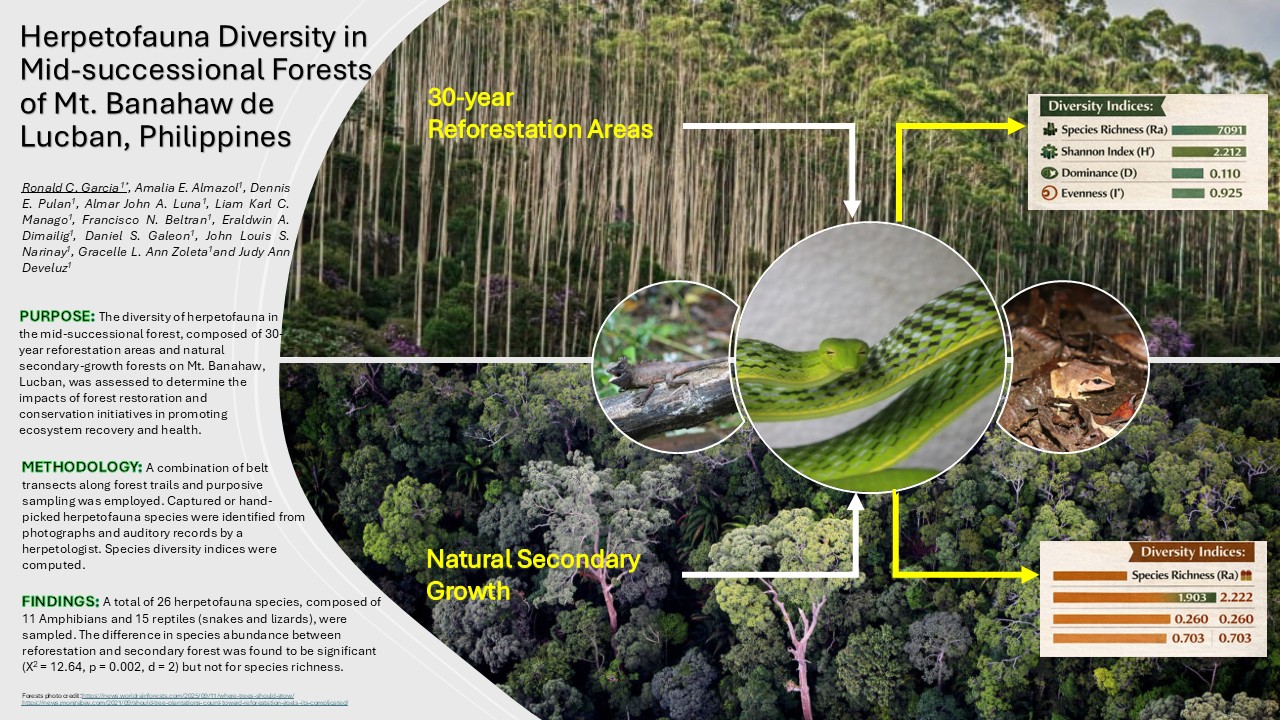
- Forest moth diversity is higher than in other zones (CCA)
- Moth-host plant relationship revealed by PCA
- Two polyphagous pests found in different zones
- Invasive weed dominates and affects moth diversity
ABSTRACT
Moths show a habitat preference for the Ranu Darungan Resort, a conservation area within Bromo Tengger Semeru National Park (BTSNP). The phenomena of Mount Semeru's eruption and anthropogenic activities can pose a threat, causing damage to primary and secondary forests, which leads to a reduction in vegetation cover and host plants. This research aims to analyze the structure of the moth community and identify potential host plants at the Ranu Darungan Resort. We documented ten moth species and thirty-eight plant species. Research has documented the wide host range of Conogethes punctiferalis (jungle zone) and Duponchelia sp. (utilization zone), which encompasses various agricultural and forestry plants. The data analysis indicates that the Jungle Zone has higher species diversity (Shannon-Wiener Index: 2.332) than the Utilization Zone (2.244). In contrast, the data show slightly higher species evenness in the Utilization Zone (1.05 vs. 1.03). Both zones demonstrate low dominance and high community similarity. Ageratina riparia, an invasive plant that spreads rapidly, dominates both habitats and can easily dominate new ones. Canonical Correspondence Analysis showed that Asota heliconia, Plodia sp., Conogethes punctiferalis, and Eacles sp. significantly correlate with soil moisture, light intensity, wind speed, and air humidity in the jungle habitat. Principal Component Analysis revealed a strong correlation between Clidema hirta, Crytococcoum patens, and Ageratina riparia in the same habitat. Our findings demonstrate that moth presence directly depends on the availability of potential host plants, highlighting the importance of plant diversity in sustaining moth species richness.
Downloads
Araujo ES, Benatto A, Rizzato FB, Poltronieri AS, Poitevin CG, Zawadneak MA, Pimentel IC. 2020. Combining biocontrol agents with different mechanisms of action to control Duponchelia fovealis, an invasive pest in South America. Crop Prot 134:105184. DOI: 10.1016/j.cropro.2020.105184 DOI: https://doi.org/10.1016/j.cropro.2020.105184
Arya MK, Chandra H, Bisht S, Fasuil F. 2021. Preliminary report on moth diversity in the landscape of Nandhaur Wildlife Sanctuary: Adding subset to lepidoptera insects of protected area network. Uttar Pradesh J Zool 42(15):12–22.
Ashton LA, Odell EH, Burwell CJ, Maunsell SC, Nakamura A, McDonald WJF, Kitching RL. 2016. Altitudinal patterns of moth diversity in tropical and subtropical Australian rainforests. Aust Ecol 41(2):197–208. DOI: 10.1111/aec.12309 DOI: https://doi.org/10.1111/aec.12309
Bala K, Sood AK, Pathania VS., Thakur S. 2018. Effect of plant nutrition in insect pest management: A review. J Pharmacogn Phytochem 7(4):2737–2742.
Borges RM, Somanathan H, Kelber A. 2016. Patterns and processes in nocturnal and crepuscular pollination services. Q rev biol 91(4):389–418. DOI: https://doi.org/10.1086/689481
Brzosko E, Bajguz A. 2019. Nectar composition in moth-pollinated Platanthera bifolia and P. chlorantha and its importance for reproductive success. Planta 250:263–279. DOI: 10.1007/s00425-019-03168-5 DOI: https://doi.org/10.1007/s00425-019-03168-5
Buxton MN, Hoare RJ, Broussard MA, Van Noort T, Fale GR, Nathan T, Pattemore DE. 2023. Moths as potential pollinators in avocado (Persea americana) orchards in temperate regions. NZ J Crop Hortic Sci 51(1):27–38. DOI: 10.1080/01140671.2021.1966480 DOI: https://doi.org/10.1080/01140671.2021.1966480
Chen GM, Chi H, Wang RC, Wang YP, Xu YY, Li XD, …, Zheng FQ. 2018. Demography and uncertainty of population growth of Conogethes punctiferalis (Lepidoptera: Crambidae) reared on five host plants with discussion on some life history statistics. J Econ Entomol 111(5):2143–2152. DOI: 10.1093/jee/toy202 DOI: https://doi.org/10.1093/jee/toy202
Chung DE, Kim HH, Kim MK, Lee KH, Park YH, Um IC. 2015. Effects of different Bombyx mori silkworm varieties on the structural characteristics and properties of silk. Int J Biol Macromol 79:943–951. DOI: 10.1016/j.ijbiomac.2015.06.012 DOI: https://doi.org/10.1016/j.ijbiomac.2015.06.012
Common IFB. 1990. Moths of Australia. Clayton (AU): CSIRO Publishing Australia. DOI: https://doi.org/10.1071/9780643101227
Conchou L, Anderson P, Birgersson G. 2017. Host plant species differentiation in a polyphagous moth: olfaction is enough. J Chem Ecol 43:794–805. DOI: 10.1007/s10886-017-0876-2 DOI: https://doi.org/10.1007/s10886-017-0876-2
Copeman SM, Frank SD. 2024. Profile of Duponchelia fovealis (Lepidoptera: Crambidae) as a greenhouse and nursery pest in the United States. J Integr Pest Manag 15(1):19. DOI: 10.1093/jipm/pmae011 DOI: https://doi.org/10.1093/jipm/pmae011
Cui J, Zhu SY, Bi R, Xu W, Gao Y, Shi SS. 2018. Effect of temperature on the development, survival, and fecundity of Heliothis viriplaca (Lepidoptera: Noctuidae). J Econo Entomol 111(4):1940–1946. DOI: 10.1093/jee/toy151 DOI: https://doi.org/10.1093/jee/toy151
Dantas J, Motta I, Vidal L, Bilio J, Pupe JM, Veiga A, …, Pujol-Luz JR. 2020. A comprehensive review of the coffee leaf miner Leucoptera coffeella (Lepidoptera: Lyonetiidae), with special regard to neotropical impacts, pest management and control. DOI: 10.20944/preprints202010.0629.v1 DOI: https://doi.org/10.20944/preprints202010.0629.v1
Dar AA, Jamal K. 2021. Moths as ecological indicators: A review. Munis Entomol Zool J 16 (2):830–836.
Da Silva DM, de Freitas Bueno A, dos Santos Stecca C, Andrade K, Neves PMOJ, de Oliveira MCN. 2017. Biology of Spodoptera eridania and Spodoptera cosmioides (Lepidoptera: Noctuidae) on different host plants. Florida Entomol 100(4):752–760. DOI: 10.1653/024.100.0423 DOI: https://doi.org/10.1653/024.100.0423
Delabye S, Maicher V, Sáfián S, Doležal J, Altman J, Janeček Š, …, Tropek R. 2021. Butterfly and moth communities differ in their response to habitat structure in rainforests of Mount Cameroon. Biotropica 53(2):567–580. DOI: 10.1111/btp.12900 DOI: https://doi.org/10.1111/btp.12900
De Menezes CW, Stein HB, Shilap AV, Carvalho GA, Tavares WD, Pereira AI, Zanuncio JC. 2019. First record of Duponchelia fovealis (Crambidae) as a pest of commercial crops of strawberry in Campo Das Vertentes, Minas Gerais, Brazil. J Lepidopt Soc 73(2):131–134. DOI: 10.18473/lepi.73i2.a8 DOI: https://doi.org/10.18473/lepi.73i2.a8
De Smedt P, Vangansbeke P, Bracke R, Schauwvliege W, Willems L, Mertens J, …, Müller J. 2019. Vertical stratification of moth communities in a deciduous forest in Belgium. Insect Conserv Divers 12(2):121–130. DOI: 10.1111/icad.12320. DOI: https://doi.org/10.1111/icad.12320
Du YL, Li J, Wang ZY. 2018. Research progress of Conogethes punctiferalis (Lepidoptera: Crambidae) in China. In Chakravarthy AK (Editor), The black spotted, yellow borer, Conogethes punctiferalis Guenée and allied species. p. 45–66. Singapore (SG): Springer Singapore. DOI: 10.1007/978-981-13-0390-6_5 DOI: https://doi.org/10.1007/978-981-13-0390-6_5
Ferracini C, Saitta V, Pogolotti C, Rollet I, Vertui F, Dovigo L. 2020. Monitoring and management of the pine processionary moth in the North-Western Italian Alps. For 11(12):1253. DOI: 10.3390/f11121253 DOI: https://doi.org/10.3390/f11121253
Friberg M, Schwind C, Thompson JN. 2016. Divergence in selection of host species and plant parts among populations of a phytophagous insect. Evol Ecol 30(4):723-737. DOI: 10.1007/s10682-016-9835-6 DOI: https://doi.org/10.1007/s10682-016-9835-6
Goftishu M, Assefa Y, Niba A, Fininsa C, Le Ru BP. 2018. Diversity and abundance of lepidopteran stem borers and their host plants in Ethiopia. J Appl Entomol 142(4):437-449. DOI: 10.1111/jen.12489 DOI: https://doi.org/10.1111/jen.12489
Gunathunga P, Dangalle CD, Pallewatta N. 2022. Diversity and habitat preferences of moths (Insecta: Lepidoptera) in Indikadamukalana, a lowland wet zone forest in Sri Lanka. J Trop For Environ 12:01. DOI: 10.31357/jtfe.v12i01.6109 DOI: https://doi.org/10.31357/jtfe.v12i01.6109
Guyot V, Castagneyrol B, Vialatte A, Deconchat M, Jactel H. 2016. Tree diversity reduces pest damage in mature forests across Europe. Biol Lett 12(4):20151037. DOI: 10.1098/rsbl.2015.1037 DOI: https://doi.org/10.1098/rsbl.2015.1037
Hadisusanto S, Purnomo P, Trijoko T, Reza A, Eprilurahman R, Yudha DS, …, Priyono DS. 2022. Biodiversity monitoring as a baseline for PROPER biodiversity protection program of PT. Geo Dipa Energi Dieng, Central Java, Indonesia. Biodivers 23:(9). DOI: 10.13057/biodiv/d230912 DOI: https://doi.org/10.13057/biodiv/d230912
Hammer O, Harper DAT, Ryan PD. 2001. PAST: Paleontological statistics software package for education and data analysis. Palaeontol Electron. Available from: http://palaeo-electronica.org/2001_1/past/issue1_01.htm.
He L, Liu Y, Guo J, Chang H, Wu K. 2022. Host plants and pollination regions for the long-distance migratory noctuid moth, Hadula trifolii Hufnagel in China. Ecol Evol 12(4):e8819. DOI: 10.1002/ece3.8819 DOI: https://doi.org/10.1002/ece3.8819
Holloway, J.D. 1987. The moths of Borneo, Part 3, Family Lasiocampidae, Eupterotidae, Bombycidae, Brahmaeidae, Saturniidae, Sphingidae. Kuala Lumpur (MY): Malayan Nature Society.
Jactel H, Moreira X, Castagneyrol B. 2021. Tree diversity and forest resistance to insect pests: patterns, mechanisms, and prospects. Annu Rev Entomol 66(1):277–296. DOI: 10.1146/annurev-ento-041720-075234 DOI: https://doi.org/10.1146/annurev-ento-041720-075234
Jaimes-Nino LM, Mörtter R, Brehm G. 2019. Diversity and trait patterns of moths at the edge of an Amazonian rainforest. J Insect Conserv 23(4):751–763. DOI: 10.1007/s10841-019-00168-4 DOI: https://doi.org/10.1007/s10841-019-00168-4
Jung, JK, Kwon HJ, Kim HS, Seo ST, Koh S. 2018. Fruit and leaf damage by Conogethes punctiferalis (Lepidoptera: Crambidae) and Acrocercops transecta (Lepidoptera: Gracillariidae) in walnut orchards. Korean J Appl Entomol 57(1):33–38.
Kadlec T, Štrobl M, Hanzelka J, Hejda M, Reif J. 2018. Differences in the community composition of nocturnal Lepidoptera between native and invaded forests are linked to the habitat structure. Biodiver Conserv 27(10):2661–2680. DOI: 10.1007/s10531-018-1560-8 DOI: https://doi.org/10.1007/s10531-018-1560-8
Karam R, Chong JH. 2019. Moths of Bukit Timah Nature Reserve, Singapore. Gardens’ Bulletin Singapore 71:317–330. DOI: 10.26492/gbs71(suppl.1).2019-012 DOI: https://doi.org/10.26492/gbs71(suppl.1).2019-12
Koffi D, Agboka K, Adjevi AK, Assogba K, Fening KO, Osae M, …, Nagoshi RN. 2021. Trapping Spodoptera frugiperda (Lepidoptera: Noctuidae) moths in different crop habitats in Togo and Ghana. J Econ Entomol 114(3):1138-1144. DOI: 10.1093/jee/toab048 DOI: https://doi.org/10.1093/jee/toab048
Kovács A, Hunyadi I, Fejes-Tóth A, Fejes-Tóth P, Hári K, Sipos K, …, Pénzes B. 2014. Behavioral and physiological study on the European pepper moth (Duponchelia fovealis, Zeller) host plant selection. Növényvédelem 50(8):357–364
Kusia ES, Borgemeister C, Khamis FM, Copeland RS, Tanga CM, Ombura FL, Subramanian S. 2021. Diversity, host plants and potential distribution of edible saturniid caterpillars in Kenya. Insects 12(7):600. DOI: 10.3390/insects12070600 DOI: https://doi.org/10.3390/insects12070600
La Cava S, Rijllo G, Zucco G, Innocenti S, Guasti M, Puletti N, …, Scalercio S. 2024. Moths in space: The below-canopy structure of forest drives abundance and mobility-related traits of moth communities. Sci Total Environ 921:171056. DOI: 10.1016/j.scitotenv.2024.171056 DOI: https://doi.org/10.1016/j.scitotenv.2024.171056
Leidinger J, Seibold S, Weisser WW, Lange M, Schall P, Türke M, Gossner MM. 2019. Effects of forest management on herbivorous insects in temperate Europe. For Ecol Manag 437:232–45. DOI: 10.1016/j.foreco.2019.01.013 DOI: https://doi.org/10.1016/j.foreco.2019.01.013
Li RT, Huang LQ, Dong JF, Wang CZ. 2020. A moth odorant receptor highly expressed in the ovipositor is involved in detecting host-plant volatiles. Elife 21(9):e53706. DOI: 10.7554/eLife.53706 DOI: https://doi.org/10.7554/eLife.53706
Lin CH, Pan QJ, Waqas MS, Liu TX. 2020. Morphological traits for sex identification of the oriental armyworm, Mythimna separata (Lepidoptera: Noctuidae). J Integr Agric 19(6):1458–1463. DOI: 10.1016/S2095-3119(19)62862-5 DOI: https://doi.org/10.1016/S2095-3119(19)62862-5
Maury HK, Purwadi MA, Ramandey ER, Bisai JR, Mauri BH. 2022. Keanekaragaman ngengat superfamily Bombicoidea: Eksplorasi Potensi Ulat Sutera di Dataran Rendah Kabupaten Jayapura [Bombycoidea moth diversity and the potential of silkworms in the lowlands of Jayapura Regency]. J Biol Papua 14(2):137–142. DOI: 10.31957/jbp.2352 DOI: https://doi.org/10.31957/jbp.2352
Milberg P, Bergman KO, Cronvall E, Eriksson ÅI, Glimskär A, Islamovic A, …, Westerberg L. 2016. Flower abundance and vegetation height as predictors for nectar-feeding insect occurrence in Swedish semi-natural grasslands. Agric Ecosyst Environ 230:47–54. DOI: 10.1016/j.agee.2016.05.029 DOI: https://doi.org/10.1016/j.agee.2016.05.029
Montañez-Reyna M, León-Cortés JL, Falcon-Brindis A. 2023. The diversity of moths (Erebidae: Arctiinae: Arctiini) from threatened mountain cloud forests in the Mesoamerican biodiversity hotspot. J Insect Conserv 27(1):141–54. DOI:10841-022-00448-6 DOI: https://doi.org/10.1007/s10841-022-00448-6
Moon MY, Kim SS, Lee DS, Yang HM, Park CW, Kim HS, Park YS. 2018. Effects of forest management practices on moth communities in a Japanese larch (Larix kaempferi (Lamb.) Carrière) plantation. For 9(9):574. DOI: 10.3390/f9090574 DOI: https://doi.org/10.3390/f9090574
Moreno C, Barbosa ÂS, Ferro VG. 2021. Abundance and richness of Arctiinae moths throughout the night in a Cerrado area. Biota Neotropica 21:e20201041. DOI: 10.1590/1676-0611-BN-2020-1041 DOI: https://doi.org/10.1590/1676-0611-bn-2020-1041
Muiruri EW, Barantal S, Iason GR, Salminen JP, Perez-Fernandez E, Koricheva J. 2019. Forest diversity effects on insect herbivores: Do leaf traits matter?. New Phytol 221(4):2250–2260. DOI: 10.1111/nph.15558 DOI: https://doi.org/10.1111/nph.15558
Orsucci M, Audiot P, Pommier A, Raynaud C, Ramora B, Zanetto A, …, Streiff R. 2016. Host specialization involving attraction, avoidance and performance, in two phytophagous moth species. J Evolut Biol 29(1):114–125. DOI: 10.1111/jeb.12766 DOI: https://doi.org/10.1111/jeb.12766
Pimienta MC, Koptur S. 2022. More than moths: Flower visitors of a night-blooming plant in south Florida pine rocklands, USA. Plants 11(20):2799. DOI: 10.3390/plants11202799 DOI: https://doi.org/10.3390/plants11202799
Rabl D, Gottsberger B, Brehm G, Hofhansl F, Fiedler K. 2020. Moth assemblages in Costa Rica rain forest mirror small-scale topographic heterogeneity. Biotropica 52(2):288–301. DOI: 10.1111/btp.12677 DOI: https://doi.org/10.1111/btp.12677
Robinson GS, Ackery PR, Kitching IJ, Beccaloni GW, Hernández LM. 2010. HOSTS – A Database of the World's Lepidopteran Hostplants.Natural History Museum, London. Available from: http://www.nhm.ac.uk/hosts
Roh HS, Park KC, Oh HW, Park CG. 2016. Morphology and distribution of antennal sensilla of two tortricid moths, Cydia pomonella and C. succedana (Lepidoptera). Microsc Res Tech 79(11):1069–1081. DOI: 10.1002/jemt.22747 DOI: https://doi.org/10.1002/jemt.22747
Root HT, Verschuyl J, Stokely T, Hammond P, Scherr MA, Betts MG. 2017. Plant diversity enhances moth diversity in an intensive forest management experiment. Ecol Appl 27(1):134–142. DOI: 10.1002/eap.1426 DOI: https://doi.org/10.1002/eap.1426
Sridhar V, Kriticos D, Nitin KS, Chakravarthy AK, Swathi P. 2018. Predicting potential global distribution of the black spotted yellow borer, Conogethes punctiferalis Guenée (Crambidae: Lepidoptera) by CLIMEX Modelling. In Chakravarthy AK (Editor), The Black spotted, Yellow Borer, Conogethes punctiferalis Guenée and Allied Species. p. 101–114. Singapore (SG): Springer Singapore. DOI: 10.1007/978-981-13-0390-6_9 DOI: https://doi.org/10.1007/978-981-13-0390-6_9
Sutrisno H, Darmawa S, Sundaiwati, Momo S. 2015. Moths of Gunung Halimun-Salak National Park. Part 2: Geometroidea & Drepanoidea. Jakarta (ID): LIPI Press.
Thom MD, Daniels J. 2017. Patterns of microhabitat and larval host-plant use by an imperiled butterfly in northern Florida. J Insect Conserv 21(1):39–52. DOI: 10.1007/s10841-016-9950-2 DOI: https://doi.org/10.1007/s10841-016-9950-2
Torres-Muros L, Hódar JA, Zamora R. 2017. Effect of habitat type and soil moisture on pupal stage of a Mediterranean forest pest (Thaumetopoea pityocampa). Agric For Entomol 19(2):130-138. DOI: 10.1111/afe.12188 DOI: https://doi.org/10.1111/afe.12188
Tyler T. 2020. Relationship between moth (night active Lepidoptera) diversity and vegetation characteristics in southern Sweden. J Insect Conserv 24(6):1005–1015. DOI: 10.1007/s10841-020-00270-y DOI: https://doi.org/10.1007/s10841-020-00270-y
Valente DM, Teston JA. 2024. Vertical stratification of Sphingidae moths (Lepidoptera: Bombycoidea: Sphingidae) in the Tapajós National Forest, Pará, Brazil. Zool (Curitiba) 41:e23008. DOI: 10.1590/S1984-4689.v41.e23008 DOI: https://doi.org/10.1590/s1984-4689.v41.e23008
Wagner DL, Fox R, Salcido DM, Dyer LA. 2021. A window to the world of global insect declines: Moth biodiversity trends are complex and heterogeneous. Proc Nat Acad Sci 118(2):e2002549117. DOI: 10.1073/pnas.200254911 DOI: https://doi.org/10.1073/pnas.2002549117
Walton RE, Sayer CD, Bennion H, Axmacher JC. 2020. Nocturnal pollinators strongly contribute to pollen transport of wild flowers in an agricultural landscape. Biol Lett 16(5):20190877. DOI: 10.1098/rsbl.2019.0877 DOI: https://doi.org/10.1098/rsbl.2019.0877
Zárate-Santana ZJ, Patino-Alonso MC, Sánchez-García AB, Galindo-Villardón P. 2021. Learning approaches and coping with academic stress for sustainability teaching: Connections through canonical correspondence analysis. Sustainability 13(2):852. DOI: 10.3390/su13020852 DOI: https://doi.org/10.3390/su13020852
Zborowski P, Edwards T. 2007. A Guide To Australian Moths. Clayton (AU): CSIRO Publishing Australia. DOI: https://doi.org/10.1071/9780643094642
Zellweger F, Baltensweiler A, Ginzler C, Roth T, Braunisch V, Bugmann H, Bollmann K. 2016. Environmental predictors of species richness in forest landscapes: abiotic factors versus vegetation structure. J Biogeogr 43(6):1080-1090. DOI: 10.1111/jbi.12696 DOI: https://doi.org/10.1111/jbi.12696
Copyright (c) 2026 Abdu Rohman, Wachju Subchan, Faqihul Birbik Hamdani, Jekti Prihatin, Doni Catur saputra

This work is licensed under a Creative Commons Attribution-NonCommercial-NoDerivatives 4.0 International License.
Authors who publish with this journal agree with the following terms:
- Authors retain copyright and grant the journal right of first publication, with the work 1 year after publication simultaneously licensed under a Creative Commons attribution-noncommerical-noderivates 4.0 International License that allows others to share, copy and redistribute the work in any medium or format, but only where the use is for non-commercial purposes and an acknowledgement of the work's authorship and initial publication in this journal is mentioned.
- Authors are able to enter into separate, additional contractual arrangements for the non-exclusive distribution of the journal's published version of the work (e.g., post it to an institutional repository or publish it in a book), with an acknowledgement of its initial publication in this journal.
- Authors are permitted and encouraged to post their work online (e.g., in institutional repositories or on their website) prior to and during the submission process, as it can lead to productive exchanges, as well as earlier and greater citation of published work (See The Effect of Open Access).