MICROSATELLITE-BASED GENETIC VARIATION IN Rhizophora apiculata AND Rhizophora mucronata FROM EAST KALIMANTAN

Downloads
ARTICLE HIGHLIGHTS
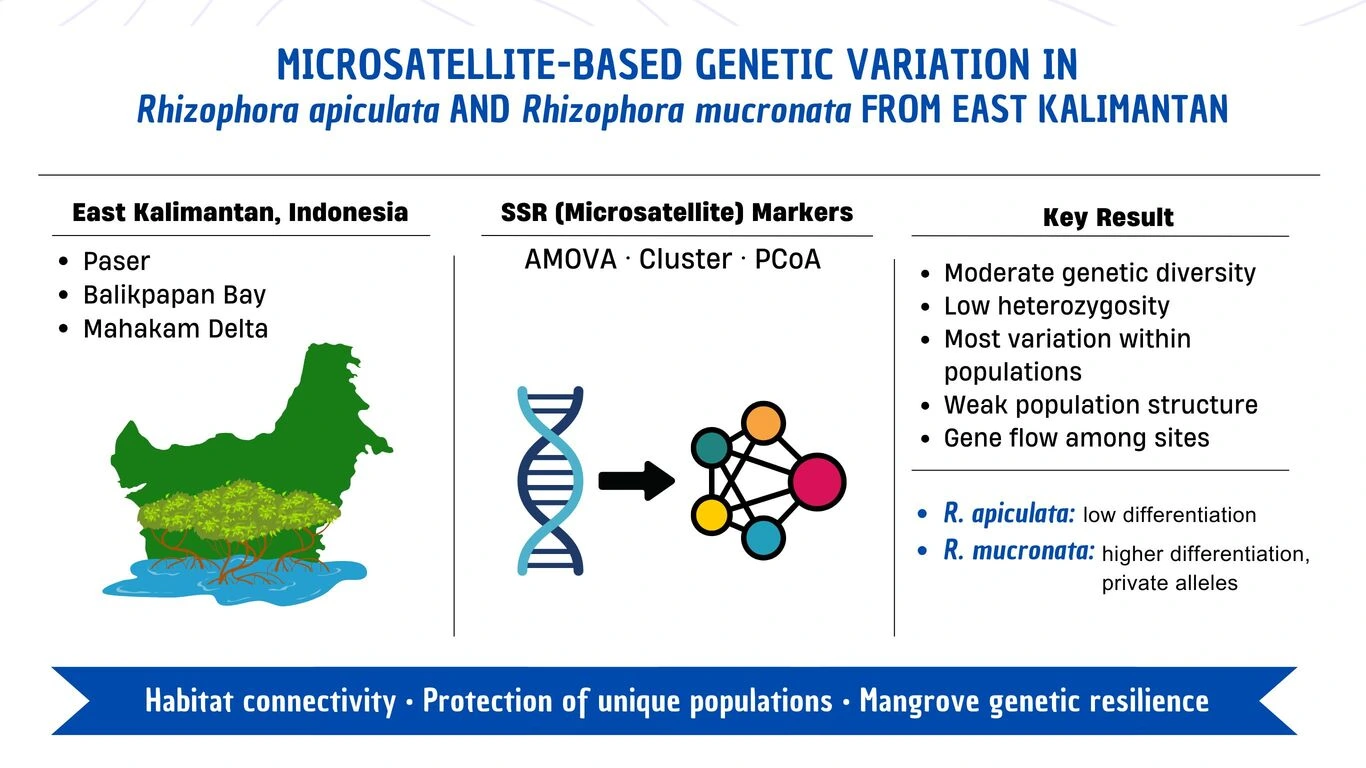
- Microsatellite markers were used to study population genetic variation in Rhizophora
- Molecular systematic analysis showed moderate genetic diversity with low heterozygosity
- Population genetic structure was dominated by within-population variation (AMOVA)
- Phenetic analyses revealed weak clustering among Rhizophora populations
- Genetic patterns supported connectivity within Rhizoporaceae populations in East Kalimantan
ABSTRACT
Mangroves of the family Rhizophoraceae are pantropical, with the genus Rhizophora forming a major component of tropical mangrove ecosystems. Rhizophora apiculata and Rhizophora mucronata are widely distributed in the Paser region, Balikpapan Bay, and the Mahakam Delta of East Kalimantan, Indonesia. This study examined genetic diversity and population structure of both Rhizophora species using simple sequence repeat (SSR) markers. The results showed moderate genetic diversity but relatively low heterozygosity in both species. Most genetic variation occurred within populations, as indicated by AMOVA, while R. apiculata exhibited lower genetic differentiation among populations and lacked private alleles, and R. mucronata showed higher population differentiation and possessed private alleles, suggesting localized genetic variation. Cluster and principal coordinate analyses revealed extensive overlap among populations for both species, indicating weak population structure and ongoing gene flow across the study area. Overall, the findings suggest that populations of R. apiculata and R. mucronata in East Kalimantan function as genetically connected units rather than as strongly differentiated populations. These results highlight the importance of maintaining habitat connectivity and protecting genetically unique populations to support the long-term resilience and sustainable management of mangrove genetic resources in East Kalimantan.
Aoki S, Fukasawa K. 2024. Kernel density estimation of allele frequency including undetected alleles. Peer J 12(4):1-15. DOI: 10.7717/peerj.17248. DOI: https://doi.org/10.7717/peerj.17248
Arifanti VB, Sidik F, Mulyanto B, Susilowati A, Wahyuni T, Subarno, Novita N. 2022. Challenges and strategies for sustainable mangrove management in Indonesia: A Review. Forests 13(5):1–18. DOI: 10.3390/f13050695. DOI: https://doi.org/10.3390/f13050695
Azman A, Ng KKS, Ng CH, Lee CT, Tnah LH, Zakaria NF, Lee SL. 2020. Low genetic diversity indicating the threatened status of Rhizophora apiculata (Rhizophoraceae) in Malaysia: Declined evolution meets habitat destruction. Sci Rep 10(1):1–12. DOI: 10.1038/s41598-020-76092-4. DOI: https://doi.org/10.1038/s41598-020-76092-4
[BPS] Badan Pusat Statistik. 2023. Luas penutupan lahan Indonesia di dalam dan di luar kawasan hutan tahun 2014–2022 menurut kelas (ribu ha) [Land cover area of Indonesia inside and outside forest zones in 2014–2022 by class (thousand ha)]. Jakarta (ID): Badan Pusat Statistik; [Internet] [cited 2024 Mar 20]. Available from: https://www.bps.go.id/id/statistics-table/1/MjA4NCMx/luas-penutupan-lahan-indonesia-di-dalam-dan-di-luar-kawasan-hutan-tahun-2014-2022-menurut-kelas--ribu-ha-.html
Canty SWJ, Kennedy JP, Fox G, Matterson K, González VL, Núñez-Vallecillo ML, Rowntree JK. 2022. Mangrove diversity is more than fringe deep. Sci Rep 12(1):1–10. DOI: 10.1038/s41598-022-05847-y. DOI: https://doi.org/10.1038/s41598-022-05847-y
Faradilla FA, Prihatini I, Suranto, Susilowati A. 2022. Genetic variation of Austropuccinia psidii in some species of Myrtaceae as host plants in Java, Indonesia based on Simple Sequence Repeats (SSR) Markers. Biodiversitas 23(1):256–263. DOI: 10.13057/biodiv/d230131. DOI: https://doi.org/10.13057/biodiv/d230131
Hoffmann AA, SgróCM. 2011. Climate change and evolutionary adaptation. Nature 470(7335):479–485. DOI: 10.1038/nature09670. DOI: https://doi.org/10.1038/nature09670
Islam MS, Lian C, Kameyama N, Wus B. Hogetsu T. 2004. Development of microsatellite markers in Rhizophora stylosa using a Dual- Suppression-Polymerase Chain Reaction Technique. Mol Ecol Notes 4:110-112. DOI: 10.1046/j.1471-8286.2003.00585.x. DOI: https://doi.org/10.1046/j.1471-8286.2003.00585.x
Kanaka KK, Sukhija N, Goli RC, Singh S, Ganguly I, Dixit SP, Malik AA. 2023. On the concepts and measures of diversity in the genomics era. Curr Plant Biol 33:100278. DOI: 10.1016/j.cpb.2023.100278. DOI: https://doi.org/10.1016/j.cpb.2023.100278
Kranke N. 2024. How phenograms and cladograms became molecular phylogenetic trees. J Hist Biol 57:423–443. DOI: 10.1007/s10739-024-09782-8. DOI: https://doi.org/10.1007/s10739-024-09782-8
Nurhati IS, Murdiyarso D. 2022. Strategi nasional pengelolaan ekosistem mangrove [National strategy for mangrove ecosystem management]. [Internet] [Accessed 2024 Mar 15]. Available from: https://www.cifor.org/knowledge/publication/879.
Petolescu C, Sarac I, Popescu S, Tenche-Constantinescu AM, Petrescu I, Camen D, Onisan E. 2024. Assessment of genetic diversity in alfalfa using DNA polymorphism analysis and statistical tools. Plants 13(20). DOI: 10.3390/plants13202853. DOI: https://doi.org/10.3390/plants13202853
Ribeiro DO, Vinson CC, Nascimento DSS, Mehlig U, Menezes MPM, Sampaio I, Silva MB. 2013. Isolation of microsatellite markers for the red mangrove, Rhizophora mangle (Rhizophoraceae). Appl Plant Sci 1(9):9–11. DOI: 10.3732/apps.1300003. DOI: https://doi.org/10.3732/apps.1300003
Richards DR, Friess DA. 2016. Rates and drivers of mangrove deforestation in Southeast Asia, 2000-2012. Proceedings of the National Academy of Sciences of the United States of America 113(2):344–349. DOI: 10.1073/pnas.1510272113. DOI: https://doi.org/10.1073/pnas.1510272113
Rosero-Galindo C, Gaitan-Solis E, Cárdenas-Henao H, Tohme J, Toro-Perea N. 2002. Polymorphic microsatellites in a mangrove species, Rhizophora mangle L. (Rhizophoraceae). Mol Ecol Notes 3(1):220–222. DOI: 10.1046/j.1471-8286. DOI: https://doi.org/10.1046/j.1471-8286.2002.00232.x
Ruang-areerate P, Naktang C, Khanbo S, Yundaeng C, U-thoomporn S, Kongkachana W, Pootakham W. 2023. Assessment of the genetic diversity and population structure of Rhizophora mucronata along coastal areas in Thailand. Biology 12(3):1–14. DOI: 10.3390/biology12030484. DOI: https://doi.org/10.3390/biology12030484
Salminah M, Alviya I. 2019. Efektivitas kebijakan pengelolaan mangrove [Effectiveness of mangrove management policy]. Jurnal Analisis Kebijakan Kehutanan 16(1):11–29. DOI: https://doi.org/10.20886/jakk.2019.16.1.11-29
Shinmura Y, Wee AK, Takayama K, Meenakshisundaram SH, Asakawa T, Onrizal, …, Kajita T. 2012. Isolation and characterization of 14 microsatellite markers for Rhizophora mucronata (Rhizophoraceae) and their population use in range-wide population studies. Conserv Genet Res 4(4):951–954. DOI: 10.1007/s12686-012-9681-y. DOI: https://doi.org/10.1007/s12686-012-9681-y
Szpiech ZA, Rosenberg NA. 2011. On the size distribution of private microsatellite alleles. Theor Popul Biol 80(2):100–113. DOI: 10.1016/j.tpb.2011.03.006. DOI: https://doi.org/10.1016/j.tpb.2011.03.006
Wee AKS, Mori GM, Lira CF, Núñez-Farfán J, Takayama K, Faulks L, Kajita T. 2019. The integration and application of genomic information in mangrove conservation. Conserv Biol 33(1):206–209. DOI: 10.1111/cobi.13140. DOI: https://doi.org/10.1111/cobi.13140
Wee AKS, Takayama K, Chua JL, Asakawa T, Meenakshisundaram SH, Onrizal, Kajita T. 2015. Genetic differentiation and phylogeography of partially sympatric species complex Rhizophora mucronata Lam. and R. stylosa Griff. using SSR markers. BMC Evol Biol 15:57. DOI: 10.1186/s12862-015-0331-3. DOI: https://doi.org/10.1186/s12862-015-0331-3
Yahya AF, Hyun JO, Lee JH, Kim YY, Lee KM, Hong KN, Kim SC. 2014. Genetic variation and population genetic structure of Rhizophora apiculata (Rhizophoraceae) in the greater Sunda Islands, Indonesia using microsatellite markers. J Plant Res 127(2):287–297. DOI: 10.1007/s10265-013-0613-z. DOI: https://doi.org/10.1007/s10265-013-0613-z
Yan YB, Duke NC, Sun M. 2016. Comparative analysis of the pattern of population genetic diversity in three Indo-West Pacific Rhizophora mangrove species. Front Plant Sci 7 (1434):1–17. DOI: 10.3389/fpls.2016.01434. DOI: https://doi.org/10.3389/fpls.2016.01434
Copyright (c) 2026 Adristi Shafa Widyasari, Abdul Razaq Chasani, Istiana Prihatini, Tri Atmoko, Mukhlisi, Burhanuddin Adman, Bina Swasta Sitepu

This work is licensed under a Creative Commons Attribution-NonCommercial-NoDerivatives 4.0 International License.
Authors who publish with this journal agree with the following terms:
- Authors retain copyright and grant the journal right of first publication, with the work 1 year after publication simultaneously licensed under a Creative Commons attribution-noncommerical-noderivates 4.0 International License that allows others to share, copy and redistribute the work in any medium or format, but only where the use is for non-commercial purposes and an acknowledgement of the work's authorship and initial publication in this journal is mentioned.
- Authors are able to enter into separate, additional contractual arrangements for the non-exclusive distribution of the journal's published version of the work (e.g., post it to an institutional repository or publish it in a book), with an acknowledgement of its initial publication in this journal.
- Authors are permitted and encouraged to post their work online (e.g., in institutional repositories or on their website) prior to and during the submission process, as it can lead to productive exchanges, as well as earlier and greater citation of published work (See The Effect of Open Access).