CHARACTERIZATION OF MICROBIAL DIVERSITY AND FATTY ACID COMPOSITION IN THE INTESTINE OF HEALTHY DOMESTIC DUCKS
MICROBIAL COMMUNITY AND FATTY ACIDS PROFILE IN DUCKS INTESTINE

Downloads
ARTICLE HIGLIGHTS
- Healthy duck gut shows rich bacterial diversity dominated by Firmicutes.
- Duck intestine is enriched in saturated fatty acids compared to the feed.
- Short chain fatty acids in duck intestine greatly exceed those in the feed.
- Genera Lactobacillus and Ruminococcus are key markers of duck gut health.
- Palmitic, stearic, and vaccenic acids emerge as major intestinal lipids.
ABSTRACT
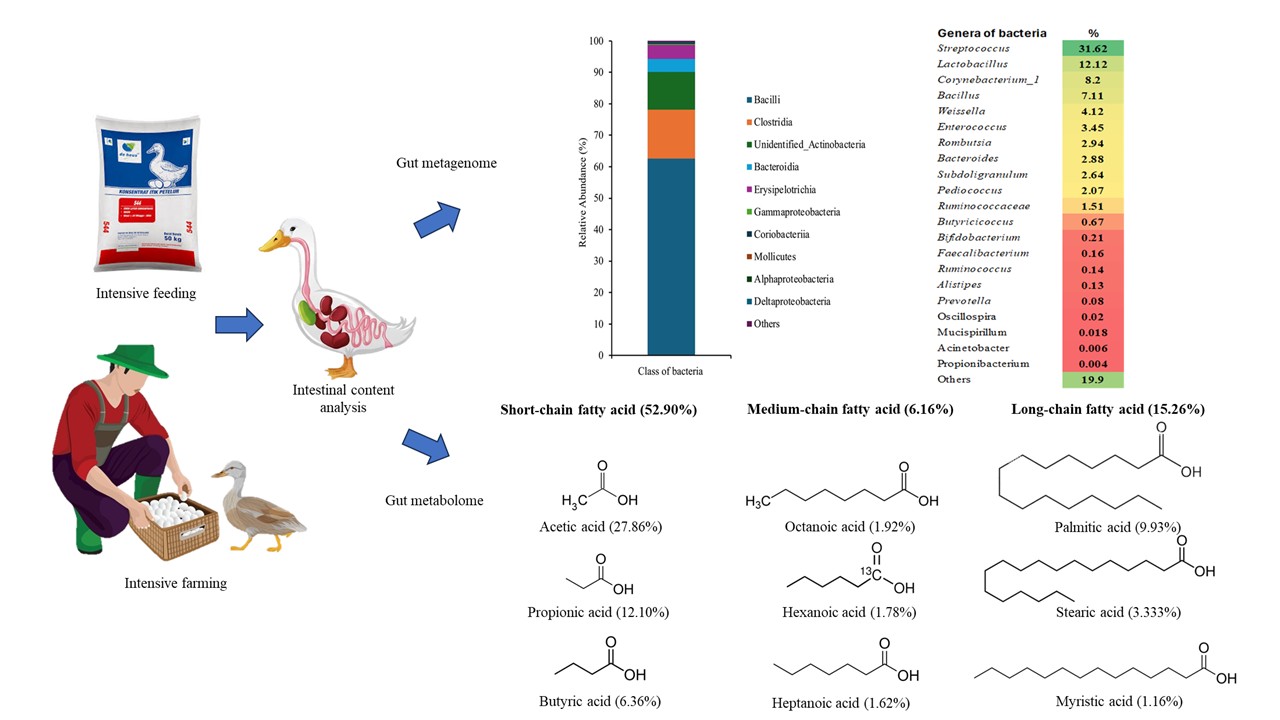
Fatty acids exhibit antibacterial properties and serve as metabolic substrates for intestinal bacteria, shaping the composition of the microbiota and the synthesis of microbial metabolites. This study aimed to analyze the duck intestinal microbiota community and its fatty acid profile. This study utilized 25 healthy domestic ducks (Anas platyrhynchos) sourced from an intensive laying farm in Central Java, Indonesia. An exploratory observational research design was employed to analyze data obtained from this study. The intestinal bacteria of duck samples were analyzed using Next-Generation Sequencing (NGS), and fatty acid components using Gas Chromatography–Mass Spectrometry (GC-MS). Duck feed samples were analyzed for nutritional composition using proximate analysis and fatty acid composition using GC-MS. The Simpson and Shannon indices revealed rich microbial diversity in the duck intestine. The abundance of bacteria was dominated by several phyla, such as Firmicutes (82.58%), Actinobacteria (12.25%), and Bacteroidetes (4.27%). The Firmicutes/Bacteroidetes ratio was 19.32, with the intestine containing greater proportion of saturated fatty acids (74.32%) compared to unsaturated fatty acids (33.62%). Additionally, the concentration of short-chain fatty acids (SCFAs) in the duck’s intestine was 15.72 times greater than that found in the feed. Microorganisms, including Bacteroides (2.88%), Faecalibacterium (0.16%), Prevotella (0.08%), Butyricicoccus (0.67%), Ruminococcus (2.2%), Oscillospira (0.02%), and Mucisspirillum (0.018%) are genera that produce SCFA. Bacteria capable of synthesizing medium-chain fatty acids (MCFA) were identified, namely Ruminococcaceae UGC-005 (1.85%) and Acinetobacter (0.005%). Bacteria producing saturated long-chain fatty acids (LCFA) were identified, namely Lactobacillus (12.12%), Prevotella (0.08%), and Alistipes (0.13%). Bacteria capable of producing polyunsaturated fatty acids (PUFA) metabolites including conjugated linoleic acid (CLA) and conjugated linolenic acid (CLnA) were identified, namely Propionibacterium (0.004%), Lactobacillus (12.12%), and Bifidobacterium (0.21%). In summary, the intestinal microbiota of healthy ducks exhibits considerable diversity and a high diversity index. Various bacterial genera contribute to the production of SCFA, MCFA, and LCFA, as well as the conversion of PUFA into CLA and CLnA metabolites. This baseline microbiota–fatty acid profile can guide microbiota-informed feed optimization and candidate probiotic selection to support SCFA production, gut health, and productivity, and it provides a reference for monitoring dysbiosis and evaluating dietary interventions in intensive duck production systems.
Ali Q, Ma S, La S, Guo Z, Liu B, Gao Z, …, Shi Y. 2022. Microbial short-chain fatty acids: A bridge between dietary fibers and poultry gut health-a review. Anim Biosci 35(10):1461. DOI: 10.5713/ab.21.0562 DOI: https://doi.org/10.5713/ab.21.0562
Angenent LT, Richter H, Buckel W, Spirito CM, Steinbusch KJ, Plugge CM, …, Hamelers HVM. 2016. Chain elongation with reactor microbiomes: open-culture biotechnology to produce biochemicals. Environ Sci Technol 50(6):2796-2810. DOI: 10.1021/acs.est.5b04847. DOI: https://doi.org/10.1021/acs.est.5b04847
Anitha M, Vijay-Kumar M, Sitaraman SV, Gewirtz AT, Srinivasan S. 2012. Gut microbial products regulate murine gastrointestinal motility via toll-like receptor 4 signaling. Gastroenterology 143: e1004 (1006–1016). DOI: 10.1053/j.gastro.2012.06.034. DOI: https://doi.org/10.1053/j.gastro.2012.06.034
AOAC International. 2016. Official methods of analysis of AOAC international. 20th Edition. Gaithersburg (US): AOAC International.
Basak S, Duttaroy AK. 2020. Conjugated linoleic acid and its beneficial effects in obesity, cardiovascular disease, and cancer. Nutrients 12(7):1913. DOI: 10.3390/nu12071913. DOI: https://doi.org/10.3390/nu12071913
Batta AK, Salen G, Batta P, Tint GS, Alberts DS, Earnest DL. 2002. Simultaneous quantitation of fatty acids, sterols and bile acids in human stool by capillary gas-liquid chromatography. J Chromatogr B Analyt Technol Biomed Life Sci 775(2):153–161. DOI: 10.1016/S1570-0232(02)00289-1. DOI: https://doi.org/10.1016/S1570-0232(02)00289-1
Bourdon C, Lelijveld N, Thompson D, Dalvi PS, Gonzales GB, Wang D, …, Nyirenda MJ. 2019. Metabolomics in plasma of Malawian children 7 years after surviving severe acute malnutrition: "ChroSAM" a cohort study. EBioMedicine 45:464–472. DOI: 10.1016/j.ebiom.2019.06.041. DOI: https://doi.org/10.1016/j.ebiom.2019.06.041
Bridgman SL, Azad MB, Field CJ, Haqq AM, Becker AB, Mandhane PJ, …, Kozyrskyj AL. 2017. Fecal short chain fatty acid variations by breastfeeding status in infants at 4 months: Differences in relative versus absolute concentrations. Front Nutr 4(11):1–12. DOI: 10.3389/fnut.2017.00011. DOI: https://doi.org/10.3389/fnut.2017.00011
Caballero-Flores G, Pickard JM, Núñez G. 2023. Microbiota-mediated colonization resistance: Mechanisms and regulation. Nat Rev Microb 21(6):347–360. DOI: 10.1038/s41579-022-00833-7 DOI: https://doi.org/10.1038/s41579-022-00833-7
Callahan BJ, Mcmurdie PJ, Rosen MJ, Han AW, Johnson AJA, Holman SP. 2016. DADA2: High-resolution sample inference from Illumina amplicon data. Nat Methods 13 (7):581–583. DOI: 10.1038/nmeth.3869. DOI: https://doi.org/10.1038/nmeth.3869
Caporaso JG, Kuczynski J, Stombaugh J, Bittinger K, Bushman FD, Costello EK, …, Knight R. 2010. QIIME allows analysis of high-throughput community sequencing data. Nat Methods 7(5):335–336. DOI: 10.1038/nmeth.f.303. DOI: https://doi.org/10.1038/nmeth.f.303
Chen J, Vitetta L. 2020. The role of butyrate in attenuating pathobiont-induced hyperinflammation. Immune Netw 20(2):e15(1–18). DOI: 10.3390/nu11051026. DOI: https://doi.org/10.4110/in.2020.20.e15
Chen J, Zhao KN, Vitetta L. 2019. Effects of intestinal microbial-elaborated butyrate on oncogenic signaling pathways. Nutrients 11(5):1026(1–26). DOI: 10.3390/nu11051026 DOI: https://doi.org/10.3390/nu11051026
Chen P, Torralba M, Tan J, Embree M, Zengler K, Starkel P, …, Schnabl B. 2015. Supplementation of saturated long-chain fatty acids maintains intestinal eubiosis and reduces ethanol-induced liver injury in mice. Gastroenterol 48(1):203–214.e16. DOI: 10.1053/j.gastro.2014.09.014. DOI: https://doi.org/10.1053/j.gastro.2014.09.014
Clavijo V, Morales T, Vives-Flores MJ, Muñoz AR. 2022. The gut microbiota of chickens in a commercial farm treated with a Salmonella phage cocktail. Sci Rep 12(1):991. DOI: 10.1038/s41598-021-04611-4. DOI: https://doi.org/10.1038/s41598-021-04679-6
Cotozzolo E, Cremonesi P, Curone G, Menchetti L, Riva F, Biscarini F, …, Brecchia G. 2020. Characterization of bacterial microbiota composition along the gastrointestinal tract in rabbits. Animals 11(1):31. DOI: 10.3390/ani11010031. DOI: https://doi.org/10.3390/ani11010031
DeSantis TZ, Hugenholtz P, Larsen N, Rojas M, Brodie EL, Keller K, …, Andersen GL. 2006. Greengenes, a chimera-checked 16S rRNA gene database and workbench compatible with ARB. Appl Environ Microbiol 72(2):5069–5072. DOI: 10.1128/AEM.03006-05. DOI: https://doi.org/10.1128/AEM.03006-05
Druart C, Neyrinck AM, Vlaeminck B, Fievez V, Cani PD, Delzenne NM. 2014. Role of the lower and upper intestine in the production and absorption of gut microbiota-derived PUFA metabolites. PLoS ONE 9(1):e87560. DOI: 10.1371/journal.pone.0087560. DOI: https://doi.org/10.1371/journal.pone.0087560
Eneroth P, Hellstrom K, Sjovall J. 1968. A method for quantitative determination of bile acid in human feces. Acta Chem Scand 22(6):1720–1744. DOI: 10.3891/acta.chem.scand.22-1729 DOI: https://doi.org/10.3891/acta.chem.scand.22-1729
Fu X, Liu Z, Zhu C, Mou H, Kong Q. 2019. Nondigestible carbohydrates, butyrate, and butyrate-producing bacteria. Crit Rev Food Sci Nutr 59: S130–S152. DOI: 10.1080/10408398.2018.1542587. DOI: https://doi.org/10.1080/10408398.2018.1542587
Gerard P. 2020. The crosstalk between the gut microbiota and lipids. OCL-Oilseeds and fats Crops and Lipids 27(70):1–7. DOI: 10.1051/ocl/2020070. DOI: https://doi.org/10.1051/ocl/2020070
Guo B, Li D, Zhou B, Jiang Y, Bai H, Zhang Y, …, Chen G. 2019. Comparative characterization of bacterial communities in geese consuming of different proportions of ryegrass. PLoS One 14(10):e0223445. DOI: 10.1371/journal.pone.0223445. DOI: https://doi.org/10.1371/journal.pone.0223445
Hao Y, Ji Z, Shen Z, Wu Y, Zhang B, Tang J, …, Xie M. 2021. Effects of total dietary fiber on cecal microbial community and intestinal morphology of growing White Pekin duck. Front Microbiol 12:727200. DOI: 10.3389/fmicb.2021.727200. DOI: https://doi.org/10.3389/fmicb.2021.727200
He J, Zhang P, Shen L, Niu L, Tan Y, Chen L, …, Zhu L. 2020. Short-chain fatty acids and their association with signalling pathways in inflammation, glucose and lipid metabolism. Int J Mol Sci 21(17):6356. DOI: 10.3390/ijms21176356. DOI: https://doi.org/10.3390/ijms21176356
Hodak CR, Bescucci DM, Shamash K, Kelly LC, Montina T, Savage PB, Inglis GD. 2023 Antimicrobial growth promoters altered the function but not the structure of enteric bacterial communities in broiler chicks ± microbiota transplantation. Animals 13(6):997. DOI: 10.3390/ani13060997. DOI: https://doi.org/10.3390/ani13060997
Holm JB, Humphrys MS, Robinson CK, Settles ML, Ott S, Fu L, …, Ravel J. 2019. Ultrahigh-throughput multiplexing and sequencing of >500 basepair amplicon regions on the illumina HiSeq 2500 platform. mSystems 4(1):e00029-19. DOI: 10.1128/mSystems.00029-19. DOI: https://doi.org/10.1128/msystems.00029-19
Hou J, Xiang J, Li D, Liu X, Pan W. 2022. Gut microbial response to host metabolic phenotypes. Front Nutr 9:1019430. DOI: 10.3389/fnut.2022.1019430. DOI: https://doi.org/10.3389/fnut.2022.1019430
Jackman JA, Yoon BK, Li D, Cho NJ. 2016. Nanotechnology formulations for antibacterial free fatty acids and monoglycerides. Molecules 21(3):305. DOI: 10.3390/molecules21030305. DOI: https://doi.org/10.3390/molecules21030305
Joseph J, Depp C, Shih PB, Cadenhead KS, Schmid-Schonbein G. 2017. Modified mediterranean diet for enrichment of short chain fatty acids: Potential adjunctive therapeutic to target immune and metabolic dysfunction in schizophrenia? Front Neurosci 11:155 (1–16). DOI: 10.3389/fnins.2017.00155. DOI: https://doi.org/10.3389/fnins.2017.00155
Jumpertz R, Le DS, Turnbaugh PJ, Trinidad C, Bogardus C, Gordon JI, Krakoff J. 2011. Energy-balance studies reveal associations between gut microbes, caloric load, and nutrient absorption in humans. Am J Clin Nutr 94(1):58–65. DOI: 10.3945/ajcn.110.010132. DOI: https://doi.org/10.3945/ajcn.110.010132
Kucek LA, Nguyen M, Angenent LT. 2016. Conversion of L-lactate into n-caproate by a continuously fed reactor microbiome. Water Res 93:163–171. DOI: 10.1016/j.watres.2016.02.018. DOI: https://doi.org/10.1016/j.watres.2016.02.018
Kulkarni HM, Jagannadham MV. 2014. Biogenesis and multifaceted roles of outer membrane vesicles from Gram-negative bacteria. Microbiol 160(Pt 10):2109–2121. DOI: 10.1099/mic.0.079400-0. DOI: https://doi.org/10.1099/mic.0.079400-0
Lajis AFB. 2020. Biomanufacturing process for the production of bacteriocins from Bacillaceae family. Bioresour Bioprocess 7(1):8. DOI: 10.1186/s40643-020-0295-z. DOI: https://doi.org/10.1186/s40643-020-0295-z
LeBlanc JG, Chain F, Martin R, Bermudez-Humaran LG, Courau S, Langella P. 2017. Beneficial effects on host energy metabolism of short-chain fatty acids and vitamins produced by commensal and probiotic bacteria. Microb Cell Fact 16(79):1–10. DOI: 10.1186/s12934-017-0691-z. DOI: https://doi.org/10.1186/s12934-017-0691-z
Lin J, Hunkapiller AA, Layton AC, Chang YJ, Robbins KR. 2013. Response of intestinal microbiota to antibiotic growth promoters in chickens. Foodborne Pathog Dis 10(4):331–337. DOI: 10.1089/fpd.2012.1348. DOI: https://doi.org/10.1089/fpd.2012.1348
Liu L, Li Q, Yang Y, Guo A. 2021. Biological function of short-chain fatty acids and its regulation on intestinal health of poultry. Front Vet Sci 8:736739. DOI: 10.3389/fvets.2021.736739. DOI: https://doi.org/10.3389/fvets.2021.736739
McDonald D, Price MN, Goodrich J, Nawrocki EP, DeSantis TZ, Probst A, … Hugenholtz P. 2012. An improved Greengenes taxonomy with explicit ranks for ecological and evolutionary analyses of bacteria and archaea. ISME J 6(3):610–-618. DOI: 10.1038/ismej.2011.139. DOI: https://doi.org/10.1038/ismej.2011.139
Magne F, Gotteland M, Gauthier L, Zazueta A, Pesoa S, Navarrete P, Balamurugan R. 2020. The Firmicutes/Bacteroidetes ratio: A relevant marker of gut dysbiosis in obese patients? Nutrients 12(5):1474. DOI: 10.3390/nu12051474. DOI: https://doi.org/10.3390/nu12051474
Maki KA, Diallo AF, Lockwood MB, Franks AT, Green SJ, Joseph PV. 2019. Considerations when designing a microbiome study: Implications for nursing science. Biol Res Nurs 21(2):125–141. DOI: 10.1177/1099800418811639. DOI: https://doi.org/10.1177/1099800418811639
Méndez-Salazar EO, Ortiz-López MG, de Los Ángeles Granados-Silvestre M, Palacios-González B, Menjivar M. 2018. Altered gut microbiota and compositional changes in Firmicutes and Proteobacteria in Mexican undernourished and obese children. Front Microbiol 9:2494. DOI: 10.3389/fmicb.2018.02494. DOI: https://doi.org/10.3389/fmicb.2018.02693
Miller EA, Winfield B, Weber BP, Flores-Figueroa C, Munoz-Aguayo J, Huisinga J, Johnson TJ. 2021. Convergence of the turkey gut microbiota following cohabitation under commercial settings. J Anim Sci Biotechnol 12(1):59(1–10). DOI: 10.1186/s40104-021-00580-4. DOI: https://doi.org/10.1186/s40104-021-00580-4
Nematbakhsh S, Pei CP, Selamat J, Nordin N, Idris LH, Razis AFA. 2021. Molecular regulation of lipogenesis, adipogenesis and fat deposition in chicken. Genes 12(3):414. DOI: 10.3390/genes12030414. DOI: https://doi.org/10.3390/genes12030414
Ohira H, Tsutsui W, Fujioka Y. 2017. Are short chain fatty acids in gut microbiota defensive players for inflammation and atherosclerosis? J Atheroscler Thromb 24(7):660–672. DOI: 10.5551/jat.RV17006. DOI: https://doi.org/10.5551/jat.RV17006
Oketch EO, Wickramasuriya SS, Oh S, Choi JS, Heo JM. 2023. Physiology of lipid digestion and absorption in poultry: An updated review on the supplementation of exogenous emulsifiers in broiler diets. J Anim Physiol Anim Nutr 107(6):1429–1443. DOI: 10.1111/jpn.13859. DOI: https://doi.org/10.1111/jpn.13859
Pham TPT, Raoult D, Million M. 2019. IGF1 levels in children with severe acute malnutrition after nutritional recovery: A good predictor for children's long-term health status. EBioMedicine 45:9–10. DOI: 10.1016/j.ebiom.2019.07.011. DOI: https://doi.org/10.1016/j.ebiom.2019.07.011
Ren Q, Yang B, Zhu G, Wang S, Fu C, Zhang H, …, Chen W. 2020. Antiproliferation activity and mechanism of c9, t11, c15-CLNA and t9, t11, c15-CLNA from Lactobacillus plantarum ZS2058 on colon cancer cells. Molecules 25(5):1225. DOI: 10.3390/molecules25051225. DOI: https://doi.org/10.3390/molecules25051225
Salsinha AS, Pimentel LL, Fontes AL, Gomes AM, Rodríguez-Alcalá LM. 2018. Microbial production of conjugated linoleic acid and conjugated linolenic acid relies on a multienzymatic system. Microbiol Mol Biol Rev 82(4):e00019-18. DOI: 10.1128/mmbr.00019-18. DOI: https://doi.org/10.1128/MMBR.00019-18
Schoeler M, Caesar R. 2019. Dietary lipids, gut microbiota and lipid metabolism. Rev Endocr Metab Disord 20(4):461–472. DOI: 10.1007/s11154-019-09512-0. DOI: https://doi.org/10.1007/s11154-019-09512-0
Schoeler M, Ellero-Simatos S, Birkner T, Mayneris-Perxachs J, Olsson L, Brolin H, …, Caesar RC. 2023. The interplay between dietary fatty acids and gut microbiota influences host metabolism and hepatic steatosis. Nat Com 14(1):5329. DOI: 10.1038/s41467-023-41074-3. DOI: https://doi.org/10.1038/s41467-023-41074-3
Schwechheimer C, Kuehn MJ. 2015. Outer-membrane vesicles from Gram-negative bacteria: biogenesis and functions. Nat Rev Microbiol 13(10):605–619. DOI: 10.1038/nrmicro3525. DOI: https://doi.org/10.1038/nrmicro3525
Shilling M, Matt L, Rubin E, Visitacion MP, Haller NA, Grey SF, Woolverton CJ. 2013. Antimicrobial effects of virgin coconut oil and its medium-chain fatty acids on Clostridium difficile. J Med Food 16(12):1079–1085. DOI: 10.1089/jmf.2012.0303. DOI: https://doi.org/10.1089/jmf.2012.0303
Sorbara MT, Dubin K, Littmann ER, Moody TU, Fontana E, Seok R, …, Pamer EG. 2019. Inhibiting antibiotic-resistant Enterobacteriaceae by microbiota-mediated intracellular acidification. J Exp Med 216(1):84–98. DOI: 10.1084/jem.20181639. DOI: https://doi.org/10.1084/jem.20181639
Susanti R, Christijanti W. 2022. Effects of production system on the gut microbiota diversity and IgA distribution of Kampong chickens, Indonesia. Biodiversitas 23(2):1082–1090. DOI: 10.13057/biodiv/d230252. DOI: https://doi.org/10.13057/biodiv/d230252
Susanti R, Christijanti W, Yuniastuti A. 2021. Immunohistochemical distribution of Immunoglobulin-A in relation to the intestinal microbiota of Cairina moschata (Muscovy) duck. J Phys Conf Ser 1918:052004. DOI: 10.1088/1742-6596/1918/5/052004. DOI: https://doi.org/10.1088/1742-6596/1918/5/052004
Susanti R, Yuniastuti A, Sasi FA, Dafip M. 2020. Metagenomic analysis of intestinal microbiota in geese from different farming systems in Gunungpati, Semarang. Indones J Biotechnol 25(2):76–83. DOI: 10.22146/ijbiotech.53936. DOI: https://doi.org/10.22146/ijbiotech.53936
Sychov MY. 2016. The digestibility of nutrients at different levels and sources of lipids in duck diets. Ukr J Ecol 6(1):361–374.
Szabó RT, Kovács-Weber M, Zimborán Á, Kovács L, Erdélyi M. 2023. Effects of short-and medium-chain fatty acids on production, meat quality, and microbial attributes—a review. Molecules 28(13):4956. DOI: 10.3390/molecules28134956. DOI: https://doi.org/10.3390/molecules28134956
Tafti ZSM, Moshiri A, Marvasti FE, Tarashi S, Khalili SFS, Motahhary A, …, Siadat SD. 2019. The effect of saturated and unsaturated fatty acids on the production of outer membrane vesicles from Bacteroides ragilis and Bacteroides thetaiotaomicron. Gastroenterol Hepatol Bed Bench 12(2):155–162.
Thaiss CA, Levy M, Korem T, Dohnalová L, Shapiro H, Jaitin DA, …, Elinav E. 2016. Microbiota diurnal rhythmicity programs host transcriptome oscillations. Cell 167(6):1495-1510.e12. DOI: 10.1016/j.cell.2016.11.003. DOI: https://doi.org/10.1016/j.cell.2016.11.003
Toral PG, Hervás G, Frutos, P. 2024. Invited review: Research on ruminal biohydrogenation-Achievements, gaps in knowledge, and future approaches from the perspective of dairy science. J Dairy Sci 107(12):10115–10140. DOI: 10.3168/jds.2023-24591 DOI: https://doi.org/10.3168/jds.2023-24591
van Zyl WF, Deane SM, Dicks LMT. 2020. Molecular insights into probiotic mechanisms of action employed against intestinal pathogenic bacteria. Gut Microbes 12(1):e1831339(1–25). DOI: 10.1080/19490976.2020.1831339. DOI: https://doi.org/10.1080/19490976.2020.1831339
Vital M, Howe AC, Tiedje JM. 2014. Revealing the bacterial butyrate synthesis pathways by analyzing (meta)genomic data. MBio 5(2):e00889. DOI: 10.1128/mBio.00889-14. DOI: https://doi.org/10.1128/mBio.00889-14
Wang H, Li X, Wang Y, Tao Y, Lu S, Zhu X, Li D. 2018a. Improvement of n-caproic acid production with Ruminococcaceae bacterium CPB6: Selection of electron acceptors and carbon sources and optimization of the culture medium. Microb Cell Fact 17(1):99–108. DOI: 10.1186/s12934-018-0946-3. DOI: https://doi.org/10.1186/s12934-018-0946-3
Wang Y, Li B, Dong H, Huang X, Chen R, Chen X, …, Zhang B. 2018b. Complete genome sequence of Clostridium kluyveri JZZ applied in Chinese strong-flavor liquor production. Curr Microbiol 75(11):1429–1433. DOI: 10.1007/s00284-018-1539-4. DOI: https://doi.org/10.1007/s00284-018-1539-4
Wei Y, Yang J, Wang J, Yang Y, Huang J, Gong H, …, Chen D. 2016. Successful treatment with fecal microbiota transplantation in patients with multiple organ dysfunction syndrome and diarrhea following severe sepsis. Crit Care 20(1):332. DOI: 10.1186/s13054-016-1491-2. DOI: https://doi.org/10.1186/s13054-016-1491-2
Wen C, Yan W, Sun C, Ji C, Zhou Q, Zhang D, …, Yang N. 2019. The gut microbiota is largely independent of host genetics in regulating fat deposition in chickens. ISME J 13 (6):1422–1436. DOI: 10.1038/s41396-019-0367-2. DOI: https://doi.org/10.1038/s41396-019-0367-2
Wessels AG. 2022. Influence of the gut microbiome on feed intake of farm animals. Microorganisms 10(7):1305. DOI: 10.3390/microorganisms10071305. DOI: https://doi.org/10.3390/microorganisms10071305
Wexler AG, Goodman AL. 2017. An insider’s perspective: Bacteroides as a window into the microbiome. Nat Microbiol 2:17026. DOI: 10.1038/nmicrobiol.2017.26. DOI: https://doi.org/10.1038/nmicrobiol.2017.26
Xiao X, Fu Z, Li N, Yang H, Wang W, Lyu W. 2021. Modulation of the intestinal microbiota by the early intervention with Clostridium butyricum in muscovy ducks. Antibiotics 10(7):826. DOI: 10.3390/antibiotics10070826. DOI: https://doi.org/10.3390/antibiotics10070826
Xie F, Xu L, Wang Y, Mao S. 2021. Metagenomic sequencing reveals that high-grain feeding alters the composition and metabolism of cecal microbiota and induces cecal mucosal injury in sheep. mSystems 6(5):e0091521. DOI: 10.1128/mSystems.00915-21. DOI: https://doi.org/10.1128/msystems.00915-21
Yang H, Xiao Y, Gui G, Li J, Wang J, Li D. 2018. Microbial community and short-chain fatty acid profile in gastrointestinal tract of goose. Poult Sci 97(4):1420–1428. DOI: 10.3382/ps/pex438. DOI: https://doi.org/10.3382/ps/pex438
Yang H, Lyu W, Lu L, Shi X, Li N, Wang W, Xiao Y. 2020. Biogeography of microbiome and short-chain fatty acids in the gastrointestinal tract of duck. Poult Sci 99(8):4016–4027. DOI: 10.1016/j.psj.2020.03.040. DOI: https://doi.org/10.1016/j.psj.2020.03.040
Yang J, Qin K, Sun Y, Yang X. 2024. Microbiota-accessible fiber activates short-chain fatty acid and bile acid metabolism to improve intestinal mucus barrier in broiler chickens. Microbiology Spectrum 12(1):e02065-23. DOI: 10.1128/spectrum.02065-23. DOI: https://doi.org/10.1128/spectrum.02065-23
Yang Q, Guo S, Lu Q, Tao Y, Zheng D, Zhou Q, Liu J. 2021. Butyryl/Caproyl-CoA:Acetate CoA-transferase: Cloning, expression and characterization of the key enzyme involved in medium-chain fatty acid biosynthesis. Biosci Rep 41(8):BSR20211135. DOI: 10.1042/BSR20211135. DOI: https://doi.org/10.1042/BSR20211135
Yang W, Yu T, Huang X, Bilotta AJ, Xu L, Lu Y, …, Cong Y. 2020. Intestinal microbiota-derived short-chain fatty acids regulation of immune cell IL-22 production and gut immunity. Nat Commun 11(1):4457. DOI: 10.1038/s41467-020-18262-6 DOI: https://doi.org/10.1038/s41467-020-18262-6
Yarza P, Yilmaz P, Pruesse E, Glöckner FO, Ludwig W, Schleifer KH, …, Rosselló-Móra R. 2014. Uniting the classification of cultured and uncultured bacteria and archaea using 16S rRNA gene sequences. Nat Rev Microbiol 12(9):635–645. DOI: 10.1038/nrmicro3330. DOI: https://doi.org/10.1038/nrmicro3330
Zhang J, Guo Z, Xue Z, Sun Z, Zhang M, Wang L, …, Zhang H. 2015. A phylo-functional core of gut microbiota in healthy young Chinese cohorts across lifestyles, geography and ethnicities. ISME J 9(9):1979–1990. DOI: 10.1038/ismej.2015.11. DOI: https://doi.org/10.1038/ismej.2015.11
Zhang WX, Tian G, Zhang KY, Bai SP, Ding XM, Wang JP, …, Zeng QF. 2025. Effects of dietary supplementation with oleic acid on growth performance, dietary fat utilization, serum and intestinal lipid metabolic parameters, and enterocyte lipid droplet metabolism in Pekin ducks. Poult Sci 104(5):105035. DOI: 10.1016/j.psj.2025.105035. DOI: https://doi.org/10.1016/j.psj.2025.105035
Zhao L, Huang Y, Lu L, Yang W, Huang T, Lin Z, …, Bian Z. 2018. Saturated long-chain fatty acid-producing bacteria contribute to enhanced colonic motility in rats. Microbiome 6:107. DOI: 10.1186/s40168-018-0492-6. DOI: https://doi.org/10.1186/s40168-018-0492-6
Zheng D, Liwinsk T, Elinav E. 2020. Interaction between microbiota and immunity in health and disease. Cell Res 30:492–506. DOI: 10.1038/s41422-020-0332-7. DOI: https://doi.org/10.1038/s41422-020-0332-7
Zhu X, Tao Y, Liang C, Li X, Wei N, Zhang W, …, Bo T. 2015. The synthesis of n-caproate from lactate: a new efficient process for medium-chain carboxylates production. Sci Rep 5:14360–14369. DOI: 10.1038/srep14360. DOI: https://doi.org/10.1038/srep14360
Zhu X, Zhou Y, Wang Y, Wu T, Li X, Li D, Tao Y. 2017. Production of high-concentration n-caproic acid from lactate through fermentation using a newly isolated Ruminococcaceae bacterium CPB6. Biotechnol Biofuels 10:102–114. DOI: 10.1186/s13068-017-0788-y. DOI: https://doi.org/10.1186/s13068-017-0788-y
Copyright (c) 2025 R Susanti, Nur Rahayu Utami, Muchamad Dafip

This work is licensed under a Creative Commons Attribution-NonCommercial-NoDerivatives 4.0 International License.
Authors who publish with this journal agree with the following terms:
- Authors retain copyright and grant the journal right of first publication, with the work 1 year after publication simultaneously licensed under a Creative Commons attribution-noncommerical-noderivates 4.0 International License that allows others to share, copy and redistribute the work in any medium or format, but only where the use is for non-commercial purposes and an acknowledgement of the work's authorship and initial publication in this journal is mentioned.
- Authors are able to enter into separate, additional contractual arrangements for the non-exclusive distribution of the journal's published version of the work (e.g., post it to an institutional repository or publish it in a book), with an acknowledgement of its initial publication in this journal.
- Authors are permitted and encouraged to post their work online (e.g., in institutional repositories or on their website) prior to and during the submission process, as it can lead to productive exchanges, as well as earlier and greater citation of published work (See The Effect of Open Access).