GENETIC CHARACTERISTICS OF LONG-TAILED PARAKEETS (Psittacula longicauda modesta Fraser, 1845) FROM ENGGANO ISLAND

ARTICLE HIGLIGHTS
- Genetic variation found in long-tailed parakeets native to Enggano Island
- Genetic information shows population differences among island parakeets
- Enggano Island population displays unique genetic characteristics
- Results support conservation efforts for long-tailed parakeets on Enggano Island
ABSTRACT
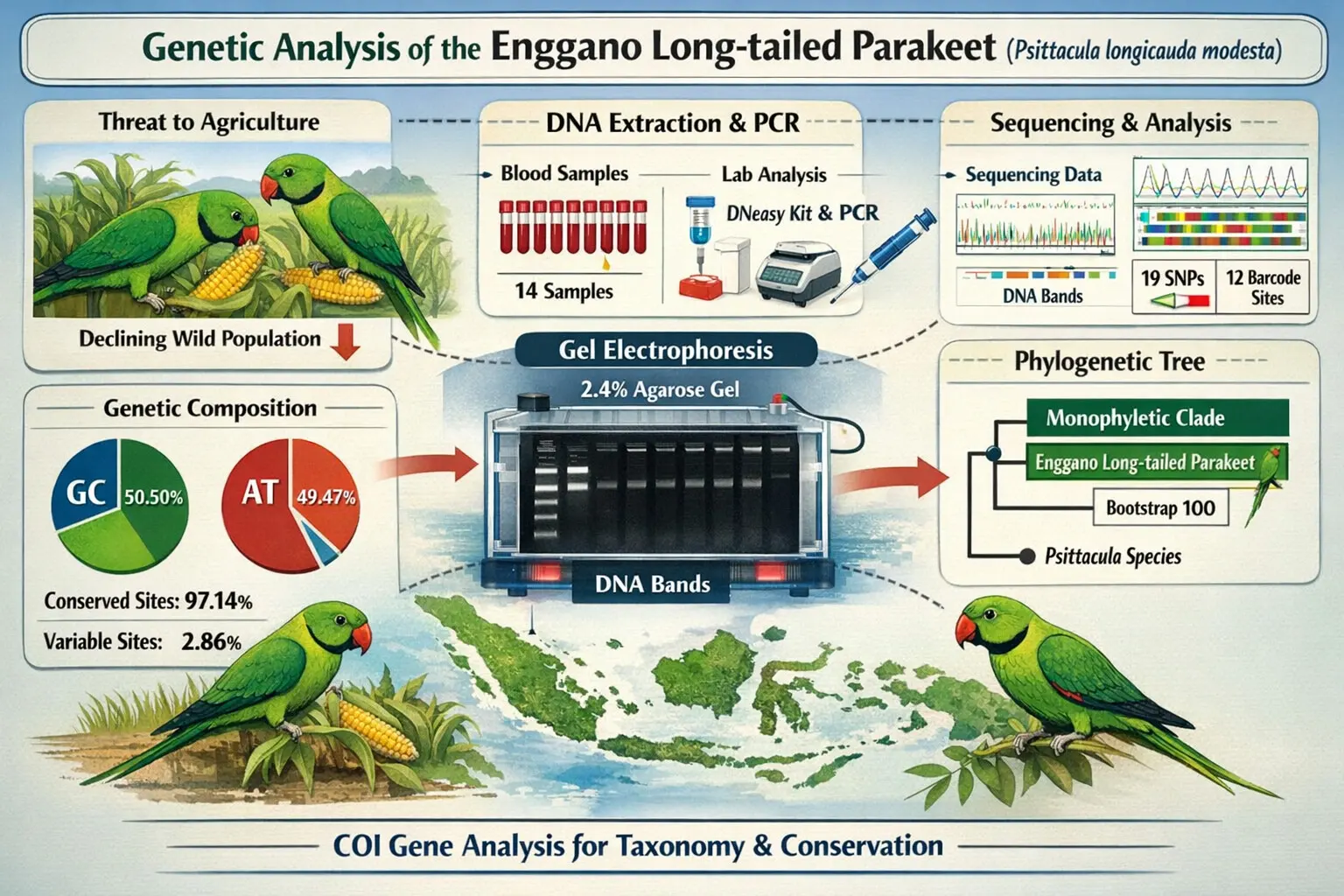
The Enggano Long-tailed Parakeet is considered as an agricultural pest by farmers on Enggano Island, leading to a continuing decline in its wild population. This study investigated the genetic characteristics, nucleotide composition, single-nucleotide polymorphisms (SNPs), species-specific barcodes, genetic distances, and phylogenetic relationships of this subspecies using the mitochondrial cytochrome oxidase subunit I (COI) gene. Fourteen blood samples were collected from community-owned captive birds. Total genomic DNA was extracted using the DNeasy® Blood and Tissue Kit following the Qiagen Spin-Column Protocol. DNA amplification was performed by Polymerase Chain Reaction (PCR) using specific primers at the Zoology Laboratory, Department of Biology, Faculty of Mathematics and Natural Sciences, University of Bengkulu. The amplified DNA was separated on a 2.4% agarose gel and visualized under ultraviolet light. Samples displaying clear DNA bands were subsequently sequenced by Apical Scientific. Sequence data were processed and aligned using MEGA version 11.0, resulting in a 665 bp COI fragment suitable for analysis. A total of 19 SNPs and 12 species-specific barcode sites were identified, indicating a distinct genetic signature in the Enggano population. Conserved sites were highly dominant (97.14%), while variable sites accounted for only 2.86%. Nucleotide composition analysis revealed a higher GC content (50.50%) than AT (49.47%). Genetic distance analysis showed 6 – 11.3% divergence between Psittacula longicauda modesta and other Psittacula species. Phylogenetic reconstruction placed all Enggano individuals in a well-supported monophyletic cluster (bootstrap value = 100), confirming their genetic separation from other parakeet species. These findings indicate low genetic diversity within the Enggano population, likely resulting from geographic isolation and small population size. The identified barcode sites underscore the strong diagnostic potential of the COI gene for molecular identification and taxonomic differentiation. Overall, this study establishes the first genetic baseline for Psittacula longicauda modesta, expands molecular resources available for the genus Psittacula, and provides valuable insights for conservation planning and taxonomic assessment of this endemic subspecies.
INTRODUCTION
The Long-tailed Parakeet (Psittacula longicauda) belongs to family Psittacidae (H.B.W., 2022). This species measures approximately 40 – 42 cm in body length and exhibits yellowish-green plumage on the upper and lower parts of the body, with additional coloration in specific regions, including bluish-purple (tail), pink (sides of the head), black (neck), and dark green (around the eyes). It inhabits mangrove forests, primary and secondary forests, forest edges, open woodlands, and oil palm plantations. Its diet consists mainly of various fruits, including berries, figs, and papayas (N.E.S.T., 2023).
In Indonesia, P. longicauda is protected under the Ministrial Regulation of the (Ministry of Environment and Forestry of the Republic of Indonesia, 2018) and is listed as Vulnerable by the IUCN (MyBIS, 2024). Despite its conservation status, the species is permitted for export under the Ministrial Regulation of the (Indonesia, 2018) and is included in CITES Appendix II (Indonesia, 2018). A 2015 expedition to Enggano Island confirmed the presence of the Long-tailed Parakeet (P. longicauda). The expedition identified the Long-tailed Parakeet as one of 14 endemic bird species on Enggano Island (Maryanto et al., n.d.).
The Enggano Long-tailed Parakeet is frequently hunted by local residents of Enggano Island and subsequently sold to other inhabitants or to fishermen from Java. These fishermen transport the birds directly to Java, such as Muara Angke (Jakarta) and Merak (Banten), making illegal capture and trade difficult for authorities to detect (Iqbal et al., 2020). Such activities have significantly contributed to the species population decline. Reduced population size increases the risk of extinction, beginning with the loss of genetic diversity (Willoughby et al., 2015). Therefore, conserving the Long-tailed Parakeet on Enggano Island is essential for maintaining ecological stability. Preliminary genetic studies are needed to assess its genetic diversity as an indicator of population health and persistence.
The COI gene is a widely used molecular marker due to its advantages, including maternal inheritance, absence of recombination, high copy number, and suitability for DNA barcoding(Imtiaz et al., 2017). The COI nucleotide sequence obtained in this study represents a novel genetic contribution, as no genetic data for the Long-tailed Parakeet (P. longicauda) are currently available in GenBank. This research aimed to characterize the species nucleotide characters, composition, codon usage, single nucleotide polymorphisms (SNPs), species-specific barcodes, genetic distances, and phylogenetic relationships.
MATERIALS AND METHODS
Sample Collection
Blood samples from 14 Enggano Long- tailed Parakeets (Psittacula longicauda modesta) were collected from four villages on Enggano Island: Kahyapu, Banjarsari, Kaana, and Meok. Sampling was conducted on 6 June 2023 and 12 June 2023. Blood was drawn from the pectoral vein at the base of the wing using a syringe, with approximately 0.5 – 1 mL collected from each individual and transferred into tubes containing EDTA (Jarulis & RH, 2021). After blood collection, the puncture site was cleaned with 76% alcohol to prevent infection and then covered with a sterile dressing. The 14 parakeets were subsequently given sugar water using a dropper. All blood samples were stored in a freezer at -20 °C (Lecce I et al., 2022). A total of 14 individuals were successfully sampled in this study.
The sample size obtained was influenced by ethical considerations, as Psittacula longicauda modesta is an endemic subspecies on Enggano Island, and excessive handling may increase stress and pose risks to the individuals. Therefore, only birds that could be safely accessed through local owners at the time of sampling were included. Additionally, a sample size of 10 – 20 individuals is commonly considered adequate for preliminary mitochondrial DNA analyses in Psittacidae. Thus, the 14 individuals sampled here are regarded as sufficiently representative for establishing a baseline assessment of the genetic characteristics of this subspecies. After blood collection, all birds were returned to their owners.
This research was conducted under ethical approval from the Research Ethics Committee, Institute for Research and Community Service, University of Bengkulu (Approval No. 107/ KER-LPPM/EC/2025). All sampling procedures followed institutional guidelines for the ethical treatment of animals and were designed to minimize stress to the birds. Molecular analyses were performed at the Zoology and Biotechnology Laboratory, Department of Biology, University of Bengkulu.
Isolation
Total DNA isolation was performed using the Dneasy® Blood Kit and Tissue Kit (catalog number 69504, 50 samples) following a modified Qiagen Spin-column Protocol. The quality and quantity of the isolated DNA were assessed using electrophoresis on a 1.2% agarose gel. The DNA samples were then stored at -20 °C in a freezer before amplification.
Amplification and Sequencing
The amplification of the COI gene was performed using the Polymerase Chain Reaction (PCR) procedure. Two primers, Forward and Reverse, were designed using the Primer 3 software, available online (accessible at http://bio-info.ut.ee/primer3-0.4.0/primer3). One pair of primers was named PLCOIF ( 5’- TATTCTCAACCAACCACAAAGACAT- 3’) and PLCOIR (5’-CAAAGAATCAGAAGAGGTGTTGGTA-3’). This study utilized the COI gene sequence from the mitochondrial genome of Psittacula alexandri (GenBank ID: NC_045378), a taxonomically related species to Psittacula longicauda, as the reference for primer design. The COI sequence used was 1548 bp in length, with a product size of 696 bp. Amplification was conducted using a SimpliAmp™ Thermal Cycler (Applied Biosystems).
The PCR reaction mixture (total volume of 25 μL) consisted of 12.5 μL of GoTaq® Green Master Mix 2X, 0.75 μL of forward primer, 0.75 μL of reverse primer, 1.5 μL of DNA template, and 9.5 μL of Nuclease-Free Water (ddH2O). The PCR cycling conditions for COI gene amplification were as follows: 95 °C for pre-denaturation (2 minutes), 95 °C for denaturation (1 minute), 58 °C for annealing (45 seconds), 72 °C for elongation (1 minute), 72 °C for post-elongation (5 minutes), and 4 °C for cooling. The denaturation-elongation cycle was repeated 30 times. PCR products (3 μL) were visualized using 2.4% agarose gel electrophoresis, and the results were documented using an ultraviolet transilluminator (λ=320 nm). High-quality DNA bands were sent to Apical
Scientific for sequencing.
Data Analysis
The nucleotide sequences obtained from sequencing were edited and aligned using ClustalW in the Molecular Evolutionary Genetics Analysis software (MEGA) version 11 (Tamura et al., 2021). Analyses of genetic characteristics, nucleotide composition, single nucleotide polymorphisms (SNPs), and species barcoding were also performed using MEGA version 11. The COI gene sequences were edited using BIOEDIT software version 7.0.9. All samples were successfully aligned, yielding a final sequence length of 665 bp.
The COI sequences from each individual were compared with sequences available in GenBank using the Basic Local Alignment Search Tool for nucleotides (BLASTn) to assess sequence similarity. Genetic distances among individuals were calculated using the Kimura 2-Parameter (K2P) model. Phylogenetic reconstruction was conducted using the Neighbor-Joining algorithm with the K2P model, and the robustness of the resulting tree was evaluated with 1000 bootstrap replications (Tamura et al., 2021).
Eight COI gene sequences from the genus Psittacula were retrieved from GenBank and used as reference sequences (P. cyanocephala NC_054153; P. cyanocephala MT433093; P. roseata NC_045379; P. roseata MK986661; P. echo OR240864; P. echo OR240830; P. alexandri NC_045378; P. alexandri MK986660). One COI gene sequence from another species in the family Psittacidae, Polytelis alexandrae (JQ175945), was included as the outgroup.
RESULTS AND DISCUSSION
COI Gene Band of the Enggano Long- Tailed Parakeets
This study utilized one of the mitochondrial genes, the COI gene. PCR visualization produced clear and distinct DNA bands Figure 1, indicating that the samples were suitable for sequencing to obtain the nucleotide composition of the COI gene.
Figure 1.Study location in mangroves ecosystem in Sekotong, West Lombok, West Nusa Tenggara, Indonesia
Based on the sequencing results, the lengths of the obtained COI sequences varied, with the forward sequences ranging from 670 to 673 base pairs (bp) and the reverse sequences ranging from 667 to 696 bp. The sequences were subsequently edited using BioEdit and MEGA 11, resulting in a final COI sequence length of 665 bp.
The agarose gel electrophoresis results were analyzed based on the position of the DNA bands after migration during electrophoresis. A DNA ladder was used as a reference to determine the fragment size corresponding to the expected target. The DNA bands displayed in the gel image confirm that the specific primers successfully annealed to the target mitochondrial DNA region. By comparing the band positions with the molecular marker, the length of the amplified fragments was verified.
The COI gene is located between nucleotide positions 5365 and 6912 of the avian mitochondrial genome (Li & Duan, 2019). Based on this information, the 665 bp COI sequence obtained in the present study represents 36.18% of the full COI gene length. This sequence corresponds to the early portion of the COI gene, specifically between nucleotide positions 20 and 715.
Nucleotide Character, Codon Position and Nucleotide Composition
The COI gene length of the Long-tailed Parakeets from Enggano was 665 bp Table 1.
| Character | n | Total Base | Number (%) |
|---|---|---|---|
| Conservative site (%) | 14 | 665 | 646 (97.14) |
| Parsimony site (%) | 14 | 665 | 10 (1.50) |
| Singleton site (%) | 14 | 665 | 9 (1.35) |
| Variable site (%) | 14 | 665 | 19 (2.86) |
| Codon position for thymine | 14 | 665 | |
| First codon | 14 | 665 | 12.6 |
| Second codon | 14 | 665 | 17.3 |
| Third codon | 14 | 665 | 42 |
| Codon position for cytosine | 14 | 665 | |
| First codon | 14 | 665 | 46 |
| Second codon | 14 | 665 | 27.4 |
| Third codon | 14 | 665 | 28.7 |
| Codon position for adenine | 14 | 665 | |
| First codon | 14 | 665 | 36.7 |
| Second codon | 14 | 665 | 24.9 |
| Third codon | 14 | 665 | 14.9 |
| Codon position for guanine | 14 | 665 | |
| First codon | 14 | 665 | 4.7 |
| Second codon | 14 | 665 | 30.3 |
| Third codon | 14 | 665 | 14.4 |
This sequence comprised 646 conserved sites (97.14%), 10 parsimony-informative sites (1.50%), and 9 singleton sites (1.35%). Thymine was the most common nucleotide in the third codon position (42%), while cytosine and adenine were predominant in the second codon position (46% and 36.7%, respectively). Guanine also showed a notable frequency in the second codon position (30.3%).
Compared with other species within the order Psittaciformes, this COI gene length is shorter than that of the green parakeet (Psittacara brevipes) from Socorro, which is 701 bp (Martínez-Gómez et al., 2017), but longer than the 625 bp reported for five Accipitridae species (Zein, 2018) and 32 Ardeidae species (Huang et al., 2016). The length obtained in this study falls within the typical range used for species identification, making it a valuable reference for Psittacula longicauda modesta.
Nucleotide composition analysis revealed that certain nucleotides dominate specific codon positions, such as thymine in the third position, cytosine in the first, and guanine in the second. These patterns may reflect mutation pressure and natural selection influencing codon usage. Previous studies of mitochondrial COI gene composition in various taxa have reported a predominance of cytosine and adenine exceeding 35% (Uddin et al., 2018). In this study, cytosine exhibited the highest proportion at 34.10%, while guanine showed the lowest at 16.50%; the GC content was 50.50%, and the AT content was 49.47% Table 2.
| Sample code | Thymine (T) | Cytosine (C) | Adenine (A) | Guanine (G) | GC content (%) | AT content (%) | Total base |
|---|---|---|---|---|---|---|---|
| PLCOI1 | 23.90 | 34.00 | 25.70 | 16.40 | 50.40 | 49.60 | 665 |
| PLCOI2 | 23.90 | 33.80 | 25.70 | 16.50 | 50.30 | 49.60 | 665 |
| PLCOI3 | 24.10 | 34.00 | 25.40 | 16.50 | 50.50 | 49.50 | 665 |
| PLCOI4 | 23.80 | 34.10 | 25.60 | 16.50 | 50.60 | 49.40 | 665 |
| PLCOI5 | 23.90 | 34.10 | 25.60 | 16.40 | 50.50 | 49.50 | 665 |
| PLCOI6 | 23.90 | 34.10 | 25.40 | 16.50 | 50.60 | 49.30 | 665 |
| PLCOI7 | 23.90 | 34.10 | 25.40 | 16.50 | 50.60 | 49.30 | 665 |
| PLCOI8 | 24.10 | 34.00 | 25.60 | 16.40 | 50.40 | 49.70 | 665 |
| PLCOI9 | 24.10 | 34.10 | 25.40 | 16.40 | 50.50 | 49.50 | 665 |
| PLCOI10 | 24.10 | 33.80 | 25.70 | 16.40 | 50.20 | 49.80 | 665 |
| PLCOI11 | 23.90 | 34.30 | 25.40 | 16.40 | 50.70 | 49.30 | 665 |
| PLCOI12 | 24.10 | 34.00 | 25.40 | 16.50 | 50.50 | 49.50 | 665 |
| PLCOI13 | 23.90 | 34.10 | 25.40 | 16.50 | 50.60 | 49.30 | 665 |
| PLCOI14 | 23.90 | 34.10 | 25.40 | 16.50 | 50.60 | 49.30 | 665 |
| Average | 24.00 | 34.10 | 25.50 | 16.50 | 50.50 | 49.47 | 665 |
This composition differs from several species within the same family (Psittacidae), where AT content commonly exceeds GC content. Examples include the nanday parakeet (Aratinga nenday) (AT: 54.03%, GC: 45.97%), Fischer’s lovebird (Agapornis fischeri) (AT: 51.1%, GC: 48.9%), and Lilian’s lovebird (Agapornis lilianae) (AT: 51.16%, GC: 48.84%) (Liu et al., 2019);(Liu et al., 2019); (Chen et al., 2019). Similarly, the Sandpiper family (Scolopacidae) exhibits a lower GC content (47.32%) relative to AT content (52.68%) (Huang & Tu, 2016).
Identification of Species Based on BLASTn (Nucleotide BLAST)
The identified species from the BLASTn results represents sequences used as references for comparison with the tested samples, originating from China Table 3.
| Species and Sample Code | Identified Species (Top 3) | BLASTnAccess code | Percent Identity (%) | Query cover (%) | Country of origin |
|---|---|---|---|---|---|
| P. longicauda 1 (PLCOI1) | Psittacula alexandri | NC_045378.1 | 94.84 | 100 | Dehong Wildlife Rescue Centre, China |
| P. longicauda 2 (PLCOI2) | Psittacula alexandri | NC_045378.1 | 94.20 | 98 | Dehong Wildlife Rescue Centre, China |
| P. longicauda 3 (PLCOI3) | Psittacula alexandri | NC_045378.1 | 94.69 | 100 | Dehong Wildlife Rescue Centre, China |
| P. longicauda 4 (PLCOI4) | Psittacula alexandri | NC_045378.1 | 94.26 | 100 | Dehong Wildlife Rescue Centre, China |
| P. longicauda 5 (PLCOI5) | Psittacula alexandri | NC_045378.1 | 94.27 | 100 | Dehong Wildlife Rescue Centre, China |
| P. longicauda 6 (PLCOI6) | Psittacula alexandri | NC_045378.1 | 94.56 | 100 | Dehong Wildlife Rescue Centre, China |
| P. longicauda 7 (PLCOI7) | Psittacula alexandri | NC_045378.1 | 94.43 | 100 | Dehong Wildlife Rescue Centre, China |
| P. longicauda 8 (PLCOI8) | Psittacula alexandri | NC_045378.1 | 94.42 | 100 | Dehong Wildlife Rescue Centre, China |
| P. longicauda 9 (PLCOI9) | Psittacula alexandri | NC_045378.1 | 94.70 | 100 | Dehong Wildlife Rescue Centre, China |
| P. longicauda 10 (PLCOI10) | Psittacula alexandri | NC_045378.1 | 94.70 | 100 | Dehong Wildlife Rescue Centre, China |
| P. longicauda 11 (PLCOI11) | Psittacula alexandri | NC_045378.1 | 94.13 | 100 | Dehong Wildlife Rescue Centre, China |
| P. longicauda 12 (PLCOI12) | Psittacula alexandri | NC_045378.1 | 94.44 | 100 | Dehong Wildlife Rescue Centre, China |
| P. longicauda 13 (PLCOI13) | Psittacula alexandri | NC_045378.1 | 94.20 | 98 | Dehong Wildlife Rescue Centre, China |
| P. longicauda 14 (PLCOI14) | Psittacula alexandri | NC_045378.1 | 94.29 | 100 | Dehong Wildlife Rescue Centre, China |
P. longicauda and P. alexandri, suggesting potential co-evolutionary patterns within neighboring Asian regions (Juniper & Parr, 1998). The BLASTn data further indicates that the reference specimens used for comparison are sourced from China, reflecting the international scope of the database, which comprises genetic information from diverse regions (Altschul et al., 1990).
It is important to emphasize that although the identified closest matches originate from these countries, this does not imply that the original specimens of P. longicauda are from those regions. Instead, they represent the available reference sequences within global databases. This identification highlights significant phylogenetic affinities between P. longicauda and P. alexandri, contributing to a deeper understanding of potential evolutionary relationships among Asian parakeet species.
Moreover, the geographic distribution of reference sequences underscores the importance of using globally curated databases to obtain accurate and meaningful results. Notably, no COI gene sequences of P. longicauda are currently available in GenBank, making the present sequence the first of its kind to be reported globally. This confirms that the analyzed sequence corresponds to P. longicauda, while sharing close genetic similarity with P. alexandri.
Single Nucleotide Polymorphism
A total of 19 single nucleotide polymorphisms (SNPs) were identified in the COI gene sequences of Long-tailed Parakeets from Enggano, occurring at nucleotide sites 5 – 12, 92, 331, and 654 – 663 Table 4 & 5. (Cendron et al., 2020);(Kyrkjeeide et al., 2020).
| Species | Sample code | Nucleotide site | ||||||||
|---|---|---|---|---|---|---|---|---|---|---|
| 5 | 6 | 7 | 8 | 10 | 11 | 12 | 92 | 331 | ||
| Psittacula longicauda modesta | PLCOI1K | T | A | T | A | G | A | A | C | A |
| P. l modesta | PLCOI2K | G | T | . | C | . | . | . | A | . |
| P. l modesta | PLCOI3K | . | . | . | T | . | . | . | . | G |
| P. l modesta | PLCOI4K | . | . | . | C | . | . | . | . | G |
| P. l modesta | PLCOI5K | . | . | . | C | C | T | G | A | . |
| P. l modesta | PLCOI6K | . | . | . | C | . | . | . | . | G |
| P. l modesta | PLCOI7K | . | . | . | C | . | . | . | . | G |
| P. l modesta | PLCOI8K | . | T | . | C | . | . | . | A | . |
| P. l modesta | PLCOI9K | . | T | . | C | . | . | . | . | . |
| P. l modesta | PLCOI10K | . | T | . | . | . | . | . | A | . |
| P. l modesta | PLCOI11KN | . | T | . | C | . | . | . | . | . |
| P. l modesta | PLCOI12KN | . | T | . | C | . | . | . | A | . |
| P. l modesta | PLCOI13M | . | . | . | T | . | . | . | . | G |
| P. l modesta | PLCOI14M | . | . | . | C | . | . | . | . | G |
| Species | Sample code | Nucleotide site | |||||||||
|---|---|---|---|---|---|---|---|---|---|---|---|
| 654 | 655 | 656 | 657 | 658 | 659 | 660 | 661 | 662 | 663 | ||
| Psittacula longicauda modesta | PLCOI2K | T | C | T | G | A | A | T | T | T | T |
| P. l modesta | PLCOI2K | C | T | G | A | . | . | . | . | T | . |
| P. l modesta | PLCOI3K | . | . | . | . | . | . | . | . | T | C |
| P. l modesta | PLCOI4K | . | . | . | . | . | . | A | A | T | C |
| P. l modesta | PLCOI5K | . | . | . | . | . | . | . | . | . | . |
| P. l modesta | PLCOI6K | . | . | . | . | . | . | . | . | T | C |
| P. l modesta | PLCOI7K | . | . | . | . | . | . | . | . | T | C |
| P. l modesta | PLCOI8K | . | . | . | . | . | . | . | . | . | . |
| P. l modesta | PLCOI9K | . | . | . | . | . | . | . | . | . | . |
| P. l modesta | PLCOI10K | . | . | . | . | . | . | . | . | . | . |
| P. l modesta | PLCOI11KN | . | . | G | A | . | T | . | C | . | . |
| P. l modesta | PLCOI12KN | . | . | . | . | G | . | . | . | . | . |
| P. l modesta | PLCOI13M | . | T | G | A | . | T | . | . | . | C |
| P. l modesta | PLCOI14M | . | . | . | . | . | . | . | . | C | |
Several nucleotide sites were conserved across all samples, indicated by dot symbols (.), suggesting functional or evolutionary constraints at these positions. SNP mapping, therefore, provides important insights into genetic variation and evolutionary processes within populations (JDRDS et al., 2017). The concentration of SNPs in the terminal regions of the COI gene suggests that these regions may be less conserved than the central portion of the gene. Reduced conservation allows the accumulation of mutations, particularly synonymous substitutions, without affecting the function of the encoded protein. As noted These SNPs were predominantly located toward the terminal regions of the COI gene. SNPs are important markers for monitoring genetic diversity, as low levels of variation may increase population vulnerability to threats such as disease outbreaks or environmental change. Consequently, SNP characterization in species such as Psittacula longicauda is valuable for assessing conservation status and understanding population structure (Xia et al., 2019). However, SNP markers generally exhibit lower polymorphism compared to simple sequence repeat (SSR) markers due to their bi- or triallelic nature by (Castle, 2011), mutations tend to accumulate in regions of the genome that are under weaker functional constraints, whereas highly conserved regions generally exhibit lower levels of genetic variation.
Species Barcode
The COI gene has been widely applied as a DNA barcode for species discrimination. In the present study, analysis of Long-tailed Parakeet (Psittacula longicauda) samples against various GenBank reference sequences identified twelve barcoding sites at positions 94, 97, 136, 226, 316, 451, 487, 502, 547, 556, 559, and 665 Table 6.
| Species | Nucleotide Sequence | |||||||||||
|---|---|---|---|---|---|---|---|---|---|---|---|---|
| 94 | 97 | 136 | 226 | 316 | 451 | 487 | 502 | 547 | 556 | 559 | 665 | |
| Psittacula longicauda 1 (PLCOI1_Enggano_ Indonesia) | G | G | T | G | G | T | T | T | C | G | C | T |
| Psittacula longicauda 2 (PLCOI2_Enggano_Indonesia) | G | G | T | G | G | T | T | T | C | G | C | T |
| Psittacula longicauda 3 (PLCOI3_Enggano_Indonesia) | G | G | T | G | G | T | T | T | C | G | C | T |
| Psittacula longicauda 4 (PLCOI4_Enggano_Indonesia) | G | G | T | G | G | T | T | T | C | G | C | T |
| Psittacula longicauda 5 (PLCOI5_Enggano_Indonesia) | G | G | T | G | G | T | T | T | C | G | C | T |
| Psittacula longicauda 6 (PLCOI6_Enggano_Indonesia) | G | G | T | G | G | T | T | T | C | G | C | T |
| Psittacula longicauda 7 (PLCOI7_Enggano_Indonesia) | G | G | T | G | G | T | T | T | C | G | C | T |
| Psittacula longicauda 8 (PLCOI8_Enggano_Indonesia) | G | G | T | G | G | T | T | T | C | G | C | T |
| Psittacula longicauda 9 (PLCOI9_Enggano_Indonesia) | G | G | T | G | G | T | T | T | C | G | C | T |
| Psittacula longicauda 10 (PLCOI10_Enggano_Indonesia) | G | G | T | G | G | T | T | T | C | G | C | T |
| Psittacula longicauda 11 (PLCOI11_Enggano_Indonesia) | G | G | T | G | G | T | T | T | C | G | C | T |
| Psittacula longicauda 12 (PLCOI12_Enggano_Indonesia) | G | G | T | G | G | T | T | T | C | G | C | T |
| Psittacula longicauda 13 (PLCOI13_Enggano_Indonesia) | G | G | T | G | G | T | T | T | C | G | C | T |
| Psittacula longicauda 14 (PLCOI14_Enggano_Indonesia) | G | G | T | G | G | T | T | T | C | G | C | T |
| Psittacula alexandri NC_045378 China | A | A | C | A | A | C | C | C | A | A | T | G |
| Psittacula alexandri MK986660 China | A | A | C | A | A | C | C | C | A | A | T | G |
| Psittacula echo OR240864 India | A | A | C | A | A | C | C | C | A | A | T | G |
| Psittacula echo OR240830 India | A | A | C | A | A | C | C | C | A | A | T | G |
| Psittacula cyanocephala NC_054153 India | A | A | C | A | A | C | C | C | A | A | T | G |
| Psittacula cyanocephala MT433093 India | A | A | C | A | A | C | C | C | A | A | T | G |
| Psittacula roseata NC_045379 China | A | A | C | A | A | C | C | C | A | A | T | G |
| Psittacula roseata MK986661 China | A | A | C | A | A | C | C | C | A | A | T | G |
These sites function as diagnostic markers that distinguish P. longicauda from Enggano from other Psittacula species worldwide, with guanine and thymine being the predominant nucleotides.
Notably, nucleotide substitutions at positions 94, 136, 226, and 316 differentiated P. longicauda from Indonesia from P. alexandri, P. echo, P. cyanocephala, and P. roseata originating from China and India. These nucleotide variations facilitated accurate species identification and were consistent with conserved mitochondrial regions commonly employed in DNA barcoding studies. Furthermore, DNA barcoding supports not only reliable species identification (Dimitriou et al., 2017) but also plays a crucial role in monitoring illegal wildlife trade and conserving endangered species (Gonçalves et al., 2015);(Tizard et al., 2019).
The Enggano population of P. longicauda exhibits unique genetic characteristics and may require targeted conservation efforts, as DNA barcoding can reveal genetic variations indicative of declining or threatened species (Li et al., 2014);(Li & Duan, 2019).
Based on the COI gene, the intrapopulation genetic distance of Psittacula longicauda modesta from Enggano (n = 14) showed a minimum value of 0.0%, a maximum of 1.8%, and an average of 0.9% Table 7. The minimum value of 0.0% indicates the presence of individuals with identical COI nucleotide sequences. Meanwhile, the maximum value of 1.8% is considered very low, suggesting minimal nucleotide variation within the population. These results indicate that the Enggano population is genetically homogeneous.
In contrast, the intragenus genetic distance ranged from 6.0% to 11.3%, with an average of 8.3%. Furthermore, the intrafamily genetic distance showed a minimum value of 10.4%, a maximum of 11.3%, and an average of 10.6%. Similar genetic distance patterns have been reported in previous studies, including those on the order Anseriformes (Sun et al., 2017). Based on interspecific genetic distance values, the species within the genus Psittacula most closely related to P. longicauda modesta is P. alexandri, while the most distantly related taxa are P. echo and Polytelis alexandrae. The observed interspecific genetic distances in this study meet commonly accepted criteria for species delineation Table 7.
The average genetic distance between Long- tailed Parakeet individuals (ingroup) and the pink- necked parakeet (Polytelis alexandrae), which belongs to the same family (Psittacidae), was 0.106 (10.6%) Table 7. This value is consistent with the findings of Hebert et al. (2004), who reported an average interspecific genetic distance of 7.93% and an average intraspecific genetic distance of 0.43%.
| Genetic distance | Maximum (%) | Minimum (%) | Average (%) |
|---|---|---|---|
| Intrapopulation (Enggano) | 1.8 | 0.0 | 0.9 |
| Intragenus (Psittacula spp) | 11.3 | 6.0 | 8.3 |
| Intrafamily (outgroup) | 11.3 | 10.4 | 10.7 |
| Genetic distance between P.l and P.a | 6.9 | 6 | 6.3 |
| Genetic distance between P.l and P.e | 11.3 | 10.1 | 10.5 |
| Genetic distance between P.l and P.c | 9.4 | 8.4 | 8.7 |
| Genetic distance between P.l and P.r | 8.5 | 7.5 | 7.8 |
| Genetic distance between P.l and P.al | 11.3 | 10.4 | 10.6 |
Genetic Distance
The intrapopulation and intragenus genetic distances of the Long-tailed Parakeet are presented in Table 7.
Phylogenetic
Phylogenetic reconstruction was performed using the Neighbor-Joining algorithm with the Kimura 2-parameter model and 1,000 bootstrap replicates, revealing a clear separation between the Long-tailed Parakeet and other Psittacula species Figure 2.
Figure 2.
The outgroup species, Polytelis alexandrae from Australia, did not cluster within any of the three groups (groups 1, 2, or 3) of the genus Psittacula. The phylogenetic tree further showed that the Enggano Long-tailed Parakeet population is divided into three nodes with bootstrap support values of 70, 32, and 38, respectively. Bootstrap values are commonly used to evaluate the reliability of clades in phylogenetic analyses (Horiike, 2016).
In addition, Psittacula alexandri appeared to be the species most closely related to the Enggano Long-tailed Parakeet population and was clearly separated from other Psittacula species within group three. This finding is consistent with (Braun et al., 2019), who reported that P. longicauda is the sister taxon to P. alexandri and P. derbiana. The COI-based phylogenetic tree constructed in this study provided insights into intraspecific differentiation among parakeet populations. Phylogenetic inference using COI gene sequences is considered reliable for resolving evolutionary relationships at the species level. The branches of the tree represent evolutionary relationships by tracing lineages back to their most recent common ancestors (Patwardhan et al., 2014); (Chen & Field, 2020);(Olsson & Alström, 2020).
This study successfully revealed previously unavailable genetic information on the Long- tailed Parakeet population from Enggano. The COI gene sequence identified in this study exhibited 12 nucleotide differences between the Enggano population and four other species within the genus Psittacula, representing a novel finding. Therefore, COI gene sequence may serve as an effective molecular marker for species identification. Moreover, this genetic information has practical applications for monitoring the trade of Long-tailed Parakeets, particularly for tracing the geographic origin of confiscated or captive individuals.
Low Genetic Diversity and Conservation Implications
The low genetic diversity observed in Psittacula longicauda modesta is reflected by the very small intrapopulation genetic distance (0.0 – 1.8%), the high proportion of conserved nucleotide sites (97.14%), and the limited number of SNPs detected in the COI gene. Such patterns are commonly reported in populations isolated on small islands, where restricted habitat size, dispersal barriers, and limited gene flow from external populations reduce the introduction of new haplotypes (Willoughby et al., 2015); (Vijay et al., 2017).
Similar conditions have been documented in other island-endemic bird species, such as the Norfolk parakeet Cyanoramphus cookii, which has experienced multiple population bottlenecks resulting in reduced genetic diversity and increased inbreeding due to small population size and long-term isolation (Genetic diversity and inbreeding in an endangered island-dwelling parrot population following repeated population bottlenecks, 2024). These findings suggest that island isolation and restricted gene flow are general drivers of declining genetic diversity in insular bird populations.
Several biological, ecological, and anthropogenic factors may contribute to the low genetic diversity observed in P. l. modesta. Enggano Island has a limited habitat area, which inherently constrains population size. In addition, pressures such as illegal capture, habitat modification, and human disturbance may further reduce effective population size and potentially induce genetic bottlenecks. Reduced genetic diversity associated with such factors has also been reported in other island-endemic birds, including the Seychelles Magpie-Robin, which exhibits extremely low mitochondrial variation due to a combination of island isolation and historical population declines (Cavill et al., 2022), and the Grenada Dove Leptotila wellsi, which shows low mtDNA diversity based on non-invasive sampling approaches (Peters et al., 2024). The high proportion of conserved sites in the COI sequences of P. l. modesta may indicate long-term population stability without the introduction of new genetic variation, or the influence of purifying selection acting to maintain functional mitochondrial regions.
From a conservation perspective, low genetic diversity has several important implications. Populations with limited genetic variation are more susceptible to inbreeding depression, which can negatively affect fitness, reproductive success, and resilience to environmental stress. Studies on C. cookii and L. wellsi demonstrate that island- endemic birds with low genetic diversity often exhibit reduced adaptive potential and heightened vulnerability to environmental change or emerging diseases. For island-endemic taxa such as P. l. modesta, these factors may collectively increase the long-term risk of population decline or eventual extinction if left unmanaged.
Taken together, these findings highlight the need for comprehensive conservation strategies, including habitat protection, strict enforcement against illegal capture and trade, and long-term monitoring of wild populations. Evidence from other island bird species emphasizes the importance of incorporating population genetic considerations into conservation planning, including the potential need to enhance gene flow or implement genetic management strategies to mitigate inbreeding.
CONCLUSION
This study provided the first genetic baseline for Psittacula longicauda modesta from Enggano Island through the characterization of a 665 bp COI gene fragment. The nucleotide character, nucleotide composition, nucleotide variation, and identified SNPs indicate that the Enggano population possesses COI gene characteristics unique to this island, while exhibiting low genetic diversity. Such reduced variability may reflect evolutionary pressures associated with geographic isolation, small population size, and habitat disturbance linked to human activities. These factors warrant attention in conservation planning, particularly as the species is increasingly regarded as an agricultural pest and its wild population continues to decline.
The identification of twelve species-specific barcode sites distinguishing P. l. modesta from other Psittacula species demonstrated the strong diagnostic utility of the COI gene and supported the application of COI gene as an effective marker for molecular identification, taxonomic refinement, and wildlife trade monitoring. Genetic distance analyses were consistent with taxonomic boundaries, together with the distinct clustering observed in the phylogenetic reconstruction, which further confirm that the Enggano population represents a discrete evolutionary lineage, likely shaped by long-term island isolation.
Overall, the findings of this study expand the available genetic resources for the genus Psittacula and provide a valuable foundation for future work on island evolution, population genetics, and evidence-based conservation strategies. The COI dataset generated in this study can contribute to clarifying the taxonomic status of P. l. modesta and informing targeted management efforts for this endemic Enggano population.
References
- Altschul S.F., Gish W., Miller W., Myers E.W., Lipman D.J.. Basic local alignment search tool. J Mol Biol. 1990; 215:403-410.
- Astuti D., Prijono S.N.. Diversity of the ornate lorikeet (Trichoglossus ornatus) birds based on mitochondrial DNA protein coding gene. J Biol Biol Educ. 2018; 10(2):465-471.
- Braun M.P., Datzmann T., Arndt T., Reinschmidt M., Schnitker H., Bahr N., Wink M.. A molecular phylogeny of the genus Psittacula sensu lato. 2019.
- Castle J.C.. SNPs occur in regions with less genomic sequence conservation. PLoSOne. 2011; 6(6)DOI
- Cavill E.L., Mak S.S.T., Accouche W., Jones G., Gopalakrishnan S., Fonseca R., Gilbert M.T.P.. Conservation genomics of the endangered Seychelles Magpie-Robin (Copsychus sechellarum): A unique insight into the history of a precious endemic bird. Ibis. 2022; 164:396-410.
- Cendron F., Perini F., Mastrangelo S., Tolone M., Criscione A., Bordonaro S., Cassandro M.. Genome-wide SNP analysis reveals the population structure and the conservation status of 23 italian chicken breeds. Animals. 2020; 10(1441)DOI
- Chen A., Field D.J.. Phylogenetic definitions for Caprimulgimorphae (Aves) and major constituent clades under the International Code of Phylogenetic Nomenclature. Vertebr Zool. 2020; 70(4):571-585.
- Chen Y.X., Zhou Y.W., Hou S.L., Huang Y.L.. Complete mitochondrial genome of Agapornis lilianae (Psittaciformes: Psittacidae), with its phylogenetic analysis. Mitochondrial DNA B Resour. 2019; 4(2):3536-3537. DOI
- Ornithology Cornell Lab. Long-tailed Parakeet (Psittacula longicauda). eBird. 2023. Publisher Full Text
- Lecce IJ Sudyka, DF Westneat, M Szulkin. Preserving avian blood and DNA sampled in the wild: A survey of personal experiences. Ecol Evol. 2022; 12(8)
- Dimitriou A.C., Forcina G., Papazoglou C., Panayides P., Guerrini M., Crabtree A., Sfenthourakis S.. DNA barcoding of bird species in Cyprus: A tool for conservation purposes. Bird Conserv Int. 2017; 27:483-494.
- Fahri. Photograph of Long-tailed Parakeet (Psittacula longicauda modesta. 2023.
- Genetic diversity and inbreeding in an endangered island-dwelling parrot population following repeated population bottlenecks. Conserv Genet. 2024; 25:725-737.
- Gonçalves P.F.M., Oliveira-Marques A.R., Matsumoto T.E., Miyaki C.Y.. DNA barcoding identifies illegal parrot trade. J Hered. 2015; 106(SI):560-564.
- H.B.W.. Handbook of the birds of the World and BirdLife International Digital Checklist of the Birds of the World. Birdlife International. 2022.
- Horiike T.. An introduction to molecular phylogenetic analysis. Rev Agric Sci. 2016; 4:36-45.
- Huang Z., Tu F.. DNA barcoding and phylogeny of Calidris and Tringa (Aves: Scolopacidae. Mitochondrial DNA A Resour. 2016; 28(4):616-619.
- Huang Z.H., Li M.F., Qin J.W.. DNA barcoding and phylogenetic relationships of Ardeidae. 2016.
- Imtiaz A., Nor S.A.M., Naim D.M.D.. Review: Progress and potential of DNA barcoding for species identification of fish species. Biodiversitas. 2017; 18(4):1394-1405.
- Iqbal M., Kuswanto A., Jarulis Rifki, I.. Notes on a visit to Enggano Island, Sumatra, Indonesia, in early 2020. BirdingASIA. 2020; 33:13-16.
- Jarulis Sari M.M., RH Wibowo. DNA barcode of mountain white-eye Zosterops montanus (Aves: Zosteropidae) based on mitochondrial DNA Cytochrome Oxidase Sub Unit I. Proceedings of the 3rd KOBI Congress, International and National Conferences. KOBICINC 2020. 2021;364-373. DOI
- Juniper T., Parr M.. Yale University Press: New Haven (US; 1998.
- Kyrkjeeide M.O., Westergaard K.B., Kleven O., Evju M., Endrestøl A., Brandrud M.K., Stabbetorp O.. Conserving on the edge: Genetic variation and structure in northern populations of the endangered plant Dracocephalum ruyschiana L. 2020.
- Li J., Cui Y., Jiang J., Yu J., Niu L., Deng J., Li J.. Applying DNA barcoding to conservation practice: A case study of endangered birds and large mammals in China. Biodivers Conserv. 2017; 26(3):653-668.
- Li S., Li B., Cheng C., Xiong Z., Liu Q., Lai J., Yan J.. Genomic signatures of near-extinction and rebirth of the crested ibis and other endangered bird species. Genome Biol. 2014; 15(557)
- Li Y., Duan Y.. Sequence and phylogenetic analysis of the mitochondrial genome for red-breasted parakeet Psittacula alexandri (Psittaciformes: Psittacidae. Mitochondrial DNA Part B: Resources. 2019; 4(2):3614-3615.
- Liu D.W., Pan Y., Zhou Y.W., Hou S.L.. Complete mitochondrial genome sequence of Nanday Conure, Aratinga nenday (Psittaciformes: Psittacidae. Mitochondrial DNA B Resour. 2019; 4(2):3348-3349.
- Liu H., Jin K., Li L.. The complete mitochondrial genome of the fischer’s lovebird Agapornis fischeri (Psittaciformes: Psittacidae. Mitochondrial DNA B Resour. 2019; 4(1):1217-1218.
- Martínez-Gómez J.E., Matías-Ferrer N., Escalante-Pliego P.. Phylogeny and taxonomy of the Socorro parakeet (Psittacara holochlorus brevipes): Recent speciation with minor morphological differentiation. J Ornithol. 2017; 158(4):965-978.
- Maryanto I., Hamidy A., Keim A.P., Sihotang V.B.L., Lupiyaningdyah P., Irham M., Ardiyani.In: M.. 2017. Ekspedisi Pulau Enggano [Expedition to Enggano Island. LIPI Press: LIPI Press.
- Kementerian Lingkungan Hidup dan Kehutanan Republik Indonesia: Jakarta (ID; 2018.
- Indonesia Ministry. Peraturan Menteri Perdagangan Republik Indonesia Nomor 122 Tahun 2018 Tentang Ketentuan Ekspor Tumbuhan Alam Dan Satwa Liar Yang Tidak Dilindungi Undang-Undang dan Termasuk Dalam Daftar Cites. 2018.
- MyBIS. Psittacula longicauda (Long-Tailed Parakeet. Malaysia Biodiversity Information System. 2024. Publisher Full Text
- N.E.S.T.. Common Birds of Malaysia: A Pocket Field Guide Book. 2023.
- JDRDS Nunes, S Liu, F Pértille, CA Perazza, PMS Villela. Large-scale SNP discovery and construction of a high-density genetic map of Colossoma macropomum through genotyping-by-sequencing. Sci Rep. 2017; 7(1)
- Olsson U., Alström P.. A comprehensive phylogeny and taxonomic evaluation of the waxbills (Aves: Estrildidae. Mol Phylogenet Evol. 2020; 146(106757)
- Patwardhan A., Ray S., Roy A.. Molecular markers in phylogenetic studies-A Review. J Phylogenet Evol Biol. 2014; 2(2)
- Peters C., Geary M., Hosie C., Nelson H., Rusk B., Muir A.. Non-invasive sampling reveals low mitochondrial genetic diversity for an island endemic species: The critically endangered grenada dove (Leptotila wellsi. Ecol Evol. 2024; 13(2)
- Sun Z., Pan T., Hu C., Sun L., Ding H., Wang H., Zhang C., Jin H., Chang Q., Kan X., Zhang B.. Rapid and recent diversification patterns in anseriformes birds: Inferred from molecular phylogeny and diversification analyses. PLoSOne. 2017; 12(9)DOI
- Tamura K., Stecher G., Kumar S.. MEGA 11: Molecular Evolutionary Genetics Analysis Version 11. Mol Biol Evol. 2021; 38(7):3022-3027.
- Tizard J., Patel S., Waugh J., Tavares E., Bergmann T., Gill B., Millar C.. DNA barcoding a unique avifauna: An important tool for evolution, systematics and conservation. BMC Evol Biol. 2019; 19(1)
- Uddin A., Mazumder T.H., Chakraborty S.. Understanding molecular biology of codon usage in mitochondrial complex IV genes of electron transport system: Relevance to mitochondrial diseases. J Cell Physiol. 2018; 234(5):6397-6413.
- Vijay N., Weissensteiner M., Burri R., Kawakami T., Ellegren H., Wolf J.B.W.. Genomewide patterns of variation in genetic diversity are shared among populations, species and higher‐order taxa. Mol Ecol. 2017; 26(16):4284-4295.
- Willoughby Sundaram, M Wijayawardena, BK Kimble, SJA Ji, Y Fernandez, NB Dewoody, J.A.. The reduction of genetic diversity in threatened vertebrates and new recommendations regarding IUCN conservation rankings. Biol Conserv. 2015; 191:495-503. DOI
- Xia W., Luo T., Zhang W., Mason A.S., Huang D., Huang X., Xiao Y.. Development of high-density SNP markers and their application in evaluating genetic diversity and population structure in Elaeis guineensis. Front Plant Sci. 2019; 10(130)
- Zein M.S.A.. Barkoding DNA burung elang (Famili Accipitridae) di Indonesia [DNA barcoding of the eagle (Family Accipitridae) in Indonesia. Berita Biologi. 2018; 17(2):165-173.
Altschul SF, Gish W, Miller W, Myers EW, Lipman DJ. 1990. Basic local alignment search tool. J Mol Biol 215:403–410. DOI: https://doi.org/10.1016/S0022-2836(05)80360-2
Astuti D, Prijono SN. 2018. Diversity of the ornate lorikeet (Trichoglossus ornatus) birds based on mitochondrial DNA protein coding gene. J Biol Biol Educ 10(2):465–471. DOI: https://doi.org/10.15294/biosaintifika.v10i2.13501
Braun MP, Datzmann T, Arndt T, Reinschmidt M, Schnitker H, Bahr N, ... Wink M. 2019. A molecular phylogeny of the genus Psittacula sensu lato (Aves: Psittaciformes: Psittacidae: Psittacula, Psittinus, Tanygnathus, †Mascarinus) with taxonomic implications. Zootaxa 4563(3):547–562. DOI: https://doi.org/10.11646/zootaxa.4563.3.8
Castle JC. 2011. SNPs occur in regions with less genomic sequence conservation. PLoSOne 6(6):e20660. DOI: 10.1371/journal.pone.0020660. DOI: https://doi.org/10.1371/journal.pone.0020660
Cavill EL, Mak SST, Accouche W, Jones G, Gopalakrishnan S, da Fonseca R, ... Gilbert MTP. 2022. Conservation genomics of the endangered Seychelles Magpie-Robin (Copsychus sechellarum): A unique insight into the history of a precious endemic bird. Ibis 164:396–410. DOI: https://doi.org/10.1111/ibi.13023
Cendron F, Perini F, Mastrangelo S, Tolone M, Criscione A, Bordonaro S, ... Cassandro M, 2020. Genome-wide SNP analysis reveals the population structure and the conservation status of 23 italian chicken breeds. Animals 10:1441. DOI: 10.3390/ani10081441 DOI: https://doi.org/10.3390/ani10081441
Chen A, Field DJ. 2020. Phylogenetic definitions for Caprimulgimorphae (Aves) and major constituent clades under the International Code of Phylogenetic Nomenclature. Vertebr Zool 70 (4):571–585.
Chen YX, Zhou YW, Hou SL, Huang YL. 2019. Complete mitochondrial genome of Agapornis lilianae (Psittaciformes: Psittacidae), with its phylogenetic analysis. Mitochondrial DNA B Resour 4(2):3536–3537. DOI: 10.1080/23802359.2019.1675552 DOI: https://doi.org/10.1080/23802359.2019.1675552
Cornell Lab of Ornithology. 2023. Long-tailed Parakeet (Psittacula longicauda). eBird. [Internet]. [Accessed: 15 January 2024]. Available from: https://ebird.org/species/lotpar2
Di Lecce I, Sudyka J, Westneat DF, Szulkin M. 2022. Preserving avian blood and DNA sampled in the wild: A survey of personal experiences. Ecol Evol 12(8):e9232. DOI: https://doi.org/10.1002/ece3.9232
Dimitriou AC, Forcina G, Papazoglou C, Panayides P, Guerrini M, Crabtree A, ... Sfenthourakis S. 2017. DNA barcoding of bird species in Cyprus: A tool for conservation purposes. Bird Conserv Int 27:483–494. DOI: https://doi.org/10.1017/S0959270916000472
Fahri. 2023. Photograph of Long-tailed Parakeet (Psittacula longicauda modesta) from Enggano Island. [Unpublished photograph].
Gautschi D, Heinsohn R, Ortiz-Catedral L, Stojanovic D, Wilson M, Crates R, …, Neaves L. 2024. Genetic diversity and inbreeding in an endangered island-dwelling parrot population following repeated population bottlenecks. Conserv Genet 25:725–737. DOI: https://doi.org/10.1007/s10592-023-01599-y
Gonçalves PFM, Oliveira-Marques AR, Matsumoto TE, Miyaki CY. 2015. DNA barcoding identifies illegal parrot trade. J Hered 106(SI):560–564. DOI: https://doi.org/10.1093/jhered/esv035
HBW. 2022. Handbook of the birds of the World and BirdLife International Digital Checklist of the Birds of the World. Birdlife International. p. 632.
Horiike T. 2016. An introduction to molecular phylogenetic analysis. Rev Agric Sci 4:36–45. DOI: https://doi.org/10.7831/ras.4.0_36
Huang Z, Tu F. 2016. DNA barcoding and phylogeny of Calidris and Tringa (Aves: Scolopacidae). Mitochondrial DNA A Resour 28(4):616–619 DOI: https://doi.org/10.3109/24701394.2016.1155121
Huang ZH, Li MF, Qin JW. 2016. DNA barcoding and phylogenetic relationships of Ardeidae (Aves: Ciconiiformes). Genet Mol Res 15(3). DOI: https://doi.org/10.4238/gmr.15038270
Imtiaz A, Nor SAM, Naim DMD. 2017. Review: Progress and potential of DNA barcoding for species identification of fish species. Biodiversitas 18(4):1394-1405. DOI: https://doi.org/10.13057/biodiv/d180415
Iqbal M, Kuswanto A, Jarulis, Rifki I. 2020. Notes on a visit to Enggano Island, Sumatra, Indonesia, in early 2020. BirdingASIA 33:13–16.
Jarulis, Sari MM, Wibowo RH. 2021. DNA barcode of mountain white-eye Zosterops montanus (Aves: Zosteropidae) based on mitochondrial DNA Cytochrome Oxidase Sub Unit I. Proceedings of the 3rd KOBI Congress, International and National Conferences. KOBICINC 2020. Dordrecht (NL): Atlantis Press. p. 364–373. DOI: 10.2991/absr.k.210621.062 DOI: https://doi.org/10.2991/absr.k.210621.062
Juniper T, Parr M. 1998. Parrots: A Guide to the Parrots of the World. New Haven (US): Yale University Press.
Kyrkjeeide MO, Westergaard KB, Kleven O, Evju M, Endrestøl A, Brandrud MK, Stabbetorp O. 2020. Conserving on the edge: Genetic variation and structure in northern populations of the endangered plant Dracocephalum ruyschiana L. (Lamiaceae). Conserv Genet 21:707–718. DOI: https://doi.org/10.1007/s10592-020-01281-7
Li J, Cui Y, Jiang J, Yu J, Niu L, Deng J, ... Li J. 2017. Applying DNA barcoding to conservation practice: A case study of endangered birds and large mammals in China. Biodivers Conserv 26(3):653–668. DOI: https://doi.org/10.1007/s10531-016-1263-y
Li S, Li B, Cheng C, Xiong Z, Liu Q, Lai J, ... Yan J. 2014. Genomic signatures of near-extinction and rebirth of the crested ibis and other endangered bird species. Genome Biol 15:557. DOI: https://doi.org/10.1186/PREACCEPT-2051958771459391
Li Y, Duan Y. 2019. Sequence and phylogenetic analysis of the mitochondrial genome for red-breasted parakeet Psittacula alexandri (Psittaciformes: Psittacidae). Mitochondrial DNA Part B: Resources. 4 (2): 3614–3615. DOI: https://doi.org/10.1080/23802359.2019.1678417
Liu DW, Pan Y, Zhou YW, Hou SL. 2019a. Complete mitochondrial genome sequence of Nanday Conure, Aratinga nenday (Psittaciformes: Psittacidae), Mitochondrial DNA B Resour 4(2):3348–3349. DOI: https://doi.org/10.1080/23802359.2019.1673253
Liu H, Jin K, Li L. 2019b. The complete mitochondrial genome of the fischer’s lovebird Agapornis fischeri (Psittaciformes: Psittacidae), Mitochondrial DNA B Resour 4(1):1217–1218. DOI: https://doi.org/10.1080/23802359.2019.1591186
Martínez-Gómez JE, Matías-Ferrer N, Escalante-Pliego P. 2017. Phylogeny and taxonomy of the Socorro parakeet (Psittacara holochlorus brevipes): Recent speciation with minor morphological differentiation. J Ornithol 158(4):965–978. DOI: https://doi.org/10.1007/s10336-017-1465-4
Maryanto I, Hamidy A, Keim AP, Sihotang VBL, Lupiyaningdyah P, Irham M, Ardiyani M (Editors). 2017. Ekspedisi Pulau Enggano [Expedition to Enggano Island]. Jakarta (ID): LIPI Press.
Ministry of Environment and Forestry of the Republic of Indonesia. 2018. Peraturan Menteri Lingkungan Hidup dan Kehutanan Republik Indonesia Nomor 106 Tahun 2018 Tentang tentang Jenis Tumbuhan dan Satwa Yang Dilindungi [Ministerial Regulation No. 106 Year 2018 concerning Protected Plant and Animal Species]. Jakarta (ID): Kementerian Lingkungan Hidup dan Kehutanan Republik Indonesia
Ministry of Trade of the Republic of Indonesia. 2018. Peraturan Menteri Perdagangan Republik Indonesia Nomor 122 Tahun 2018 Tentang Ketentuan Ekspor Tumbuhan Alam Dan Satwa Liar Yang Tidak Dilindungi Undang-Undang dan Termasuk Dalam Daftar Cites [Ministerial Regulation No. 122 Year 2018 concerning the Export Regulations of Non-Protected Plants and Wild Animals Included in the CITES List]. Jakarta (ID): Kementerian Perdagangan Republik Indonesia.
MyBIS. 2024. Psittacula longicauda (Long-Tailed Parakeet). Malaysia Biodiversity Information System. [Internet]. [cited 2024 Aug 07]. Available from: https://www.mybis.gov.my/ sp/22383
NEST. 2023. Common Birds of Malaysia: A Pocket Field Guide Book. Selangor (MY): Pertubuhan Kelestarian Ekosistem Alam (NEST).
Nunes JDRDS, Liu S, Pértille F, Perazza CA, Villela PMS. 2017. Large-scale SNP discovery and construction of a high-density genetic map of Colossoma macropomum through genotyping-by-sequencing. Sci Rep 7(1):46112. DOI: https://doi.org/10.1038/srep46112
Olsson U, Alström P. 2020. A comprehensive phylogeny and taxonomic evaluation of the waxbills (Aves: Estrildidae). Mol Phylogenet Evol 146:106757. DOI: https://doi.org/10.1016/j.ympev.2020.106757
Patwardhan A, Ray S, Roy A. 2014. Molecular markers in phylogenetic studies-A Review. J Phylogenet Evol Biol 2:2.
Peters C, Geary M, Hosie C, Nelson H, Rusk B, Muir A. 2024. Non-invasive sampling reveals low mitochondrial genetic diversity for an island endemic species: The critically endangered grenada dove (Leptotila wellsi). Ecol Evol 13(2):e10767 DOI: https://doi.org/10.1002/ece3.10767
Sun Z, Pan T, Hu C, Sun L, Ding H, Wang H, Zhang C, Jin H, Chang Q, Kan X, Zhang B. 2017. Rapid and recent diversification patterns in anseriformes birds: Inferred from molecular phylogeny and diversification analyses. PLoSOne 12(9):e0184529. DOI: 10.1371/journal.pone.0184529 DOI: https://doi.org/10.1371/journal.pone.0184529
Tamura K, Stecher G, Kumar S. 2021. MEGA 11: Molecular Evolutionary Genetics Analysis Version 11. Mol Biol Evol 38(7):3022–3027. DOI: https://doi.org/10.1093/molbev/msab120
Tizard J, Patel S, Waugh J, Tavares E, Bergmann T, Gill B, ... Millar C. 2019. DNA barcoding a unique avifauna: An important tool for evolution, systematics and conservation. BMC Evol Biol 19(1):52. DOI: https://doi.org/10.1186/s12862-019-1346-y
Uddin A, Mazumder TH, Chakraborty S. 2018. Understanding molecular biology of codon usage in mitochondrial complex IV genes of electron transport system: Relevance to mitochondrial diseases. J Cell Physiol 234(5):6397–6413. DOI: https://doi.org/10.1002/jcp.27375
Vijay N, Weissensteiner M, Burri R, Kawakami T, Ellegren H, Wolf JBW. 2017. Genomewide patterns of variation in genetic diversity are shared among populations, species and higher‐order taxa. Mol Ecol 26(16):4284–4295. DOI: https://doi.org/10.1111/mec.14195
Willoughby JR, Sundaram M, Wijayawardena BK, Kimble SJA, Ji Y, Fernandez NB, ... Dewoody JA. 2015. The reduction of genetic diversity in threatened vertebrates and new recommendations regarding IUCN conservation rankings. Biol Conserv 191:495–503. DOI: 10.1016/j.biocon.2015.07.025 DOI: https://doi.org/10.1016/j.biocon.2015.07.025
Xia W, Luo T, Zhang W, Mason AS, Huang D, Huang X, ... Xiao Y. 2019. Development of high-density SNP markers and their application in evaluating genetic diversity and population structure in Elaeis guineensis. Front Plant Sci 10:130. DOI: https://doi.org/10.3389/fpls.2019.00130
Zein MSA. 2018. Barkoding DNA burung elang (Famili Accipitridae) di Indonesia [DNA barcoding of the eagle (Family Accipitridae) in Indonesia]. Berita Biologi 17(2):165–173. DOI: https://doi.org/10.14203/beritabiologi.v17i2.3108
Copyright (c) 2025 Adipraja Mahmuda, Jarulis, Dwi Astuti

This work is licensed under a Creative Commons Attribution-NonCommercial-NoDerivatives 4.0 International License.
Authors who publish with this journal agree with the following terms:
- Authors retain copyright and grant the journal right of first publication, with the work 1 year after publication simultaneously licensed under a Creative Commons attribution-noncommerical-noderivates 4.0 International License that allows others to share, copy and redistribute the work in any medium or format, but only where the use is for non-commercial purposes and an acknowledgement of the work's authorship and initial publication in this journal is mentioned.
- Authors are able to enter into separate, additional contractual arrangements for the non-exclusive distribution of the journal's published version of the work (e.g., post it to an institutional repository or publish it in a book), with an acknowledgement of its initial publication in this journal.
- Authors are permitted and encouraged to post their work online (e.g., in institutional repositories or on their website) prior to and during the submission process, as it can lead to productive exchanges, as well as earlier and greater citation of published work (See The Effect of Open Access).