PLANT SPECIES COMPOSITION OF THE FLOODPLAIN VEGETATION IN THE SONGKHLA LAKE BASIN

ARTICLE HIGLIGHTS
- Floodplain vegetation in the Songkhla Lake Basin comprises 109 vascular plant species grouped into five community types.
- Inundation depth and human disturbance are the main factors shaping plant community composition.
- The flora is dominated by perennial terrestrial and helophytic (marsh) plants.
- Human activities accelerate secondary succession in floodplain areas.
- This process causes a decline of rare native species.
- Urgent conservation measures are needed to protect native plants and maintain aquatic refugia.
ABSTRACT
This study examined plant diversity in the threatened Songkhla Lake Basin floodplain, a vital yet degrading wetland. Carried out from September 2022 to January 2024 across ten plots using the Braun-Blanquet method and cluster analysis, the research aimed to document floristic composition, identify influencing factors, and assess the conservation status. As many as 109 vascular plant species (91 genera, 55 families) were identified in this study, mainly represented by Poaceae and Cyperaceae. Perennial terrestrial plants (64%) and helophytes (24.2%) were dominant. Five distinct vegetation communities were classified based on inundation depth. Results showed that human disturbances, such as agriculture and irrigation, speed up secondary succession, resulting in permanent habitat loss, decline of rare native species, and increased invasion by alien species. The findings emphasized an urgent need to conserve these remaining floodplain ecosystems.
INTRODUCTION
Floodplain ecosystems are among the most ecologically significant and productive wetland habitats worldwide, serving as critical interfaces between terrestrial and aquatic environments. These dynamic systems support exceptional biodiversity through their unique hydrological regimes, which create diverse microhabitats and facilitate complex ecological processes (Jing et al., 2023). The vegetation of floodplains plays fundamental roles in ecosystem functioning, including flood control, water purification, sediment retention, and carbon sequestration, while providing essential habitat for numerous wildlife species and supporting local livelihoods (Pander et al., 2018);(Wang et al., 2013); (Ward et al., 2016).
In Southeast Asia, freshwater wetlands and associated floodplain vegetation face unprecedented pressures from rapid economic development, population growth, and climate change. These ecosystems are particularly vulnerable due to their high productivity and strategic locations, making them prime targets for agricultural conversion, urban expansion, and aquaculture development. The loss and degradation of wetland vegetation threatens biodiversity and compromises critical ecosystem services directly impact the food, water, and natural disaster security of the region’s populations, as well as profoundly affecting the economy and livelihoods of communities. (The economics of ecosystems and biodiversity for water and wetlands. Executive Summary, 2013); (Hughes, 2017)
Songkhla Lake, the largest natural lake in Thailand, represents a unique and ecologically important wetland system in peninsular Thailand. Covering approximately 1,040 km², this shallow lake basin encompasses diverse aquatic and semi-aquatic habitats, from freshwater marshes in the north to brackish lagoons in the south. The lake›s extensive floodplains support a complex mosaic of vegetation communities that have adapted to seasonal flooding cycles and varying salinity gradients. These wetlands serve as crucial stopover sites for migratory waterbirds, spawning grounds for economically important fish species, and sources of livelihood for thousands of local communities (Hue et al., 2018).
However, the Songkhla Lake Basin faces significant environmental challenges that threaten its ecological integrity. Intensive shrimp farming, urban encroachment, agricultural runoff, and industrial pollution have led to habitat fragmentation, water quality degradation, and alterations in natural hydrological patterns (Doungsuwan et al., 2013). These anthropogenic pressures have resulted in observable changes in vegetation composition, with invasive species expanding their range while native wetland plants experience population declines.
Despite the ecological and economic importance of Songkhla Lake›s floodplain vegetation, comprehensive botanical surveys of these habitats remain limited. Previous studies have focused primarily on aquatic macrophytes in the lake proper (Chotikarn et al., 2022) or on specific taxonomic groups (Accumulation of trace metals in mangrove plant Soneratia caseolaris in Songkhla Lake, 2018), leaving significant knowledge gaps regarding the overall plant species composition and distribution patterns across the diverse floodplain habitats. Most existing vegetation data are either outdated, geographically restricted, or lack the taxonomic resolution necessary for effective conservation planning and ecosystem management.
Understanding the current composition and distribution of floodplain vegetation is crucial for several reasons. First, accurate species inventories provide baseline data essential for monitoring ecosystem health and detecting environmental changes. Second, knowledge of plant community structure helps identify priority areas for conservation and restoration efforts. Third, comprehensive floristic data support the development of evidence-based management strategies that balance conservation objectives with the sustainable use of natural resources.
This study aimed to provide a comprehensive assessment of plant species composition in the floodplain vegetation of the Songkhla Lake Basin, specifically, to document the floristic diversity and community structure of floodplain vegetation across different habitat types and hydrological zones, to identify key environmental factors influencing vegetation patterns, and to assess the conservation status and threats to native plant communities.
MATERIALS AND METHODS
Study Area
Location
Field surveys were conducted on the floodplain of Songkhla Lake Basin (7°00′00″N to 7°50′00″ N and 100°15′00″ E to 100°45′00″ E), Songkhla and Phatthalung Provinces. This extensive lake basin is located on the east coast of the peninsular Thailand.The area is fed by numerous tributaries originating from the surrounding mountain ranges, including the Banthat Range to the west and other highland areas that form the watershed divide.
Climate
The Songkhla Lake Basin experiences a tropical monsoon climate (Am), classified according to the Köppen climate classification (Kottek et al., 2006). The mean annual temperature is approximately 28.2 °C . The average annual rainfall 2,089.5 mm. The region is characterized by distinct wet and dry seasons, with the heaviest rainfall occurring from July to December. Runoff is highest during this period and lowest from January to April (Department, 2024), significantly influencing the floodplain›s hydrology.
Study Area and Study Plots
The Songkhla Lake Basin, Thailand’s largest natural lake system, covers approximately 8,729 km², including 1,017 km² of open water (Chesoh et al., 2009). Despite its size, much of the floodplain vegetation has been degraded due to agriculture, aquaculture, urbanization, and deforestation (Doungsuwan et al., 2013).
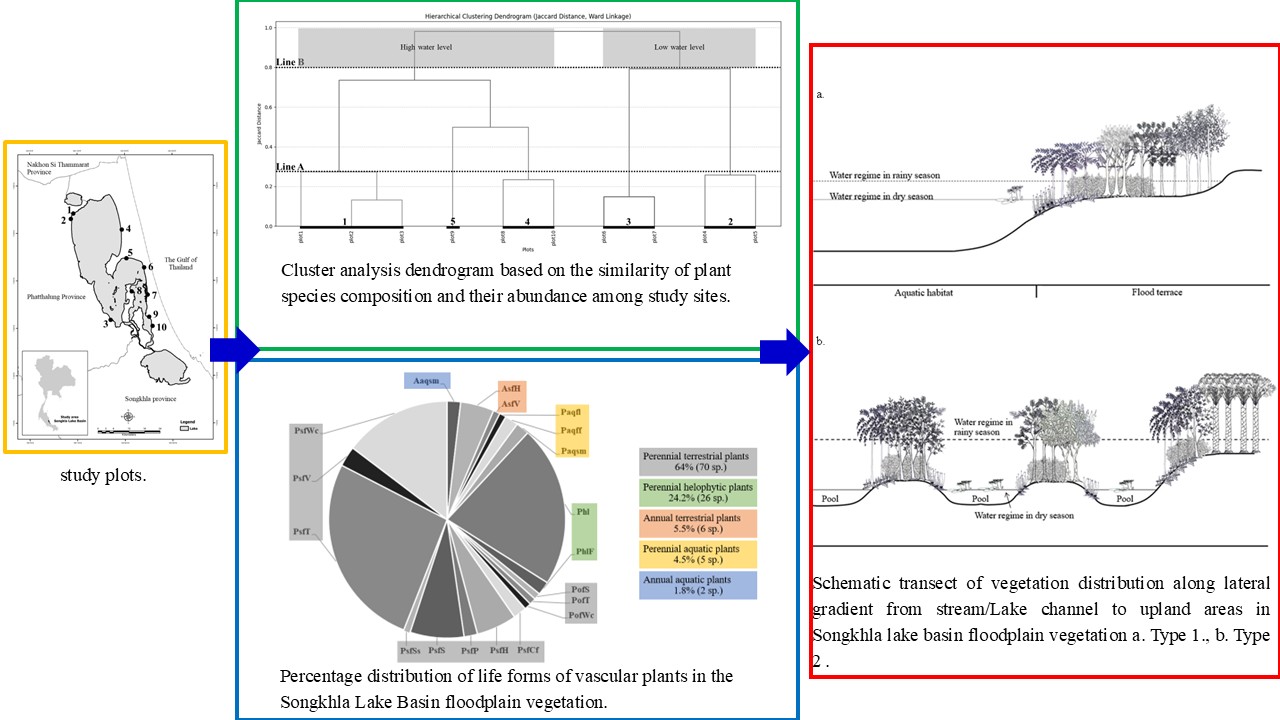
Only scattered patches of remnant vegetation remain along the lake’s edge and tributaries. Study plots were selected within these patches Figure 1. Ten study plots were selected within the remnants of the floodplain vegetation. Flood duration time refers to the period during which each study plot is inundated in the study year, based on observations made in the field.
Figure 1.Locations of the study plots
Figure 2.Photo of study sites
This variable reflects the hydrological regime influencing vegetation structure and species composition, especially in flood-prone ecosystems. The characteristics of each study plot were shown in Table 1.
| Study plots | Coordinates | Site description | Flood duration time | Water depth |
|---|---|---|---|---|
| time | (m) | |||
| 1 | 7°44’00.8” N 100°09’04.7” E | Inundated woodland | Nov–Dec | up to 1.5 |
| 2 | 7°43’11.2” N 100°08’42.8” E | Seasonal paddy field with remnant vegetation | Nov–Dec | ca 1.2 |
| 3 | 7°21’38.5” N 100°16’50.7” E | Seasonal paddy field with remnant vegetation | Nov–Dec | ca 1.0 |
| 4 | 7°40’39.4” N 100°19’18.2” E | Open grassland with shrub | Dec–Jan | ca 0.5 |
| 5 | 7°34’50.3” N 100°20’21.6” E | Open grassland with shrub | Dec–Jan | ca 0.5 |
| 6 | 7°30’19.3” N 100°24’28.4” E | Woodland remnant | Dec | ca 0.5 |
| 7 | 7°27’14.8” N 100°24’59.5” E | Woodland remnant | Dec | ca 0.5 |
| 8 | 7°27’39.5” N 100°21’15.1” E | Open grassland with shrub | Nov–Jan | up to 1.0 |
| 9 | 7°23’06.9” N 100°25’15.9” E | Stream edged | Dec | up to 1.5 |
| 10 | 7°20’44.8” N 100°25’40.5” E | Open grassland with shrub | Nov–Jan | up to 1.5 |
Data Collection
Study plots were selected subjectively using the Braun-Blanquet method (Kent & Coker, 1994) in remnant areas of natural floodplain vegetation, ranging from rarely to permanently flooded Table 1. Plots were chosen to represent distinct plant communities that exhibit uniform structure and dominant species. Monthly field surveys took place from September 2022 to January 2024 to capture seasonal and hydrological variations. Plant species were collected from zones exposed to the highest water levels observed during the study period to document the flora composition under extreme inundation. Species found within and around the plots were gathered to complete the floodplain flora inventory, including field notes on diagnostic features, ecological traits, and photographs for accurate identification.
In this study, plant identification was primarily based on field observations, focusing on morphological characteristics. Field photos were cross-checked with established botanical literature and databases. The following sources were used: Flora of Thailand (Smitinand, T. & Larsen, K.), a key regional reference for Thai flora.
Vegetation Analysis
Cluster Analysis
Cluster analysis was performed using Python (Version 3.10; Python Software Foundation, 2024). Specifically, K-Means clustering was applied to the dataset via the scikit-learn library (Scikit-learn: Machine learning in Python, 2011). Before clustering, data preprocessing and manipulation were performed using the Pandas library (McKinney, 2010), and visualizations were generated with Matplotlib (Hunter, 2007). Each group was subsequently identified as a distinct vegetation unit. These units were labelled approximately based on dominant species, structural appearance, and environmental setting.
Relative Abundance of Growth Strategies/Life Forms of Community Types
To explain differences in structure among community types identified by vegetation classification, all vascular plant species found in the study plots were grouped according to various growth strategies and life forms. This classification assumes that variations in plant form and strategy reflect adaptations to different environmental conditions. Often, vegetation stands with very different species composition share similar structure and life forms due to the influence of similar environmental factors. Therefore, analyzing the dominant growth strategies and life forms of each community type, together with environmental factors such as land use history, flood duration, and water depth, can help us better understand spatial variation among these communities (Pérez-Harguindeguy et al., 2013).
The relative abundance of each life form within a community type was calculated by summing the percentage cover of all species sharing the same growth strategy or life form. The results were then presented as percentages to reflect the dominance of each life form category within the respective vegetation community. Plant species were broadly classified as either annual or perennial.
Annuals encompass all vascular plants that complete their life cycle within a single year and endure unfavorable conditions as seeds. In certain instances, species generally regarded as perennial in different environments were classified as annuals here if they exhibited significant seasonal variations in above-ground presence within the floodplain.
Perennials are vascular plants that live for more than 1 year. Some may temporarily disappear during dry or unfavorable periods but persist through underground structures such as rhizomes or corms. Perennials are further classified as either terrestrial or aquatic based on their primary habitat.
This study exclusively targeted terrestrial areas subject to seasonal flooding. Within our defined study boundaries, all plant species encountered were required to experience inundation for at least 1 month during the study year; no arid habitats were included in the study. This specific water regime, characterized by seasonal flooding that occurs at least once a month, defines the vegetation as swamp vegetation, indicative of a seasonal wetland ecosystem. Furthermore, these criteria for seasonal and occasional flooding may be applied to categorize plant groups within the study.
In this context, aquatic plants are strictly defined as species that grow exclusively in fully submerged or floating aquatic environments. Conversely, helophytes are classified as plants that can thrive in continuously waterlogged conditions or saturated soils, characterized by their root systems and basal stem portions being submerged beneath the water surface or within the muddy substrate. In contrast, their central stems, leaves, and inflorescences are elevated above the water level. This distinction is crucial for understanding the various growth strategies and adaptations of the flora within these unique, periodically inundated terrestrial habitats.
RESULTS AND DISCUSSIONS
Taxonomic Diversity
In this study, a total of 109 vascular plant species were recorded, belonging to 91 genera and 55 families. The most species-rich family was Poaceae(10 species), followed by Cyperaceae (9 species). The third most common families were Fabaceae, Phyllanthaceae, and Rubiaceae, each was represented by 6 species. The Lythraceae family comprised 4 species, while the Arecaceae, Euphorbiaceae, Myrtaceae, and Pontederiaceae families each was represented by 3 species. Other families were represented by 2 species each, and the remaining families were represented by a single
species Table 2.
| Family | Scientific name | Vernacular | Habitat | 1 | 2 | 3 | 4 | 5 | 6 | 7 | 8 | 9 | 10 |
|---|---|---|---|---|---|---|---|---|---|---|---|---|---|
| Achariaceae | Hydnocarpus ilicifolius King | Krabao Klak | PsfT | x | |||||||||
| Amaryllidaceae | Crinum amoenum Ker Gawl. ex Roxb. | Kra Thiam Chang | PsfH | x | x | ||||||||
| Anacardiaceae | Semecarpus cochinchinensis Engl. | Rak Khao | PofT | x | |||||||||
| Annonaceae | Uvaria argentea Blume | Nom Maeo Bai Nha | PsfWc | x | x | x | x | x | x | x | x | x | x |
| Apocynaceae | Ichnocarpus frutescens (L.) W.T.Aiton | Thao Ko | PsfWc | x | x | x | x | ||||||
| Araceae | Wrightia religiosa (Teijsm. & Binn.) Benth. ex Kurz | Mok Ban | PofS | x | |||||||||
| Arecaceae | Colocasia esculenta (L.) Schott | Bon | Phl | x | |||||||||
| Calamus godefroyi Becc | Wai Nam | PsfWc | x | ||||||||||
| Corypha utan Lam. | Lan Phru | PsfP | x | ||||||||||
| Asteraceae | Eclipta prostrata (L.) L. | Ka Pho | PsfP | ||||||||||
| Tarlmounia elliptica (DC.) H. Rob., S. C. Keeley, Skvarla & R. Chan | Kameng | AsfH | x | x | x | x | x | x | x | x | x | x | |
| Balsaminaceae | Hydrocera triflora (L.) Wight & Arn. | Tan Mon | PsfWc | x | x | x | x | ||||||
| Bignoniaceae | Dolichandrone columnaris Santisuk | Thian Nam | PsfH | x | x | x | |||||||
| Capparaceae | Crateva religiosa G.Forst. | Khae Thung | PsfT | x | x | ||||||||
| Celastraceae | Salacia chinensis L. | Kum Nam | PsfT | x | x | x | x | ||||||
| Combretaceae | Combretum quadrangulare Kurz | Kamphaeng Chet Chan | PsfWc | ||||||||||
| Combretum trifoliatum Vent | Sa Kae Na | PsfT | x | x | x | x | x | x | x | x | x | ||
| Commolinaceae | Cyanotis axillaris (L.) D.Don ex Sweet | Khot sang | PsfWc | x | x | x | x | x | x | x | x | ||
| Convolvulaceae | Argyreia capitiformis (Poir.) Ooststr. | Phak Plaap Na | AsfH | x | |||||||||
| Merremia gemella (Burm.f.) Hallier f | Fon Saen Ha | PsfWc | x | ||||||||||
| Costaceae | Hellenia speciosa (J.Koenig) S.R.Dutta | Thao Sa-Uek Yai | PsfV | x | |||||||||
| Cucurbitaceae | Trichosanthes scabra Lour. | Ueang Mai Na | PsfH | x | x | ||||||||
| Cyperaceae | Actinoscirpus grossus (L.f.) Goetgh. & D.A.Simpson | Khi Ka Dang | AsfV | x | x | x | x | ||||||
| Cyperus compactus Retz | Kok Sam Liam | Phl | x | x | x | x | x | ||||||
| Cyperus compressus L. | Ya Bai Khom | Phl | x | x | x | x | x | ||||||
| Cyperus denudatus L.f. | Kok Dok Baen | Phl | x | x | x | x | x | ||||||
| Kok Klom | Phl | x | x | x | x | x | |||||||
| Cyperaceae | Cyperus digitatus Roxb. | Kok Dok Daeng | Phl | x | x | x | x | x | x | ||||
| Cyperus pulcherrimus Wild. ex Kunth. | Ya Hang Ka | Phl | x | x | x | x | x | x | |||||
| Eleocharis ochrostachys Steud. | Chut Nu | Phl | x | x | x | x | x | x | |||||
| Fimbristylis dichotoma (L.) Vahl. | Ya Nio Nu | Phl | x | x | x | x | x | x | |||||
| Lepironia articulata (Retz.) Domin | Krachut | Phl | x | x | x | x | x | x | |||||
| Dilleniaceae | Tetracera loureiri (Finet & Gagnep.) Pierre ex Craib | Rot Sukhon | PsfWc | x | x | x | x | x | x | x | x | x | x |
| Dioscoreaceae | Dioscorea sp. | Man Nok | PsfWc | x | x | x | x | x | x | x | |||
| Ebenaceae | Diospyros mollis Griff. | Ma Kluea | PsfT | x | |||||||||
| Diospyros rhodocalyx Kurz | Ta Ko Na | PsfT | x | x | x | ||||||||
| Euphorbiaceae | Croton sp. | - | PsfS | x | x | x | |||||||
| Mallotus sp. | - | PsfS | x | x | x | ||||||||
| Shirakiopsis indica (Willd.) Esser | Ku Ra | PsfT | x | x | x | x | x | x | x | x | x | x | |
| Fabaceae | Albizia myriophylla Benth. | Oi Chang | PsfWc | x | x | x | x | ||||||
| Brachypterum scandens (Roxb.) Wight & Arn. ex Miq. | Thao Wan Priang | PsfWc | x | x | x | x | x | x | |||||
| Canavalia rosea (Sw.) DC. | Thua Khla | PsfV | x | x | x | x | x | x | |||||
| Dalbergia entadoides Pierre ex Gagnep. | Khreua Kraphi | PsfWc | x | x | x | x | x | x | |||||
| Derris trifoliata Lour. | Thop Thaep Nam | PsfWc | x | x | x | ||||||||
| Erythrina fusca Lour. | Thong Lang | PsfT | x | x | |||||||||
| Gentianaceae | Cyrtophyllum fragrans (Roxb.) DC. | Kan Krao | PsfT | x | x | ||||||||
| Guttifereae | Garcinia celebica L. | Wa | PsfT | x | x | x | |||||||
| Hydrocharitaceae | Ottelia alismoides (L.) Pers. | Santawa Bai Phai | Paqsm | x | x | x | x | x | x | x | |||
| Vallisneria spiralis L. | Santawa Bai Khao | Paqsm | x | ||||||||||
| Lamiaceae | Gmelina asiatica L | Song Maeo | PsfSs | x | x | ||||||||
| Lecythidaceae | Barringtonia acutangula (L.) Gaertn. | Chik Na | PsfT | x | x | x | x | x | x | x | x | x | x |
| Lentibulariaceae | Utricularia aurea Lour. | Saraikhiao Niao | Aaqsm | x | x | x | x | x | |||||
| Utricularia sp. | - | Aaqsm | x | x | x | x | x | ||||||
| Linderniaceae | Bonnaya succosa (Kerr ex Barnett) Eb.Fisch., Schäferh. & Kai Müll. | Phak Wanon | PsfH | x | x | x | x | x | |||||
| Lythraceae | Lagerstroemia floribunda Jack | Tabaek Na | PsfT | x | x | x | x | ||||||
| Lagerstroemia speciosa (L.) Pers. | Inthanin Nam | PsfT | x | x | x | x | |||||||
| Lagerstroemia spireana Gagnep. | Pueai nam | PsfT | x | x | x | ||||||||
| Sonneratia caseolaris (L.) Engl. | Lamphu | PsfT | x | x | x | x | x | x | x | x | x | x | |
| Malvaceae | Grewia hirsuta Vahl | Khao Tak | PsfS | x | x | ||||||||
| Marantaceae | Schumannianthus benthamianus (Kuntze) Veldkamp & I.M.Turner | Khla Nam | PsfH | x | x | x | x | x | x | ||||
| . | Marsilea scalaripes D.M. Johnson | Phak Waen | PhlF | x | x | x | |||||||
| Menispermaceae | Tinospora sp. | - | PsfWc | x | x | ||||||||
|
Menyanthaceae Molluginaceae |
Nymphoides indica (L.) KuntzeNymphoides parviflora (Wall. ex G.Don) Tippery Glinus oppositifolius (L.) Aug.DC. |
Bua BaBua Sai Ting Sadao Din |
Paqff PaqffPSfH |
x | x | x | x | x | x | x | x | x | x |
| Moraceae | Streblus sp. | Khoy | PSfT | x | x | x | x | x | x | ||||
| Myrtaceae | Melaleuca quinquenervia (Cav.) S.T. Blake | Samet Khao | PSfT | x | x | x | x | x | x | x | x | x | x |
| Syzygium borneense (Miq.) Miq. | Wha Nok | PSfT | x | ||||||||||
| Syzygium cumini (L.) Skeels | Wha | PsfT | x | x | x | x | x | x | |||||
| Nymphaeaceae | Nymphaea nouchali Burm.f. | Bua Phuean | Paqfl | x | x | x | x | x | x | x | x | x | x |
| Olacaceae | Jasminum elongatum (P.J. Bergius) Willd. | Khiao Ngu | PofWc | x | x | x | x | x | |||||
| Phlydraceae | Philydrum lanuginosum Banks & Sol. Ex Gaerth | Phak Kra Chap | PsfH | x | x | ||||||||
| Phyllanthaceae | Antidesma ghaesembilla Gaertn. | Maow Thung | PsfT | x | x | x | x | x | x | x | |||
| Bridelia curtisii Hook.f. | Ma Ka Bai Na | PsfT | x | x | x | x | x | x | |||||
| Hymenocardia punctata Wall. ex Lindl. | Hu Ling | PsfT | x | x | x | x | x | x | |||||
| Phyllanthus lanceolarius (Roxb.) Müll.Arg. | Daeng Nam | PsfS | x | x | |||||||||
| Phyllanthus subscandens (Zoll. & Moritzi) Müll.Arg. | Kra Dum Phee | PsfT | x | x | x | x | |||||||
| Phyllanthus reticulatus Poir. | Kang Pla Daeng | PsfS | x | x | x | x | x | x | |||||
| Poaceae | Arundo donex L. | O Yai | Phl | x | x | x | x | x | |||||
| Chrysopogon aciculatus (Retz.) Trin. | Ya Khi Troei | Phl | x | x | x | x | x | ||||||
| Chrysopogon festucoides (J.Presl) Veldkamp | Ya Faek | Phl | x | x | x | x | x | x | x | x | x | x | |
| Cynodon dactylon (L.) Pers. | Ya Phraek | Phl | x | x | x | x | x | x | x | x | x | x | |
| Hygroryza aristata (Retz.) Nees. | Ya Phong Lom | Phl | x | x | |||||||||
| Hymenachne acutigluma (Steud.) Gilliland | Ya Kaen | Phl | x | x | |||||||||
| Leersia hexandra Sw. | Ya Khom Bang | Phl | x | x | x | ||||||||
| Leersia stipitata Bor | Ya Sia | Phl | x | x | x | x | x | ||||||
| Miscanthus fuscus (Roxb.) Benth. | Ya Phong | Phl | x | x | x | x | x | ||||||
| Oryza rufipogon Griff. | Ya Khao Phee | Phl | x | x | x | x | x | ||||||
| Polygalaceae | Xanthophyllum lanceatum (Miq.) J. J. Sm. | Chum Saeng | PsfT | x | x | x | x | x | x | x | x | x | x |
| Polygonaceae | Persicaria attenuata (R.Br.) Soják | Phak Phai Nam | AsfH | x | x | x | x | x | x | x | x | x | x |
| Pontederiaceae | Pontederia elata (Ridl.) M.Pell. & C.N.Horn | Phlong | Phl | x | x | x | x | x | x | x | |||
| Pontederia hastata L. | Phak Top Thai | Phl | x | x | x | x | x | x | x | ||||
| Pontederia vaginalis Burm.f. | Phak Rin | Phl | x | x | x | x | x | x | x | ||||
|
Potamogetonaceae Pteridaceae Rubiaceae |
Potamogeton nodosus Poir.Acrostichum aureum L.Kailarsenia campanula (Ridl.) Tirveng. |
Nae Pak Ped Prong Khai Phut Nam |
Phl PhlF PsfS |
x x |
x x |
x | x | ||||||
| Mitragyna diversifolia (Wall. ex G.Don) Havil. | Thom Khi Mu | PsfT | x | x | x | x | x | ||||||
| Morinda citrifolia L. | Yo | PsfT | x | x | x | x | x | x | x | x | x | x | |
| Nauclea orientalis (L.) L. | Kan Lueang | PsfT | x | x | x | x | x | x | |||||
| Paederia foetida L. | Man Pu | PsfV | x | x | x | x | |||||||
| Tamilnadia uliginosa (Retz.) Tirveng. & Sastre | Talum Phuk | PsfT | x | x | |||||||||
| Rutaceae | Feroniella lucida (Scheff.) Swingle | Ka Sang | PsfS | x | |||||||||
| Salicaceae | Homalium caryophyllaceum (Zoll. & Moritzi) Benth. | Naeng | PsfT | x | x | x | |||||||
| Schizaeaceae | Lygodium japonicum (Thunb.) Sw. | Kut Ngo Ngae | PsfCf | x | x | x | x | x | x | x | x | x | x |
| Lygodium microphyllum (Cav.) R. Br. | Li Phao Yung | PsfCf | x | x | x | x | x | x | x | x | x | x | |
| Sphenocleaceae | Sphenoclea zeylanica Gaertn. | Phak Pod | AsfH | x | x | x | x | x | x | ||||
| Stemonaceae | Stemona cochinchinensis Gagnep. | Sam Sip Klip | PsfWc | x | x | ||||||||
| Vitaceae | Cayratia trifolia (L.) Mabb. & J.Wen | Thao Khan | PsfWc | x | x | x | x | x | x | x | x | x | x |
| Leea rubra Blume | Ka Tang Bai | PsfS | x | x | x | x | x | x | x | x | x | x |
Life Forms and Morphological Adaptations of Floodplain Plants in the Songkhla Lake Basin
Based on their growth strategies and life forms, the vascular plant species identified within the floodplain vegetation of Songkhla Lake Basin were classified into 5 main groups Figure 2, which are: 1) Annual aquatic plants; 2) Annual terrestrial plants; 3) Perennial aquatic plants; 4) Perennial terrestrial plants; and 5) Perennial helophytic plants. Each of these main groups was further divided into more specific subgroups Figure. 2. The most prevalent group observed was perennial terrestrial plants, accounting for 70 species (64% of the total flora), followed by perennial helophytes, comprising 26 species (24.2%). The less numerous groups included annual terrestrial plants (6 species, 5%), perennial aquatic plants (5 species, 4.5%), and annual aquatic plants (2 species, 1.8%).
Figure 2.Distribution of life forms of vascular plants in the Songkhla Lake Basin floodplain
Cluster Analysis
Cluster analysis was employed to classify the vegetation of ten study plots located within the Songkhla Lake Basin floodplain into distinct community types. From the hierarchical cluster analysis, 5 community types were identified at a 75% similarity level Figure. 3, Line A).
The nomenclature for these community types was derived from their predominant species, physiognomy, and associated habitats. These 5 recognized community types are detailed as follows:
Figure 3.Cluster analysis dendrogram based on similarities in plant species composition and abundance among study sites
1. Barringtonia-Diyospyros-Lagerstroemia woodland
This community type is primarily characterized
by the presence of Perennial Seasonal Flooded Tree (PsfT) species. Dominant plant species within the PsfT life form included Barringtonia acutangula (L.) Gaertn., Diospyros rhodocalyx Kurz, and Lagerstroemia speciosa (L.) Pers. Perennial helophyte (Phl) species were also prevalent, particularly in areas subjected to at least 2 months of inundation, with a strong representation from the Cyperaceae, Poaceae, and Pontederiaceae families. Commonly observed species in this category included Cayratia trifolia (L.) Mabb. & J.Wen and Combretum trifoliatum Vent. Notably, 19 species were exclusively recorded in this vegetation type, absent from all other vegetation forms (Table 2), while 21 species were consistently observed across all study plots.
2. Antidesma-Phyllanthus-Shirakiopsis shrubland
The most frequently observed life form was the Perennial seasonal flooded tree (PsfT), representing 16 species. Prominent species within this group included Antidesma ghaesembilla Gaertn. and Phyllanthus subscandens (Zoll. & Moritzi) Müll. Arg., as well as Shirakiopsis indica (Willd.) Esser. Perennial seasonal flooded woody climbers (PsfWc) comprised 12 species, with 1/3 belonging to the Fabaceae family. Perennial helophytes (Phl) accounted for 10 species, predominantly from the Poaceae family. Additionally, seven species were uniquely found in this vegetation type, not observed in any other vegetation form. These unique species included Colocasia esculenta (L.) Schott, Crinum amoenum Ker Gawl. ex Roxb., Nymphoides parviflora (Wall. ex G.Don) Tippery, Phyllanthus lanceolarius (Roxb.) Müll.Arg., Potamogeton nodosus Poir., Tinospora sp., and Wrightia religiosa (Teijsm. & Binn.) Benth. ex Kurz.
3. Combretum-Shirakiopsis woodland
In the relatively disturbed dry areas, only 2 species of perennial helophytes (Phl) were found: Chrysopogon festucoides (J. Presl) Veldkamp and Cynodon dactylon (L.) Pers. The most abundant life forms were the perennial, seasonal flooded trees (PsfT) and the perennial, seasonal flooded woody climbers (PsfWc), each comprising eight species. During the short-duration flooded season (with water levels not exceeding 30 cm), 2 aquatic plant species were observed: Nymphoides indica (L.) Kuntze and Nymphaea nouchali Burm.f. Additionally, 2 relatively rare species, Corypha utan Lam. and Dolichandrone columnaris Santisuk, were found in this group.
4. Acrosticum-Cyperus-Shirakiopsis glassland-small shrub
This is a mixed community of helophytes and small shrubs, seemingly dominated by perennial helophytes (Phl) species. It was observed in areas subjected to relatively long-term inundation (up to 50 cm deep for 3 months). During the wet season, the vegetation was dominated by numerous Phl species, specifically Cyperus compactus Retz. and Chrysopogon aciculatus (Retz.) Trin., Eleocharis acutangula (Roxb.), and other members of the genus Cyperus. This group also included one species of perennial helophyte fern (PhlF), Acrostichum aureum
L. The aquatic plants present were Nymphaea nouchali Burm.f. and Nymphoides indica (L.). Kuntze, Ottelia alismoides (L.) Pers., and Utricularia aurea Lour. Conversely, during the dry period, some tree and shrub species persisted, such as Shirakiopsis indica (Willd.) Essere and Combretum trifoliatum Vent.
5. “Stream edged” Communities
This area, located along the stream banks, is mainly inhabited by plants adapted to flooding. The dominant vegetation included perennial helophytes (Phl) from the Cyperaceae and Poaceae families. Further from the edge, Lagerstroemia speciosa (L.) Pers. and Barringtonia acutangula (L.) Gaertn. were seen. During periods of heavy flooding, when water levels rise by about 1 meter, Phl species became submerged. At these times, free-floating aquatic plants like Nymphaea nouchali Burm.f. and Nymphoides indica (L.) Kuntze became common. However, once water levels return to normal, the Phl community reappeared.
Taxonomic Diversity and Species Richness
The plant species composition in the Songkhla Lake basin floodplain vegetation was characterized by several dominant families. Poaceae and Cyperaceae were the most common families, a finding that aligns with their status as the most prominent plant families in the Thai flora, encompassing approximately 248 and 600 species of Cyperaceae and Poaceae, respectively (Larsen & Nielsen, 1994); (A & T, 1998). The prevalence of these 2 families is largely attributable to the nature of the Songkhla Lake Basin floodplain areas, which are predominantly open and subject to periodic flooding. Many species within these families are adapted as helophytes, thriving in both aquatic and terrestrial environments as both aquatic and terrestrial herbs. Their abundance in wetlands is also well-documented (Sukumaran & Jeeva, 2011). Fabaceae is the most prominent family, followed by Phyllanthaceae and Rubiaceae.
In this study, these 3 families were identified as significant components of the pioneer plant community, commonly observed in disturbed vegetation (Chronic disturbance of moist tropical forests favours deciduous over evergreen tree communities across a climate gradient in the Western Ghats. bioRxiv, 2024);(Garate-Quispe et al., 2024). Fabaceae and Rubiaceae, in particular, exhibited remarkable diversity in their habits and life forms, encompassing trees, shrubs, woody climbers, and vines. Consequently, these 2 families represented the most diverse groups within the floodplain vegetation. Many historically common plant species have become rare or are now virtually extinct. These include Pontederia hastata L. Figure 4E, Pontederia vaginalis Burm.f. Figure 4F, Lagerstroemia speciosa (L.) Pers. Figure 4B, and Nymphaea nouchali Burm.f. Figure 4D, primarily due to alterations in the water regime. Combretum trifoliatum Vent. Figure 4A has also experienced a decline in occurrence, attributed to habitat changes. Furthermore, Kailarsenia campanula (Ridl.) Tirveng. Figure 4C is now classified as a rare species, with only 2 populations found during this study Table 2.
Figure 4.Combretum trifoliatum Vent; B = Lagerstroemia speciosa (L.) Pers.; C = Kailarsenia campanula (Ridl.) Tirveng; D = Nymphaea nouchali Burm.f.; E = Pontederia hastata L.; F = Pontederia vaginalis Burm.f.
Plant Growth Strategies and Life Forms in the Floodplain Vegetation of the Songkhla Lake Basin
In aquatic and wetland plant communities, dominant species are generally perennial aquatic herbs, predominantly classified as free-floating and submerged plants, as documented by Cronk & Fennessy (2001). However, the present study revealed that perennial terrestrial plants constitute 69.5% of the total flora, while aquatic species
account for only 6.3% Figure. 2. Although most aquatic species in these habitats are perennial, perennial aquatic plants often fail to complete their life cycles during the flood pulse preceding the onset of the dry period, except in regions with permanent water bodies. Consequently, the helophytic growth strategy confers a selective advantage in these environments, enabling species to survive unfavourable conditions and reestablish during the subsequent flood season. This adaptive mechanism facilitates persistence through alternating flood and dry phases, resulting in a predominance of helophytic species within these communities (Parolin, 2009).
During the dry season, the landscape is characterized by shallow pools and elevated lake edges that serve as vital refuges and habitats for a diverse array of flora and fauna. Terrestrial plants can endure these conditions, whereas aquatic plants cannot survive extended desiccation and consequently disappear. Conversely, during flooding, some annual terrestrial species may be absent; however, perennial terrestrial plants generally remain unaffected by these conditions. These areas support seasonal vegetation, including species such as Crinum amoenum Ker Gawl. ex Roxb. and various small herbaceous helophytes. With the advent of the wet season, these habitats are progressively colonized by aquatic plants, exemplified by Lepironia articulata (Retz.) Domin, Ottelia alismoides (L.) Pers., Nymphaea nouchali Burm.f., Nymphoides indica (L.) Kuntze, and Utricularia aurea Lour. As a result, terrestrial plant diversity exceeds that of aquatic plants within these habitats.
Spatial Variation in Composition and Structure among Vegetation Types in the Songkhla Lake Basin Floodplain
At a 20% similarity threshold, the cluster analysis allowed for a broad categorization of plant communities into 2 major groups, with inundation depth serving as the primary distinguishing factor. One group was characterized by high water levels (up to 1.5 m), while the other comprised communities adapted to low water levels (up to 0.5 m) Figure. 3, Line B). The two identified vegetation groups display not only unique habitat distributions but also distinct structural variations.
This study examined the spatial patterns of floodplain vegetation within the context of these two groups. Vegetation analysis results indicated that broad-scale differences in species composition and structure are influenced by successional stages, which are linked to past land uses. However, at a finer scale, the water regime appears to be a more significant determining factor.
Vegetations Dominated by High Water Levels
The Barringtonia-DiospyrosLagerstroemia woodland in the Songkhla Lake Basin exhibits a relatively complex vegetation structure compared to other local vegetation types, suggesting it represents a more or less «primary vegetation» that historically occurred in the study area. This aligns with the key features of primary floodplain vegetation, which thrives in dynamic river environments by adapting to floods through the development of specialized roots or physiological changes. These adaptations encompass a diverse array of life forms, ranging from fast-growing annual herbs to resilient perennial woody species, and hold significant ecological importance in flood control, erosion prevention, water quality, and habitat provision (Wellstein et al., 2003).
This study identified several flood-adapted species, including Sonneratia caseolaris (L.). Engl., which possesses pneumatophores. Lenticels were also observed in Brachypterum scandens (Roxb.) Wight & Arn. ex Miq. Furthermore, the floodplain species of the Songkhla Lake Basin displayed various adaptive traits for germination and establishment in inundated conditions. Many exhibited hydrochory (water dispersal) via their diaspore characteristics. Notable examples included the cork-like pericarp of Barringtonia acutangula (L.) Gaertn., winged fruits in Combretum trifoliatum Vent. and Hymenocardia punctata Wall., and spongy syncarps in Nauclea orientalis L. These features not only facilitate flotation and water dispersal but also maintain seed viability by protecting tissues from oxygen-depleted conditions. This seed buoyancy is a crucial adaptation, consistent with observations in other inundated habitats like Central American floodplains (Lopez, 2001), the Drenthse and Vechtplassen area in the Netherlands, the Peene River valley in Germany (Broek T et al., 2005), and northern Australian floodplain plant communities (Finlayson, 2005). Nevertheless, further information on the vegetation history is needed to fully confirm these observations.
Vegetation Dominated by Low Water Levels
The study area is characterized by a distinct embankment that creates a trough, separating the open floodplain from the lake. This structure prevents direct lake flooding during periods of elevated water levels, effectively shielding the adjacent landscape from inundation. Consequently, increased water levels within the study area primarily result from accumulated surface runoff generated by local precipitation, which eventually drains into the lake. The proximity to agricultural land contributes to ongoing anthropogenic disturbances, classifying the area as undergoing secondary succession.
In this successional context, the vegetation is dominated by pioneer wetland species, particularly members of the genera Cyperus and Fimbristylis, which exhibit key adaptive traits such as rapid growth, short life cycles, and high tolerance to hydrological fluctuations (flooding and drying). In areas where disturbance has stabilized, mid-successional species, such as Nymphaea sp. and Ottelia sp., may establish. As succession progresses toward a more stable state, climax communities tend to be composed of helophytic species, such as Lepironia articulata (Retz.) Domin, and riparian woody species, such as Barringtonia acutangula (L.) (Valk AG, 1981). This pattern aligns with findings by (Parolin et al., 2004) and (Keddy, 2010), who reported that late-successional tree species in floodplain systems often develop specific adaptations enabling them to withstand prolonged inundation. This finding is consistent with the present study, in which helophytic species were more prevalent than woody species within the low-water-level group Table 2. This species composition further supports the interpretation that the area is currently undergoing secondary succession.
Anticipated Natural Vegetation in the Songkhla Lake Basin under Inundated Conditions
In this study, spatial variation and divergent habitat distributions among vegetation types can primarily be attributed to differences in their secondary successional stages. The observed lateral gradient variation is an indication of the influence of human disturbance on natural processes. Consequently, all vegetation types, apart from the Barringtonia-Diospyros-Lagerstroemia woodland, may represent transitional successional states. Indeed, floodplains are characterized by their dynamic fluvial landforms and natural succession, which typically correspond to specific vegetation types (Jing et al., 2023). In the context of the Songkhla Lake Basin floodplain, successional stages often manifest as a zonation, transitioning from frequently disturbed areas near the lake›s edge to more stable, distant sections. Human activities within the Songkhla Lake Basin floodplain can trigger secondary succession in existing vegetation. This process might, in turn, mirror the natural successional patterns driven by the dynamic fluvial landforms along the lateral gradient. Based on these observed natural-successional courses, a proposed expected vegetation pattern for the Songkhla Lake Basin can be established.
The variation along the lateral gradient appears to reflect 2 distinct types of Songkhla Lake Basin floodplain vegetation Figure. 5. Type 1 is characterized by a geographical structure where a sand ridge slopes down into the lake Figure 5a. While this type is fully inundated during high water levels, it does not retain significant pools during periods of low water levels. Consequently, herbaceous vegetation disappears in the dry season and regenerates upon the return of favorable conditions. Type 2 features the lake›s edge extending deeper inland, forming an area that is also fully inundated Figure 5b. Crucially, Type 2 retains permanent pools during the dry season when water levels recede. These pools serve as vital refugia for both aquatic plants and animals, providing essential habitat during periods of low water. During the rainy season, when the area is re-inundated, species from these refugia can redistribute. This area experiences significant disturbance due to agricultural activity, which often leads to a misunderstanding of its perennially wet nature, as visible pools may not be extensive. Nonetheless, the presence of these depressed areas that retain water during the dry season allows obligate aquatic plants to persist, and species that disappear during the dry season re-establish themselves during the wet season. This further highlights the importance of these pools as a gene reservoir for both flora and fauna.
Figure 5.Schematic transect of vegetation distribution along the lateral gradient from stream/Lake channel to upland areas in Songkhla Lake Basin floodplain
CONCLUSION
This study highlighted the high taxonomic and ecological diversity of vascular plant species in the floodplain vegetation of the Songkhla Lake Basin. A total of 109 species representing 91 genera and 55 families were recorded, with Poaceae and Cyperaceae being the most species-rich families. These families are well-adapted to the region’s periodically inundated conditions and are commonly found in wetland ecosystems. Cluster analysis classified the vegetation into five distinct community types, each associated with different hydrological regimes and successional stages. The Barringtonia-Diospyros-Lagerstroemia woodland appears to represent a primary vegetation type, while other communities exhibit characteristics of various secondary successional stages due to anthropogenic disturbances.
In terms of life forms, the vegetation is predominantly composed of perennial terrestrial and helophytic plants, which together account for over 88% of the total flora. This dominance reflects their ecological advantage in withstanding seasonal hydrological fluctuations. While aquatic plants were less diverse, they played a vital ecological role in habitats with permanent or prolonged inundation, particularly in stream-edge depressions, where they function as genetic refugia during dry periods.
The study identified depth and duration of inundation, as well as successional stage, as the primary determinants of plant community composition and structure. Vegetation can broadly be grouped into communities adapted to either deep or shallow inundation. At finer spatial scales, historical land use and human activities strongly influence vegetation structure and species distribution, further emphasizing the dynamic nature of floodplain ecosystems.
Overall, the observed spatial patterns of vegetation along the lateral gradient of the floodplain suggest that only the Barringtonia-Diospyros-Lagerstroemia woodland approximates a remnant of primary vegetation. The remaining community types are likely transitional and represent different stages of secondary succession. These findings underscore the importance of preserving areas that maintain their natural hydrological regimes and structural complexity.
For effective restoration and conservation planning, it is essential to recognize the ecological significance of both primary and transitional vegetation types, particularly their roles in maintaining biodiversity and ecological resilience. Permanent water-retaining depressions should be prioritized as critical refuges for aquatic flora and fauna. Restoration strategies should integrate knowledge of natural successional trajectories, life-form adaptations, and the influence of hydrology to support sustainable management of this ecologically important floodplain system.
Conservation Measures
This region, characterized by the accumulation of fertile alluvial sediment, is highly suitable for agriculture and human settlement. However, the inconsistent annual water cycles often lead to a misunderstanding that these areas are not true wetlands. This misperception contributes to their destruction, particularly for seemingly «unproductive» areas (Type 2), which are frequently converted into reservoirs. This occurs despite the natural presence of groundwater, and such conversions irrevocably destroy vital refugia for native plant and animal populations. The altered water levels in these man-made reservoirs render them unsuitable for the original flora and fauna, as the natural water regime is a critical determinant of plant community structure. Consequently, this study may represent one of the last opportunities to document these remnant ecosystems. Widespread irrigation projects are rapidly transforming such habitats across Thailand, leading to their permanent loss. The construction of reservoirs and dams along the lake margins specifically alters water levels, threatening the existence of many rare plant species, potentially leading to their extinction soon. This habitat degradation also creates opportunities for invasive alien species, such as the “Blackchin Tilapia” (Sarotherodon melanotheron Ruppell), to establish themselves. As native plant communities disappear, the associated native animal populations lose their critical habitats, leading to population declines and a reduced ability to compete against invading non-native species.
References
- Chronic disturbance of moist tropical forests favours deciduous over evergreen tree communities across a climate gradient in the Western Ghats. bioRxiv. 2024. DOI
- Chesoh S., Chamnein C., Chaisuksan Y.. Method for analyzing fish assemblage distribution with application to fishery landings of tropical shallow lake as Songkhla Lake, Thailand. Mod Appl Sci. 2009; 3(5):179-87. DOI
- Chotikarn P., Pramneechote P., Sinutok S.. Photosynthetic responses of freshwater macrophytes to the daily light cycle in Songkhla Lagoon. Plants. 2022; 11(21)DOI
- Cronk J.K., Fennessy M.S.. CRC Press: Boca Raton (US; 2001.
- Doungsuwan N., Ratanachai C., Sompongchaiyakul P., Sangganjanavanich P.. Impacts of the National Economic and Social Development Plan on Songkhla Lake Basin development, Thailand. Int Bus Econ Res J (IBER. 2013; 12(8)DOI
- Finlayson C.M.. Plant ecology of Australia’s tropical floodplain wetlands: A review. Ann Bot. 2005; 96(4):541-55. DOI
- Garate-Quispe J., Canahuire-Robles R., Alarcón-Aguirre G., Dueñas-Linares H., Roman-Dañobeytia F.. Changes in floristic and vegetation structure in a chronosequence of abandoned gold-mining lands in a tropical Amazon forest. Heliyon. 2024; 10(9)DOI
- Hue H., Pradit S., Jarunee C., Lim A., Nitiratsuwan T., Carneiro G.. Physical properties of three Songkhla Lagoon fish species in the lower Gulf of Thailand during and after the monsoon season. Appl Ecol Environ Res. 2018; 16(5):6113-6127. DOI
- Hughes A.C.. Understanding the drivers of Southeast Asian biodiversity loss. Ecosphere. 2017; 8(1)DOI
- Hunter J.D.. Matplotlib: A 2D graphics environment. Comput Sci Eng. 2007; 9(3):90-5. DOI
- Jing L., Zeng Q., He K., Liu P., Fan R., Lu W., Lei G., Lu C., Wen L.. Vegetation dynamics in a large floodplain wetland: The effects of hydroclimatic regime. Remote Sens. 2023; 15(10)DOI
- Keddy P.A.. Cambridge University Press: Cambridge (UK; 2010.
- Kent M., Coker P.. John Wiley & Sons Ltd: Chichester (UK; 1994.
- Kottek M., Grieser J., Beck C., Rudolf B., Rubel F.. World map of Köppen–Geiger climate classification update. Meteorol Z. 2006; 15(3):259-63. DOI
- Larsen K., Nielsen I.. 9th Flora of Thailand Meeting, Aarhus. 1994.
- Lopez O.R.. Seed flotation and post-flooding germination in tropical terra firme and seasonally floodedforest species. Funct Ecol. 2001; 15:763-71. DOI
- McKinney W.. Data structures for statistical computing in Python. Proceedings of the 9th Python in Scientific Computing Conference. 2010; 445:51-6.
- Pander J., Mueller M., Geist J.. Habitat diversity and connectivity govern the conservation value of restored aquatic floodplain habitats. Biol Conserv. 2018; 217:1-10. DOI
- Parolin P., Simone O., Haase K., Waldhoff D., Rottenberger S., Kuhn U., Junk W.J.. Central Amazonian floodplain forest: Tree adaptations in a pulsing system. Bot Rev. 2004; 70(3):357-80. DOI
- Parolin P.. Submerged in darkness: adaptations to prolonged submergence by woody species of the Amazonian floodplains. Ann Bot. 2009; 03(2):359-76. DOI
- Scikit-learn: Machine learning in Python. J Mach Learn Res. 2011; 12(85):2825-30. Publisher Full Text
- Pérez-Harguindeguy N., Díaz S., Garnier E., Lavorel S., Poorter H., Jaureguiberry P., Cornelissen J.H.C.. New handbook for standardised measurement of plant functional traits worldwide. Australian J Bot Res. 2013; 61:167-234. DOI
- Accumulation of trace metals in mangrove plant Soneratia caseolaris in Songkhla Lake, Thailand. Appl Ecol Environ Res. 2018; 16(4):4081-95. DOI
- Foundation Python Software. 2024. Publisher Full Text
- Department Royal Irrigation. Bureau of Water Management and Hydrology, Hydrology Division, Water Information and Forecasting Section: Bangkok (TH; 2024.
- A Simpson D., T Koyama. Cyperaceae. Flora of Thailand. 1998; 6(4):247-485.
- Smitinand T., Larsen K.. TISTR Press: Bangkok (TH; 1979.
- Sukumaran S., Jeeva S.. Angiosperm flora from wetlands of Kanyakumari District, Tamilnadu, India. Check List. 2011; 7(4):486-95. DOI
- Institute for European Environmental Policy (IEEP: Brussels (BE; 2013.
- Broek TDiggelen RR Bobbink, LPM Lamers. Variation in seed buoyancy of wetland species with different flooding frequencies. J Veg Sci. 2005; 6(4):579-86. DOI
- Valk AG Succession in wetlands: A Gleasonian approach. Ecology. 1981; 2(3):688-96. DOI
- Ward D.P., Pettit N.E., Adame M., Douglas M.M., Setterfield S.A., Bunn S.E.. Seasonal spatial dynamics of floodplain macrophyte and periphyton abundance in the Alligator Rivers region (Kakadu) of northern Australia. Ecohydrology. 2016; 9(8):1675-86. DOI
- Wang Y., Jia Y., Guan L., Lu C., Lei G., Wen L., Liu G.. Optimizing hydrological conditions to sustain wintering waterbird populations in Poyang Lake National Natural Reserve: Implications for dam operations. Freshw Biol. 2013; 58(11):2366-79. DOI
- Wellstein C., Uehlinger U., Zah R.. Terrestrial floodplain vegetation. Aquat Ecol Ser. 2003; 1:121-44. DOI
Biswas N, Sadekar V, Biniwale S, Taneja Y, Osuri A, Page N, …, Naniwadekar R. 2024. Chronic disturbance of moist tropical forests favours deciduous over evergreen tree communities across a climate gradient in the Western Ghats. bioRxiv. DOI: 10.1101/2024.01.16.575954 DOI: https://doi.org/10.1101/2024.01.16.575954
Chesoh S, Chamnein C, Chaisuksan Y. 2009. Method for analyzing fish assemblage distribution with application to fishery landings of tropical shallow lake as Songkhla Lake, Thailand. Mod Appl Sci 3(5):179–87. DOI: 10.5539/mas.v3n5p179 DOI: https://doi.org/10.5539/mas.v3n5p179
Chotikarn P, Pramneechote P, Sinutok S. 2022. Photosynthetic responses of freshwater macrophytes to the daily light cycle in Songkhla Lagoon. Plants 11(21):2806. DOI: 10.3390/plants11212806 DOI: https://doi.org/10.3390/plants11212806
Cronk JK, Fennessy MS. 2001. Wetland plants: Biology and ecology. Boca Raton (US): CRC Press.
Doungsuwan N, Ratanachai C, Sompongchaiyakul P, Sangganjanavanich P. 2013. Impacts of the National Economic and Social Development Plan on Songkhla Lake Basin development, Thailand. Int Bus Econ Res J (IBER) 12(8):895. DOI: 10.19030/iber.v12i8.7987 DOI: https://doi.org/10.19030/iber.v12i8.7987
Finlayson CM. 2005. Plant ecology of Australia’s tropical floodplain wetlands: A review. Ann Bot 96(4):541–55. DOI: 10.1093/aob/mci210 DOI: https://doi.org/10.1093/aob/mci209
Garate-Quispe J, Canahuire-Robles R, Alarcón-Aguirre G, Dueñas-Linares H, Roman-Dañobeytia F. 2024. Changes in floristic and vegetation structure in a chronosequence of abandoned gold-mining lands in a tropical Amazon forest. Heliyon 10(9):e29908. DOI: 10.1016/j.heliyon.2024.e29908 DOI: https://doi.org/10.1016/j.heliyon.2024.e29908
Hue H, Pradit S, Jarunee C, Lim A, Nitiratsuwan T, Carneiro G. 2018. Physical properties of three Songkhla Lagoon fish species in the lower Gulf of Thailand during and after the monsoon season. Appl Ecol Environ Res 16(5):6113–6127. DOI: 10.15666/aeer/1605_61136127 DOI: https://doi.org/10.15666/aeer/1605_61136127
Hughes AC. 2017. Understanding the drivers of Southeast Asian biodiversity loss. Ecosphere 8(1):e01624. DOI: 10.1002/ecs2.1624 DOI: https://doi.org/10.1002/ecs2.1624
Hunter JD. 2007. Matplotlib: A 2D graphics environment. Comput Sci Eng 9(3):90–5. DOI: 10.1109/MCSE.2007.55 DOI: https://doi.org/10.1109/MCSE.2007.55
Jing L, Zeng Q, He K, Liu P, Fan R, Lu W, Lei G, Lu C, Wen L. 2023. Vegetation dynamics in a large floodplain wetland: The effects of hydroclimatic regime. Remote Sens 15(10):2614. DOI: 10.3390/rs15102614 DOI: https://doi.org/10.3390/rs15102614
Keddy PA. 2010. Wetland ecology: Principles and conservation. Second Edition. Cambridge (UK): Cambridge University Press. DOI: https://doi.org/10.1017/CBO9780511778179
Kent M, Coker P. 1994. Vegetation Description and Analysis. Chichester (UK): John Wiley & Sons Ltd.
Kottek M, Grieser J, Beck C, Rudolf B, Rubel F. 2006. World map of Köppen–Geiger climate classification update. Meteorol Z 15(3):259–63. DOI: 10.1127/0941-2948/2006d/0130 DOI: https://doi.org/10.1127/0941-2948/2006/0130
Larsen K, Nielsen I. 1994. 9th Flora of Thailand Meeting, Aarhus, 27–30 July 1994. Aarhus (DK): Department of Systematic Botany/ Herbarium AAU, Aarhus University.
Lopez OR. 2001. Seed flotation and post-flooding germination in tropical terra firme and seasonally floodedforest species. Funct Ecol 15:763–71. DOI: 10.1046/j.0269-8463.2001.00576.x DOI: https://doi.org/10.1046/j.0269-8463.2001.00586.x
McKinney W. 2010. Data structures for statistical computing in Python. In: Proceedings of the 9th Python in Scientific Computing Conference. Vol. 445. p. 51–6. DOI: https://doi.org/10.25080/Majora-92bf1922-00a
Pander J, Mueller M, Geist J. 2018. Habitat diversity and connectivity govern the conservation value of restored aquatic floodplain habitats. Biol Conserv 217:1–10. DOI: 10.1016/j.biocon.2017.10.035 DOI: https://doi.org/10.1016/j.biocon.2017.10.024
Parolin P, De Simone O, Haase K, Waldhoff D, Rottenberger S, Kuhn U, … Junk WJ. 2004. Central Amazonian floodplain forest: Tree adaptations in a pulsing system. Bot Rev 70(3):357–80. DOI: 10.1663/0006-8101(2004)070[0357:CAFFTA]2.0.CO;2 DOI: https://doi.org/10.1663/0006-8101(2004)070[0357:CAFFTA]2.0.CO;2
Parolin P. 2009. Submerged in darkness: adaptations to prolonged submergence by woody species of the Amazonian floodplains. Ann Bot 1 03(2):359–76. DOI: 10.1093/aob/mcn216 DOI: https://doi.org/10.1093/aob/mcn216
Pedregosa F, Varoquaux G, Gramfort A, Michel V, Thirion B, Grisel O, …, Duchesnay É. 2011. Scikit-learn: Machine learning in Python. J Mach Learn Res 12(85):2825–30. Available from: http://jmlr.org/papers/v12/pedregosa11a.html
Pérez-Harguindeguy N, Díaz S, Garnier E, Lavorel S, Poorter H, Jaureguiberry P, … Cornelissen JHC. 2013. New handbook for standardised measurement of plant functional traits worldwide. Australian J Bot Res 61:167–234. DOI: 10.1071/BT12225 DOI: https://doi.org/10.1071/BT12225
Pradit S, Shazili NA, Saengsakda M, Chotikarn P, Kobkeatthawin T, …, Towatana P. 2018. Accumulation of trace metals in mangrove plant Soneratia caseolaris in Songkhla Lake, Thailand. Appl Ecol Environ Res 16(4):4081–95. DOI: 10.15666/aeer/1604_40814095 DOI: https://doi.org/10.15666/aeer/1604_40814095
Python Software Foundation. 2024. Python Language Reference [Internet]. [cited 2024 Nov 24]. Available from: https://www.python.org/
Royal Irrigation Department. 2024. Field report on Songkhla Lake Basin and the Lower Eastern Southern Basin, 28 January – 3 February 2024. Bangkok (TH): Bureau of Water Management and Hydrology, Hydrology Division, Water Information and Forecasting Section.
Simpson D A, Koyama T. 1998. Cyperaceae. In Santisuk T, Larsen K (Editors.), Flora of Thailand, Vol. 6(4). p. 247–485. Bangkok (TH): The Forest Herbarium, Royal Forest Department.
Smitinand T, Larsen K. 1979. Flora of Thailand. Vol.3. Bangkok (TH): TISTR Press.
Sukumaran S, Jeeva S. 2011. Angiosperm flora from wetlands of Kanyakumari District, Tamilnadu, India. Check List 7(4):486–95. DOI: 10.15560/7.4.486 DOI: https://doi.org/10.15560/7.4.486
Russi D., ten Brink P, Russi D, Farmer A, Badura T, Coates D, Förster J, …, Davidson N. 2013. The economics of ecosystems and biodiversity for water and wetlands. Executive Summary. Brussels (BE): Institute for European Environmental Policy (IEEP).
van den Broek T, van Diggelen R, Bobbink R, Lamers LPM. 2005. Variation in seed buoyancy of wetland species with different flooding frequencies. J Veg Sci 6(4):579–86. DOI: 10.1111/j.1654-1103.2005.tb02399.x DOI: https://doi.org/10.1111/j.1654-1103.2005.tb02399.x
van der Valk AG. 1981. Succession in wetlands: A Gleasonian approach. Ecology 2(3):688–96. DOI: 10.2307/1936708 DOI: https://doi.org/10.2307/1937737
Ward DP, Pettit NE, Adame M, Douglas MM, Setterfield SA, Bunn SE. 2016. Seasonal spatial dynamics of floodplain macrophyte and periphyton abundance in the Alligator Rivers region (Kakadu) of northern Australia. Ecohydrology 9(8):1675–86. DOI: 10.1002/eco.1798 DOI: https://doi.org/10.1002/eco.1757
Wang Y, Jia Y, Guan L, Lu C, Lei G, Wen L, Liu G. 2013. Optimizing hydrological conditions to sustain wintering waterbird populations in Poyang Lake National Natural Reserve: Implications for dam operations. Freshw Biol 58(11):2366–79. DOI: 10.1111/fwb.12185 DOI: https://doi.org/10.1111/fwb.12216
Wellstein C, Uehlinger U, Zah R. 2003. Terrestrial floodplain vegetation. In: Ward JV, Uehlinger U (Editors), Ecology of a glacial flood plain. Aquat Ecol Ser Vol 1. Dordrecht (NL): Springer. p. 121–44. DOI: 10.1007/978-94-017-0181-5_7 DOI: https://doi.org/10.1007/978-94-017-0181-5_7
Copyright (c) 2025 Anusit Cheechang, Kitichate Sridith

This work is licensed under a Creative Commons Attribution-NonCommercial-NoDerivatives 4.0 International License.
Authors who publish with this journal agree with the following terms:
- Authors retain copyright and grant the journal right of first publication, with the work 1 year after publication simultaneously licensed under a Creative Commons attribution-noncommerical-noderivates 4.0 International License that allows others to share, copy and redistribute the work in any medium or format, but only where the use is for non-commercial purposes and an acknowledgement of the work's authorship and initial publication in this journal is mentioned.
- Authors are able to enter into separate, additional contractual arrangements for the non-exclusive distribution of the journal's published version of the work (e.g., post it to an institutional repository or publish it in a book), with an acknowledgement of its initial publication in this journal.
- Authors are permitted and encouraged to post their work online (e.g., in institutional repositories or on their website) prior to and during the submission process, as it can lead to productive exchanges, as well as earlier and greater citation of published work (See The Effect of Open Access).