COMMUNITY BELIEFS ON ANIMAL SIGNALLING: EVIDENCE FROM WEST PAPUAN TRIBAL GROUPS

Downloads
ARTICLE HIGHLIGHTS
- Indigenous communities read animal signs as early warnings for nature events
- Shared experiences shape how different animal behaviours gain meaning
- Local wisdom shows animals as sensitive partners in human survival
ABSTRACT
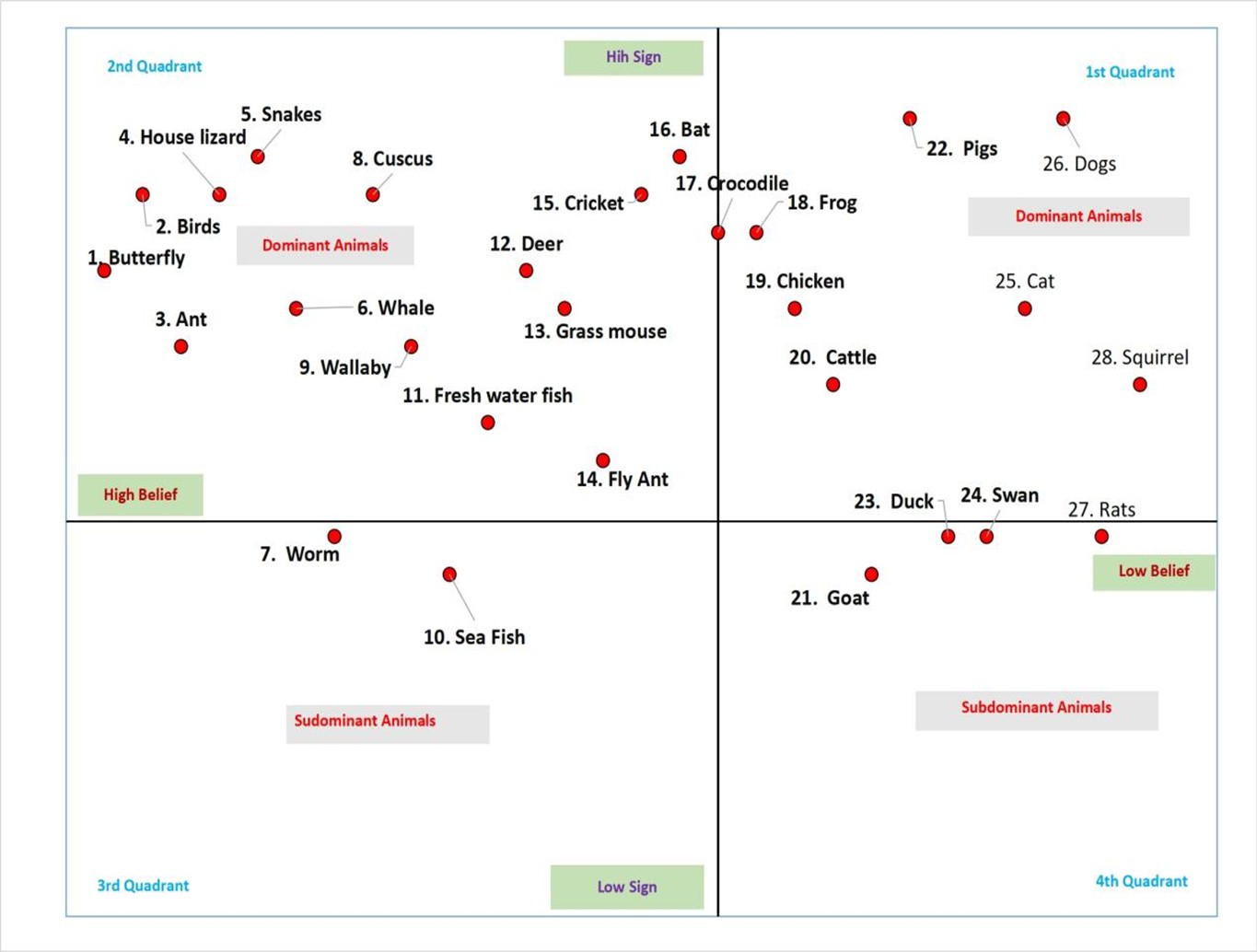
Observing animal behavior and daily activities can help humans gain knowledge and derive practical benefits. A mixed-method approach, combining desk-based study and telephone interviews, was employed to collect data from seven major Papuan tribal groups. The desk study involved the collection of approximately 2,000 references published between 1980 and 2020 using keyword-based searches conducted with specialized software. Data were also provided by leaders from the seven major communities. The collected data were analyzed using Rayyan, VoS Viewer, Crammer’s Phi, and Microsoft Excel. The principal findings indicate that 14 publications addressed topics related to animal signaling and community beliefs. The animals recognized by the seven major tribal group as exhibiting signals included mammals (52%), fish (8%), reptiles (12%), amphibians (8%), birds (4%), and insects (16%). Animals were reported to convey signals through vocalizations (sounds), appearance, body parts, wastes, tracks, constructed objects, and odors. The result of Crammer’s Phi analysis showed (168) = 219.48, P = 0.0046, df = 168, = 0.05 and 0.01, and φc = 0.0105 (1%). This results indicate a significant association between perceived values in interpreting animal signals and tribal community groups in West Papua. A Cartesian graph demonstrated low-to-high levels of both animal signaling and beliefs. Beliefs and practices related to animal sensitivity and communication vary across cultures and communities worldwide. Many indigenous communities maintain a deep spiritual connection with nature and animals, viewing them as sentient beings with their own forms of communication and sensitivity.
Altrichter M. 2005. Factor underlying the interaction between people and wildlife in the Argentine Chaco. [Dissertation]. Tucson (US): School of Natural Resources, University of Arizona.
Baker S. 2001. Animals, Representation, and Reality. Soc Anim 9(3):189–201. DOI: 10.1163/156853001753644372 DOI: https://doi.org/10.1163/156853001753644372
Baum MJ. 2009. Hormones and behavior sexual differentiation of pheromone processing : Links to male-typical mating behavior and partner preference. Horm Behav 55(5):579–88. DOI: 10.1016/j.yhbeh.2009.02.008 DOI: https://doi.org/10.1016/j.yhbeh.2009.02.008
Bekoff M. 2011. Minding animals: A transdisciplinary approach for furthering our understanding of animals in society. Animals 1(1):4–6. DOI: 10.3390/ani1010004 DOI: https://doi.org/10.3390/ani1010004
Brashares JS, Golden CD, Weinbaum KZ, Barrett CB, Okello GV. 2011. Economic and geographic drivers of wildlife consumption in rural Africa. Proc Natl Acad Sci USA 108(34):13931–6. DOI: 10.1073/pnas.1011526108 DOI: https://doi.org/10.1073/pnas.1011526108
Cao K, Huang Q. 2018. Geo-sensor(s) for potential prediction of earthquakes : Can earthquake be predicted by abnormal animal phenomena? Ann GIS 24(2):125–38. DOI: 10.1080/19475683.2018.1450785 DOI: https://doi.org/10.1080/19475683.2018.1450785
CBD Secretariat. 2022. Biodiversity Fact. Montreal (CA): Secretariat of the Convention on Biological Diversity. [Internet]. Available from: https://www.cbd.int
Chanu TA, Teron R, Singh OSK, Singh HT 2019. Animals as weather-forecasting bio-indicators a case study of different communities of Bishnupur District, Manipur, NE India. Int J Adv Res 7(5):502–9. DOI: 10.21474/IJAR01/9066 DOI: https://doi.org/10.21474/IJAR01/9066
Corsi F. 2004. Applications of existing biodiversity information: Capacity to support decision making. [Dissertation]. Wageningen (NL): University of Wageningen.
Coulter K. 2016. The work done by animals : Identifying and understanding animals ’ work. In: Coulter K (Author), Animals, work, and the promise of interspecies solidarity. New York (US): Palgrave Macmillan. DOI: 10.1057/9781137558800_3 DOI: https://doi.org/10.1057/9781137558800
Davies NB, Krebs JR, West SA. 2012. An introduction to behavioural ecology. Chichester (UK): Blackwell Publishing.
Devendra C. 2007. Perspectives on animal production systems in Asia. Livest Sci 106(1):1–18. DOI: 10.1016/j.livsci.2006.05.005 DOI: https://doi.org/10.1016/j.livsci.2006.05.005
Engen S, Fauchald P, Hausner V. 2019. Stakeholders’ perceptions of protected area management following a nationwide community-based conservation reform. Plos One 14(4):e0215437. DOI: 10.1371/journal.pone.0215437 DOI: https://doi.org/10.1371/journal.pone.0215437
Finke DL, Snyder WE. 2010. Conserving the benefits of predator biodiversity. Biol Conserv 143(10):2260–69. DOI: 10.1016/j.biocon.2010.03.022 DOI: https://doi.org/10.1016/j.biocon.2010.03.022
Freeman RE. 2015. The stakeholder approach. In: Freeman RE (Author), Strategic management: A stakeholder approach. Cambridge (UK): Cambridge University Press. DOI: 10.1017/cbo9781139192675.003 DOI: https://doi.org/10.1017/CBO9781139192675.003
Galacgac ES, Balisacan CM. 2009. Traditional weather forecasting for sustainable agroforestry practices in Ilocos Norte Province, Philippines. For Ecol Manag 257(10):2044–53. DOI: 10.1016/j.foreco.2009.01.002 DOI: https://doi.org/10.1016/j.foreco.2009.01.002
Gotelli NJ, Colwell RK. 2001. Quantifying biodiversity: Procedures and pitfalls in the measurement and comparison of species richness. Ecol Lett 4(4):379–91. DOI: 10.1046/j.1461-0248.2001.00230.x DOI: https://doi.org/10.1046/j.1461-0248.2001.00230.x
Higginbottom K. 2004. Wildlife tourism: Impacts, management and planning. Altona (AU): Common Ground Publishing Party Ltd.
Hills AM. 1995. Empathy and belief in the mental experience of animals. Anthrozoos 8(3):132-42. DOI: 10.2752/089279395787156347 DOI: https://doi.org/10.2752/089279395787156347
Holman N. 2008. Community participation: Using social network analysis to improve developmental benefits. Environment and Planning C 26(3):525–43. DOI: 10.1068/c0719p DOI: https://doi.org/10.1068/c0719p
Honda T, Iijima H, Tsuboi T, Uchida K. 2018. A review of urban wildlife management from the animal personality perspective: The case of urban deer. Sci Total Environ 644:576–82. DOI: 10.1016/j.scitotenv.2018.06.335 DOI: https://doi.org/10.1016/j.scitotenv.2018.06.335
Ikeya M. 2004. Forecasting using animal monitoring. In: Ikeya M (Author), Earthquakes and animals: From folk legends to science. Singapore (SG): World Scientific Publishing. p.220–32. DOI: 10.1142/9789812832696_0010 DOI: https://doi.org/10.1142/9789812832696_0010
Iyai DA, Saragih DTR. 2015. Pola gender dalam peternakan babi pada peternak etnis Arfak, Papua Barat [Gender pattern in pig farming systems of Arfak ethnic, West Papua]. Sains Peternakan 13(1):22–35. DOI: https://doi.org/10.20961/sainspet.v13i1.4422
Kartikasari SN, Marshall AJ, Beehler BM. 2012. Seri Ekologi Indonesia, Jilid VI: Ekologi Papua. Jakarta (ID): Yayasan Pustaka Obor Indonesia dan Conservation International. 1024 p.
Kwapena N. 1984. Traditional conservation and utilization of wildlife in Papua New Guinea. The Environ 4(7 Suppl 7):22–6. DOI: 10.1007/BF01907288 DOI: https://doi.org/10.1007/BF01907288
Lindenmayer DB. 2010. Landscape change and the science of biodiversity conservation in tropical forests : A view from the temperate world. Biol Conserv 143(10):5–11. DOI: 10.1016/j.biocon.2009.12.015. DOI: https://doi.org/10.1016/j.biocon.2009.12.015
Lurz RW. 2011. Belief attribution in animals: On how to move forward conceptually and empirically. Rev Philos Psychol 2(1):19–59. DOI: 10.1007/s13164-010-0042-z DOI: https://doi.org/10.1007/s13164-010-0042-z
Luskin MS, Christina ED, Kelley LC, Potts MD. 2014. Modern hunting practices and wild meat trade in the oil palm plantation-dominated landscapes of Sumatra, Indonesia. Hum Ecol 42(1):35–45. DOI: 10.1007/s10745-013-9606-8 DOI: https://doi.org/10.1007/s10745-013-9606-8
Mamuko F, Walangitan H, Tilaar W. 2016. Persepsi dan partisipasi masyarakat dalam upaya rehabilitasi hutan dan lahan di Kabupaten Bolaang Mongondow Timur [Perception and community participation in forest and land rehabilitation efforts in East Bolaang Mongondow Regency]. Eugenia 22(2):80-92. DOI: 10.35791/eug.22.2.2016.12959 DOI: https://doi.org/10.35791/eug.22.2.2016.12959
Martinelli D. 2017. Zoosemiotics, typologies of signs, and continuity between humans and other animals. In: Gordon R, Seckbach J (Editors), Biocommunication-Sign Mediated Interactions between Cells and Organisms. Hoboken (US): World Scientific. p. 63–86. DOI: https://doi.org/10.1142/9781786340450_0003
Mclear C. 2020. Animals and objectivity. In: Callanan JJ, Allais L (Editors), Kant and Animals. New York (US): OxfordUniversity Press. p.42-65. DOI: https://doi.org/10.1093/oso/9780198859918.003.0003
Miller SM, Montalto FA. 2019. Stakeholder perceptions of the ecosystem services provided by green infrastructure in New York City. Ecosyst Serv 37(1):100928. DOI: 10.1016/j.ecoser.2019.100928 DOI: https://doi.org/10.1016/j.ecoser.2019.100928
Ministry of National Development Planning of the Republic of Indonesia/National Development Planning Agency (BAPPENAS). 2016. Indonesian Biodiversity Strategy and Action Plan 2015 – 2020. Jakarta (ID): Ministry of National Development Planning of the Republic of Indonesia/National Development Planning Agency (BAPPENAS).
Morris P, Knight S, Lesley S. 2012. Belief in animal mind: Does familiarity with animals influence beliefs about animal emotions? Soc Anim 20(3):11–24. DOI: 10.1163/15685306-12341234 DOI: https://doi.org/10.1163/15685306-12341234
Muniesa F. 2015. Actor-Network Theory. In: Wright J (Editor), International Encyclopedia of Social and Behavioral Sciences. Second Edition. Amsterdam (NL): Elsevier. DOI: 10.1016/B978-0-08-097086-8.85001-1 DOI: https://doi.org/10.1016/B978-0-08-097086-8.85001-1
Sárközi A. 2008. Abode of the soul of humans, animals and objects in Mongolian folk belief. Acta Orient Acad Sci Hung 61(4):467–75. DOI: 10.1556/AOrient.61.2008.4.3 DOI: https://doi.org/10.1556/AOrient.61.2008.4.3
Owoseni AO. 2016. Animals in Yoruba belief. In: Leeming DA (Editor), Encyclopedia of Psychology and Religion. Heidelberg (DE): Springer. pp.1–4. DOI: 10.1007/978-3-642-27771-9_200136-1 DOI: https://doi.org/10.1007/978-3-642-27771-9_200136-1
Paramida C, Roslinda E, Wardenaar E. 2019. Persepsi masyarakat terhadap dampak konversi lahan hutan menjadi perkebunan kelapa sawit PT. Bumi Pratama Khatulistiwa di Desa Sungai Enau Kecamatan Kuala Mandor Kabupaten Kubu Raya [Community Perception of the Impacts of Forest Conversion to Plantation of Palm Oil PT Bumi Pratama Khatulistiwa in the Sungai Enau Village, Kuala Mandor Subdistrict, Kubu Raya District]. Jurnal Hutan Lestari 7(4):1525–38. DOI: 10.26418/jhl.v7i4.37842 DOI: https://doi.org/10.26418/jhl.v7i4.37842
Pattiselanno F, Arobaya AYS. 2013. Managing tropical forest for Indonesian Papuan’s livelihood. Paper presented in the Institute of Foresters of Australia National Conference, 7 – 11 April 2013, Canberra, Australia. p.207–15. DOI: 10.13140/2.1.4686.5602
Rowell JT, Ellner SP, Reeve HK. 2006. Why animals lie: How dishonesty and belief can coexist in a signaling system. Am Nat 168(6). DOI: 10.1086/508809 DOI: https://doi.org/10.1086/508809
Santos R, Antunes P, Baptista G, Mateus P, Madruga L. 2006. Stakeholder participation in the design of environmental policy mixes. Ecol Econ 60(1):100–10. DOI: 10.1016/j.ecolecon.2005.11.025 DOI: https://doi.org/10.1016/j.ecolecon.2005.11.025
Sawitri G. 2018. Kedudukan para pihak dalam perjanjian kerjasama operasional pengembangan lahan perumahan dan implikasinya terhadap hak pengelolaan lahan [The legal standing of the stakeholders in an operational cooperation agreement for residential land development and its implications for land management rights]. Notarius 11(1):54-67. DOI: 10.14710/nts.v11i1.23125 DOI: https://doi.org/10.14710/nts.v11i1.23125
Sax B. 1994. Animal in religion. Soc Anim 2(2):167–74. DOI: 10.1163/156853094X00180 DOI: https://doi.org/10.1163/156853094X00180
Scanes CG, Chengzhong P. 2018. Animals and religion, belief systems, symbolism and myth. In: Scanes CG, Toukhsati SR (Editors), Animals and Human Society. Cambridge (US): Academic Press. p.257–80. DOI: 10.1016/B978-0-12-805247-1/00017-4 DOI: https://doi.org/10.1016/B978-0-12-805247-1.00017-4
Sheldrake R. 2005. Listen to the animals: Why did so many animals escape December's tsunami?. The Ecologist March 2005. Comments pages. p.18-20.
Sodhi NS, Koh LP, Clements R, Wanger TC, Hill JK, Hamer KC, …, Lee TM. 2010. Conserving Southeast Asian forest biodiversity in human-modified landscapes. Biol Conserv 143(10):2375–84. DOI: 10.1016/j.biocon.2009.12.029 DOI: https://doi.org/10.1016/j.biocon.2009.12.029
Strelan JG. 1977. Search for salvation: Studies in the history and theology of cargo cults. Adelaide (AU): Lutheran Publishing House.
Supuma M. 2018. Endemic birds in Papua New Guinea’s montane Forests: Human use and conservation. [Dissertation]. Townsville (AU): College of Science and Engineering, James Cook University. [Internet] Available from: https://researchonline.jcu.edu.au/58743/1/ JCU_58743-supuma-2018-thesis.pdf
Twine R. 2020. Where are the nonhuman animals in the sociology of climate change? Soc Anim 31(1):105–30. DOI: 10.1163/15685306-BJA10025. DOI: https://doi.org/10.1163/15685306-BJA10025
Walker JK, McGrath N, Handel IG, Waran NK, Phillips CJC. 2014. Does owning a companion animal influence the belief that animals experience emotions such as grief? Anim Welf 23(1):71–9. DOI: 10.7120/09627286.23.1.071 DOI: https://doi.org/10.7120/09627286.23.1.071
Wallisch K. 1999. Animal behavior as a weather predictor. [Dissertation]. Norman (US): Oklahoma State University. 130 p.
Weber DS, Mandler T, Dyck M, de Groot PJVC, Lee DS, Clark DA 2015. Unexpected and undesired conservation outcomes of wildlife trade bans-An emerging problem for stakeholders? Glob Ecol Conserv 3(C):389–400. DOI: 10.1016/j.gecco.2015.01.006 DOI: https://doi.org/10.1016/j.gecco.2015.01.006
Wemelsfelder F, Hunter AE, Paul ES, Lawrence AB. 2012. Assessing pig body language: Agreement and consistency between pig farmers, veterinarians, and animal activists. J Anim Sci 90(10):3652–65. DOI: 10.2527/jas2011-4691 DOI: https://doi.org/10.2527/jas.2011-4691
Weyah W, Keiluhu HJ, Karim AK. 2018. Wildlife use in Lapua Community of Kaureh, Papua. Jurnal Biologi Udayana 22(2):51–8. DOI: 10.24843/JBIOUNUD.2018.v22.i02.p01 DOI: https://doi.org/10.24843/JBIOUNUD.2018.v22.i02.p01
Widjaya EA, Rahayuningsih Y, Rahajoe JS, Ubaidillah R, Maryanto I, Walujo EB, Semiadi G. 2014. Kekinian Keanekaragaman Hayati Indonesia [The Current State of Biodiversity in Indonesia]. Jakarta (ID): Pusat Penelitian Biologi, Lembaga Ilmu Pengetahuan Indonesia (LIPI).
Copyright (c) 2025 Deny Anjelus Iyai, Yubelince Yustenci Runtuboi, Vapriel A. Pattikawa, Stepani F. Haryati, Azchar Prianka P., Rizki Prasetya, Meky Sagrim, Fitri A. Arief, Ferawati R. Runtuboi, Riskayanti Riskayanti, Ditasari Amalia, Juni C. Dami, Stepanus Pakage

This work is licensed under a Creative Commons Attribution-NonCommercial-NoDerivatives 4.0 International License.
Authors who publish with this journal agree with the following terms:
- Authors retain copyright and grant the journal right of first publication, with the work 1 year after publication simultaneously licensed under a Creative Commons attribution-noncommerical-noderivates 4.0 International License that allows others to share, copy and redistribute the work in any medium or format, but only where the use is for non-commercial purposes and an acknowledgement of the work's authorship and initial publication in this journal is mentioned.
- Authors are able to enter into separate, additional contractual arrangements for the non-exclusive distribution of the journal's published version of the work (e.g., post it to an institutional repository or publish it in a book), with an acknowledgement of its initial publication in this journal.
- Authors are permitted and encouraged to post their work online (e.g., in institutional repositories or on their website) prior to and during the submission process, as it can lead to productive exchanges, as well as earlier and greater citation of published work (See The Effect of Open Access).