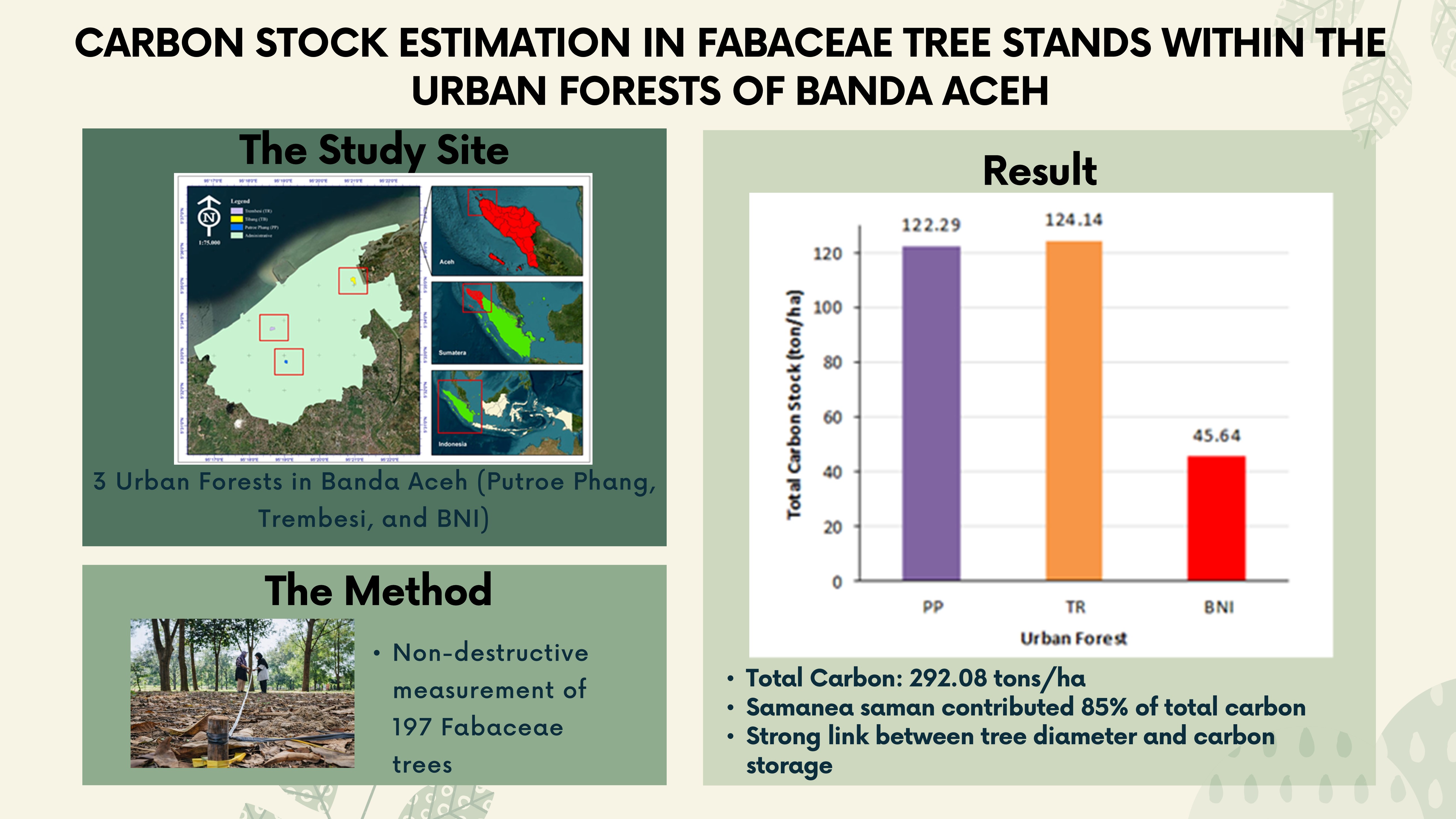
CARBON STOCK ESTIMATION IN FABACEAE TREE STANDS WITHIN THE URBAN FORESTSOF BANDA ACEH

Downloads
ARTICLE HIGHLIGHTS
- Identified four Fabaceae tree species across three urban forests in Banda Aceh.
- Total estimated potential carbon stock in Fabaceae stands reached 292.08 tonnes/ha.
- Trembesi Urban Forest contributed the highest carbon stock at 124.14 tonnes/ha.
- Samanea saman is the dominant carbon contributor, storing 248.44 tonnes/ha.
- Stem diameter serves as a highly reliable predictor for urban tree carbon stocks.
ABSTRACT
Urban forests play a crucial role in absorbing carbon emissions through the biomass carbon stocks stored in vegetation. The Fabaceae family is a potential group of tree for carbon storage, but its contribution to the Banda Aceh urban forest area remains understudied. This study aims to identify tree species from the Fabaceae family and estimate the potential carbon stocks stored in stands of this family in the Banda Aceh urban forest. The study was conducted in three urban forest locations: Putroe Phang (PP), Trembesi (TR), and BNI Urban Forests (BNI). Carbon stocks were estimated using a non-destructive method with an allometric equation approach. The results showed that there were four tree species from the Fabaceae family, namely Samanea saman, Pterocarpus indicus, Tamarindus indica, and Delonix regia, with a total of 197 individuals recorded. The total potential carbon stocks stored in Fabaceae stands in the three urban forest areas reached 292.08 tons/ha, with the largest contribution coming from the Trembesi (TR) Urban Forest at 124.14 tons/ha. The tree species that provides the largest contribution to carbon biomass is Samanea saman with an estimate of 248.44 tons/ha.
Abbas S, Wong MS, Wu J, Shahzad N, Irteza SM. 2020. Approaches of satellite remote sensing for the assessment of above-ground biomass across tropical forests: Pan-tropical to national scales. Remote Sens 12(20):3351. DOI: 10.3390/rs12203351 DOI: https://doi.org/10.3390/rs12203351
Amin N. 2016. Carbon reserves in urban forest plants in Banda Aceh. In: Proceedings of the National Seminar on Biotics 4(1):71–80. DOI: 10.22373/pbio.v4i1.2534
Amin N, Hasanuddin, Djufri. 2014. The potential of plant species in the Banda Aceh Urban Forest to reduce CO2 emissions. J EduBio Tropica 2:187–250.
Basuki TM, van Laake PE, Skidmore AK, Hussin YA. 2009. Allometric equations for estimating the above-ground biomass in tropical lowland Dipterocarp forests. For Ecol Manag 257(8):1684–1694. DOI: 10.1016/j.foreco.2009.01.027
[BMKG] Meteorology, Climatology, and Geophysics Agency. 2022. Indonesia's extreme climate change. [Internet]. [Accessed 15 April 2022]. Available from https://www.bmkg.go.id/ iklim/?p=ekstrem-climate-change
Brown S. 1997. Estimating biomass and biomass change of tropical forests: A primer. FAO Forestry Paper. Vol 134. Rome (IT): Food and Agriculture Organization.
[BSN] Indonesian National Standard. 2019. SNI 7724:2019 – Measurement and calculation of carbon stocks for forest carbon stock estimation. Jakarta (ID): Indonesian National Standard.
Chaunan NN, Jadeja MB, Patel MS, Shah BN. 2019. Pharmacognostic studies on stems of Samanea saman (Jacq) Merr. Pharma Sci Monit 10:76–84. DOI: 10.1016/j.foreco.2009.01.027 DOI: https://doi.org/10.1016/j.foreco.2009.01.027
Chave J, Réjou-Méchain M, Búrquez A, Chidumayo E, Colgan MS, Delitti WBC, Vieilledent G. 2014. Improved allometric models to estimate the aboveground biomass of tropical trees. Glob Change Biol 20(10):3177–3190. DOI: 10.1111/gcb.12629 DOI: https://doi.org/10.1111/gcb.12629
Chen X, Luo M, Larjavaara M. 2023. Effects of climate and plant functional types on forest above-ground biomass accumulation. Carbon Balance Manag 18:5. DOI: 10.1186/s13021-023-00225-1 DOI: https://doi.org/10.1186/s13021-023-00225-1
Dahlan EN. 2010. Trembesi was once foreign, now it is no longer. Bogor (ID): IPB Press.
Dharma W, Zakaria R. 2022. Vegetation analysis of 10 urban forest in the city of Banda Aceh, Indonesia. Biodiversity 23:4131–4137. DOI: 10.13057/biodiv/d230834 DOI: https://doi.org/10.13057/biodiv/d230834
Duveiller G, Hooker J, Cescatti A. 2018. The mark of vegetation change on Earth’s surface energy balance. Nat Commun 9(1):679. DOI: 10.1038/s41467-017-02810-8 DOI: https://doi.org/10.1038/s41467-017-02810-8
Fajar AR, Nur BA. 2017. Estimation of carbon reserves by modeling the application of tamarind planting on green roads in Rembang Regency. In: Proceeding Biology Education Conference. Vol 14. p. 229–232.
Forrester DI. 2021. Does individual-tree biomass growth increase continuously with tree size?. For Ecol Manag 118717:1–10. DOI: 10.1016/j.foreco.2020.118717 DOI: https://doi.org/10.1016/j.foreco.2020.118717
Gielen B, Acosta M, Altimir N, Buchmann N, Cescatti A, Ceschia É, Wohlfahrt G. 2018. Ancillary vegetation measurements at ICOS ecosystem stations. Int Agrophys 32(4):645–664. DOI: 10.1515/intag-2017-0048 DOI: https://doi.org/10.1515/intag-2017-0048
Gunawan S, Karyati, Syafrudin M. 2021. Pollutant content on the leaves of Angana (Pterocarpus indicus Willd.) in Samarinda City. Journal of Development Research 3(2):46–54. DOI: 10.36087/jrp.v3i2.72 DOI: https://doi.org/10.36087/jrp.v3i2.72
Indrawan M, Primack RB, Supriatna J. 2012. Conservation biology. Jakarta (ID): Yayasan Obor Indonesia.
Irundu D, Beddu MA, Najmawati. 2020. Potential biomass and carbon storage in green open spaces in Polewali City, West Sulawesi. Journal of Forests and Society 12:49–57. DOI: 10.24259/jhm.v12i1.9675 DOI: https://doi.org/10.24259/jhm.v12i1.9675
Irwan MR, Widiyanti P, Irsyam ASD, Astuti RS. 2021. Diversity of conservation status and potential of the Fabaceae family in the Bogor Botanical Gardens collection. Tropical Biosciences 1:1–10. DOI: 10.32678/tropicalbiosci.v1i2.4310 DOI: https://doi.org/10.32678/tropicalbiosci.v1i2.4310
Istomo, Farida NE. 2017. Potential above-ground carbon storage of Acacia nilotica L. (Willd.) ex Del. stands in Baluran National Park, East Java. Journal of Natural Resources and Environmental Management 7(2):155–162. DOI: 10.29244/jpsl.7.2.155-162 DOI: https://doi.org/10.29244/jpsl.7.2.155-162
Jilo D, Birhane E, Tadesse T, Ubuy MH. 2025. Aboveground biomass models for common woody species of lowland forest in Borana woodland, Southern Ethiopia. Forests 16(5):823. DOI: 10.3390/f16050823 DOI: https://doi.org/10.3390/f16050823
Lahoti S, Lahoti A, Joshi RK, Saitô O. 2020. Vegetation structure, species composition, and carbon sink potential of urban green spaces in Nagpur City, India. Land 9(4):107. DOI: 10.3390/land9040107 DOI: https://doi.org/10.3390/land9040107
Loguercio GA, Simon A, Winter AN, Ivancich H, Reiter EJ, Caselli M, Walentowski H. 2024. Carbon density and sequestration in the temperate forests of northern Patagonia, Argentina. Front For Glob Change 7:1373187. DOI: 10.3389/ffgc.2024.1373187 DOI: https://doi.org/10.3389/ffgc.2024.1373187
Lubis SH, Arifin HS, Samsoedin I. 2013. Analysis of tree carbon stocks in urban forest landscapes in DKI Jakarta. Journal of Social and Economic Research on Forestry 10(1):1–20. DOI: 10.20886/jpsek.2013.10.1.1-20 DOI: https://doi.org/10.20886/jpsek.2013.10.1.1-20
McPherson EG, van Doorn NS, Peper PJ. 2016. Urban tree database and allometric equations. General Technical Report; PSW-GTR-253. Albany (US): USDA Forest Service. DOI: https://doi.org/10.2737/PSW-GTR-253
Mountford H, Waskow D, Gonzalez L, Gajjar C. 2021. COP 26: Key outcomes from the UN climate talks in Glasgow. Rockville (US): World Resources Institute.
Mueller-Dombois D, Ellenberg H. 1974. Aims and methods of vegetation ecology. New York (US): John Wiley and Sons.
Muluneh MG, Worku BB. 2022. Carbon storages and sequestration potentials in remnant forests of different patch sizes in northern Ethiopia: An implication for climate change mitigation. Agric Food Secur 11(57):1–24. DOI: 10.1186/s40066-022-00395-0 DOI: https://doi.org/10.1186/s40066-022-00395-0
Municipal Government of Banda Aceh. 2019. Masterplan Banda Aceh Smart City 2019-2029: Becoming an Islamic smart city that is attractive and competitive. Banda Aceh (ID): Municipal Government of Banda Aceh.
Nowak DJ, Greenfield EJ, Hoehn RE, Lapoint E. 2013. Carbon storage and sequestration by trees in urban and community areas of the United States. Environ Pollut 178:229–236. DOI: 10.1016/j.envpol.2013.03.019 DOI: https://doi.org/10.1016/j.envpol.2013.03.019
Ow LF, Ghosh D, Yusof MLM. 2019. Growth of Samanea saman: Estimated cooling potential of this tree in an urban environment. Urban For Urban Green 41:264–271. DOI: 10.1016/j.ufug.2019.03.021 DOI: https://doi.org/10.1016/j.ufug.2019.03.021
Pipite A. 2022. Estimation of aboveground biomass (ABG) using allometric equation: case study of colo-i-suva forest park in Fiji. Earth Environ Sci Res Rev 5(3):137–147. DOI: https://doi.org/10.33140/EESRR.05.03.09
Poorter L, Amissah L, Bongers F, Hordijk I, Kok J, Laurance SGW, Chazdon RL. 2021. Multidimensional tropical forest recovery. Science 374(6573):1370–1376. DOI: 10.1126/science.abh3629 DOI: https://doi.org/10.1126/science.abh3629
Poorter L, van der Sande MT, Thompson J, Arets EJMM, Alarcón A, Álvarez-Sánchez J, Peña-Claros M. 2015. Diversity enhances carbon storage in tropical forests. Glob Ecol Biogeogr 24(11):1314–1328. DOI: 10.1111/geb.12364 DOI: https://doi.org/10.1111/geb.12364
Pragasan LA. 2015. Total carbon stock of tree vegetation and its relationship with altitudinal gradient from the Shervarayan Hills located in India. J Earth Sci Clim Change 6(4).
Santoso N, Sutopo P, Pambudi GP, Danarta VF, Wibisono RA, Astuti TP, Wicaksono DB. 2021. Estimation of biomass and carbon sequestration in several areas of the Jakarta, Bekasi, and Bogor Urban Forest Parks. Journal of Plantation Forest Research 18(1):35–49. DOI: 10.20886/jpht.2021.18.1.35-49 DOI: https://doi.org/10.20886/jpht.2021.18.1.35-49
Saremi H, Kumar L, Stone C, Melville GJ, Turner R. 2014. Sub-compartment variation in tree height, stem diameter and stocking in a Pinus radiata D. Don plantation examined using airborne LiDAR data. Remote Sens 6(8):7592–7609. DOI: 10.3390/rs6087592 DOI: https://doi.org/10.3390/rs6087592
Singh S, Kumar SN. 2014. A review: Introduction to genus Delonix. World J Pharm Pharm Sci 3(6):2045–2055.
Soerianegara I, Indrawan A. 1988. Indonesian forest ecology. Bogor (ID): Forest Ecology Laboratory, Faculty of Forestry, Bogor Agricultural University.
Stiling P. 2012. Ecology. New York (US): The McGraw-Hill Companies.
Sukma Y. 2019. Phenotypic relationship of Fabaceae family members in the BNI Banda Aceh Urban Forest as a reference for higher plant botany courses. [Thesis]. Banda Aceh (ID): UIN Ar-Raniry.
Sun T. 2023. The impact of global climate change policy on employment-environmental regulation in the context of just transition. SHS Web of Conferences 154:01017. DOI: 10.1051/shsconf/202315401017 DOI: https://doi.org/10.1051/shsconf/202315401017
Sutthichaimethee P, Saraphirom P, Junsiri C. 2025. Long-term strategy for determining the potential of climate-smart agriculture to maximize efficiency under sustainability in Thailand. Sustainability 17(8):3635. DOI: 10.3390/su17083635 DOI: https://doi.org/10.3390/su17083635
Tagesson T, Schurgers G, Horion S, Ciais P, Tian F, Brandt M, Fensholt R. 2020. Recent divergence in the contributions of tropical and boreal forests to the terrestrial carbon sink. Nat Ecol Evol 4(2):202–209. DOI: 10.1038/s41559-019-1090-0 DOI: https://doi.org/10.1038/s41559-019-1090-0
Wang Y, Chang Q, Li X. 2021. Promoting sustainable carbon sequestration of plants in urban greenspace by planting design: a case study in parks of Beijing. Urban For Urban Green 64:127291. DOI: 10.1016/j.ufug.2021.127291 DOI: https://doi.org/10.1016/j.ufug.2021.127291
Wang Z, Xu L, Shi Y, Ma Q, Wu Y, Lu Z, Zhang Q. 2021. Impact of land use change on vegetation carbon storage during rapid urbanization: A case study of Hangzhou, China. Chinese Geogr Sci 31(2):209–222. DOI: 10.1007/s11769-021-1183-y DOI: https://doi.org/10.1007/s11769-021-1183-y
Copyright (c) 2026 Wira Dharma, Yekki Yasmin, Nada Ariqah, Essy Harnelly, Alia Rizki, Amirunnas, Anita Rauzana, Rahmad Zakaria

This work is licensed under a Creative Commons Attribution-NonCommercial-NoDerivatives 4.0 International License.
Authors who publish with this journal agree with the following terms:
- Authors retain copyright and grant the journal right of first publication, with the work 1 year after publication simultaneously licensed under a Creative Commons attribution-noncommerical-noderivates 4.0 International License that allows others to share, copy and redistribute the work in any medium or format, but only where the use is for non-commercial purposes and an acknowledgement of the work's authorship and initial publication in this journal is mentioned.
- Authors are able to enter into separate, additional contractual arrangements for the non-exclusive distribution of the journal's published version of the work (e.g., post it to an institutional repository or publish it in a book), with an acknowledgement of its initial publication in this journal.
- Authors are permitted and encouraged to post their work online (e.g., in institutional repositories or on their website) prior to and during the submission process, as it can lead to productive exchanges, as well as earlier and greater citation of published work (See The Effect of Open Access).