ANTIBACTERIAL ACTIVITY OF Melaleuca cajuputi HYDROSOL FROM ESSENTIAL OIL DISTILLATION AGAINST PATHOGENIC BACTERIA

Downloads
ARTICLE HIGLIGHTS
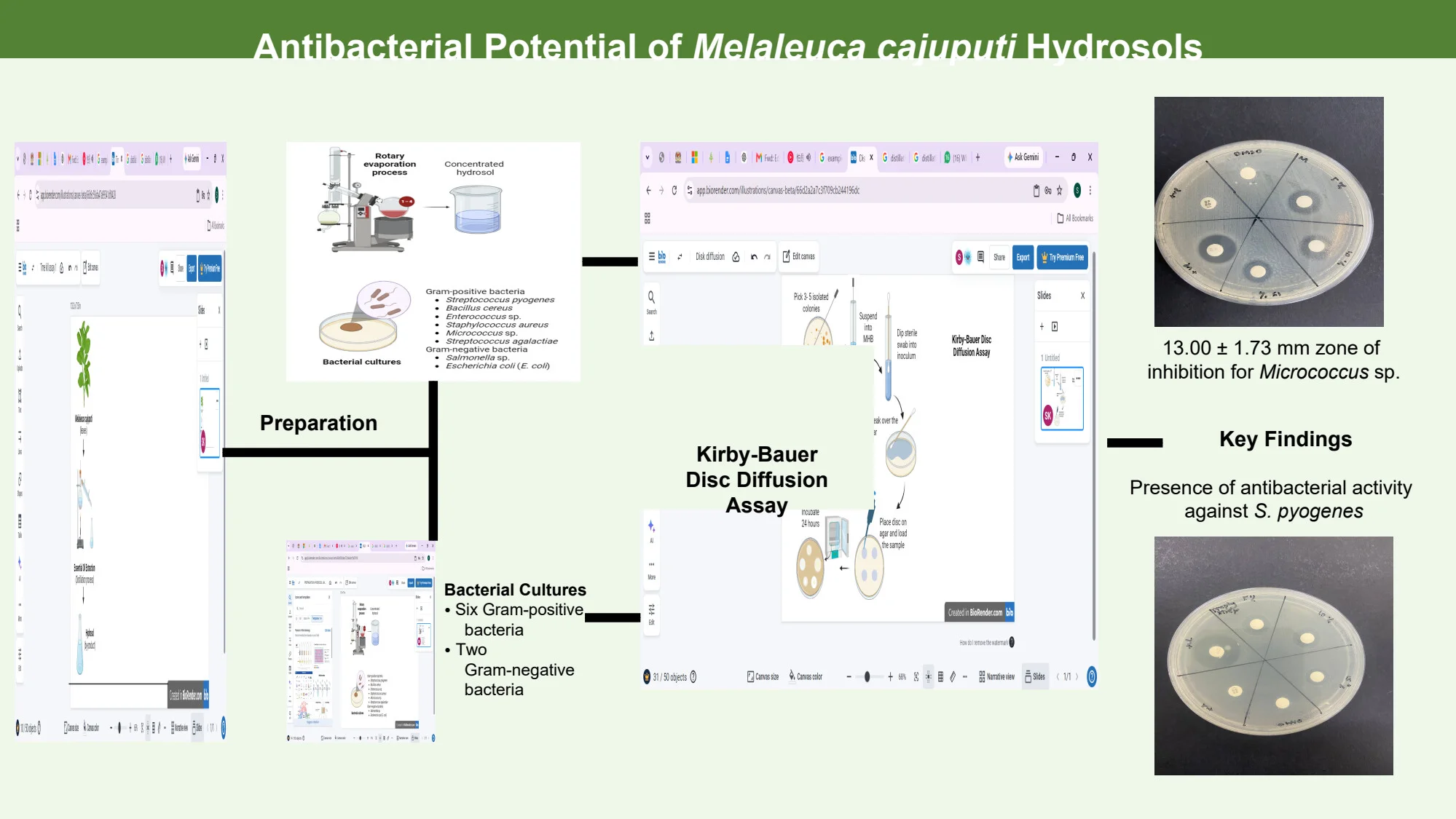
- Melaleuca cajuputi hydrosols inhibited the growth of selected pathogenic bacteria.
- Strong antibacterial activity was observed against Gram-positive bacteria, while no antibacterial effect was detected against Gram-negative bacteria (Salmonella sp. and Escherichia coli).
- Streptococcus pyogenes and Micrococcus sp. showed the largest antibacterial activity with the presence of inhibition zones of 13.00 ± 2.00 mm and 13.00 ± 1.73 mm.
- Hydrosols from Melaleuca cajuputi oil extraction demonstrate potential as sustainable natural antimicrobial agents.
ABSTRACT
Antibiotic resistance has become a major global concern and remains one of the most pressing threats to public health. In the search for alternative antimicrobial agents, plants have long been a valuable source of bioactive compounds. Melaleuca cajuputi is well known for its essential oils, which are rich in phytochemicals with antimicrobial potential. However, limited attention has been given to its hydrosols, which are typically considered by-products of essential oil distillation but may also possess biologically active constituents. This study investigated the antibacterial activity of hydrosols obtained from Melaleuca cajuputi oil extraction. The Kirby–Bauer disc diffusion method was employed to evaluate the hydrosol’s effects against six pathogenic bacteria. The results showed clear inhibition zones for all tested Gram-positive bacteria, whereas no inhibitory effects were observed for Gram-negative bacteria, including Salmonella spp. and Escherichia coli. The highest activity was observed against Streptococcus pyogenes and Micrococcus sp., with inhibition zones of 13.00 ± 2.00 mm and 13.00 ± 1.73 mm, respectively, at a hydrosol concentration of 15% (v/v). These findings suggest that Melaleuca cajuputi hydrosols may contain bioactive compounds with potential for antibacterial properties. However, more studies involving chemical characterization and minimum inhibitory concentration (MIC) are required to substantiate its efficacy and elucidate its mechanism of action.
Downloads
Aćimović M, Tešević V, Smiljanić K, Cvetković M, Stanković J, Kiprovski B, Sikora V. 2020. Hydrolates: By-products of essential oil distillation, chemical composition, biological activity, and potential uses. Adv Technol 9(2):54–70. DOI: https://doi.org/10.5937/savteh2002054A
Breijyeh Z, Jubeh B, Karaman R. 2020. Resistance of Gram-negative bacteria to current antibacterial agents and approaches to resolve it. Molecules 25(6):1340. DOI: https://doi.org/10.3390/molecules25061340
Ehling-Schulz M, Lereclus D, Koehler TM. 2019. The Bacillus cereus group: Bacillus species with pathogenic potential. Microbiol Spectr 7(3): GPP3-0032-2018. DOI: https://doi.org/10.1128/microbiolspec.GPP3-0032-2018
Farahmandfar R, Esmaeilzadeh Kenari R, Asnaashari M, Shahrampour D, Bakhshandeh T. 2019. Bioactive compounds, antioxidant and antimicrobial activities of Arum maculatum leaf extracts as affected by various solvents and extraction methods. Food Sci Nutr 7(2):465–475. DOI: https://doi.org/10.1002/fsn3.815
Gallardo-Villagrán M, Paulus L, Leger DY, Therrien B, Liagre B. 2022. Dimethyl sulfoxide: A bio-friendly or bio-hazard chemical? The effect of DMSO in human fibroblast-like synoviocytes. Molecules 27(14):4472. DOI: https://doi.org/10.3390/molecules27144472
Guitor AK, Wright GD. 2018. Antimicrobial resistance and respiratory infections. Chest 154(5):1202–1212. DOI: https://doi.org/10.1016/j.chest.2018.06.019
Hombach M, Maurer FP, Pfiffner T, Böttger EC, Furrer R. 2015. Standardization of operator-dependent variables affecting precision and accuracy of the disk diffusion method for antibiotic susceptibility testing. J Clin Microbiol 53(12):3864–3869. DOI: https://doi.org/10.1128/JCM.02351-15
Lai HY, Lu YCC, Fan KH, Virgirinia RP, Prasetyaningrum N, Nugraeni Y, Huang HM. 2025. Investigating the biological activities of Sapindus mukorossi seed hydrosol and its potential as a skincare ingredient. Sci Rep 15(1):42801. DOI: https://doi.org/10.1038/s41598-025-27030-9
Li X, Li Z, Li R, Zhang Y, Fu W, Li L, Hao R. 2025. Hydrosol extracts from Prunus species: Optimization, antibacterial activity, and applications in food preservation. Food Biosci 107406. DOI: https://doi.org/10.1016/j.fbio.2025.107406
Malanovic N, Lohner K. 2016. Antimicrobial peptides targeting Gram-positive bacteria. Pharmaceuticals 9(3):59. DOI: https://doi.org/10.3390/ph9030059
Noor AA, Yusuf SM, Wahab WN, Adam MF, Sul’ain MD. 2021. Evaluation of composition, antioxidants and toxicity of Melaleuca cajuputi leaves. Adv Tradit Med 21(4):693–699. DOI: https://doi.org/10.1007/s13596-020-00479-x
Quinn GA, Banat AM, Abdelhameed AM, Banat IM. 2020. Streptomyces from traditional medicine: sources of new innovations in antibiotic discovery. J Med Microbiol 69(8):1040–1048. DOI: https://doi.org/10.1099/jmm.0.001232
Riyankati B, Hadi S, Handayani SS. 2022. Characterization and chemical composition analysis of tea tree (Melaleuca alternifolia) leaf hydrosols growing on Lombok Island. J Penelit Pendidik IPA 8(1):119–123. DOI: https://doi.org/10.29303/jppipa.v8i1.1239
Rohde M. 2019. The Gram-positive bacterial cell wall. Microbiol Spectr 7(3):10–1128. DOI: https://doi.org/10.1128/microbiolspec.GPP3-0044-2018
Summer K, Browne J, Hollanders M, Benkendorff K. 2022. Out of control: The need for standardised solvent approaches and data reporting in antibiofilm assays incorporating dimethyl-sulfoxide (DMSO). Biofilm 4:100081. DOI: https://doi.org/10.1016/j.bioflm.2022.100081
Taglienti A, Donati L, Ferretti L, Tomassoli L, Sapienza F, Sabatino M, Di Massimo G, Fiorentino S, Vecchiarelli V, Nota P, Ragno R. 2022. In vivo antiphytoviral activity of essential oils and hydrosols from Origanum vulgare, Thymus vulgaris, and Rosmarinus officinalis to control Zucchini yellow mosaic virus and Tomato leaf curl New Delhi virus in Cucurbita pepo L. Front Microbiol 13:840893. DOI: https://doi.org/10.3389/fmicb.2022.840893
Ukit U, Widiana A, Rahmawati E, Hasby RM. 2019. Antibacterial activities test of cajuput leaf waste extract (Melaleuca cajuputi Powell) on pathogenic bacteria. J Phys Conf Ser 1402(3):033030. DOI: https://doi.org/10.1088/1742-6596/1402/3/033030
Vohrnová S, Kozáková J, Honskus M. 2025. Comparison of Streptococcus pneumoniae isolates occurring in optochin-susceptible and optochin-resistant variants by analyzing whole-genome sequencing data. Microbiol Spectr 13(4), e01939-24. DOI: https://doi.org/10.1128/spectrum.01939-24
Webster CM, Shepherd M. 2023. A mini-review: environmental and metabolic factors affecting aminoglycoside efficacy. World J Microbiol Biotechnol 39(1):7. DOI: https://doi.org/10.1007/s11274-022-03445-8
Windels EM, Michiels JE, Van den Bergh B, Fauvart M, Michiels J. 2019. Antibiotics: Combating tolerance to stop resistance. mBio 10(5), e02095-19. DOI: https://doi.org/10.1128/mBio.02095-19
Copyright (c) 2026 Siti Khadijah Awang, Irdeana Marsha Baharuddin, Muhammad Iqbal Mashudi, Muhammad Hanif Abdullah, Fazilah Ariffin

This work is licensed under a Creative Commons Attribution-NonCommercial-NoDerivatives 4.0 International License.
Authors who publish with this journal agree with the following terms:
- Authors retain copyright and grant the journal right of first publication, with the work 1 year after publication simultaneously licensed under a Creative Commons attribution-noncommerical-noderivates 4.0 International License that allows others to share, copy and redistribute the work in any medium or format, but only where the use is for non-commercial purposes and an acknowledgement of the work's authorship and initial publication in this journal is mentioned.
- Authors are able to enter into separate, additional contractual arrangements for the non-exclusive distribution of the journal's published version of the work (e.g., post it to an institutional repository or publish it in a book), with an acknowledgement of its initial publication in this journal.
- Authors are permitted and encouraged to post their work online (e.g., in institutional repositories or on their website) prior to and during the submission process, as it can lead to productive exchanges, as well as earlier and greater citation of published work (See The Effect of Open Access).