MOTH COMMUNITY RESPONSES TO VEGETATION COMPLEXITY AND MICROCLIMATE IN NYARIBUNGAN,MAHAKAM ULU, EAST KALIMANTAN

Downloads
ARTICLE HIGHLIGHTS
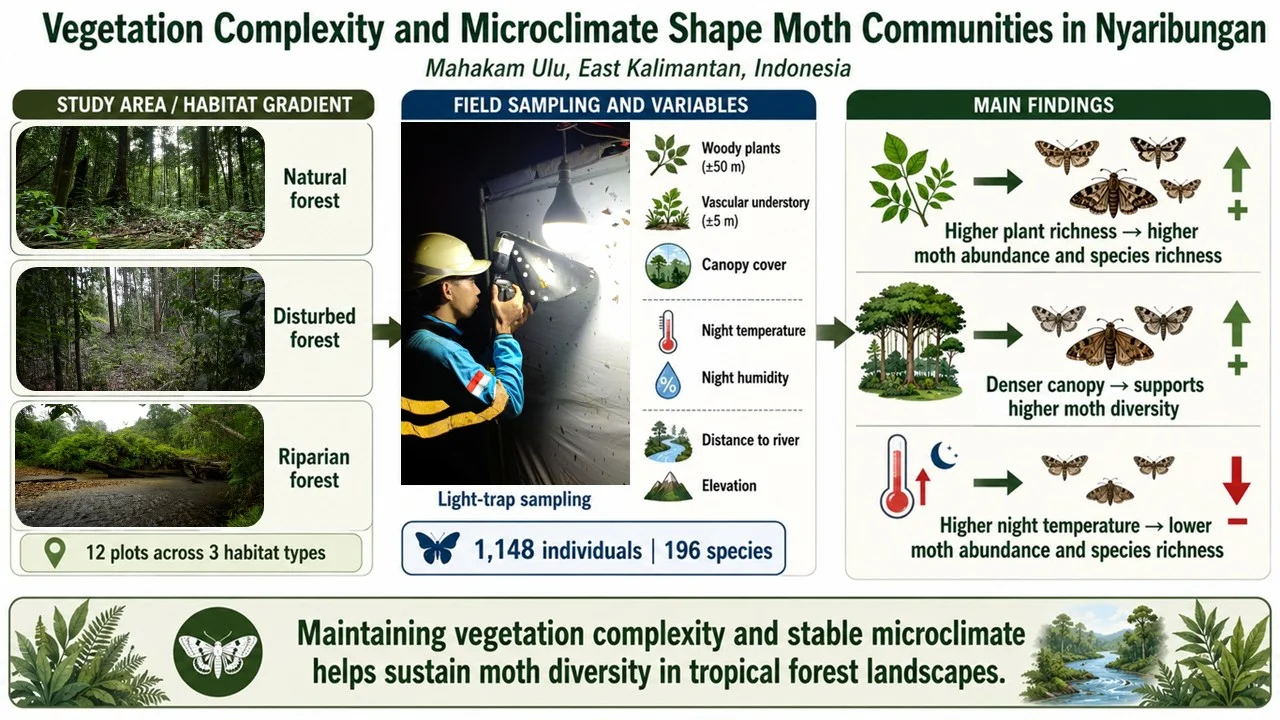
- Moth communities differed across three tropical forest habitats.
- Natural forest supported the richest moth community.
- Plant richness and canopy cover were linked to higher moth diversity.
- Higher night temperature was linked to lower moth abundance.
- Vegetation complexity is important for sustaining moth diversity.
ABSTRACT
Vegetation complexity and local microclimatic conditions are important factors shaping moth communities in tropical forest landscapes. This study examined differences in moth community structure and composition among habitat types and evaluated the relationships of moth abundance and species richness with vegetation richness and local environmental variables in Nyaribungan Village, Mahakam Ulu, East Kalimantan, Indonesia. Moths were sampled using light traps in 12 plots distributed across three habitat types: natural forest, disturbed forest, and riparian buffer, with four plots in each habitat. Woody plants were recorded within a ±50 m radius and vascular understory plants within a 5 m radius from each trap point. Environmental variables included canopy cover, nighttime temperature, nighttime relative humidity, distance to river, and elevation. A total of 1,149 moth individuals representing 196 species from 18 families were recorded. Natural forest supported the highest abundance, species richness, and Shannon diversity, whereas disturbed forest had the lowest values and riparian buffer was intermediate. Moth community composition differed significantly among habitat types at the global level. Bivariate negative binomial models showed that woody plant richness, vascular plant richness, and canopy cover were positively associated with moth abundance and species richness, whereas night temperature was negatively associated with both metrics. These findings indicate that vegetation-rich, closed-canopy habitats were associated with more abundant and species-rich moth communities, highlighting the importance of natural forest remnants and riparian habitats for maintaining moth diversity in disturbed tropical forest landscapes.
Downloads
Achury R, Staab M, Seibold S, Müller J, Heidrich L, Püls M, … Weisser W. 2025. Habitat and land-use intensity shape moth community structure across temperate forest and grassland. J Anim Ecol 94(11):2308–2321. DOI: 10.1111/1365-2656.70132 DOI: https://doi.org/10.1111/1365-2656.70132
Anderson MJ. 2001. A new method for non-parametric multivariate analysis of variance. Austral Ecol 26(1):32–46. DOI: 10.1111/j.1442-9993.2001.01070.pp.x DOI: https://doi.org/10.1111/j.1442-9993.2001.01070.pp.x
Anderson MJ. 2006. Distance-based tests for homogeneity of multivariate dispersions. Biometrics 62(1):245–253. DOI: 10.1111/j.1541-0420.2005.00440.x DOI: https://doi.org/10.1111/j.1541-0420.2005.00440.x
Axmacher JC, Brehm G, Hemp A, Tünte H, Lyaruu HVM, Müller-Hohenstein K, Fiedler K. 2009. Determinants of diversity in afrotropical herbivorous insects (Lepidoptera: Geometridae): Plant diversity, vegetation structure or abiotic factors? J Biogeogr 36:337–349. DOI: 10.1111/j.1365-2699.2008.01997.x DOI: https://doi.org/10.1111/j.1365-2699.2008.01997.x
Axmacher JC, Tünte H, Schrumpf M, Müller-Hohenstein K, Lyaruu HVM, Fiedler K. 2004. Diverging diversity patterns of vascular plants and geometrid moths during forest regeneration on Mt Kilimanjaro, Tanzania. J Biogeogr 31:895–904. DOI: 10.1111/j.1365-2699.2004.00995.x DOI: https://doi.org/10.1111/j.1365-2699.2004.00995.x
Banza P, Belo ADF, Evans DM. 2015. The structure and robustness of nocturnal Lepidopteran pollen-transfer networks in a biodiversity hotspot. Insect Conserv Divers 8(6):538–546. DOI: 10.1111/icad.12134 DOI: https://doi.org/10.1111/icad.12134
Beck J, Brehm G, Fiedler K. 2011. Links between the environment, abundance and diversity of Andean moths. Biotropica 43:208–217. DOI: 10.1111/j.1744-7429.2010.00689.x DOI: https://doi.org/10.1111/j.1744-7429.2010.00689.x
Beck J, Schulze CH, Linsenmair KE, Fiedler K. 2002. From forest to farmland: Diversity of geometrid moths along two habitat gradients on Borneo. J Trop Ecol 18(1):33–51. DOI: 10.1017/S026646740200202X DOI: https://doi.org/10.1017/S026646740200202X
Benjamini Y, Hochberg Y. 1995. Controlling the false discovery rate: A practical and powerful approach to multiple testing. J R Stat Soc B 57(1):289–300. DOI: 10.1111/j.2517-6161.1995.tb02031.x DOI: https://doi.org/10.1111/j.2517-6161.1995.tb02031.x
Brehm G. 2017. A new LED lamp for the collection of nocturnal Lepidoptera and a spectral comparison of light-trapping lamps. Nota Lepidopterol 40(1):87–108. DOI: 10.3897/nl.40.11887 DOI: https://doi.org/10.3897/nl.40.11887
Dufrêne M, Legendre P. 1997. Species assemblages and indicator species: The need for a flexible asymmetrical approach. Ecol Monogr 67(3):345–366. DOI: 10.1890/0012-9615(1997)067[0345:SAAIST]2.0.CO;2 DOI: https://doi.org/10.1890/0012-9615(1997)067[0345:SAAIST]2.0.CO;2
Ferro VG, Romanowski HP. 2012. Diversity and composition of tiger moths (Lepidoptera: Arctiidae) in an area of Atlantic Forest in southern Brazil: Is the fauna more diverse in the grassland or in the forest? Zoologia 29(1):7–18. DOI: 10.1590/S1984-46702012000100002 DOI: https://doi.org/10.1590/S1984-46702012000100002
Fetnassi N, Ude K, Kull A, Tammaru T. 2022. Weather sensitivity of sugar bait trapping of nocturnal moths: A case study from northern Europe. Insects 13(12):1087. DOI: 10.3390/insects13121087 DOI: https://doi.org/10.3390/insects13121087
Fisher RA. 1925. Statistical methods for research workers. Edinburgh (GB-SCT): Oliver and Boyd.
Gray REJ, Slade EM, Chung AYC, Lewis OT. 2019. Movement of moths through riparian reserves within oil palm plantations. Front For Glob Change 2:68. DOI: 10.3389/ffgc.2019.00068 DOI: https://doi.org/10.3389/ffgc.2019.00068
Hawes J, da Silva Motta C, Overal WL, Barlow J, Gardner TA, Peres CA. 2009. Diversity and composition of Amazonian moths in primary, secondary and plantation forests. J Trop Ecol 25(3):281–300. DOI: 10.1017/S0266467409006038 DOI: https://doi.org/10.1017/S0266467409006038
Hilbe JM. 2011. Negative binomial regression. Second Edition. Cambridge (UK): Cambridge University Press. DOI: https://doi.org/10.1017/CBO9780511973420
Holloway JD [Internet]. n.d. Moths of Borneo. [cited 24 Mar 2026]. Available from: http://www.mothsofborneo.com
Holloway JD. 1983. The Moths of Borneo: Family Notodontidae. Malay Nat J 37:1–107.
Holloway JD. 1985. The Moths of Borneo: Family Noctuidae: Subfamilies Euteliinae, Stictopterinae, Plusiinae, Pantheinae. Malay Nat J 38:157–317.
Holloway JD. 1986. The Moths of Borneo: Key to families; families Cossidae, Metarbelidae, Ratardidae, Dudgeoneidae, Epipyropidae and Limacodidae. Malay Nat J 40:1–166.
Holloway JD. 1989. The Moths of Borneo: Family Noctuidae: Noctuinae, Heliothinae, Hadeninae, Acronictinae, Amphipyrinae, Agaristinae. Malay Nat J 43:57–226.
Holloway JD. 1993. The Moths of Borneo: Family Geometridae: Ennominae. Malay Nat J 47:1–309.
Holloway JD. 1996. The Moths of Borneo: Family Geometridae: Oenochrominae, Desmobathrinae, Geometrinae. Malay Nat J 49:147–326.
Holloway JD. 1997. The Moths of Borneo: Family Geometridae: Sterrhinae, Larentiinae, addenda to other subfamilies. Malay Nat J 51:1–242.
Holloway JD. 2005. The Moths of Borneo: Family Noctuidae, subfamily Catocalinae. Malay Nat J 58(1-4):1–529.
Holloway JD. 2011. The Moths of Borneo: Family Noctuidae, subfamilies Rivulinae, Phytometrinae, Herminiinae, Hypeninae and Hypenodinae. Malay Nat J 63:1–548.
iNaturalist [Internet]. n.d. iNaturalist. [cited 24 Mar 2026]. Available from: https://www.inaturalist.org
Intachat J, Holloway JD, Staines H. 2001. Effects of weather and phenology on the abundance and diversity of geometroid moths in a natural Malaysian tropical rain forest. J Trop Ecol 17(3):411–429. DOI: 10.1017/S0266467401001286 DOI: https://doi.org/10.1017/S0266467401001286
Jonason D, Franzén M, Ranius T. 2014. Surveying moths using light traps: Effects of weather and time of year. PLoS One 9(3):e92453. DOI: 10.1371/journal.pone.0092453 DOI: https://doi.org/10.1371/journal.pone.0092453
Kitching RL, Ashton LA, Nakamura A, Whitaker T. 2013. Distance-driven species turnover in Bornean rainforests: Homogenization of moth assemblages. Ecography 36(1):1–10. DOI: 10.1111/j.1600-0587.2012.07538.x DOI: https://doi.org/10.1111/j.1600-0587.2012.00023.x
Kitching RL, Orr AG, Thalib L, Mitchell H, Hopkins MS, Graham AW. 2000. Moth assemblages as indicators of environmental quality in remnants of upland Australian rain forest. J Appl Ecol 37(2):284–297. DOI: 10.1046/j.1365-2664.2000.00490.x DOI: https://doi.org/10.1046/j.1365-2664.2000.00490.x
La Cava S, Rijllo G, Zucco G, Innocenti S, Guasti M, Puletti N, … Scalercio S. 2024. Moths in space: The below-canopy structure of forest drives abundance and mobility-related traits of moth communities. Sci Total Environ 921:171056. DOI: 10.1016/j.scitotenv.2024.171056 DOI: https://doi.org/10.1016/j.scitotenv.2024.171056
Luke SH, Slade EM, Gray CL, Annammala KV, Drewer J, Williamson J, … Struebig MJ. 2019. Riparian buffers in tropical agriculture: Scientific support, effectiveness and directions for policy. J Appl Ecol 56(1):85–92. DOI: 10.1111/1365-2664.13280 DOI: https://doi.org/10.1111/1365-2664.13280
Magurran AE. 2004. Measuring biological diversity. Malden (US): Wiley-Blackwell.
McGeachie WJ. 1989. The effects of moonlight illuminance, temperature and wind speed on light-trap catches of moths. Bull Entomol Res 79(2):185–192. DOI: 10.1017/S000748530001817X DOI: https://doi.org/10.1017/S0007485300018162
Milodowski DT, Coomes DA, Swinfield T, Jucker T, Riutta T, Malhi Y, … Williams M. 2021. The impact of logging on vertical canopy structure across a gradient of tropical forest degradation intensity in Borneo. J Appl Ecol 58(8):1764–1775. DOI: 10.1111/1365-2664.13895 DOI: https://doi.org/10.1111/1365-2664.13895
Neff F, Chittaro Y, Korner-Nievergelt F, Litsios G, Rey E, Knop E. 2025. Moth communities are shaped by season, weather, elevation, and landscape composition. Insect Conserv Divers 18(4):670–680. DOI: 10.1111/icad.12835 DOI: https://doi.org/10.1111/icad.12835
New TR. 2004. Moths (Insecta: Lepidoptera) and conservation: Background and perspective. J Insect Conserv 8:79–94. DOI: https://doi.org/10.1023/B:JICO.0000045807.04047.bd
Niermann J, Brehm G. 2022. The number of moths caught by light traps is affected more by microhabitat than the type of UV lamp used in a grassland habitat. Eur J Entomol 119:36-42. DOI: 10.14411/eje.2022.004 DOI: https://doi.org/10.14411/eje.2022.004
Patrick B. 2016. Invertebrates: Light trapping v1.0. DOCCM-286730. Wellington (NZ): Department of Conservation, New Zealand.
Root HT, Verschuyl J, Stokely T, Hammond P, Scherr MA, Betts MG. 2017. Plant diversity enhances moth diversity in an intensive forest management experiment. Ecol Appl 27:134–142. DOI: 10.1002/eap.1426 DOI: https://doi.org/10.1002/eap.1426
Schulze CH, Fiedler K. 2003. Hawkmoth diversity in northern Borneo does not reflect the influence of anthropogenic habitat disturbance. Ecotropica 9:99–102.
Setiawan AW, Tjiu A, Meididit A, Iswinanto, Ginanjar A, Atut Y, Agusti R. 2021. Plant diversity in logged over forest in Mahakam Ulu, East Kalimantan, Indonesia. Biodiversitas 22(11):4829–4838. DOI: 10.13057/biodiv/d221115 DOI: https://doi.org/10.13057/biodiv/d221115
Tukey JW. 1949. Comparing individual means in the analysis of variance. Biometrics 5(2):99–114. DOI: https://doi.org/10.2307/3001913
Tyler T. 2020. Relationship between moth (night active Lepidoptera) diversity and vegetation characteristics in southern Sweden. J Insect Conserv 24:1005–1015. DOI: 10.1007/s10841-020-00270-y DOI: https://doi.org/10.1007/s10841-020-00270-y
Wildermuth B, Penanhoat A, Sennhenn-Reulen H, Matevski D, Drescher J, Aubry-Kientz M, … Schuldt A. 2024. Canopy structure influences arthropod communities within and beyond tree identity effects: Insights from combining LiDAR data, insecticidal fogging and machine learning regression modelling. Ecol Indic 160:111901. DOI: 10.1016/j.ecolind.2024.111901 DOI: https://doi.org/10.1016/j.ecolind.2024.111901
Williamson J, Slade EM, Luke SH, Swinfield T, Chung AYC, Coomes DA, … Struebig MJ. 2021. Riparian buffers act as microclimatic refugia in oil palm landscapes. J Appl Ecol 58(2):431–442. DOI: 10.1111/1365-2664.13784 DOI: https://doi.org/10.1111/1365-2664.13784
Willott SJ. 1999. The effects of selective logging on the distribution of moths in a Bornean rainforest. Philos Trans R Soc Lond B Biol Sci 354(1391):1783–1790. DOI: 10.1098/rstb.1999.0520 DOI: https://doi.org/10.1098/rstb.1999.0520
WWF-Indonesia. 2013. Local green development initiative in the “heart of the Heart of Borneo”. Jakarta (ID): WWF-Indonesia.
Yela JL, Holyoak M. 1997. Effects of moonlight and meteorological factors on light and bait trap catches of noctuid moths (Lepidoptera: Noctuidae). Environ Entomol 26(6):1283–1290. DOI: 10.1093/ee/26.6.1283 DOI: https://doi.org/10.1093/ee/26.6.1283
Copyright (c) 2026 Deba Oktaviansyah Putra Baharudin, Ndan Imang, Paulus Matius, Krishna Purnawan Candra, Kiswanto, Rachmat Budiwijaya Suba, Yaya Rayadin

This work is licensed under a Creative Commons Attribution-NonCommercial-NoDerivatives 4.0 International License.
Authors who publish with this journal agree with the following terms:
- Authors retain copyright and grant the journal right of first publication, with the work 1 year after publication simultaneously licensed under a Creative Commons attribution-noncommerical-noderivates 4.0 International License that allows others to share, copy and redistribute the work in any medium or format, but only where the use is for non-commercial purposes and an acknowledgement of the work's authorship and initial publication in this journal is mentioned.
- Authors are able to enter into separate, additional contractual arrangements for the non-exclusive distribution of the journal's published version of the work (e.g., post it to an institutional repository or publish it in a book), with an acknowledgement of its initial publication in this journal.
- Authors are permitted and encouraged to post their work online (e.g., in institutional repositories or on their website) prior to and during the submission process, as it can lead to productive exchanges, as well as earlier and greater citation of published work (See The Effect of Open Access).