PHYSIOLOGICAL AND METABOLOMIC APPROACH FROM DIFFERENT ACCESSIONS OF MULBERRY TREATED WITH SALT STRESS IN INDONESIA

Downloads
ARTICLE HIGHLIGHTS
- Information on salinity-tolerant mulberry accessions is currently unavailable. This research reveals the discovery of salinity-tolerant mulberry accessions from the exploration of various mulberry accessions in Indonesia.
- Salinity-tolerant mulberry accessions can be utilized for sustainable development and biodiversity conservation.
- Salinity stress treatment is known to increase secondary metabolites in mulberry plants.
- Profiling of secondary metabolites in mulberry plants in response to salinity stress is known.
- The integration of metabolomics and ecophysiology offers a new perspective on how plants adapt to stress.
ABSTRACT
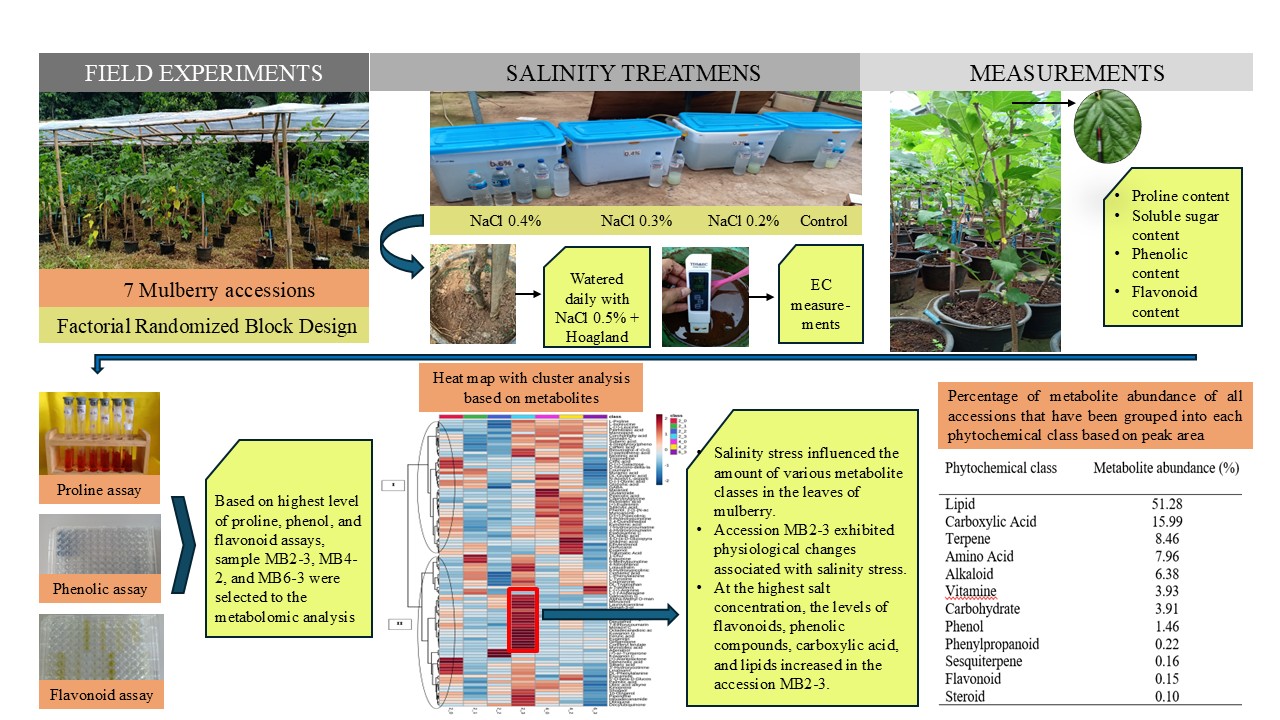
Land salinity in Indonesia continues to increase, therefore research is needed to obtain saline-resistant plants such as mulberries. Mulberry plants are well recognized for their resilience to various abiotic stresses, including salinity. This study aimed to identify tolerant accessions to salinity stress, in accordance with their growth characteristics, and to examine the alterations in secondary metabolites as a reaction to salt stress. The experiment was designed using a factorial randomized block design, which included seven mulberry accessions, identified as MB1 through MB7, and varying NaCl concentrations of 0% (control), 0.2%, 0.3%, and 0.4%. The study’s results showed that MB2-3 accession tolerates high salinity stress by accumulating proline, flavonoid compounds, phenolic and dissolved sugars, as well as secondary metabolites, with increasing NaCl concentration. Based on the results of UHPLC-Q-Orbitrap HRMS analysis of mulberry leaf extract, 100 selected metabolites were obtained. The heat map results showed metabolic substances such as phenylpropanoids, organic acids, lipids, and carbohydrates increased in response to salinity stress. The integration of metabolomics and ecophysiology called ecophysiolomics offers a new perspective on how plants adapt to stress. By analyzing the involvement of metabolites that facilitate tolerance to salinity stress, we can gain a valuable understanding of how mulberry plants endure this environmental challenge.
.
Ackah M, Shi Y, Wu M, Wang L, Guo P, Guo L, …, Qiu C. 2021. Metabolomics response to drought stress in Morus alba L. variety Yu-711. Plants 10(1636):1–35. DOI: https://doi.org/10.3390/plants10081636
Ahmed S, Shawon A, Roy SK, Woo SH, Sonawan KD, Shohael AM. 2019. Effect of salinity on the morphological, physiological, and biochemical properties of lettuce (Lactuca sativa L.) in Bangladesh. Open Agric 4:361–373. DOI: https://doi.org/10.1515/opag-2019-0033
Antunes ACN, Acunha T, Perin EC, Rombaldi V, Galli V, Chaves FC. 2019. Untargeted metabolomics of strawberry (Fragaria x ananassa ‘Camarosa’) fruit from plants grown under osmotic stress conditions. J Sci Food Agric 99(15):6973–6980. DOI: https://doi.org/10.1002/jsfa.9986
Bates LS, Waldren RP, Teare ID. 1973. Rapid determination of free proline for water-stress studies. Plant Soil 39:205–207. DOI: https://doi.org/10.1007/BF00018060
Blasco B, Leyva R, Romero L, Ruiz JM. 2013. Iodine effects on phenolic metabolism in lettuce plants under salt stress. J Agric Food Chem 61(11):2591–2596. DOI: https://doi.org/10.1021/jf303917n
Brenes M, Solana A, Boscaiu M, Fita A, Vicente O, Calatayud A, …, Plazas M. 2020. Physiological and biochemical responses to salt stress in cultivated eggplant (Solanum melongena L.) and in S. insanum L., a close wild relative. Agron 10(651):1–19. DOI: https://doi.org/10.3390/agronomy10050651
Cárdenas-Pérez S, Niedojadło K, Mierek-Adamska A, Dąbrowska GB, Piernik A. 2022. Maternal salinity influences anatomical parameters, pectin content, biochemical and genetic modifications of two Salicornia europaea populations under salt stress. Sci Rep 12(2968):1–16. DOI: https://doi.org/10.1038/s41598-022-06385-3
Choi SY, Park J, Kim J, Lee J, Yang H. 2021. Investigation of chemical profiles of different parts of Morus alba using a combination of molecular networking methods with mass spectral data from two ionization modes of LC/MS. Plants 10(1711):1–9. DOI: https://doi.org/10.3390/plants10081711
Gharsallah C, Fakhfak H, Grubb D, Gorsane F. 2016. Effect of salt stress on ion concentration, proline content, antioxidant enzyme activities and gene expression in tomato cultivars. AoB Plants 8(55):1–21. DOI: https://doi.org/10.1093/aobpla/plw055
Gigon A, Matos AR, Laffray D, Zuily-Fodil Y, Pham-Thi AT. 2004. Effect of drought stress on lipid metabolism in the leaves of Arabidopsis thaliana (Ecotype Columbia). Ann Bot 94:345–351. DOI: https://doi.org/10.1093/aob/mch150
Hamooh BT, Sattar FA, Wellman G, Mousa MAA. 2021. Metabolomic and biochemical analysis of two potato (Solanum tuberosum L.) cultivars exposed to in vitro osmotic and salt stresses. Plants 10(98):1–14. DOI: https://doi.org/10.3390/plants10010098
Harinasut P, Poonsopa D, Roengmongkol K, Charoensataporn R. 2003. Salinity effects on antioxidant enzymes in mulberry cultivar. ScienceAsia 29:109–113. DOI: https://doi.org/10.2306/scienceasia1513-1874.2003.29.109
Harrathi J, Hosni K, Karray-Bouraoui N, Attia H, Marzouk B, Magné C, Lachaal M. 2012. Effect of salt stress on growth, fatty acids and essential oils in safflower (Carthamus tinctorius L.). Acta Physiol Plant 34:129–137. DOI: https://doi.org/10.1007/s11738-011-0811-z
Ifmaily. 2018. Penetapan kadar pati buah sukun (Artocarpus altilis L.) dengan metode Luff Schoorl. [Determination of breadfruit (Artocarpus altilis L.) starch content using the Luff–Schoorl method]. Chempublish J 3(1):1–10. DOI: https://doi.org/10.22437/chp.v3i1.5056
Khan MIR, Iqbal N, Masood A, Khan N. 2012. Variation in salt tolerance of wheat cultivars: role of glycine betaine and ethylene. Pedosphere 22(6):746–754. DOI: https://doi.org/10.1016/S1002-0160(12)60060-5
Khumaida N, Syukur M, Bintang M, Nurcholis W. 2019. Phenolic and flavonoid content in ethanol extract and agro-morphological diversity of Curcuma aeruginosa accessions growing in West Java, Indonesia. Biodiversitas 20(3):656–663. DOI: https://doi.org/10.13057/biodiv/d200306
Kumar MSS, Ali K, Dahuja A, Tyagi A. 2015. Role of phytosterols in drought stress tolerance in rice. Plant Physiol Biochem 96:83–89. DOI: https://doi.org/10.1016/j.plaphy.2015.07.014
Kumar SG, Reddy AM, Sudhakar C. 2003. NaCl effects on proline metabolism in two high yielding genotypes of mulberry (Morus alba L.) with contrasting salt tolerance. Plant Sci 165:1245–1251. DOI: https://doi.org/10.1016/S0168-9452(03)00332-7
Liu CY, Liu XQ, Long DP, Cao BN, Xiang ZH, Zhao AC. 2017. De novo assembly of mulberry (Morus alba L.) transcriptome and identification of candidate unigenes related to salt stress responses. Russ J Plant Physiol 64(5):738–748. DOI: https://doi.org/10.1134/S1021443717050053
Liu Y, Ji D, Turgeon R, Chen J, Lin T, Huang J, …, Lv Z. 2019. Physiological and proteomic responses of mulberry trees (Morus alba L.) to combined salt and drought stress. Int J Mol Sci 20(2486):1–20. DOI: https://doi.org/10.3390/ijms20102486
López-Pérez L, Martínez-Ballesta MDC, Maurel C, Carvajal M. 2009. Changes in plasma membrane lipids, aquaporins and proton pump of broccoli roots, as an adaptation mechanism to salinity. Phytochem 70(4):492–500. DOI: https://doi.org/10.1016/j.phytochem.2009.01.014
Mahmoudi H, Huang J, Gruber MY, Kaddour R, Lachaâl M, Ouerghi Z, Hannoufa A. 2010. The impact of genotype and salinity on physiological function, secondary metabolite accumulation, and antioxidative responses in lettuce. J Agric Food Chem 58(8):5122–5130. DOI: https://doi.org/10.1021/jf904274v
Mishra RK, Singhal GS. 1993. Photosynthetic activity and peroxidation of thylakoid lipids during photoinhibition and high temperature treatment of isolated wheat chloroplasts. J Plant Physiol 141(3):286–292. DOI: https://doi.org/10.1016/S0176-1617(11)81736-0
Moradi P, Mahdavi A, Khoshkam M, Iriti M. 2017 Lipidomics unravels the role of leaf lipids in thyme plant response to drought stress. Inter J Mol Sci Article 18(2067):1–15. DOI: https://doi.org/10.3390/ijms18102067
Nam K-H, Kim DY, Kim HJ, Pack IS, Kim HJ, Chung YS, …, Kim CG. 2019. Global metabolite profiling based on GC-MS and LC-MS/MS analyses in ABF3-overexpressing soybean with enhanced drought tolerance. Appl Biol Chem 62(15):1–9. DOI: https://doi.org/10.1186/s13765-019-0425-5
Pacheco FV, de Paula Avelar R, Alvarenga ICA, Bertolucci DKV, de Alvarenga AA, Pinto JEBP. 2016. Essential oil of minkey-pepper (Piper aduncum L.) cultivated under different light environments. Ind Crops Prod 85:251–257. DOI: https://doi.org/10.1016/j.indcrop.2016.03.016
Pardo JM. 2010. Biotechnology of water and salinity stress tolerance. Curr Opin Biotechnol 21:185–196. DOI: https://doi.org/10.1016/j.copbio.2010.02.005
Rogowska A, Szakiel A. 2020. The role of sterols in plant response to abiotic stress. Phytochem Rev 19:1525–1538. DOI: https://doi.org/10.1007/s11101-020-09708-2
Sanchez DH, Siahpoosh MR, Roessner U, Udvardi M, Kopka J. 2008. Plant metabolomics reveals conserved and divergent metabolic responses to salinity. Physiol Plant 132(2):209–219. DOI: https://doi.org/10.1111/j.1399-3054.2007.00993.x
Singh AK. 2004. The physiology of salt tolerance in four genotypes of chickpea during germination. J Agric Sci Technol 6:87-93.
Upchurch RG. 2008. Fatty acid unsaturation, mobilization, and regulation in the response of plants to stress. Biotechnol Lett 30(6):967–977. DOI: https://doi.org/10.1007/s10529-008-9639-z
Vijayan K, Chakraborti SP, Ercisli S, Ghosh PD. 2008. NaCl induced morpho-biochemical and anatomical changes in mulberry (Morus spp.). Plant Growth Regul 56:61–69. DOI: https://doi.org/10.1007/s10725-008-9284-5
Yu C, Huang S, Hu X, Deng W, Xiong C, Ye C, …, Peng B. 2013. Changes in photosynthesis, chlorophyll fluorescence, and antioxidant enzymes of mulberry (Morus spp.) in response to salinity and high-temperature stress. Biologia 68(3):404–413. DOI: https://doi.org/10.2478/s11756-013-0167-5
Zhang L, Martinelli E, Senizza B, Miras-Moreno B, Yildiztugay E, Arikan B, …, Zengin G. 2021. The combination of mild salinity conditions and exogenously applied phenolics modulates functional traits in lettuce. Plants 10(1457):1–14. DOI: https://doi.org/10.3390/plants10071457
Zhang W, Wang C, Qin C, Wood T, Olafsdottir G, Welti R, Wang X. 2003. The oleate-stimulated phospholipase D, PLD, and phosphatidic acid decrease H2O2-induced cell death in Arabidopsis. Plant Cell 15:2285–2295. DOI: https://doi.org/10.1105/tpc.013961
Copyright (c) 2026 Yasinta Ratna Esti Wulandari, Yohana Caecilia Sulistyaningsih, Agik Suprayogi, Min Rahminiwati, Triadiati Triadiati

This work is licensed under a Creative Commons Attribution-NonCommercial-NoDerivatives 4.0 International License.
Authors who publish with this journal agree with the following terms:
- Authors retain copyright and grant the journal right of first publication, with the work 1 year after publication simultaneously licensed under a Creative Commons attribution-noncommerical-noderivates 4.0 International License that allows others to share, copy and redistribute the work in any medium or format, but only where the use is for non-commercial purposes and an acknowledgement of the work's authorship and initial publication in this journal is mentioned.
- Authors are able to enter into separate, additional contractual arrangements for the non-exclusive distribution of the journal's published version of the work (e.g., post it to an institutional repository or publish it in a book), with an acknowledgement of its initial publication in this journal.
- Authors are permitted and encouraged to post their work online (e.g., in institutional repositories or on their website) prior to and during the submission process, as it can lead to productive exchanges, as well as earlier and greater citation of published work (See The Effect of Open Access).