ANTIOXIDANT, REPELLENT, AND INSECTICIDAL ACTIVITIES OF Azadirachta indica LEAF CRUDE EXTRACTS AGAINST Dinoderus minutus

Downloads
ARTICLE HIGLIGHTS
- Neem crude leaf extracts exhibit strong antioxidant and insecticidal potential.
- Water-ethanol (1:1) mixture extracts more bioactive compounds than absolute ethanol or water.
- Extracts show repellent effect and mortality against powder-post beetles.
- Research confirms the potential of neem extract as a natural alternative as pest control for bamboo.
- Provides a sustainable alternative to synthetic insecticides
ABSTRACT
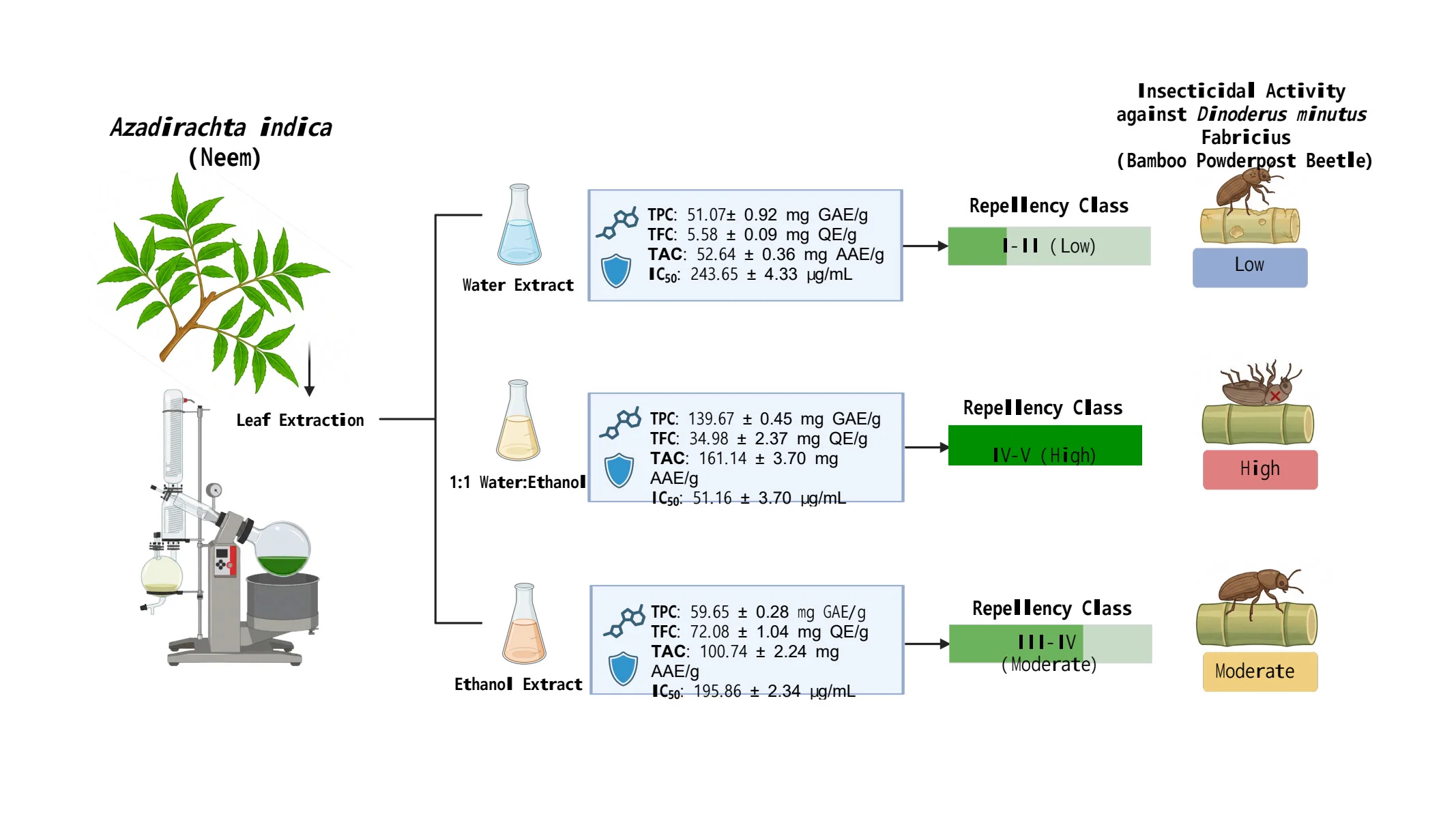
Azadirachta indica, widely known as “neem plant,” is recognized for its pesticidal and insecticidal applications due to its anti-feedant, repellent, and insect growth-regulating properties. Although various studies have reported the effectiveness of its botanical extracts in controlling insect pests, limited research has focused on their use in bamboo protection, especially against wood-boring beetles like Dinoderus minutus or powder post beetle. This study determined the total phenolic content (TPC), total flavonoid content (TFC), total antioxidant capacity (TAC), DPPH radical scavenging activity, repellency, and insecticidal properties against D. minutus of water, water-ethanol (1:1), and ethanol crude leaf extracts (CLEs) of A. indica. The water–ethanol (1:1) extract recorded the highest total phenolic content (TPC) at 139.67 mg GAE/g and the highest total antioxidant capacity (TAC) at 161.14 mg AAE/g. In contrast, the ethanol extract showed the highest total flavonoid content (TFC) at 72.08 mg QE/g. Notably, the strong antioxidant performance of the water–ethanol extract is consistent with its DPPH median inhibitory concentration (IC50) of 51.16 µg/mL. After 24 hours of exposure, the water–ethanol (1:1) extract demonstrated promising repellency, falling within Class IV–V (fair to very repellent). In a 7-day insecticidal bioassay against D. minutus, the same extract exhibited the highest toxicity, with a median lethal concentration (LC50) of 2.74%.
Downloads
Abdulkadir A, Mat N, Jahan M. 2017. In-vitro antioxidant potential in leaf, stem, and bark of Azadirachta indica. Pertanika 40:497–506.
Abdelhady MIS, Bader A, Shaheen U, El-Malah Y, Abourehab MAS, Barghash MF. 2015. Azadirachta indica as a source for antioxidant and cytotoxic polyphenolic compounds. Biosci Biotechnol Res Asia 12(2):1209–1222. DOI: 10.13005/bbra/1774 DOI: https://doi.org/10.13005/bbra/1774
Adier MFV, Sevilla MEP, Valerio DNR, Ongpeng JMC. 2023. Bamboo as sustainable building materials: a systematic review of properties, treatment methods, and standards. Buildings. 13(10):2449. DOI: 10.3390/buildings13102449 DOI: https://doi.org/10.3390/buildings13102449
Adusei S, Azupio S. 2022. Neem: A novel biocide for pest and disease control of plants. J Chem 2022(1):6778554. DOI: https://doi.org/10.1155/2022/6778554
Ainsworth EA, Gillespie KM. 2007. Estimation of total phenolic content and other oxidation substrates in plant tissues using Folin–Ciocalteu reagent. Nat Protoc 2(4):875–877. DOI: 10.1038/nprot.2007.102 DOI: https://doi.org/10.1038/nprot.2007.102
Ang AMG, Uy MM. 2023. Anti-inflammatory and antioxidant properties of Agelas sp., Ircinia sp., and Aaptos suberitoides. J Med Pharm Allied Sci 12(5):6091–6097. DOI: 10.55522/jmpas.V12I5.5640 DOI: https://doi.org/10.55522/jmpas.V12I5.5640
Ashauer R, Boxall ABA, Brown CD. 2007. New ecotoxicological model to simulate survival of aquatic invertebrates after exposure to fluctuating and sequential pulses of pesticides. Environ Sci Technol 41(4):1480–1486. DOI: 10.1021/es061727b DOI: https://doi.org/10.1021/es061727b
Bentoulla T, Kotsou K, Kalompatsios D, Alibade A, Athanasiadis V, Bozinou E, Lalas SI. 2024. Investigation and enhancement of the antioxidant compound recovery of Pyrus communis peel. Waste 2(3):382–396. DOI: 10.3390/waste2030021 DOI: https://doi.org/10.3390/waste2030021
Baruah H, Boro H, Swargiary A. 2023. Study of antioxidant and larvicidal properties of selected medicinal plants of fringe villages of Manas National Park, Assam, India. Biomed Pharmacol J 16(3):1751-1760. DOI: 10.13005/bpj/2753 DOI: https://doi.org/10.13005/bpj/2753
Caparida DRS, Rojo MJA, Parlucha JA, Paquit JC. 2021. Natural durability of commercially important bamboo species in the Philippines against powderpost beetle (Dinoderus minutus Fabricius). Int J Biosci. 6655:103–109. DOI: 10.12692/ijb/19.6.103-109 DOI: https://doi.org/10.12692/ijb/19.6.103-109
Chang CC, Yang MH, Wen HM, Chern JC. 2002. Estimation of total flavonoid content in propolis by two complementary colorimetric methods. J Food Drug Anal 10(3):178–182. DOI: 10.38212/2224-6614.2748 DOI: https://doi.org/10.38212/2224-6614.2748
Dai J, Mumper RJ. 2010. Plant phenolics: extraction, analysis and their antioxidant and anticancer properties. Molecules 15(10):7313–7352. DOI: 10.3390/molecules15107313 DOI: https://doi.org/10.3390/molecules15107313
Dougoud J, Toepfer S, Bateman M, Jenner WH. 2019. Efficacy of homemade botanical insecticides based on traditional knowledge: A review. Agron Sustain Dev 39(4). DOI: 10.1007/s13593-019-0583-1 DOI: https://doi.org/10.1007/s13593-019-0583-1
Fatmawaty, Anggreni NGM, Fadhil N, Prasasty VD. 2019. Potential in vitro and in vivo antioxidant activities from Piper crocatum and Persea americana leaf extracts. Biomed Pharmacol J 12(2):661–667. DOI: 10.13005/bpj/1686 DOI: https://doi.org/10.13005/bpj/1686
Finney DJ. 1952. Probit analysis: A statistical treatment of the sigmoid response curve. Second edition. Cambridge (UK): Cambridge University Press.
Garcia C. 2005. Management of powder-post beetles, Dinoderus minutus F. in freshly cut bamboo [Master’s Thesis]. Corvallis (US): Oregon State University.
Ghimeray AK, Jin CW, Ghimire BK, Cho DH. 2009. Antioxidant activity and quantitative estimation of azadirachtin and nimbin in Azadirachta indica A. Juss grown in foothills of Nepal. Afr J Biotechnol 8(13):3084–3091. DOI: 10.4314/ajb.v8i13.60994
Hasan MU, Sagheer M, Ranjha MH, Ali Q, Hanif CMS, Anwar H. 2014. Evaluation of some plant essential oils as repellent and toxicant against Trogoderma granarium (Everts) (Coleoptera: Dermestidae). J Glob Innov Agric Soc Sci 2(2):65–69. DOI: 10.17957/JGIASS/2.2.499 DOI: https://doi.org/10.17957/JGIASS/2.2.499
Hooven LA, Sherman KA, Butcher S, Giebultowicz JM. 2009. Does the time of day matter in insecticide applications? Circadian rhythms in pesticide susceptibility in Drosophila melanogaster. PLoS ONE 4(7):e6469. DOI: 10.1371/journal.pone.0006469 DOI: https://doi.org/10.1371/journal.pone.0006469
Hossain MD, Sarwar MS, Dewan SM, Hossain MS, Shahid-Ud-Daula A, Islam MS. 2014. Investigation of total phenolic content and antioxidant activities of Azadirachta indica roots. Avicenna J Phytomed 4(2):97–102.
Jyotsna B, Patil S, Prakash YS, Rathnagiri P, Kishor KB, Jalaja N. 2024. Essential oils from plant resources as potent insecticides and repellents: current status and future perspectives. Biocatal Agric Biotechnol 61:103395. DOI: 10.1016/j.bcab.2024.103395 DOI: https://doi.org/10.1016/j.bcab.2024.103395
Khanal S. 2021. Qualitative and quantitative phytochemical screening of Azadirachta indica Juss. plant parts. Int J Appl Sci Biotechnol 9(2):122–127. DOI: 10.3126/ijasbt.v9i2.38050 DOI: https://doi.org/10.3126/ijasbt.v9i2.38050
Kiranmai M, Sri U, Ibrahim M, Kumar CBM. 2012. Antioxidant activity and total flavonoids content of different parts of Azadirachta indica A. Juss. J Med Plants Res 6(46):5737–5742. DOI: 10.5897/JMPR12.766
Kumar A, Nirmal P, Kumar M, Jose A, Tomer V, Oz E, ..., Oz F. 2023. Major phytochemicals: recent advances in health benefits and extraction methods. Molecules 28(2):887. DOI: 10.3390/molecules28020887 DOI: https://doi.org/10.3390/molecules28020887
Liese W, Kumar S. 2003. Bamboo preservation compendium. Technical Report 22. Beijing (CH): International Network Bamboo and Rattan (INBAR);
Martínez-Castro R, Flórez-Santiago J, Valle-Molinares R, Cabrera-Barraza J, Espitia-Almeida F. 2024. Optimized microwave-assisted azadirachtin extraction using response surface methodology. Heliyon, 10(10):e31504. DOI: 10.1016/j.heliyon.2024.e31504 DOI: https://doi.org/10.1016/j.heliyon.2024.e31504
Michel MR, Aguilar-Zárate M, Rojas R, Martínez-Ávila GCG, Aguilar-Zárate P. 2023. The insecticidal activity of Azadirachta indica leaf extract: optimization of the microencapsulation process by complex coacervation. Plants 12(6):1318. DOI: 10.3390/plants12061318 DOI: https://doi.org/10.3390/plants12061318
Naseer R, Sultana B, Anwar F, Mehmood Z, Mushtaq M. 2014. Variations in phenolics, antioxidant and antifungal activities among different parts of selected medicinal plants. Pak J Bot 42(2):705–712. DOI: 10.13140/2.1.4472.8967
National Research Council (US) Panel on Neem. 1992. Neem: A tree for solving global problems. Washington DC (US): National Academies Press. Available from: https://www.ncbi.nlm.nih.gov/books/NBK234643/
Ogbuewu IP, Odoemenam VU, Obikaonu HO, Opara MN, Emenalom OO, Uchegbu MC, …, Iloeje MU. 2011. The growing importance of neem (Azadirachta indica A. Juss) in agriculture, industry, medicine and environment: a review. Res J Med Plants 5(3):230–245. DOI: 10.3923/rjmp.2011.230.245 DOI: https://doi.org/10.3923/rjmp.2011.230.245
Okolo E, Oyewole C. 2019. Insecticidal effect of neem (Azadirachta indica) extracts obtained from leaves and seeds on pests of cowpea (Vigna unguiculata). J Agric Sci 26:17–31. DOI: sumerianz.com/?ic=journal-home&journal=30
Prieto P, Pineda M, Aguilar M. 1999. Spectrophotometric quantitation of antioxidant capacity through the formation of a phosphomolybdenum complex: specific application to the determination of vitamin E. Anal Biochem 269(2):337–341. DOI: 10.1006/abio.1999.4019 DOI: https://doi.org/10.1006/abio.1999.4019
Puttongsiri T, Manichart N, Teerarak M, Sikhao P, Somala N, Tongsri P, Pilasombut K. 2025. Siamese neem tree as a natural preservative: chemical profile, antioxidant properties, and antibacterial efficacy against foodborne pathogens. J Agric Food Res 19:101559. DOI: 10.1016/j.jafr.2024.101559 DOI: https://doi.org/10.1016/j.jafr.2024.101559
Rocha RP, Melo EC, Radünz LL. 2011. Influence of drying process on the quality of medicinal plants: a review. J Med Plants Res 5(33):7076–7084. DOI: 10.5897/JMPRx11.001 DOI: https://doi.org/10.5897/JMPRX11.001
Rosemary UB, Nestor AJF, Abalis OR. 2018. Efficacy of Azadirachta indica leaf powder and ethanol extract on adult Periplaneta americana under laboratory condition. Open Access Libr J 5:e4458. DOI: 10.4236/oalib.1104458 DOI: https://doi.org/10.4236/oalib.1104458
Routray W, Orsat V. 2013. Preparative extraction and separation of phenolic compounds. In: Ramawat KG, Mérillon JM (Editors), Natural products. First Edition. p. 2013–2045. Berlin (DE): Springer. DOI: 10.1007/978-3-642-22144-6_55 DOI: https://doi.org/10.1007/978-3-642-22144-6_55
Senate of the Philippines. 2026. Zubiri pushes for Philippine Bamboo Industry Development Act [photo release]. https://senate.gov.ph/media/photo-release/zubiri-pushes-for-philippine-bamboo-industry-development-act
Singh M, Jha A, Kumar A, Hettiarachchy N, Rai AK, Sharma D. 2014. Influence of solvents on the extraction of major phenolic compounds (punicalagin, ellagic acid, and gallic acid) and their antioxidant activities in pomegranate aril. J Food Sci Technol 51:2070–2077. DOI: 10.1007/s13197-014-1267-0 DOI: https://doi.org/10.1007/s13197-014-1267-0
Sithisarn P, Supabphol R, Gritsanapan W. 2005. Antioxidant activity of Siamese neem tree (VP 1209). J Ethnopharmacol 99(1):109–112. DOI: 10.1016/j.jep.2005.02.008 DOI: https://doi.org/10.1016/j.jep.2005.02.008
Sowa G, Bednarska AJ, Laskowski R. 2024. Mortality pattern of Poecilus cupreus beetles after repeated topical exposure to insecticide—stochastic death or individual tolerance? Environ Sci Technol 58(4):1854–1864. DOI: 10.1021/acs.est.3c08031 DOI: https://doi.org/10.1021/acs.est.3c08031
Souto AL, Sylvestre M, Tölke ED, Tavares JF, Barbosa-Filho JM, Cebrián-Torrejón G. 2021. Plant-derived pesticides as an alternative to pest management and sustainable agricultural production: prospects, applications and challenges. Molecules 26(16):4835. DOI: 10.3390/molecules26164835 DOI: https://doi.org/10.3390/molecules26164835
Sultana B, Anwar F, Ashraf M. 2009. Effect of extraction solvent/technique on the antioxidant activity of selected medicinal plant extracts. Molecules 14(6):2167–2180. DOI: 10.3390/molecules14062167 DOI: https://doi.org/10.3390/molecules14062167
Tabassum R, Aihetasham A, Zubair A, Qurat-ul-ain AA. 2023. Termiticidal activity of ethanolic leaf extracts of medicinal plants Calotropis gigantea and Morus alba against Heterotermes indicola (Wasmann). J Popul Ther Clin Pharmacol 30(19):2192–2203. DOI: 10.53555/jptcp.v30i19.6091 DOI: https://doi.org/10.53555/jptcp.v30i19.6091
Tulashie SK, Adjei F, Abraham J, Addo E. 2021. Potential of neem extracts as natural insecticide against fall armyworm (Spodoptera frugiperda (JE Smith) (Lepidoptera: Noctuidae)). Case Stud Chem Environ Eng 4:100130. DOI: 10.1016/j.cscee.2021.100130 DOI: https://doi.org/10.1016/j.cscee.2021.100130
Ukoroije RB, Otayor RA. 2020. Review on the bio-insecticidal properties of some plant secondary metabolites: types, formulations, modes of action, advantages and limitations. Asian J Res Zool 3(4):27–60. DOI: 10.9734/ajriz/2020/v3i430099 DOI: https://doi.org/10.9734/ajriz/2020/v3i430099
Yadav DK, Bharitkar YP, Chatterjee K, Ghosh M, Mondal NB, Swarnaka S. 2016. Importance of neem leaf: An insight into its role in combating diseases. Indian J Exp Biol 54(11):708–718.
Yadav S, Verma M, Rose NM. 2021. Assessment of total phenolic content and antimicrobial activity of plants leaves extract. J Pharmacogn Phytochem 10(1):819–823.
Yıldırım A, Mavi A, Oktay M, Kara AA, Algur ÖF, Bilaloğlu V. 2000. Comparison of antioxidant and antimicrobial activities of tilia (Tilia argentea Desf ex DC), sage (Salvia triloba L.), and black tea (Camellia sinensis) extracts. J Agric Food Chem 48(10):5030–5034. DOI: 10.1021/jf000590k. DOI: https://doi.org/10.1021/jf000590k
Zhao L, Xu L, Tao X, Han X, Yin L, Qi Y, Peng J. 2016. Protective effect of the total flavonoids from Rosa laevigata Michx fruit on renal ischemia-reperfusion injury through suppression of oxidative stress and inflammation. Molecules 21(7):952. DOI: 10.3390/molecules21070952. DOI: https://doi.org/10.3390/molecules21070952
Copyright (c) 2026 Mark Jun A. Rojo, Joy M. Jamago, Gina B. Barbosa, Analyn G. Gultiano, Rajane Faith B. Ladrillo, Ellen Joy P. Pandan, Jason A. Parlucha, Maricel S. Cabiladas, Kisshi D. Salise, Baum Mia C. Bolonos, Regiez Novem P. Idulsa, Christian Dave Z. Nebla, Aileen May G. Ang

This work is licensed under a Creative Commons Attribution-NonCommercial-NoDerivatives 4.0 International License.
Authors who publish with this journal agree with the following terms:
- Authors retain copyright and grant the journal right of first publication, with the work 1 year after publication simultaneously licensed under a Creative Commons attribution-noncommerical-noderivates 4.0 International License that allows others to share, copy and redistribute the work in any medium or format, but only where the use is for non-commercial purposes and an acknowledgement of the work's authorship and initial publication in this journal is mentioned.
- Authors are able to enter into separate, additional contractual arrangements for the non-exclusive distribution of the journal's published version of the work (e.g., post it to an institutional repository or publish it in a book), with an acknowledgement of its initial publication in this journal.
- Authors are permitted and encouraged to post their work online (e.g., in institutional repositories or on their website) prior to and during the submission process, as it can lead to productive exchanges, as well as earlier and greater citation of published work (See The Effect of Open Access).