FUTURE PERSPECTIVES OF CARBON QUANTUM DOTS: SYNTHESIS, APPLICATIONS, AND ENVIRONMENTAL IMPLICATIONS IN AQUACULTURE

Downloads
ARTICLE HIGLIGHTS
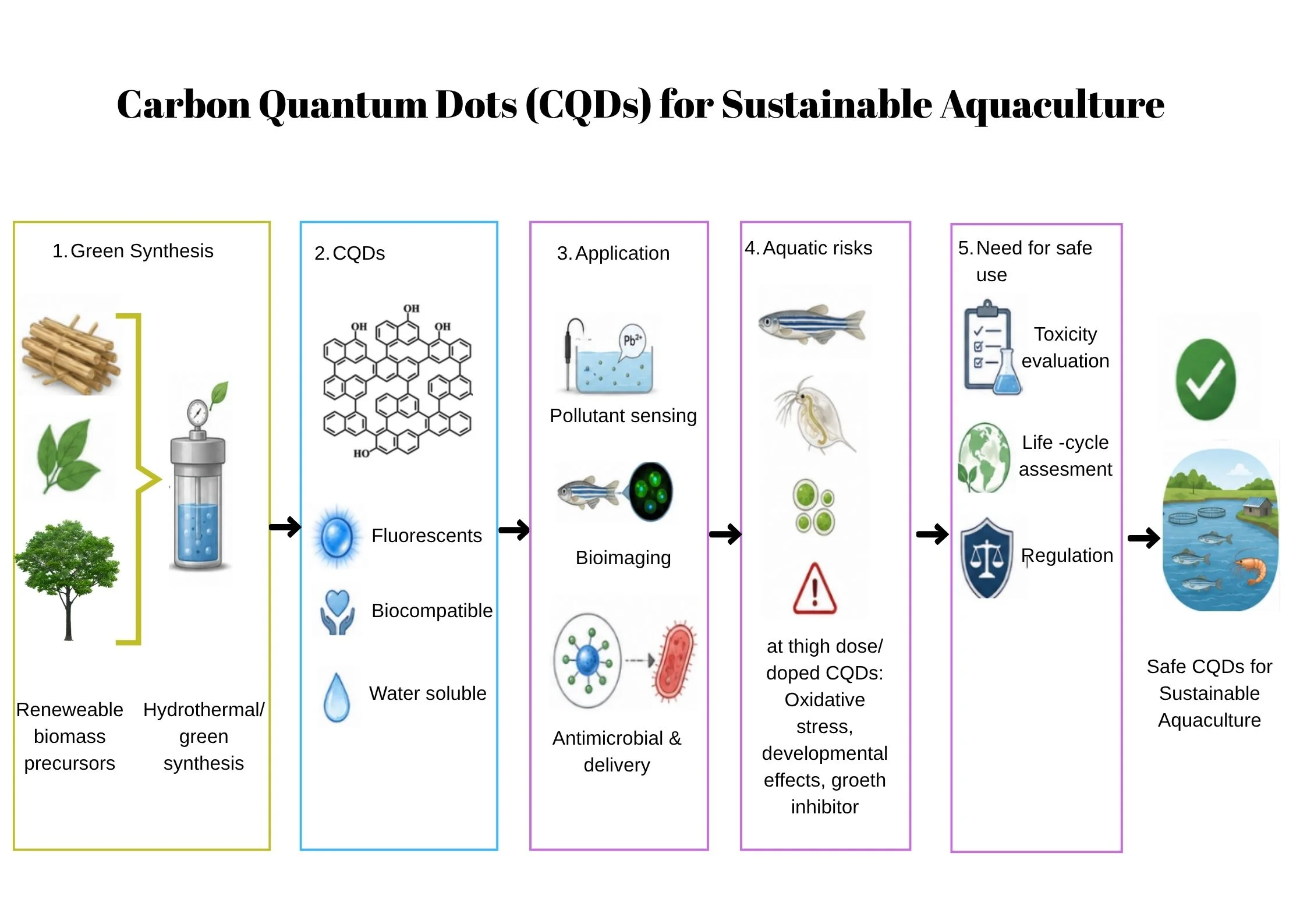
- Carbon quantum dots enable sustainable applications in modern aquaculture
- Biomass-derived carbon dots support green synthesis and circular economy
- Fluorescent carbon dots enable rapid sensing of pollutants in aquatic systems
- Carbon dots support bioimaging, antimicrobial activity, and gene delivery
- Toxicity risks highlight the need for safety standards and life cycle assessment
ABSTRACT
Carbon quantum dots (CQDs) have emerged as promising carbon-based nanomaterials owing to their excellent optical properties, high biocompatibility, and versatile synthesis routes. Recent research trends have shifted from fundamental synthesis and characterization to functional applications in bioimaging, biosensing, biomedical therapy, food safety, and aquaculture. Green synthesis using renewable biomass has become the dominant approach, supporting circular economy concepts while reducing hazardous waste. Numerous studies demonstrate that CQDs can act as sensitive sensors for heavy metals and pollutants, stable probes for cellular and in vivo imaging, antimicrobial agents, and efficient nanocarriers for drug and gene delivery. Despite these advances, toxicological findings reveal that CQDs may induce oxidative stress, developmental abnormalities, and ecological risks in aquatic organisms, particularly at high concentrations or when heteroatom-doped. Moreover, the absence of specific regulations highlights the urgent need for standardized safety protocols and life-cycle assessments. This review outlines the progress, applications, challenges, and regulatory considerations of CQDs, emphasizing their potential role in advancing sustainable biotechnology and modern aquaculture.
Atchudan R, Edison TNJI, Perumal S, Muthuchamy N, Lee, Y. R. 2020. Hydrophilic nitrogen-doped carbon dots from biowaste using dwarf banana peel for environmental and biological applications. Fuel 275:117821. [Internet]. [cited 13 Sep 2025]. DOI: 10.1016/j.fuel.2020.117821 DOI: https://doi.org/10.1016/j.fuel.2020.117821
Cao L, Wang X, Meziani MJ, Lu F, Wang H, Luo PG, …, Sun YP. 2007. Carbon dots for multiphoton bioimaging. J Am Chem Soc 129(37):11318–11319. [Internet]. [cited 11 Sep 2025]. DOI: 10.1021/ja073527l DOI: https://doi.org/10.1021/ja073527l
Chahal S, Macairan JR, Yousefi N, Tufenkji N, Naccache R. 2021. Green synthesis of carbon dots and their applications. RSC Advances 11:25354–25363. [Internet]. [cited 17 June 2026]. DOI: 10.1039/d1ra04718c DOI: https://doi.org/10.1039/D1RA04718C
Chousidis I, Stalikas CD, Leonardos ID. 2020. Induced toxicity in early-life stage zebrafish (Danio rerio) and its behavioral analysis after exposure to non-doped, nitrogen-doped and nitrogen, sulfur-co doped carbon quantum dots. Environ Toxicol Pharmacol 79:103426. [Internet]. [cited 15 Sep 2025]. DOI: 10.1016/j.etap.2020.103426 DOI: https://doi.org/10.1016/j.etap.2020.103426
Chung CY, Chen YJ, Kang CH, Lin HY, Huang CC, Hsu PH, Lin HJ. 2021. Toxic or not toxic, that is the carbon quantum dot’s question: A comprehensive evaluation with zebrafish embryo, eleutheroembryo, and adult models. Polymers 13:1598. [Internet]. [cited 15 May 2026]. DOI: 10.3390/polym13101598 DOI: https://doi.org/10.3390/polym13101598
Das P, Ganguly S, Agarwal T, Maity P, Ghosh S, Choudhary S, …, Das NC. 2019. Heteroatom doped blue luminescent carbon dots as a nano-probe for targeted cell labeling and anticancer drug delivery vehicle. Mater Chem Phys 237:121860. [Internet]. [cited 13 Sep 2025]. DOI: 10.1016/j.matchemphys.2019.121860 DOI: https://doi.org/10.1016/j.matchemphys.2019.121860
Das S, Mondal S, Ghosh D. 2024. Carbon quantum dots in bioimaging and biomedicines. Front Bioeng Biotechnol 11:1333752. [Internet]. [cited 11 Oct 2025]. DOI: 10.3389/fbioe.2023.1333752 DOI: https://doi.org/10.3389/fbioe.2023.1333752
Dawood A, Ghali M, Micheli L, Hashem MH, Piccirillo C. 2025. Aquatic biomass-based carbon dots: a green nanostructure for marine biosensing applications. Clean Technol 7:64. [Internet]. [cited 1 Aug 2025]. DOI: 10.3390/cleantechnol7030064 DOI: https://doi.org/10.3390/cleantechnol7030064
European Commission. 2018. Commission Regulation (EU) 2018/1881 amending Regulation (EC) No 1907/2006 concerning REACH as regards nanoforms of substances. Official Journal of the European Union 308: 1–20.
Gao Z, Lin Z, Chen X, Lai Z, Huang Z. 2016. Carbon dots-based fluorescent probe for trace Hg²+ detection in water sample. Sens Actuators B: Chem 222:965–971. [Internet]. [cited 23 Sep 2025]. DOI: 10.1016/j.snb.2015.09.104 DOI: https://doi.org/10.1016/j.snb.2015.09.032
Gedda G, Lee CY, Lin YC, Wu HF. 2016. Green synthesis of carbon dots from prawn shells for highly selective and sensitive detection of copper ions. Sens Actuators B: Chem 224:396–403. [Internet]. [cited 11 Sep 2025]. DOI: 10.1016/j.snb.2015.10.104 DOI: https://doi.org/10.1016/j.snb.2015.09.065
Hasanzadeh A, Jahromi MAM, Abdoli A, Karimi M. 2020. Photoluminescent carbon quantum dot/poly-L-lysine core-shell nanoparticles: A novel candidate for gene delivery. J Drug Deliv Sci Technol 60:102118. [Internet]. [cited 15 Sep 2025]. DOI: 10.1016/j.jddst.2020.102118 DOI: https://doi.org/10.1016/j.jddst.2020.102118
Huang C, Dong H, Su Y, Wu Y, Narron R, Yong Q. 2019. Synthesis of carbon quantum dot nanoparticles derived from byproducts in bio-refinery process for cell imaging and in vivo bioimaging. Nanomaterials 9(3):387. [Internet]. [cited 3 Sep 2025]. DOI: 10.3390/nano9030387 DOI: https://doi.org/10.3390/nano9030387
Kang YF, Li YH, Fang YW, Xu Y, Wei XM, Yin XB. 2015. Carbon quantum dots for zebrafish fluorescence imaging. Sci Rep 5:11835. [Internet]. [cited 2 July 2026]. DOI: 10.1038/srep11835 DOI: https://doi.org/10.1038/srep11835
Khan R, Shukla S, Kumar M, Barceló D, Zuarro A, Bhargava PC. 2024. Progress and obstacles in employing carbon quantum dots for sustainable wastewater treatment. Enviro Res 261:119671. [Internet]. [cited 13 Sep 2025]. DOI: 10.1016/j.envres.2024.119671 DOI: https://doi.org/10.1016/j.envres.2024.119671
Kohli HK, Parab DD. 2025. Green synthesis of carbon quantum dots and applications: An insight. Next Mater 8:100527. [Internet]. [cited 23 Sep 2025]. DOI: 10.1016/j.nxmate.2025.100527 DOI: https://doi.org/10.1016/j.nxmate.2025.100527
Kudr J, Richtera L, Xhaxhiu K, Hynek D, Heger Z, Zitka O, Adam V. 2017. Carbon dots based FRET for the detection of DNA damage. Biosens Bioelectron 92:133–139. [Internet]. [cited 2025 Sep 11]. DOI: 10.1016/j.bios.2016.12.045 DOI: https://doi.org/10.1016/j.bios.2017.01.067
Kuznietsova H, Géloën A, Dziubenko N, Zaderko A, Alekseev S, Lysenko V, Skryshevsky V. 2023. In vitro and in vivo toxicity of carbon dots with diferent chemical compositions. Discov Nano 18:111. [Internet]. [cited 8 Sep 2026]. DOI: 10.1186/s11671-023-03891-9 DOI: https://doi.org/10.1186/s11671-023-03891-9
Lamba R, Yukta Y, Mondal J, Kumar R, Pani B, Singh B. 2024. Carbon dots: Synthesis, characterizations, and recent advancements in biomedical, optoelectronics, sensing, and catalysis applications. ACS Appl Bio Mater 7(4):1234–1256. [Internet]. [cited 11 Sep 2025]. DOI: 10.1021/acsabm.4c00004 DOI: https://doi.org/10.1021/acsabm.4c00004
Li X, Chen CC, Wu L, Zhou J, Huang Y, Zhu X. 2024. Neglected negative effect of carbon quantum dots (CQDs) entering the ocean on marine organisms living in different water layers. Mar Pollut Bull 199:115921. [Internet]. [cited 13 Sep 2025]. DOI: 10.1016/j.marpolbul.2024.115921 DOI: https://doi.org/10.1016/j.marpolbul.2023.115921
Lin F, Bao YW, Wu FG. 2019. Carbon dots for sensing and killing microorganisms. C-J Carbon Res 5(2):33. [Internet]. [cited 24 Sep 2025]. DOI: 10.3390/c5020033 DOI: https://doi.org/10.3390/c5020033
Ma Y, Zhang M, Wang H, Wang B, Huang H, Liu Y, Kang Z. 2020. N-doped carbon dots derived from leaves with low toxicity via damaging cytomembrane for broad-spectrum antibacterial activity. Mater Today Commun 24:101222. [Internet]. [cited 5 Sep 2025]. DOI: 10.1016/j.mtcomm.2020.101222 DOI: https://doi.org/10.1016/j.mtcomm.2020.101222
Molkenova A, Atabaev TS. 2019. Phosphorus-doped carbon dots (P-CDs) from dextrose for low-concentration ferric ions sensing in water. Optik 187:70–73. [Internet]. [cited 13 Sep 2025]. DOI: 10.1016/j.ijleo.2019.04.013 DOI: https://doi.org/10.1016/j.ijleo.2019.05.013
Nazri NAA, Azeman NH, Abu Bakar MH, Mobarak NN, Tg Abd Aziz TH, Md Zain AR, …, Bakar AAA. 2023. Chlorophyll detection by localized surface plasmon resonance using functionalized carbon quantum dots triangle Ag Nanoparticles. Nanomaterials 13(7):1247. [Internet]. [cited 5 Sep 2025]. DOI: 10.3390/nano13071247 DOI: https://doi.org/10.3390/nano13071247
Octavera A, Ariyanta HA, Zahra L, Hakim DF, Maulana F, Sholeha NA, …, Alimuddin. 2026. Upcycling eucalyptus kraft lignin into fluorescent graphene quantum dots for reproductive cell imaging in aquaculture biotechnology. Bioresour Technol 442:133769. [Internet]. [cited 26 March 2026]. DOI: 10.1016/j.biortech.2025.133769 DOI: https://doi.org/10.1016/j.biortech.2025.133769
[OECD] The Organisation for Economic Co-operation and Development. 2025. Guidance on sample preparation and dosimetry for the safety testing of manufactured nanomaterials, 2025 Edition, OECD Series on the Safety of Manufactured Nanomaterials and other Advanced Materials. Paris (FR): OECD Publishing. DOI: 10.1787/87ec4ecc-en DOI: https://doi.org/10.1787/87ec4ecc-en
[OECD] The Organisation for Economic Co-operation and Development. 2025. Safe and sustainable by design tools, integrative systems and platforms for nanomaterials and nano-enabled products, OECD Series on the Safety of Manufactured Nanomaterials and other Advanced Materials. Paris (FR): OECD Publishing. DOI: 10.1787/e411a4b7-en DOI: https://doi.org/10.1787/e411a4b7-en
Poshtkar M, Rezazadeh A, Haeili M, Ghasempour Z, Ehsani A. 2025. P-doped carbon quantum dots from potato starch as antimicrobial materials for food applications. LWT - Food Sci Technol 232:118399. [Internet]. [cited 23 Sep 2025]. DOI: 10.1016/j.lwt.2025.118399 DOI: https://doi.org/10.1016/j.lwt.2025.118399
Qureshi ZA, Dabash H, Ponnamma D, Abbas MKG. 2024. Carbon dots as versatile nanomaterials in sensing and imaging: Efficiency and beyond. Heliyon 10(2):31634. [Internet]. [cited 15 Sep 2025]. DOI: 10.1016/j.heliyon.2024.e31634 DOI: https://doi.org/10.1016/j.heliyon.2024.e31634
Rahmi CN, Sugiarti S, Yuliani AD. 2023. Karbon dots (C-dots) dari bahan hayati untuk deteksi logam berat [Carbon dots (C-Dots) from biomass for heavy metal detection]. Alchemy Jurnal Penelitian Kimia 19(2):234–246. [Internet]. [cited 23 Sep 2025]. DOI: 10.20961/alchemy.19.2.61881.234-246 DOI: https://doi.org/10.20961/alchemy.19.2.61881.234-246
Solikhin A, Fachruddin A, Pakusadewo B, Kurniawan T, Anbumozhi V. 2023. Prospects of nanotechnology in Indonesia’s food and agriculture sector: From laboratory to industry. SEARCA Discussion Paper Series 2023-1. Los Baños, Laguna (PH): Southeast Asian Regional Center for Graduate Study and Research in Agriculture (SEARCA).
Vyas T, Kumar H, Choudhary S, Joshi A. 2024. Carbon quantum dot (CQD)-dithizone-based thin-film chemical sensors for the specific detection of lead ions in water resources. Environ Sci: Water Res Technol 11:00452. [Internet]. [cited 11 Sep 2025]. DOI: 10.1039/d4ew00452c DOI: https://doi.org/10.1039/D4EW00452C
Wang C, Wang Y, Shi H, Yan Y, Liu E, Hu X, Fan J. 2019. A strong blue fluorescent nanoprobe for highly sensitive and selective detection of mercury (II) based on sulfur doped carbon quantum dots. Mater Chem Phys 232:145–151. [Internet]. [cited 17 Sep 2025]. DOI: 10.1016/j.matchemphys.2019.04.077 DOI: https://doi.org/10.1016/j.matchemphys.2019.04.071
Wang Z, Xu C, Lu Y, Chen X, Yuan H, Wei G, …, Chen J. 2017. Fluorescence sensor array based on amino acid derived carbon dots for pattern-based detection of toxic metal ions. Sens Actuators B: Chem 241:1324–1330. [Internet]. [cited 15 Sep 2025]. DOI: 10.1016/j.snb.2016.10.128 DOI: https://doi.org/10.1016/j.snb.2016.09.186
Xu H, Zhan WH, Wan MJ, Guan X. 2025. Research on green synthesis and performance analysis of biomass-derived carbon quantum dots. Ind Crops Prod 227(1):120775. [Internet]. [cited 17 Sep 2025]. DOI: 10.1016/j.indcrop.2025.120775 DOI: https://doi.org/10.1016/j.indcrop.2025.120775
Xu S, Che S, Ma P, Zhang F, Xu L, Liu X, …, Sun Y. 2019. One-step fabrication of boronic-acid-functionalized carbon dots for the detection of sialic acid. Talanta 197:548–552. [Internet]. [cited 5 Sep 2025]. DOI: 10.1016/j.talanta.2019.01.040 DOI: https://doi.org/10.1016/j.talanta.2019.01.074
Yao K, Lv X, Zheng G, Chen Z, Jiang Y, Zhu X, …, Cai Z. 2018. Effects of carbon quantum dots on aquatic environments: comparison of toxicity to organisms at different trophic levels. Environ Sci Technol 52(24):14445–14451. [Internet]. [cited 15 Sep 2025]. DOI: 10.1021/acs.est.8b04235 DOI: https://doi.org/10.1021/acs.est.8b04235
Zhong W, Yang J. 2024. Fluorescent carbon quantum dots for heavy metal sensing. Sci Total Environ 922:177473. [Internet]. [cited 15 Sep 2025]. DOI: 10.1016/j.scitotenv.2024.177473 DOI: https://doi.org/10.1016/j.scitotenv.2024.177473
Zhou J, Deng W, Wang Y, Cao X, Chen J, Wang Q, …, Xu X. 2016. Cationic carbon quantum dots derived from alginate for gene delivery: One-step synthesis and cellular uptake. Acta Biomater 42:209–219. [Internet]. [cited 25 Sep 2025]. DOI: 10.1016/j.actbio.2016.06.021 DOI: https://doi.org/10.1016/j.actbio.2016.06.021
Copyright (c) 2026 Shella Marlinda, Anna Octavera, Harits Atika Ariyatna, Irzal Effendi, Sulasy Rohmy, Shavika Miranti, Sri Nuryati, Alimuddin

This work is licensed under a Creative Commons Attribution-NonCommercial-NoDerivatives 4.0 International License.
Authors who publish with this journal agree with the following terms:
- Authors retain copyright and grant the journal right of first publication, with the work 1 year after publication simultaneously licensed under a Creative Commons attribution-noncommerical-noderivates 4.0 International License that allows others to share, copy and redistribute the work in any medium or format, but only where the use is for non-commercial purposes and an acknowledgement of the work's authorship and initial publication in this journal is mentioned.
- Authors are able to enter into separate, additional contractual arrangements for the non-exclusive distribution of the journal's published version of the work (e.g., post it to an institutional repository or publish it in a book), with an acknowledgement of its initial publication in this journal.
- Authors are permitted and encouraged to post their work online (e.g., in institutional repositories or on their website) prior to and during the submission process, as it can lead to productive exchanges, as well as earlier and greater citation of published work (See The Effect of Open Access).