ETHNOBOTANICAL, NUTRITIONAL, AND FUNCTIONAL PROSPECTS OF INDONESIAN MANGROVE APPLES (Sonneratia spp.)

Downloads
ARTICLE HIGHLIGHTS
- Comprehensive review of Indonesian mangrove apple (Sonneratia spp.), focusing on S. alba, S. caseolaris, and S. ovata across major coastal regions.
- Nutritional profile of Indonesian mangrove apple characterized by significant levels of vitamins, flavonoids, and organic acids with high bioactive potential.
- Documented functional properties of Indonesian mangrove apple, include antioxidant, anti-inflammatory, anti-allergic, and antidiabetic activities.
- Emphasizes the role of mangrove apple utilization in promoting supporting food security and public health, sustainable coastal ecosystem conservation and biodiversity preservation.
ABSTRACT
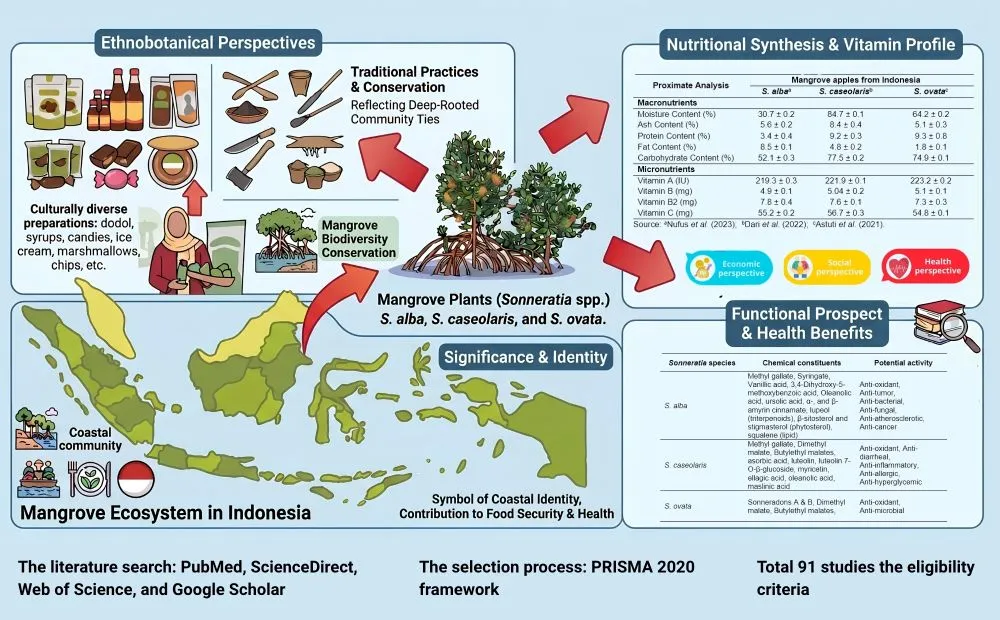
Mangrove apples (Sonneratia spp.), native to Indonesia’s extensive mangrove forests, is distributed across Sumatra, Kalimantan, Sulawesi, Maluku, and Papua. This review synthesizes ethnobotanical uses, nutritional attributes, and functional potential of three main species S. alba, S. caseolaris, and S. ovata that hold both ecological and cultural significance. A review article search was conducted following the PRISMA 2020 framework and structured in accordance with the standard IMRaD across Scopus, PubMed, ScienceDirect, Web of Science, and Google Scholar, yielding 91 eligible studies from an initial 612 records. Ethnobotanical evidence documents diverse applications in traditional foods, including chips, stick crackers, sweets such as dodol, syrup, candy, ice cream, and marshmallow, reflecting deep-rooted ties between coastal communities and mangrove ecosystems. Nutritional analyses highlight rich contents of vitamins and bioactive compounds such as flavonoids, and organic acids. These constituents exhibit antioxidant, anti-inflammatory, anti-allergic, and antidiabetic properties, underscoring the species’ promise as a functional food ingredient. By integrating traditional culinary heritage with scientific evidence, this review positions Sonneratia spp. as both a symbol of Indonesia’s coastal identity and a contributor to food security, health, and biodiversity conservation.
Apriliani D. 2015. The effect of mangrove fruit puree (Sonneratia caseolaris) and sugar amount on the organoleptic properties of ice cream. Boga 4(1):116–125.
Arbiastutie Y, Diba F, Masriani. 2021. Ethnobotanical and ecological studies of medicinal plants in a mangrove forest in Mempawah District, West Kalimantan, Indonesia. Biodiversitas 22(6):3164–3170. [Internet]. [cited 30 Jul 2025]. DOI: 10.13057/biodiv/d220619 DOI: https://doi.org/10.13057/biodiv/d220619
Ardiansyah PR, Djuhria W, Verly D, Lena JD, Silvana DH, Feny M, Grace S. 2020. Proximate Analysis on Sonneratia alba Mangrove Fruit Flour. Media Teknol Has Perikan 8(3):82. [Internet]. [cited 3 Sept 2025]. DOI: 10.35800/mthp.8.3.2020. 27526 DOI: https://doi.org/10.35800/mthp.8.3.2020.27526
Arifanti VB, Frida S, Budi M, Arida S, Tien W, Subarno, …, Novita N. 2022. Challenges and strategies for sustainable mangrove management in Indonesia: A review. Forests 13(5):1–18. [Internet]. [cited 27 Jul 2025]. DOI: 10.3390/ f13050695 DOI: https://doi.org/10.3390/f13050695
Astuti MD, Wulandari M, Rosyidah K, Nurmasari R. 2021. Proxymate and phytochemical analysis pedada fruit (Sonneratia ovata Back.). J Sains Terap Kim 15(2):154. [Internet]. [cited 3 Sept 2025]. DOI: 10.20527/jstk.v15i2.10728 DOI: https://doi.org/10.20527/jstk.v15i2.10728
Audah KA. 2024. The potential of Sonneratia caseolaris mangrove plant as functional food and medicine. J Funct Food Nutraceutical 6(1):5. [Internet]. [cited 28 Jul 2025]. DOI: 10.33555/ jffn.v6i1.163
Dari DW, Dini J, Yusra A, Mila M, Vita M. 2022. Chemical characteristics of juice of mangrove apple (Sonneratia caseolaris) added with sugar. Int J Front Life Sci Res 2(1):018–028. [Internet]. [cited 3 Sept 2025]. DOI: 10.53294/ijflsr.2022.2.1.0023 DOI: https://doi.org/10.53294/ijflsr.2022.2.1.0023
Dev S, Rabindra NA, Sheuly A, Abdullah AB, Kaniz A, Hemayet H, …, Asish KD. 2021. Toxicological screening and evaluation of anti-allergic and anti-hyperglycemic potential of Sonneratia caseolaris (L.) Engl. fruits. Clin Phytoscience 7(1). [Internet]. [cited 4 Sept 2025]. DOI: 10.1186/s40816-021-00301-4 DOI: https://doi.org/10.1186/s40816-021-00301-4
Dharmayasa IGNP, Sugiana IP, Anantanasakul P. 2025. Mangrove species distribution across soil texture gradients in Benoa Bay and Nusa Lembongan, Bali Province, Indonesia. Biodiversitas 26(6):2908–2915. [Internet]. [cited 27 Jul 2025]. DOI: 10.13057/biodiv/ d260633 DOI: https://doi.org/10.13057/biodiv/d260633
Hardoko, Prihanto NH, Sasmito BB. 2019. Antioxidant activity and characteristics of pedada mangrove fruit vinegar (Sonneratia Alba). J Fish Mar Res 3(3):322–330. [Internet]. [cited 31 Jul 2025]. DOI: 10.21776/ub.jfmr.2019. 003.03.6 DOI: https://doi.org/10.21776/ub.jfmr.2019.003.03.6
Holmes R, Ulrich S, Rignolda D, Emma PH, Mark W, Juan CB, …, Karen D. 2025. Mangrove dynamics and resilience in North Sulawesi, Indonesia, across the Holocene. Ecol Indic 171(February):113231. [Internet]. [cited 28 Jul 2025]. DOI: 10.1016/ j.ecolind.2025.113231. DOI: https://doi.org/10.1016/j.ecolind.2025.113231
Hossain SJ, Iftekharuzzaman M, Haque M, Ahasanul SM, Badhan M, Mohammad R, …, Hemayet. 2016. Nutrient compositions, antioxidant activity, and common phenolics of Sonneratia apetala (Buch.-Ham.) fruit. Int J Food Prop 19(5):1080–1092. [Internet]. [cited 5 Sept 2025]. DOI: 10.1080/10942912.2015.1055361 DOI: https://doi.org/10.1080/10942912.2015.1055361
Jariyah, Sri D, Anugerah DP. 2021. Ice cream processing training at the Bintang Mangrove Waste Bank Group, Gunung Anyar Surabaya. J Ilm Pengabdi Kpd Masy 5(1). [Internet]. [cited 2 Sept 2025]. DOI: 10.25077/logista.5.1.266-271.2021 DOI: https://doi.org/10.25077/logista.5.1.266-271.2021
Kalor JD, Wanimbo E, Indrayani E. 2025. A systematic review of bioactive compounds, traditional uses, and conservation perspectives of Sonneratia caseolaris. Int J Pharm Bio-Med Sci 05(05):350–357. [Internet]. [cited 28 Jul 2025]. DOI: 10.47191/ijpbms/v5-i5-10 DOI: https://doi.org/10.47191/ijpbms/v5-i5-10
Khumaidah L, Purnomo AS, Fatmawati S. 2019. Antimicrobial activity of Sonneratia ovata backer. HAYATI 26(4):152–155. [Internet]. [cited 5 Sept 2025]. DOI: 10.4308/hjb.26.4.152 DOI: https://doi.org/10.4308/hjb.26.4.152
Kulkarnii CP, Manohar SM. 2014. A review of botany, phytochemistry, and pharmacology of the mangrove apple Sonneratia alba J. Sm. J Appl Pharm Sci 14(05):1–11. [Internet]. [cited 28 Jul 2025]. DOI: 10.7324/japs.2024.181289 DOI: https://doi.org/10.7324/JAPS.2024.181289
Kundu P, Shovan LD, Faisal A, Hiron SD, Lopa S, Utpal KK, Samir KS. 2023. Exploration of in vivo and in vitro biological effects of Sonneratia caseolaris (L.) fruits supported by molecular docking and ADMET study. Biomed Res Int (1)2023. [Internet]. [cited 4 Sept 2025]. DOI: 10.1155/ 2023/4522446 DOI: https://doi.org/10.1155/2023/4522446
Kurniawansyah A, Susiloningtyas D, Manessa MDM. 2023. Mangrove ecosystem management in Indonesia: Review, limitation, gap, and knowledge. Marit Technol Res 5(3). [Internet]. [cited 27 Jul 2025]. DOI: 10.33175/mtr.2023.262310 DOI: https://doi.org/10.33175/mtr.2023.262310
Kusmana C. 2018. Mangrove plant utilization by local coastal community in Indonesia. IOP Conf Ser Earth Environ Sci 196(1). [Internet]. [cited 1 Sept 2025]. DOI: 10.1088/1755-1315/196/1/012028 DOI: https://doi.org/10.1088/1755-1315/196/1/012028
Kusmana C, Sukristijiono S. 2016. Mangrove resource uses by local community in Indonesia. J Nat Resour Environ Manag 6(2):217–224. [Internet]. [cited 31 Jul 2025]. DOI: 10.19081/jpsl.2016.6.2.217 DOI: https://doi.org/10.19081/jpsl.2016.6.2.217
Lestari U, Darma S, Sri S, Ratnawita R. 2023. Training on the utilization of bada fruit innovation to become a functional instant drink as an immune system enhancer in the village of Teluk Majelis. Salus Publica J Community Serv 1(1):13–17. [Internet]. [cited 2 Sept 2025]. DOI: 10.58905/saluspublica.v1i1.65 DOI: https://doi.org/10.58905/saluspublica.v1i1.65
Li T, Xinran K, He B, Kaixuan D, Mengwen Z, Zanshan F, …, Haichao Z. 2025. A population structure and flowering traits in endangered Sonneratia mangroves: Conservation implications on Hainan Island, China. Glob Ecol Conserv 59:e03483. [Internet]. [cited 28 Jul 2025]. DOI: 10.1016/ j.gecco.2025.e03483. DOI: https://doi.org/10.1016/j.gecco.2025.e03483
Liu B, Xin W, Yiming W, Xiaohong C, Xiaobao J, Xiongming L. 2023. Review of compounds and activities from mangrove Sonneratia genus and their endophytes. J Holist Integr Pharm 4(3):218–227. DOI: 10.1016/j.jhip.2023.11.003. DOI: https://doi.org/10.1016/j.jhip.2023.11.003
Lukman KM, Jay MDQ, Husen R, La OA, Yaya IU, Yuki S, …, Ryo K. 2025. Mangrove forest food products as alternative livelihood measures: mangrove conservation by community in Muara Gembong, Bekasi Regency, Indonesia. Discov Sustain 6(1). [Internet]. [cited 31Jul 2025]. DOI: 10.1007/s43621-025-01049-4 DOI: https://doi.org/10.1007/s43621-025-01049-4
Mahmud. 2011. Mangrove vegetation as foods amongst ethnics in Papua. Biota J Ilm Ilmu-Ilmu Hayati 16(1):88–94. [Internet]. [cited 31 Jul 2025]. DOI: 10.24002/biota.v16i1.63 DOI: https://doi.org/10.24002/biota.v16i1.63
Melviani, Duryat, Melya R. 2024. Ethnobotanical study on the use of mangroves as a food source in Pesawaran Regency, Lampung Province. J Sylva Indones 7(02):133–140. [Internet]. [cited 5 Sept 2025]. DOI: 10.32734/jsi.v7i02.18091 DOI: https://doi.org/10.32734/jsi.v8i2.16758
Naharuddin. 2021. The critical level of mangrove ecosystem in lariang watershed downstream, West Sulawesi-Indonesia. Int J Sustain Dev Plan 16(5):841–851. [Internet]. [cited 27 Jul 2025]; DOI: 10.18280/ijsdp.160505 DOI: https://doi.org/10.18280/ijsdp.160505
Nasution MR, Nabilah C, Djohari M. 2025. Potential of kedabu (Sonneratia ovata Backer ) fruit juice supplemented in kombucha beverage as antibacterial agent. Biomedich 14(1):453–463. [Internet]. [cited 5 Sept 2025]. DOI: 10.14421/biomedich.2025.141.453-463 DOI: https://doi.org/10.14421/biomedich.2025.141.453-463
Nufus H, Mohamad G, Alaudin, Asri M, Sri W, Cut MNA, …, Neneng M. 2023. Bioactive and antioxidants compounds mangrove Sonneratia alba J.E. Smith from Lhok Bubon Village, Samatoga District, West Aceh Regency. J Kelaut Trop 26(1):59–70. [Internet]. [cited 3 Sept 2025]. DOI: 10.14710/ jkt.v26i1.16211 DOI: https://doi.org/10.14710/jkt.v26i1.16211
Page MJ, Joanne EM, Patrick MB, Isabelle B, Tammy CH, Cynthia DM, …, Moher D. 2021. The PRISMA 2020 statement: An updated guideline for reporting systematic reviews. BMJ 372. [Internet]. [cited 30 Jul 2025]. DOI: 10.1136/bmj.n71 DOI: https://doi.org/10.1136/bmj.n71
Pazla R, Antonius, Zaitul I, Anuraga J, Laily RA, Maureen CH, Jumjunidang. 2025. The potential of tannin from Sonneratia alba fruit in defaunation of rumen protozoa and reducing methane gas production: An approach to increase livestock digestive efficiency. Czech J Anim Sci 70(6):223–233. [Internet]. [cited 4 Sept 2025]. DOI: 10.17221/130/2024-CJAS DOI: https://doi.org/10.17221/130/2024-CJAS
Prastari C, Aidil FI, Benny M, Fathul R, Sri N, Marwita SP, …, Putra CS. 2025. Community empowerment through innovation in mangrove fruit-based dodol (Sonneratia caseolaris) processing in Resun Village, Lingga Regency. Dinamisia 9(3):897–905. DOI: 10.31849/rdxvqb03
Pugra IW, Sutiarso MA, Joaquin CJ. 2025. The cultural significance of traditional foods in shaping Indonesian social identity: Challenges and preservation strategies. J Lang Lit Soc Cult Stud 3(1):21–31. [Internet]. [cited 5 Sept 2025]. DOI: 10.58881/jllscs.v3i1.318 DOI: https://doi.org/10.58881/jllscs.v3i1.318
Pujiastuti DY, Eka S, Cahaya PM, Uszhaqia ARN, Dwitha N. 2025. Characterization of quality on pedada fruit jelly candy (Sonneratia Caseolaris) with different addition of carrageenan. Fish J 15(4):2278–2287. [Internet]. [cited 31 Jul 2025]. DOI: 10.29303/jp.v15i4. 1566 DOI: https://doi.org/10.29303/jp.v15i4.1566
Raka NS, Nor S, Perdana ISM, Amir YY. 2023. Identification of mangrove types on Ya`Ang Beach, Labuhan Village, Brodong District, Lamongan Regency. J Trop Mar Res 5(1):9–20. [Internet]. [cited 30 Jul 2025]. DOI: 10.30649/jrkt.v5i1.58 DOI: https://doi.org/10.30649/jrkt.v5i1.58
Rosulva I, Hariyadi P, Budijanto S, Boing SA. 2021. Potential of mangrove fruit as an alternative food source. J Teknol Has Pertan 14(2):131–150
Sayuti M, Rufnia AA, Wiranti. 2025. The effects of pedada fruit (Sonneratia caseolaris) juice fortification on the sensory, chemical, and microbiological quality of hard candy. Chanos chanos 2:1–13. [Internet]. [cited 1 Sept 2025]. DOI: 10.15578/chanos.v23i1.14958 DOI: https://doi.org/10.15578/chanos.v23i1.14958
Siahaya VG, Moniharapon T, Mailoa MN, Leatemia JA. 2017. Potential of mangrove apples (Sonneratia alba) as a botanical insecticide. Mod Appl Sci 12(1):1. [Internet]. [cited 4 Sept 2025]. DOI: 10.5539/mas.v12n1p1 DOI: https://doi.org/10.5539/mas.v12n1p1
Socfindo Conservation. 2026. Apel mangrove [Mangrove apples]. [Internet]. [cited 30 Mar 2026]. Available from: https://www.socfindoconservation.co.id/plant/497
Suhardi RM, Wira R, Huie CS, Junaldo AM, Yi HW, Meng SS, Yu CC. 2024. A review of the mangrove ecosystem in Indonesia: Biodiversity, conservation, and challenges in sustainable management. Ecol Genet Genomics. 32(July):100282. [Internet]. [cited 27 Jul 2025]. DOI: 10.1016/ j.egg.2024.100282 DOI: https://doi.org/10.1016/j.egg.2024.100282
Visakhadevi J, Andriyono S, Yuli Pujiastuti D. 2024. Shelf life study of pedada fruit jam (Sonneratia caesolaris) with the addition of carrageenan. J Mar Coast Sci 13(1):27–34. [Internet]. [cited 3 Sept 2025]. DOI: 10.20473/jmcs. v13i1.45176 DOI: https://doi.org/10.20473/jmcs.v13i1.45176
Wahyuningsih S, Andhika SY, Avry P, Hery K, Ahmad J, Michael DEW, Sunardi. 2023. Mangrove state forest and communities’ welfare: A case study in Sagulung and Sei Beduk Sub-District, Batam,Indonesia. J Archipel 2(02):123–131. [Internet]. [cited 30 Jul 2025]. DOI: 10.69853/ja.v2i02.31 DOI: https://doi.org/10.69853/ja.v2i02.31
Wati DM, Duryat D, Riniarti M. 2025. Ethnobotanical analysis of mangroves as food resources in East Lampung. J Wasian 11(1):20–26. [Internet]. [cited 29 Jul 2025]. DOI: 10.62142/ t1hm0x58 DOI: https://doi.org/10.62142/t1hm0x58
Wijaya S. 2019. Indonesian food culture mapping: A starter contribution to promote Indonesian culinary tourism. J Ethn Foods 6(1):1–10. [Internet]. [cited 31 Jul 2025]. DOI: 10.1186/s42779-019-0009-3 DOI: https://doi.org/10.1186/s42779-019-0009-3
Wintah, Kiswanto. 2024. Organoleptic study of mangrove pudding from Sonneratia alba fruit. J Nutr Sci 5(1):7–11. [Internet]. [cited 31 Jul 2025].; DOI: 10.35308/jns.v5i1.8912 DOI: https://doi.org/10.35308/jns.v5i1.8912
Wu SB, Ying W, Xu WL, Yun Z, Zheng Z, Jin FH. 2009. Chemical constituents from the fruits of Sonneratia caseolaris and Sonneratia ovata (Sonneratiaceae). Biochem Syst Ecol 37(1):1–5. [Internet]. [cited 30 Jul 2025]. DOI: 10.1016/ j.bse.2009.01.002. DOI: https://doi.org/10.1016/j.bse.2009.01.002
Copyright (c) 2026 Muhammad Agung Islamy, Erika Meiliana Sari, Olifia Mutiara Sandi

This work is licensed under a Creative Commons Attribution-NonCommercial-NoDerivatives 4.0 International License.
Authors who publish with this journal agree with the following terms:
- Authors retain copyright and grant the journal right of first publication, with the work 1 year after publication simultaneously licensed under a Creative Commons attribution-noncommerical-noderivates 4.0 International License that allows others to share, copy and redistribute the work in any medium or format, but only where the use is for non-commercial purposes and an acknowledgement of the work's authorship and initial publication in this journal is mentioned.
- Authors are able to enter into separate, additional contractual arrangements for the non-exclusive distribution of the journal's published version of the work (e.g., post it to an institutional repository or publish it in a book), with an acknowledgement of its initial publication in this journal.
- Authors are permitted and encouraged to post their work online (e.g., in institutional repositories or on their website) prior to and during the submission process, as it can lead to productive exchanges, as well as earlier and greater citation of published work (See The Effect of Open Access).