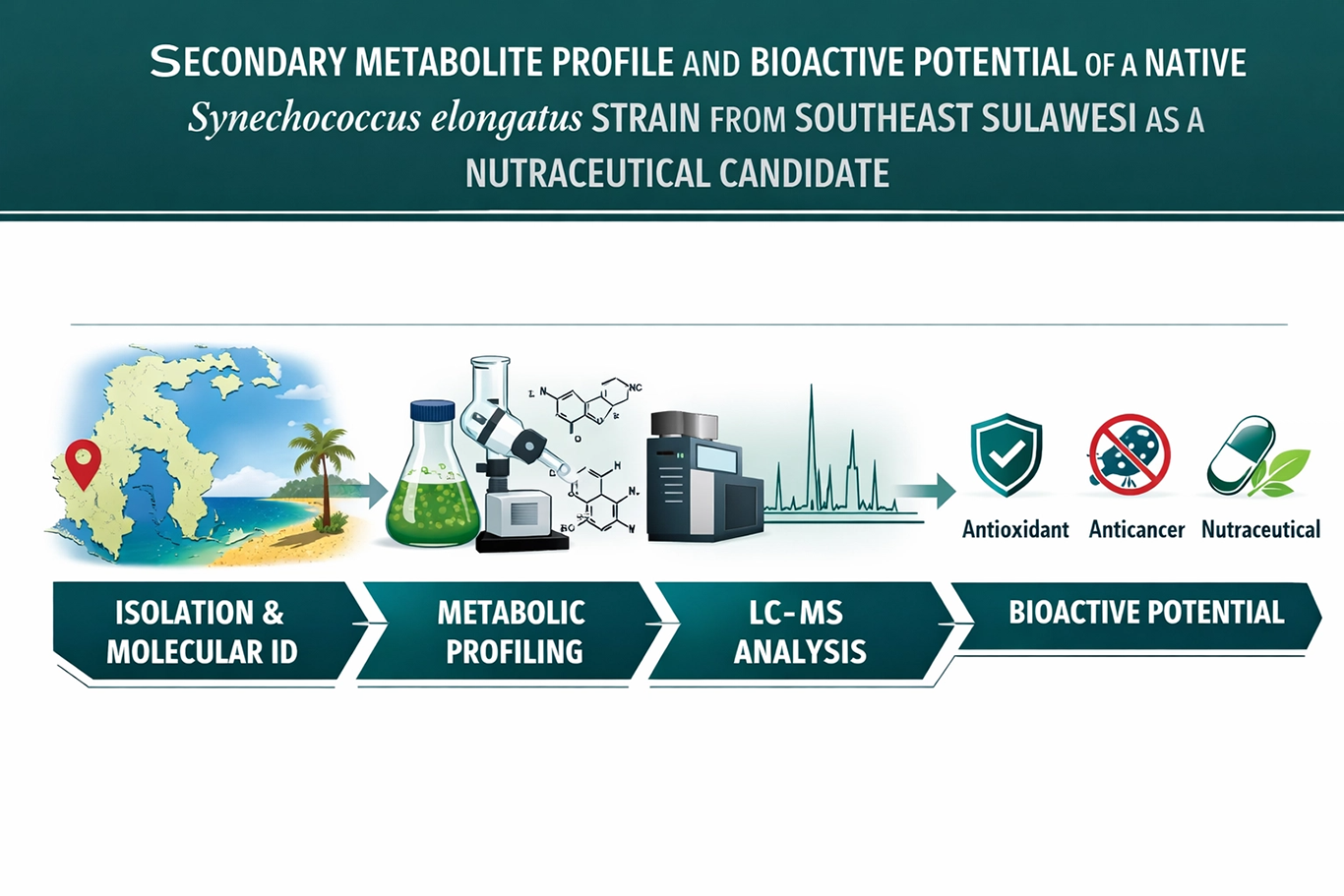
SECONDARY METABOLITE PROFILE AND BIOACTIVE POTENTIAL OF A NATIVE Synechococcus elongatus STRAIN FROM SOUTHEAST SULAWESI AS A NUTRACEUTICAL CANDIDATE

Downloads
ARTICLE HIGLIGHTS
- A native Synechococcus elongatus strain was isolated from coastal waters of Southeast Sulawesi, Indonesia.
- Molecular identification confirmed 99.70% sequence identity with S. elongatus.
- High total phenolic (249.81 mg GAE/g) and flavonoid (78.43 mg QE/g) contents were recorded
- LC-MS analysis identified 30 bioactive compounds, including palmitic and juniperic acids.
- The methanolic extract showed moderate antioxidant activity (IC50 114.34 mg/L) and anticancer potential (LC50 170.07 mg/L).
- Toxicity testing yielded an LC50 of 254.06 mg/L, supporting further investigation of its potential for sustainable nutraceutical and pharmaceutical applications.
ABSTRACT
Microalgae represent a potential biological resource for the development of functional raw materials due to their ability to produce a diverse range of bioactive compounds. This study aimed to identify, characterize the secondary metabolite content, and evaluate the bioactive potential of the microalga Synechococcus elongatus isolated from the coastal waters of Tambo Watu Beach, Konawe, Southeast Sulawesi. Sample identification was performed using morphological and molecular methods. Molecular analysis using BLASTn revealed that the WW1 isolate shared a 99.70% identity with the species S. elongatus. The methanolic extract from the microalgal biomass yielded 13.5%. Qualitative phytochemical screening indicated the presence of phenolic compounds, flavonoids, alkaloids, and terpenoids/steroids, but was negative for saponins. Quantitative analysis revealed a total phenolic content of 249.81 mg GAE/g extract and a total flavonoid content of 78.43 mg QE/g extract. Compound identification via LC-MS successfully detected 30 compounds, including fatty acids such as palmitic acid and juniperic acid, as well as other compounds like xanthine and deoxycholic acid, which have potential applications in the cosmetic and pharmaceutical fields. Bioactivity testing demonstrated that the S. elongatus extract possessed moderate antioxidant activity with an IC₅₀ value of 114.34 mg/L. Toxicity assessment using the Brine Shrimp Lethality Test (BSLT) showed weak toxicity with an LC₅₀ value of 254.06 mg/L, indicating its safety profile. Furthermore, the extract exhibited moderate anticancer potential with an LC₅₀ value of 170.07 mg/L. However, the extract showed no antibacterial activity against E. coli and S. aureus, nor antifungal activity against C. albicans, at concentrations up to 100 mg/disk. In conclusion, the S. elongatus isolate from Konawe waters is a rich source of phenolic and flavonoid compounds, exhibiting moderate antioxidant and anticancer bioactivities with low toxicity. These results affirm its potential for further development as a candidate for functional raw materials in the nutraceutical, pharmaceutical, and cosmetic industries.
Abdel-Raouf N, Al-Homaidan AA, Ibraheem IBM. 2012. Microalgae and wastewater treatment. Saudi J Biol Sci 19:257–275. DOI: 10.1016/j.sjbs.2012.04.005 DOI: https://doi.org/10.1016/j.sjbs.2012.04.005
Altschul SF, Gish W, Miller W, Myers EW, Lipman DJ. 1990. Basic local alignment search tool. J Mol Biol 215:403–410. DOI: 10.1016/S0022-2836(05)80360-2 DOI: https://doi.org/10.1016/S0022-2836(05)80360-2
Andersen RA, Kawachi M. 2005. Traditional microalgae isolation techniques. In: Andersen RA (Author), Algal culturing techniques. Cambridge (US): Academic Press. p. 83–100. DOI: https://doi.org/10.1016/B978-012088426-1/50007-X
DOI:10.1016/B978-012088426-1/50007-X DOI: https://doi.org/10.1016/B978-012088426-1/50007-X
Assunção J, Amaro HM, Malcata FX, Guedes AC. 2022. Cyanobacterial pigments: Photosynthetic function and biotechnological purposes. In: Lopes G, Silva M, Vasconcelos V (Editors), The pharmacological potential of Cyanobacteria. Cambridge (US): Academic Press. p. 201–256. DOI: 10.1016/B978-0-12-821491-6.00008-9 DOI: https://doi.org/10.1016/B978-0-12-821491-6.00008-9
Atanasov AG, Zotchev SB, Dirsch VM, Supuran CT. 2021. Natural products in drug discovery: advances and opportunities. Nat Rev Drug Discov 20:200–216. DOI: 10.1038/s41573-020-00114-z. DOI: https://doi.org/10.1038/s41573-020-00114-z
Azwanida NN. 2015. A review on the extraction methods use in medicinal plants, principle, strength and limitation. Med Aromat Plants 4:1–6. DOI: 10.4172/2167-0412.1000196 DOI: https://doi.org/10.4172/2167-0412.1000196
Bauer AW, Kirby WM, Sherris JC, Turck M. 1966. Antibiotic susceptibility testing by a standardized single disk method. Am J Clin Pathol 45:493–496. DOI: 10.1093/ajcp/45.4_ts.493 DOI: https://doi.org/10.1093/ajcp/45.4_ts.493
Blois MS. 1958. Antioxidant determinations by the use of a stable free radical. Nature 181:1199–1200. DOI: 10.1038/1811199a0 DOI: https://doi.org/10.1038/1811199a0
Boekema EJ, Hifney A, Yakushevska AE, Piotrowski M, Keegstra W, Berry S, Kruip J. 2001. A giant chlorophyll–protein complex induced by iron deficiency in cyanobacteria. Nature 412:745–748. DOI: 10.1038/35089104 DOI: https://doi.org/10.1038/35089104
Carroll AR, Copp BR, Davis RA, Keyzers RA, Prinsep MR. 2019. Marine natural products. Nat Prod Rep 36:122–173. DOI: 10.1039/c8np00092a DOI: https://doi.org/10.1039/C8NP00092A
Chang CC, Yang MH, Wen HM, Chern JC. 2002. Estimation of total flavonoid content in propolis by two complementary colorimetric methods. J Food Drug Anal 10:178–182. DOI: 10.38212/2224-6614.2748 DOI: https://doi.org/10.38212/2224-6614.2748
Coates RC, Podell S, Korobeynikov A, Lapidus A, Pevzner P, Sherman DH, Gerwick WH. 2014. Characterization of cyanobacterial hydrocarbon composition and distribution of biosynthetic pathways. PLOS ONE 9:e85140. DOI: 10.1371/journal.pone.0085140 DOI: https://doi.org/10.1371/journal.pone.0085140
Colla LM, Furlong EB, Costa JAV. 2007. Antioxidant properties of Spirulina (Arthospira) platensis cultivated under different temperatures and nitrogen regimes. Braz Arch Biol Technol 50:161–167. DOI: 10.1590/S1516-89132007000100020 DOI: https://doi.org/10.1590/S1516-89132007000100020
Demay J, Bernard C, Reinhardt A, Marie B. 2019. Natural products from cyanobacteria: Focus on beneficial activities. Mar Drugs 17:320. DOI: 10.3390/md17060320 DOI: https://doi.org/10.3390/md17060320
Finney DJ. 1971. Probit analysis. Cambridge (UK): Cambridge University Press.
Flombaum P, Gallegos JL, Gordillo RA, Rincón J, Zabala LL, Jiao N, Martiny AC. 2013. Present and future global distributions of the marine Cyanobacteria Prochlorococcus and Synechococcus. Proc Nat Acad Sci 110:9824–9829. DOI: 10.1073/pnas.1307701110 DOI: https://doi.org/10.1073/pnas.1307701110
Goiris K, Muylaert K, Fraeye I, Foubert I, De Brabanter J, De Cooman L. 2012. Antioxidant potential of microalgae in relation to their phenolic and carotenoid content. J Appl Phycol 24:1477–1486. DOI: 10.1007/s10811-012-9804-6 DOI: https://doi.org/10.1007/s10811-012-9804-6
Harborne AJ. 1998. Phytochemical methods a guide to modern techniques of plant analysis. Dordrecht (NL): Springer Science & Business Media.
Hutomo M, Moosa MK. 2005. Indonesian marine and coastal biodiversity: Present status. Indian J Mar Sci 34:88–97.
Kumar S, Stecher G, Li M, Knyaz C, Tamura K. 2018. MEGA X: Molecular evolutionary genetics analysis across computing platforms. Mol Biol Evol 35:1547–1549. DOI: 10.1093/molbev/msy096 DOI: https://doi.org/10.1093/molbev/msy096
Larasati SJH, Trianto A, Radjasa OK, Sabdono A. 2023. Bacterial diversity of the gorgonian coral Plexaura sp.: Screening for anti-pathogenic property against nosocomial pathogenic Acinetobacter baumannii. Int J Conserv Sci 14:341–350. DOI: https://doi.org/10.36868/IJCS.2023.01.24
Leliaert F, Smith DR, Moreau H, Herron MD, Verbruggen H, Delwiche CF, De Clerck O. 2012. Phylogeny and molecular evolution of the green algae. Crit Rev Plant Sci 31:1–46. DOI: 10.1080/07352689.2011.615705 DOI: https://doi.org/10.1080/07352689.2011.615705
Meyer BN, Ferrigni NR, Putnam JE, Jacobsen LB, Nichols DE, McLaughlin JL. 1982. Brine shrimp: A convenient general bioassay for active plant constituents. Planta Med 45:31–34. DOI: 10.1055/s-2007-971236 DOI: https://doi.org/10.1055/s-2007-971236
Molinski TF, Dalisay DS, Lievens SL, Saludes JP. 2009. Drug development from marine natural products. Nat Rev Drug Discov 8:69–85. DOI: 10.1038/nrd2487 DOI: https://doi.org/10.1038/nrd2487
Newman DJ, Cragg GM. 2007. Natural products as sources of new drugs over the last 25 years. J Nat Prod 70:461–477. DOI: 10.1021/np068054v DOI: https://doi.org/10.1021/np068054v
Newman DJ, Cragg GM. 2020. Natural products as sources of new drugs over the nearly four decades from 01/1981 to 09/2019. J Nat Prod 83:770–803. DOI: 10.1021/acs.jnatprod.9b01285 DOI: https://doi.org/10.1021/acs.jnatprod.9b01285
Philp JC, Ritchie RJ, Allan JE. 2013. Biobased chemicals: the convergence of green chemistry with industrial biotechnology. Trends Biotechnol 31:219–222. DOI: 10.1016/j.tibtech.2012.11.007 DOI: https://doi.org/10.1016/j.tibtech.2012.12.007
Puglisi MP, Sneed JM, Sharp KH, Ritson-Williams R, Paul VJ. 2014. Marine chemical ecology in benthic environments. Nat Prod Rep 31:1510–1553. DOI: 10.1039/c4np00075g DOI: https://doi.org/10.1039/C4NP00017J
Purnamawati S, Indrastuti N, Danarti R, Saefudin T. 2018. The role of moisturizers in addressing various kinds of dermatitis: a review. Clin Med Res 15(3–4):75–87. DOI: 10.3121/cmr.2017.1363 DOI: https://doi.org/10.3121/cmr.2017.1363
Rastogi RP, Sinha RP. 2009. Biotechnological and industrial significance of cyanobacterial secondary metabolites. Biotechnol Adv 27:521–539. DOI: 10.1016/j.biotechadv.2009.04.006 DOI: https://doi.org/10.1016/j.biotechadv.2009.04.009
Richa RR, Kumari S, Singh KL, Kannaujiya VK, Singh G, Kesheri M, Sinha RP. 2011. Biotechnological potential of mycosporine-like amino acids and phycobiliproteins of cyanobacterial origin. Biotechnol Bioinf Bioeng 1:159–171.
Sasidharan S, Chen Y, Saravanan D, Sundram KM, Latha LY. 2011. Extraction, isolation and characterization of bioactive compounds from plants’ extracts. Afr J Trad Complement Altern Med 8:1–10. DOI: 10.4314/ajtcam.v8i1.60483 DOI: https://doi.org/10.4314/ajtcam.v8i1.60483
Sciuto K, Moro I. 2015. Cryptic species in microalgae: a review. Eur J Phycol 50:437–451. DOI: 10.1080/09670262.2015.1083546
Shapiro SS, Saliou C. 2001. Role of vitamins in skin care. Nutrition 17:839–844. DOI: 10.1016/s0899-9007(01)00664-8 DOI: https://doi.org/10.1016/S0899-9007(01)00660-8
Singh R, Kumar M, Mittal A, Mehta PK. 2016. Microbial enzymes: Industrial progress in 21st century. 3 Biotech 6:174. DOI: 10.1007/s13205-016-0485-8 DOI: https://doi.org/10.1007/s13205-016-0485-8
Singleton VL, Rossi JA. 1965. Colorimetry of total phenolics with phosphomolybdic-phosphotungstic acid reagents. Am J Enol Vitic 16:144–158. DOI: https://doi.org/10.5344/ajev.1965.16.3.144
Smith CA, O'Maille G, Want EJ, Qin C, Trauger SA, Brandon TR, Siuzdak G. 2005. METLIN: A metabolite mass spectral database. Ther Drug Monit 27:747–751. DOI: 10.1097/01.ftd.0000184423.86144.5b DOI: https://doi.org/10.1097/01.ftd.0000179845.53213.39
Smith WP. 1994. Hydroxy acids and skin aging. Cosmet Toilet 109:41–48.
Spolaore P, Joannis-Cassan C, Duran E, Isambert A. 2006. Commercial applications of microalgae. J Biosci Bioeng 101:87–96. DOI: 10.1263/jbb.101.87 DOI: https://doi.org/10.1263/jbb.101.87
Stackebrandt E, Goebel BM. 1994. Taxonomic note: a place for DNA-DNA reassociation and 16S rRNA sequence analysis in the present species definition in bacteriology. Int J Syst Evol Microbiol 44:846–849. DOI: 10.1099/00207713-44-4-846 DOI: https://doi.org/10.1099/00207713-44-4-846
Tamura K, Stecher G, Peterson D, Filipski A, Kumar S. 2013. MEGA6: Molecular evolutionary genetics analysis version 6.0. Mol Biol Evol 30:2725–2729. DOI: 10.1093/molbev/mst197 DOI: https://doi.org/10.1093/molbev/mst197
Tzovenis I, Podola B, Tsaliki E. 1997. The impact of freeze-drying on the lipids of the rotifer Brachionus plicatilis. Aquac Res 28:381–389. DOI: 10.1046/j.1365-2109.1997.00868.x
Walne PR. 1966. Experiments on the large-scale culture of the larvae of Ostrea edulis. J Fish Invest Min Agric Fish London, Ser 2 25:1–53.
Wolfender JL, Rudaz S, Hae Choi Y, Kyong Kim H. 2013. Plant metabolomics: from holistic data to relevant biomarkers. Curr Med Chem 20:1056–1090. DOI: 10.2174/0929867311320080005 DOI: https://doi.org/10.2174/0929867311320080009
Copyright (c) 2026 Haslianti Haslianti, Muhammad Fajar Purnama, Suwarjoyowirayatno, Asnani, Andi Besse Patadjai, Mohamad Nuh Ibrahim, Muhaimin Hamzah, Wellem Henrik Muskita, La Ode Baytul Abidin, La Ode Muhammad Arsal, Herlan Hidayat, I Made Windi Hermawan, Amanah Rahmadiyah

This work is licensed under a Creative Commons Attribution-NonCommercial-NoDerivatives 4.0 International License.
Authors who publish with this journal agree with the following terms:
- Authors retain copyright and grant the journal right of first publication, with the work 1 year after publication simultaneously licensed under a Creative Commons attribution-noncommerical-noderivates 4.0 International License that allows others to share, copy and redistribute the work in any medium or format, but only where the use is for non-commercial purposes and an acknowledgement of the work's authorship and initial publication in this journal is mentioned.
- Authors are able to enter into separate, additional contractual arrangements for the non-exclusive distribution of the journal's published version of the work (e.g., post it to an institutional repository or publish it in a book), with an acknowledgement of its initial publication in this journal.
- Authors are permitted and encouraged to post their work online (e.g., in institutional repositories or on their website) prior to and during the submission process, as it can lead to productive exchanges, as well as earlier and greater citation of published work (See The Effect of Open Access).