EFFECT OF DIFFERENT CULTURE MEDIA ON THE GROWTH AND CHLOROPHYLL-a CONTENT OF Navicula sp. and Synechococcus sp

Downloads
ARTICLE HIGLIGHTS
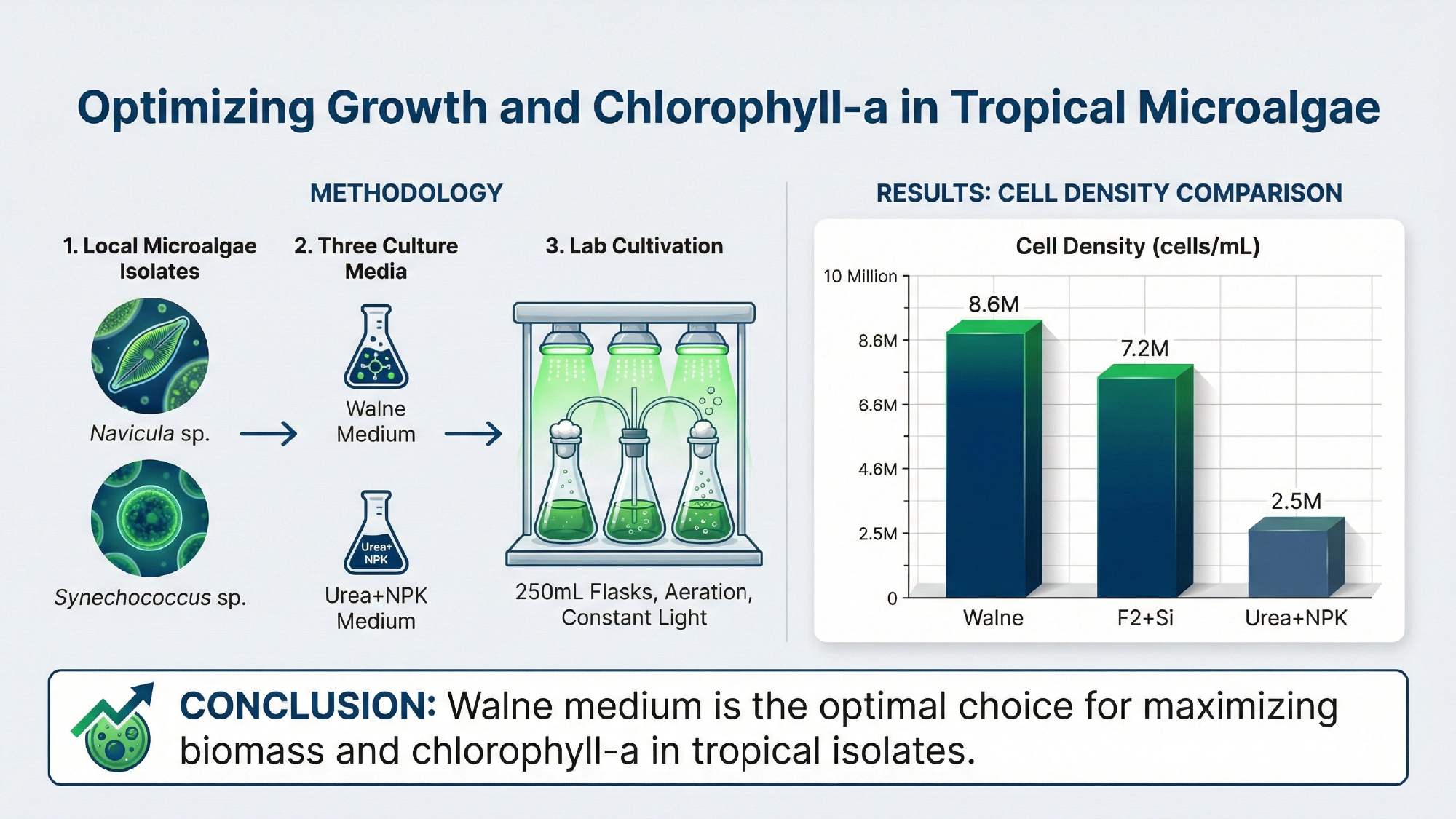
- Walne medium significantly enhances microalgae growth and chlorophyll-a content.
- F2+Si medium effectively supports Navicula sp. growth in cultivation.
- Urea+NPK limits microalgae due to nutrient deficiency.
- Optimal media selection is crucial for tropical microalgae cultivation.
ABSTRACT
This research addressed a critical knowledge gap regarding the optimal cultivation conditions for indigenous microalgal strains from high-biodiversity tropical marine ecosystems, offering insights into their physiological responses to varied nutrient regimes. In particular, this study focused on evaluating the effect of three different culture media (Walne, F2+Si, and Urea+NPK) on the growth and chlorophyll-a content of local microalgae isolates, Navicula sp. and Synechococcus sp., isolated from Southeast Sulawesi waters. The isolates were cultivated at a laboratory scale in January 2025 using 250 mL Erlenmeyer flasks containing 100 mL of media, under continuous aeration at room temperature (26 - 30 °C) and constant illumination (90 µmol photons/m²/s). Growth was monitored every two days. The results demonstrated that Walne medium yielded the highest cell density and chlorophyll-a content for both species. In Walne medium, Navicula sp. reached a peak density of 8,656,000 ± 53,777 cells/mL with a specific growth rate (SGR) of 1.1453 ± 0.033, while the density of Synechococcus sp. reached 4,965,833 ± 16,646 cells/mL with an SGR of 0.8297 ± 0.032. The F2+Si medium also supported good growth, particularly for Navicula sp. (SGR of 1.0967 ± 0.003). However, the Urea+NPK medium consistently produced the lowest results for all parameters due to limitations in micronutrient and vitamin. One-Way ANOVA revealed no significant difference (P > 0.05) between Walne and F2+Si media for the growth of Navicula sp., but Walne medium was significantly superior for Synechococcus sp. This study concluded that the choice of the culture medium is crucial for optimizing microalgal growth. Walne medium is recommended as the optimal medium for cultivating both Navicula sp. and Synechococcus sp., whereas F2+Si serves as an effective alternative for Navicula sp. The findings underscore the importance of comprehensive nutrient formulations for maximizing biomass yield in local isolates and provide a foundation for developing cost-effective cultivation strategies in tropical regions.
Ajayan KV. 2023. Microalgal cultivation: Cultivation media and its supplementary compounds. J Food Agric Res 3(2):145–167. DOI: 10.47509/JFAR.2023.v03i02.04
Alwathnani H, Perveen K. 2017. Antibacterial activity and morphological changes in human pathogenic bacteria by microalgae Chlorella vulgaris extracts. Biomed Res 28(4):1610-1614.
Andersen RA. 2005. Algal culturing techniques. Burlington (US): Elsevier Academic Press.
[APHA] American Public Health Association, [AWWA] American Water Works Association, [WEF] Water Environment Federation. 2017. Standard methods for the examination of water and wastewater. 23rd Edition. Washington DC (US): American Public Health Association.
Beale SI. 1999. Enzymes of chlorophyll biosynthesis. Photosynth Res 60(1):43-73. DOI: 10.1023/A:1006297731456
Borowitzka MA. 2013. High-value products from microalgae their development and commercialisation. J Appl Phycol 25(3):743-756. DOI: 10.1007/s10811-013-9983-9
Boyd PW, Rynearson TA, Armstrong EA, Fu F, Hayashi K, Hu Z, Thomas MK. 2013. Marine phytoplankton temperature versus growth responses from polar to tropical waters–outcome of a scientific community-wide study. PloSone 8(5):e63091. DOI: 10.1371/ journal.pone.0063091
Busby WF, Lewin JC. 1967. Silicate uptake and silica shell formation by synchronously dividing cells of the diatom Navicula pelliculosa. Phycologia 6(1):31–44. DOI: 10.2216/i0031-8884-6-1-31.1
Cheah WY, Show PL, Juan JC, Chang JS, Ling TC. 2018. Waste to energy: The effects of Pseudomonas sp. on Chlorella sorokiniana biomass and lipid productions in palm oil mill effluent. Clean Technol Environ Policy 20(9):2037-2045. DOI: 10.1007/s10098-018-1505-7
Chisti Y. 2007. Biodiesel from microalgae. Biotechnol Adv 25(3):294–306. DOI: 10.1016/j.biotechadv.2007.02.001
Cloern JE, Grenz C, Vidergar-Lucas L. 1995. An empirical model of the phytoplankton chlorophyll:carbon ratio—the conversion factor between productivity and growth rate. Limnol Oceanogr 40(7):1313–1321. DOI: 10.4319/lo.1995.40.7.1313
Croft MT, Lawrence AD, Raux-Deery E, Warren MJ, Smith AG. 2005. Algae acquire vitamin B12 through a symbiotic relationship with bacteria. Nature 438(7064):90-93. DOI: 10.1038/nature04056
Dupont CL, Buck KN, Palenik B, Barbeau K. 2010. Nickel utilization in phytoplankton assemblages from contrasting oceanic regimes. Deep-Sea Res I: Oceanogr Res Pap 57(4):553-566. DOI: 10.1016/j.dsr.2009.12.014
Falkowski PG, Raven JA. 2013. Aquatic photosynthesis. Princeton (US): Princeton University Press.
Finkel ZV, Beardall J, Flynn KJ, Quigg A, Rees TAV, Raven JA. 2010. Phytoplankton in a changing world: Cell size and elemental stoichiometry. J Plankton Res 32(1):119-137. DOI: 10.1093/plankt/fbp098
Geider RJ. 1987. Light and temperature dependence of the carbon to chlorophyll a ratio in microalgae and cyanobacteria: Implications for physiology and growth of phytoplankton. New Phytol 106(1):1-34. DOI: 10.1111/j.1469-8137.1987.tb04788.x
Geider RJ, La Roche J. 2002. Redfield revisited: Variability of C:N:P in marine phytoplankton. Eur J Phycol 37(1):1-17. DOI: 10.1017/S0967026201003456
Geider RJ, MacIntyre HL, Kana TM. 1997. Dynamic model of phytoplankton growth and acclimation: responses of the balanced growth rate and the chlorophyll a: carbon ratio to light, nutrient-limitation and temperature. Mar Ecol Prog Ser 148:187-200.
DOI: 10.3354/meps148187
Glass AD. 2003. Nitrogen use efficiency of crop plants: physiological constraints upon nitrogen absorption. Crit Rev Plant Sci 22(5):453-470. DOI: 10.1080/713989757
Grossman AR, Schaefer MR, Chiang GG, Collier J. 1993. The phycobilisome, a light-harvesting complex responsive to environmental conditions. Microbiol Rev 57(3):725-749. DOI: 10.1128/mr.57.3.725-749.1993
Guillard RRL. 1975. Culture of phytoplankton for feeding marine invertebrates. In Smith WL, Chanley MH (Editors), Culture of marine invertebrate animals. New York (US): Plenum Press. p. 29–60. DOI: 10.1007/978-1-4615-8714-93
Guillard RRL, Ryther JH. 1962. Studies of marine planktonic diatoms. I. Cyclotella nana Hustedt, and Detonula confervacea (Cleve) Gran. Can J Microbiol 8(2):229-239. DOI: 10.1139/m62-029
Guiry MD. 2012. How many species of algae are there? J Phycol 48(5):1057-1063. DOI: 10.1111/j.1529-8817.2012.01222.x
Healey FP. 1973. Inorganic nutrient uptake and deficiency in algae. CRC Crit Rev Microbiol 3(1):69-113. DOI: 10.3109/10408417309108746
Hu Q. 2004. Environmental effects on cell composition. In Richmond A (Editor), Handbook of microalgal culture: Biotechnology and applied phycology. Oxford (UK): Blackwell Publishing. p. 83–93. DOI: 10.1002/9780470995280.ch5
Izani R, Lani N, Susanty D. 2021. Kultivasi Chlorella sp. pada media limbah ayam broiler dan profil metabolitnya dengan analisis GC-MS [Cultivation of Chlorella sp. in broiler chicken waste medium and its metabolite profile analyzed by GC-MS]. Jurnal Sains Natural 11(1):1–7. DOI: 10.31938/jsn.v11i1.290
Jain P, Minhas AK, Shukla S, Puri M, Barrow CJ, Mandal S. 2022. Bioprospecting indigenous marine microalgae for polyunsaturated fatty acids under different media conditions. Front Bioeng Biotechnol 10:842797. DOI: 10.3389/fbioe.2022.842797
Jeffrey SW, Humphrey GF. 1975. New spectrophotometric equations for determining chlorophylls a, b, c1 and c2 in higher plants, algae and natural phytoplankton. Biochem Physiol Pflanzen 167(2):191–194. DOI: 10.1016/S0015-3796(17)30778-3
[JGI] Joint Genome Institute. 2008. Insights into the metabolism of cosmopolitan marine cyanobacteria. DOE Joint Genome Institute.
Kana TM, Glibert PM. 1987. Effect of irradiances up to 2000 μE m-² s-¹ on marine Synechococcus WH7803 – I. Growth, pigmentation, and cell composition. Deep Sea Rest A: Oceanogr Res Pap 34(4):479–495. DOI: 10.1016/0198-0149(87)90001-X
Khan MI, Shin JH, Kim JD. 2018. The promising future of microalgae: Current status, challenges, and optimization of a sustainable and renewable industry for biofuels, feed, and other products. Microb Cell Fact 17(1):36. DOI: 10.1186/s12934-018-0879-x
Labara Tirado J, Herdean A, Ralph PJ. 2025. The need for smart microalgal bioprospecting. Nat Prod Bioprospect 15(1):7. DOI: 10.1007/s13659-024-00487-3
Li C, Du M, Han Y, Sun W, Chen Z, Liu Q, Wang J. 2025. Microalgae in health care and functional foods: β-glucan applications, innovations in drug delivery and synthetic biology. Front Pharmacol 16:1557298. DOI: 10.3389/fphar.2025.1557298
Litchman E, Klausmeier CA, Schofield OM, Falkowski PG. 2007. The role of functional traits and trade-offs in structuring phytoplankton communities: Scaling from cellular to ecosystem level. Ecol Lett 10(12):1170–1181. DOI: 10.1111/j.1461-0248.2007.01117.x
Ma’mun S, Wahyudi A, Raghdanesa AS. 2022. Growth rate measurements of Chlorella vulgaris in a photobioreactor by Neubauer-improved counting chamber and densitometer. IOP Conf Ser: Earth Environ Sci 963(1):012015. DOI: 10.1088/1755-1315/963/1/012015
Martin-Jézéquel V, Hildebrand M, Brzezinski MA. 2000. Silicon metabolism in diatoms: Implications for growth. J Phycol 36(5):821-840. DOI: 10.1046/j.1529-8817.2000.00019.x
Monod J. 2012. The growth of bacterial cultures. Selected Papers in Molecular Biology by Jacques Monod 139:606. DOI: 10.1016/B978-0-12-460482-7.50020-8
Morel FMM, Price NM. 2003. The biogeochemical cycles of trace metals in the oceans. Science 300(5621):944-947. DOI: 10.1126/science.1083545
Partensky F, Hess WR, Vaulot D. 1999. Prochlorococcus, a marine photosynthetic prokaryote of global significance. Microbiol Mol Biol Rev 63(1):106–127. DOI: 10.1128/MMBR.63.1.106-127.1999
Raven JA, Waite AM. 2004. The evolution of silicification in diatoms: Inescapable sinking and sinking as escape?. New Phytol 162(1):45-61. DOI: 10.1111/j.1469-8137.2004.01022.x
Redfield AC. 1958. The biological control of chemical factors in the environment. Am Sci 46(3):205-221.
Richmond A. 2004. Handbook of microalgal culture: Biotechnology and applied phycology. Oxford (UK): Blackwell Science Ltd. DOI: 10.1002/9780470995280
Saito MA, Moffett JW, Chisholm SW, Waterbury JB. 2002. Cobalt limitation and uptake in Prochlorococcus. Limnol Oceanogr 47(6):1629-1636. DOI: 10.4319/lo.2002.47.6.1629
Savvidou GM, Boli E, Logothetis D, Lymperopoulou T, Ferraro A, Louli V, Mamma D, Kekos D, Magoulas K, Kolisis NF. 2020. A study on the effect of macro- and micro-nutrients on Nannochloropsis oceanica growth, fatty acid composition and magnetic harvesting efficiency. Plants 9(5):660. DOI: 10.3390/plants9050660
Sharma AK, Jaryal S, Sharma S, Dhyani A, Tewari BS, Mahato N. 2025. Biofuels from microalgae: A review on microalgae cultivation, biodiesel production techniques and storage stability. Processes 13(2):488. DOI: 10.3390/pr13020488
Spolaore P, Joannis-Cassan C, Duran E, Isambert A. 2006. Commercial applications of microalgae. J Biosci Bioeng 101(2):87-96. DOI: 10.1263/jbb.101.87
Sterner RW, Elser JJ. 2003. Ecological stoichiometry: The biology of elements from molecules to the biosphere. Princeton (US): Princeton University Press. DOI: 10.1515/9781400885695
Sunda WG. 2012. Feedback interactions between trace metal nutrients and phytoplankton in the ocean. Front Microbiol 3:204. DOI: 10.3389/fmicb.2012.00204
Sunda WG, Huntsman SA. 1995. Iron uptake and growth limitation in oceanic and coastal phytoplankton. Mar Chem 50(1-4):189-206. DOI: 10.1016/0304-4203(95)00035-P
Tomascik T, Mah AJ, Nontji A, Moosa MK. 1997. The Ecology of the Indonesian Seas. Oxford (UK): Oxford University Press. DOI: 10.1093/oso/9780198501855.001.0001
Trenkenshu RP. 2019. Calculation of the specific growth rate of microalgae. Mar Biol J 4(1):100–108. DOI: 10.21072/mbj.2019.04.1.09
Walne PR. 1966. Experiments in the large-scale culture of the larvae of Ostrea edulis L. Fishery Investigations, Series II 25(4). London (UK): H.M. Stationary Office. 53 p.
Wang L, Liu J, Chen F. 2019. Chlorophyll biosynthesis in microalgae: Advances and perspectives. Front Plant Sci 10:455. DOI: 10.3389/fpls.2019.00455
Wijffels RH, Kruse O, Hellingwerf KJ. 2013. Potential of industrial biotechnology with cyanobacteria and eukaryotic microalgae. Curr Opin Biotechnol 24(3):405-413. DOI: 10.1016/j.copbio.2013.04.004
Copyright (c) 2026 Haslianti, Wa Ode Nilda Arifiana Effendy, Suwarjoyowirayatno, La Ode Baytul Abidin, Muhaimin Hamzah, Asmariani, Fatmawati, Wa Ode Intiyani Mangurana, Herlan Hidayat, Asjun

This work is licensed under a Creative Commons Attribution-NonCommercial-NoDerivatives 4.0 International License.
Authors who publish with this journal agree with the following terms:
- Authors retain copyright and grant the journal right of first publication, with the work 1 year after publication simultaneously licensed under a Creative Commons attribution-noncommerical-noderivates 4.0 International License that allows others to share, copy and redistribute the work in any medium or format, but only where the use is for non-commercial purposes and an acknowledgement of the work's authorship and initial publication in this journal is mentioned.
- Authors are able to enter into separate, additional contractual arrangements for the non-exclusive distribution of the journal's published version of the work (e.g., post it to an institutional repository or publish it in a book), with an acknowledgement of its initial publication in this journal.
- Authors are permitted and encouraged to post their work online (e.g., in institutional repositories or on their website) prior to and during the submission process, as it can lead to productive exchanges, as well as earlier and greater citation of published work (See The Effect of Open Access).