TREE CARBON STOCK ESTIMATION AND MODELING OF PALSABANGON WATERSHED USING THE INVEST MODEL IN QUEZON PROVINCE, PHILIPPINES

Downloads
ARTICLE HIGLIGHTS
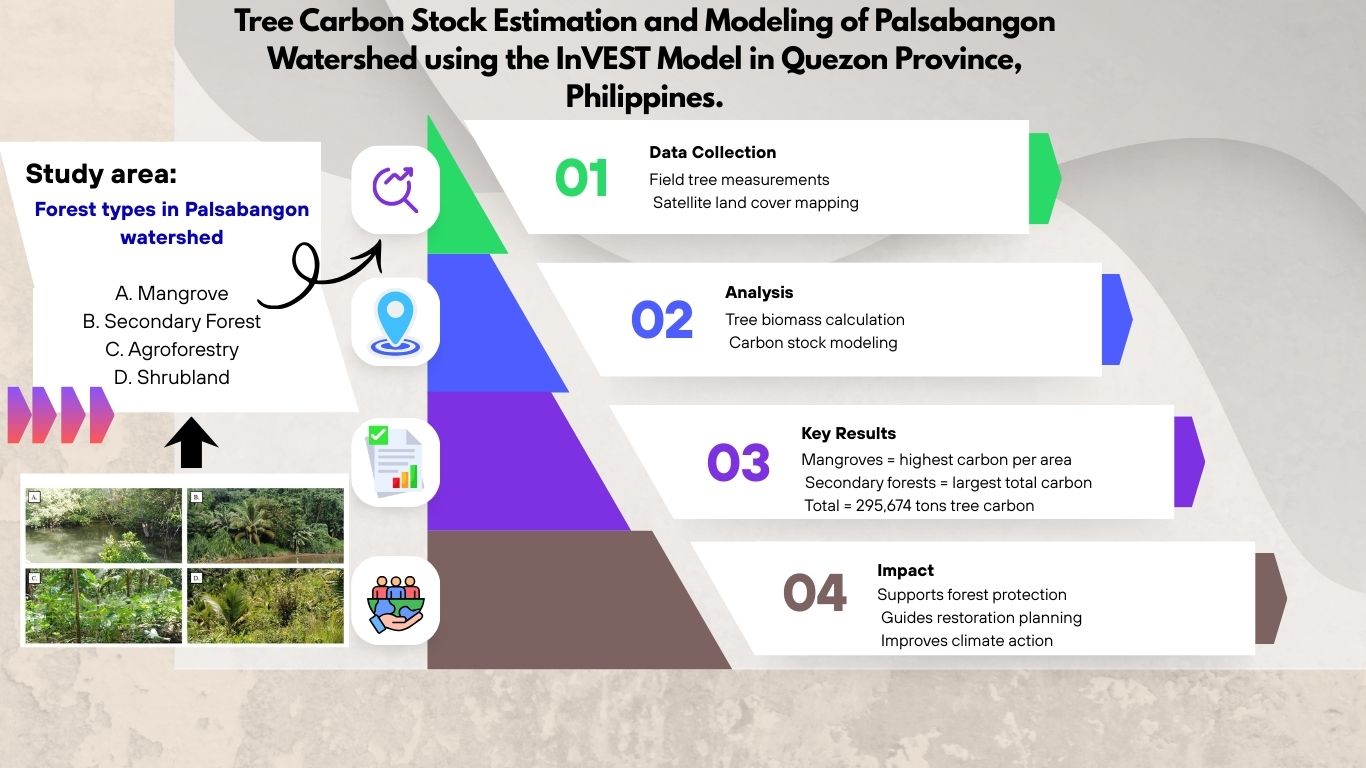
- First carbon mapping of Palsabangon watershed using InVEST model
- Combines remote sensing and field data across four key vegetation types
- Reveals mangroves store highest carbon per hectare among land covers
- Secondary forests hold largest total carbon due to broader area coverage
- Informs creation of carbon conservation zones in vulnerable watershed areas
ABSTRACT
The Palsabangon Watershed is primarily composed of young secondary forests, shrublands, agroforestry, and remnant mangrove stands that are increasingly threatened by land-use conversion, resource extraction, and natural disturbances. The watershed remains undeclared and unprotected by law in the southern Sierra Madre Mountain Range of Quezon Province, Philippines. Despite these pressures, the watershed continues to play an important role in carbon sequestration and climate regulation. To assess carbon stock, four vegetation types; secondary forest, shrubland, agroforestry, and mangrove were evaluated through quadrat sampling using thirteen 5 m × 40 m rectangular plots. Tree carbon was estimated using allometric equations, and land use/land cover maps were generated from Sentinel-2 satellite imagery. The dominant vegetation cover was secondary forest, followed by shrubland, agroforestry, and mangrove forest. Carbon stock estimation was performed using the Carbon Storage and Sequestration model within the Integrated Valuation of Ecosystem Services and Tradeoffs (InVEST) software. The estimates of tree carbon stock (C) in Palsabangon Watershed revealed that mangrove forests had the highest density (85.1 MgC/ha), followed by secondary forests (67.8 MgC/ha), agroforestry (50.4 MgC/ha), and shrublands (43.3 MgC/ha). Tree carbon stock in mangroves and secondary forests was attributed to the younger age and declining tree density of these ecosystems, caused by anthropogenic and natural factors. The total tree carbon stock of the watershed was estimated at 295,674 tonnes C, with secondary forests contributing the most (140,666.7 tonnes C). Despite the young age of the forest stands, the watershed demonstrates significant potential for carbon accumulation. To ensure long-term sustainability, we recommend the establishment of forest carbon conservation zones to protect and enhance carbon sequestration capacity of the watershed.
Abino AC, Castillo JAC, Lee YJ. 2014. Species diversity, biomass, and carbon stock assessments of a natural mangrove forest in Palawan, Philippines. Pak J Bot 46(6):1955–1962.
Almarines NR, Lapitan RL. 2014. Carbon stock determination of selected terrestrial ecosystem in the Upper Marikina Watershed, Antipolo City, Rizal Province, Philippines. Asia Life Sci 23(1):49–63.
Brakas SG, Aune JB. 2011. Biomass and carbon accumulation in land use systems of Claveria, the Philippines. In: Kumar BM, Nair PKR (Editors), Carbon sequestration potential of agroforestry systems: Opportunities and challenges. Advances in Agroforestry Series Volume 8. Dordrecht (NL): Springer Dordrecht. p. 163–175. DOI: 10.1007/978-94-007-1630-8_9 DOI: https://doi.org/10.1007/978-94-007-1630-8_9
Brown S. 1997. Estimating biomass and biomass change of tropical forests: A primer. FAO Forestry Paper-134. Rome (IT): Food and Agriculture Organization of the United Nations.
Cairns MA, Brown S, Helmer EH, Baumgardner GA. 1997. Root biomass allocation in the world's upland forests. Oecologia 111(1):1–11. DOI: 10.1007/s004420050201 DOI: https://doi.org/10.1007/s004420050201
Chisholm RA, Muller-Landau HC, Abdul Rahman K, Bebber DP, Bin Y, Bohlman SA, ..., Zimmerman JK. 2013. Scale-dependent relationships between tree species richness and ecosystem function in forests. J Ecol 101:1214–1224. DOI: 10.1111/1365-2745.12132 DOI: https://doi.org/10.1111/1365-2745.12132
Dida JJV, Tiburan CL, Tsutsumida N, Saizen I. 2021. Carbon stock estimation of selected watersheds in Laguna, Philippines using InVEST. Philipp J Sci 150(2):501–513. DOI: https://doi.org/10.56899/150.02.15
[FAO] Food and Agriculture Organization of the United Nations. 2006. Global forest resources assessment 2005: Progress towards sustainable forest management. FAO Forestry Paper-147). Rome (IT): Food and Agriculture Organization of the United Nations. [Internet]. Available from: https://www.fao.org/3/a0400e/a0400e00.htm
Gevaña DT, Pampolina NM. 2009. Plant diversity and carbon storage of a Rhizophora stand in Verde Passage, San Juan, Batangas, Philippines. J Environ Sci Manag 12(2):1–10.
Gevaña DT, Pollisco JPT, Pampolina NM, Kim D, Im S. 2013. Plant diversity and aboveground carbon along altitudinal gradients in Quezon Mountain Range in Southern Mindanao, Philippines. J Environ Sci Manag 16(1):20–28. DOI: 10.47125/jesam/2013_1/03 DOI: https://doi.org/10.47125/jesam/2013_1/03
Gullison RE, Frumhoff PC, Canadell JG, Field CB, Nepstad DC, Hayhoe K, ..., Nobre C. 2007. Tropical forests and climate policy. Science 316(5827):985–986. DOI: 10.1126/science.1136163 DOI: https://doi.org/10.1126/science.1136163
Isbell F, Calcagno V, Hector A, Connolly J, Harpole WS, Reich PB, ..., Loreau M. 2011. High plant diversity is needed to maintain ecosystem services. Nature 477(7363):199–202. DOI: 10.1038/nature10282 DOI: https://doi.org/10.1038/nature10282
Jiang W, Deng Y, Tang Z, Lei X, Chen Z. 2017. Modelling the potential impacts of urban ecosystem changes on carbon storage under different scenarios by linking the CLUE-S and the InVEST models. Ecol Model 345(C):30–40. DOI: 10.1016/j.ecolmodel.2016.12.002 DOI: https://doi.org/10.1016/j.ecolmodel.2016.12.002
Komiyama A, Poungparn S, Kato S. 2005. Common allometric equations for estimating the tree weight of mangroves. J Trop Ecol 21(4):471–477. DOI: 10.1017/S0266467405002476 DOI: https://doi.org/10.1017/S0266467405002476
Labata MM, Aranico EC, Tabaranza ACE, Patricio JHP, Amparado RF Jr. 2012. Carbon stock assessment of three selected agroforestry systems in Bukidnon, Philippines. Adv Environ Sci 4(1):5–11.
Lasco RD, Pulhin FB. 2003. Philippine forest ecosystems and climate change: Carbon stocks, rate of sequestration, and the Kyoto Protocol. Ann Trop Res 25(2):37–51.
Lasco RD, Visco RG, Pulhin JM. 2001. Secondary forests in the Philippines: Formation and transformation in the 20th century. J Trop For Sci 13(4):652–670.
Loreau M, Hector A. 2001. Partitioning selection and complementarity in biodiversity experiments. Nature 412(6842):72–76. DOI: 10.1038/35083573 DOI: https://doi.org/10.1038/35083573
Malabrigo PL, Galang MA, Urriza RC, Umali AGA, Replan EL, Dida JJV, ..., Boncodin JC. 2017. Mangrove forest inventory and estimation of carbon storage and sedimentation in Pagbilao. Prepared for Philippine Statistics Authority. Manila (PH): Wealth Accounting and Valuation of Ecosystem Services (WAVES).
Municipality of Pagbilao. 2015. Comprehensive Land Use Plan (CLUP) 2015–2024. Manila (PH): Municipal Planning and Development Office.
Myers DE. 1994. Spatial interpolation: An overview Geoderma 62:17–28. DOI: https://doi.org/10.1016/0016-7061(94)90025-6
Nie X, Lu B, Chen Z, Yang Y, Chen S, Chen Z, Wang H. 2020. Increase or decrease? Integrating the CLUMondo and InVEST models to assess the impact of the implementation of the Major Function Oriented Zone planning on carbon storage. Ecol Indic 118:1–12. DOI: 10.1016/j.ecolind.2020.106708 DOI: https://doi.org/10.1016/j.ecolind.2020.106708
Paclibar GC, Tadiosa E. 2020. Plant species diversity and assessment in Quezon Protected Landscape, Southern Luzon, Philippines. Philipp J Syst Biol 14(3):1–19. DOI: 10.26757/pjsb2020c14010 DOI: https://doi.org/10.26757/pjsb2020c14010
Poorter L, van der Sande MT, Thompson J, Arets EJMM, Alarcón A, Álvarez-Sánchez J, ..., Peña-Claros M. 2015. Diversity enhances carbon storage in tropical forests. Glob Ecol Biogeogr 24(11):1314–1328. DOI: 10.1111/geb.12364 DOI: https://doi.org/10.1111/geb.12364
Primavera JH. 2004. Philippine mangroves: Status, threats, and sustainable development. In: Vannucci M (Editor), Mangrove management and conservation: Present and future. Tokyo (JP): United Nations University Press. p. 192–207.
Richards JA, Jia X. 2006. Remote sensing digital image analysis: An introduction. Fourth edition. Heidelberg (DE): Springer Berlin. 439 p. DOI: 10.1007/3-540-29711-1 DOI: https://doi.org/10.1007/3-540-29711-1
Sun W, Liu X. 2020. Review on carbon storage estimation of forest ecosystem and applications in China. For Ecosyst 7:4. DOI: 10.1186/s40663-019-0210-2 DOI: https://doi.org/10.1186/s40663-019-0210-2
Tilman D, Reich PB, Knops J, Wedin D, Mielke T, Lechman C. 2001. Diversity and productivity in a long-term grassland experiment. Science 294(5543):843–845. DOI: 10.1126/science.1060391 DOI: https://doi.org/10.1126/science.1060391
Vorstius A, Spray CJ. 2015. A comparison of ecosystem services mapping tools for their potential to support planning and decision-making on a local scale. Ecosyst Serv 15:75–83. DOI: 10.1016/j.ecoser.2015.07.007 DOI: https://doi.org/10.1016/j.ecoser.2015.07.007
Wang P. 2009. Forest carbon cycle model: A review. Chin J Appl Ecol 20(6):1505–1510. (In Chinese with English abstract)
Wilson EO, Peter FM. 1988. Biodiversity. Washington DC (US): National Academy Press.
Xiang H, Jia M, Wang Z, Li L, Mao D, Zhang D, ..., Zhu W. 2018. Impacts of land cover changes on ecosystem carbon stocks over the transboundary Tumen River Basin in Northeast Asia. Chin Geogr Sci 28(6):973–985. DOI: 10.1007/s11769-018-1006-y DOI: https://doi.org/10.1007/s11769-018-1006-y
Yachi S, Loreau M. 1999. Biodiversity and ecosystem productivity in a fluctuating environment: The insurance hypothesis. Proc Natl Acad Sci USA 96(4):1463–1468. DOI: 10.1073/pnas.96.4.1463 DOI: https://doi.org/10.1073/pnas.96.4.1463
Zhang H, Liu Q, Lu P, Yu Q. 2005. Overview of the carbon cycle model of terrestrial ecosystems. China Sci Technol Inf 13:25–26. (In Chinese).
Copyright (c) 2026 Raffy D. Gordula, Nelson M. Pampolina, Cristino L. Tiburan Jr., Inocencio E. Buot Jr.

This work is licensed under a Creative Commons Attribution-NonCommercial-NoDerivatives 4.0 International License.
Authors who publish with this journal agree with the following terms:
- Authors retain copyright and grant the journal right of first publication, with the work 1 year after publication simultaneously licensed under a Creative Commons attribution-noncommerical-noderivates 4.0 International License that allows others to share, copy and redistribute the work in any medium or format, but only where the use is for non-commercial purposes and an acknowledgement of the work's authorship and initial publication in this journal is mentioned.
- Authors are able to enter into separate, additional contractual arrangements for the non-exclusive distribution of the journal's published version of the work (e.g., post it to an institutional repository or publish it in a book), with an acknowledgement of its initial publication in this journal.
- Authors are permitted and encouraged to post their work online (e.g., in institutional repositories or on their website) prior to and during the submission process, as it can lead to productive exchanges, as well as earlier and greater citation of published work (See The Effect of Open Access).