UPDATED CHECKLIST OF HERPETOFAUNA IN BALINSASAYAO TWIN LAKES NATURAL PARK, NEGROS ORIENTAL: A LONG-TERM ECOLOGICAL RESEARCH SITE IN THE PHILIPPINES

Downloads
ARTICLE HIGLIGHTS
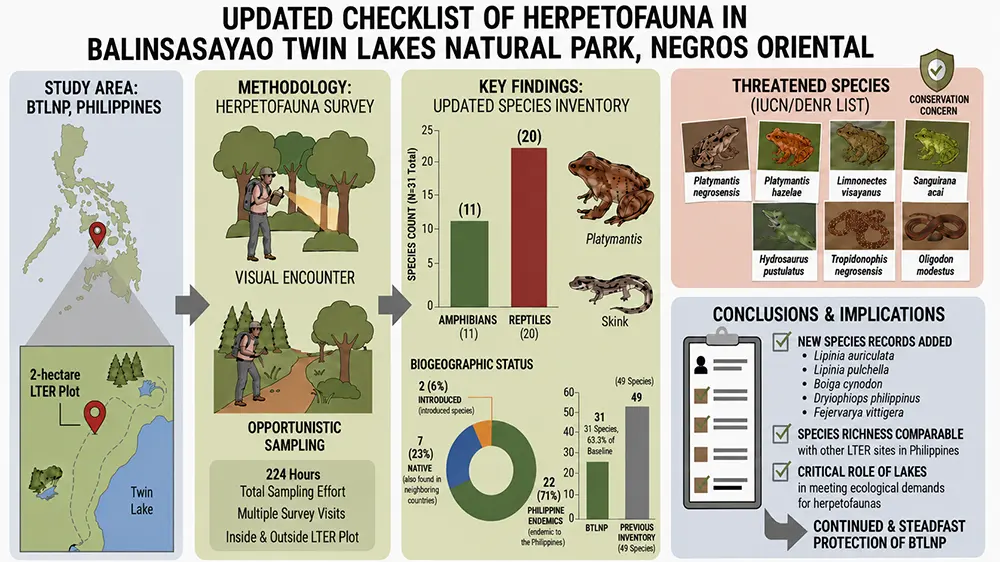
- Updated checklist reveals rich amphibian and reptile diversity.
- Twenty-two endemic species found occur only in the Philippines.
- Seven threatened species highlight the area's conservation importance.
- Species richness is comparable with other long-term research sites.
- Continued monitoring may reveal more amphibian and reptile species.
ABSTRACT
The Balinsasayao Twin Lakes Natural Park (BTLNP) is one the established Long-term Ecological Research Sites (LTER) in the Philippines. LTER sites are valuable for providing underlying causes for changes in the environment, management of natural resources, and conservation of biodiversity. Through this, researchers could quantify simultaneously certain complex ecological interactions. This primary aim of this study is to assess the herpetofauna to update the existing data on herps, and compare its species richness with other LTER sites. Survey was done by using the cruising method in the established 2-hectare plot, and other areas outside of it. A total of three sampling visits with six field days was spent from the sampling visits on. The findings of this study included detecting 29 herpetofauna species, composed of: 11 amphibian and 18 reptile species, 17 of which are endemic and six are resident. This record represents 54.7% of the total number of 53 species listed by Dolino et al., 2004. There are five species described to be threatened, namely: Platymantis negrosensis, Platymantis hazelae, Limnonectes visayanus, Sanguirana acai, Hydrosaurus pustulatus, Tropidonophis negrosensis, and Oligodon modestus. In comparison with the other LTER sites, albeit having a completely different presence of species, the level of species richness at BTLNP is close to Mt. Hamiguitan. This implies that the habitat is similar in conditions, and the demands of each species are well provided. The presence of the lake itself might be the major reason as it can offer a variety of resources for these species. Many egg laying species are also benefit from it as well. Therefore, its worth should not be undervalued. A longer monitoring and a more systematic sampling is recommended to potentially observe more species that may be unique to BTLNP.
Alcala EL, Alcala AC, Dolino CN. 2004. Amphibians and reptiles in tropical rainforest fragments on Negros Island, the Philippines. Environ Conserv 31(3):254–261. DOI: https://doi.org/10.1017/S0376892904001407
Alcala AC, Brown WC. 1998. Philippine amphibians: An illustrated field guide. Makati City (PH): Bookmark. 116 p.
Alcala E, Bucol AA, Alcala AC. 2012. A reassessment of three species of herpetofauna in Silliman University Campus, Dumaguete City, Philippines. Development Education Journal of Multidisciplinary Research.
Alcala AC, Bucol AA, Diesmos AC, Brown RM. 2012. Vulnerability of Philippine amphibians to climate change. Philipp J Sci 141(1):77–87.
Asad S, Wilting A, Siku J, Rödel MO. 2020. Possible spatial separation at macro-habitat scales between two congeneric Psammodynastes species, including observations of fishing behaviour in Psammodynastes pictus. Salamandra 56(4):411-415.
Aureo WA, Jose RP, Reyes TD, Bucol LA. 2019. Anurans species diversity and composition along the elevational gradient of the Balinsasayao Twin Lakes Natural Park, Negros Oriental, Philippines. J Biodiv Environ Sci 14(6):161–167.
Aureo W, Reyes Jr. T, Mutia FC, Tandang D, Jose R. 2021. Floristic composition and community structure along the elevational gradient of Balinsasayao Twin Lakes Natural Park in Negros Oriental, Philippines. One Ecosyst 6:e56536. DOI: https://doi.org/10.3897/oneeco.5.e56536
Bickford D. 2005. Long-term frog monitoring by local people in Papua New Guinea and the 1997–98 El Niño Southern Oscillation. In Donnelly MA, Crother BI, Guyer C, Wake MH, White ME (Editors), Ecology and evolution in the tropics: A herpetological perspective. Chicago (US): University of Chicago Press. p. 260–283.
Brockerhoff EG, Barbaro L, Castagneyrol B, Forrester DI, Gardiner B, González-Olabarria J.R, Jactel H. 2017. Forest biodiversity, ecosystem functioning and the provision of ecosystem services. Biodivers Conserv 26:3005–3035. DOI: 10.1007/s10531-017-1453-2 DOI: https://doi.org/10.1007/s10531-017-1453-2
Brown RM, Prue A, Onn CK, Gaulke M, Sanguila MB, Siler CD. 2017. Taxonomic reappraisal of the Northeast Mindanao Stream Frog, Sanguirana albotuberculata (Inger 1954), validation of Rana mearnsi, Stejneger 1905, and description of a new species from the Central Philippines. Herpetol Monogr 31(1):182–203. DOI: 10.1655/HERPMONOGRAPHS-D-16-00009.1 DOI: https://doi.org/10.1655/HERPMONOGRAPHS-D-16-00009.1
Brown RM, Siler CD, Diesmos AC, Alcala AC. 2009. Philippine frogs of the genus Leptobrachium (Anura: Megophryidae): Phylogeny-based species delimitation, taxonomic review, and descriptions of three new species. Herpetol Monogr 23:1–44. DOI: https://doi.org/10.1655/09-037.1
Biodiversity Indicators Partnership. 2010. Biodiversity indicators and the 2010 biodiversity target: Outputs, experiences and lessons learnt from the 2010 Biodiversity Indicators Partnership. CBD Tech Ser 53. 196 p. Montreal (CA): Secretariat of the Convention on Biological Diversity.
Bucol LA, Bucol AA, Arche NC. 2019. Abundance and microhabitat use by the frog Platymantis hazelae (Anura: Ceratobatrachidae). Rev Biol Trop 67(3):518–533
[CBD] Convention on Biological Diversity. 2011. [Accessed 9 March 2026]. Available from: http://www.cbd.int/sp/ targets/rationale/target-11/.
Chao A, Gotelli NJ, Hsieh TC, Sander EL, Ma KH, Colwell RK, Ellison AM. 2014. Rarefaction and extrapolation with Hill numbers: A framework for sampling and estimation in species diversity studies. Ecol Monogr 84(1):45–67. DOI: https://doi.org/10.1890/13-0133.1
Collen B, Ram M, Dewhurst N, Clausnitzer V, Kalkman V, Cumberlidge N, Baillie J. 2009. Broadening the coverage of biodiversity assessments. In: Vié J., Hilton-Taylor C, Stuart S (Editors), Wildlife in a Changing World. An Analysis of the 2008 IUCN Red List of Threatened Species. Gland (CH): International Union for Conservation of Nature. p.67–76.
Cortéz-Gómez AMM, Ruiz-Agudelo CA, Valencia-Aguilar A, Ladle RJ. 2015. Ecological functions of neotropical amphibians and reptiles: A review. Univ Sci 20(2):229–245. DOI: https://doi.org/10.11144/Javeriana.SC20-2.efna
Cruz PHPG, Afuang LE, Gonzalez JCT, Gruezo WS. 2018. Amphibians and reptiles of Luzon Island, Philippines: The herpetofauna of Pantabangan-Carranglan watershed, Nueva Ecija Province, Caraballo Mountain range. Asian Herpetol Res 9(4):201–223.
Cruz-García K, Narváez AE. 2024. Herpetofauna diversity and habitat use assessment in two remnant forests of western Ecuador. South Am J Herpetol 33(1):1–9. DOI: https://doi.org/10.2994/SAJH-D-21-00020.1
Davis DR, Watters JL, Köhler G, Whitsett C, Huron NA, Brown RM, …, Siler CD. 2015. Redescription of the rare Philippine false gecko Pseudogekko brevipes (Reptilia: Squamata: Gekkonidae) and description of a new species. Zootaxa 4020(2):357–374. DOI: https://doi.org/10.11646/zootaxa.4020.2.7
Diesmos AC, Brown RM, Gee GV. 2005. Preliminary report on the amphibians and reptiles of Balbalasang-Balbalan National Park, Luzon Island, Philippines. Sylvatrop 13(1/2):63–80.
Diesmos AC, Watters JL, Huron NA, Davis DR, Alcala AC, Crombie RI, …, Cameron D. 2015. Amphibians of the Philippines, Part I: Checklist of the species. Proc California Acad Sci Ser 4, 62(20):457–539.
Dolino CN, Cariño AB, Cadeliña AM. 2004. Threatened wildlife of the Twin Lakes Balinsasayao and Danao Natural Park, Negros Oriental, Philippines. Silliman J 45(2).
Ferner JW, Brown RM, Sison RV, Kennedy RS. 2000. The amphibians and reptiles of Panay Island, Philippines. Asiat Herpetol Res 9:1–37. DOI: https://doi.org/10.5962/bhl.part.15561
[GBIF] Global Biodiversity Information Facility. 2026. GBIF.org. [Accessed: 6 April 2026]. Available from: https://www.gbif.org.
Ghosh D, Basu P. 2020. Factors influencing herpetofauna abundance and diversity in a tropical agricultural landscape mosaic. Biotropica 52(5):927–937. DOI: https://doi.org/10.1111/btp.12799
Harvey JA, Ambavane P, Williamson M, Diesmos A. 2021. Evaluating the effects of the invasive cane toad (Rhinella marina) on island biodiversity, focusing on the Philippines. Pac Conserv Biol 28(3):199–210. DOI: https://doi.org/10.1071/PC21012
Heaney LR, Balete DS, Alcala A, Ong P, Dans AL, Rickart E, …, Oliver WR. 1998. A Synopsis of mamalian fauna of the Philippine Islands. Fieldiana Zool 88:1–61. DOI: 10.5962/bhl.title.3419 DOI: https://doi.org/10.5962/bhl.title.3419
Hecnar SJ. 2004. Great Lakes wetlands as amphibian habitats: A review. Aquat Ecosyst Health Manag 7(2):289–303. DOI: 10.1080/14634980490461542 DOI: https://doi.org/10.1080/14634980490461542
Heideman PD, Erickson KR. 1987. The climate and hydrology of the Lake Balinsasayao watershed, Negros Oriental, Philippines. Silliman J 34:82–107.
Herse MR, With KA, Boyle WA. 2018. The importance of core habitat for a threatened species in changing landscapes. J Appl Ecol 55(5):2241–2252. DOI: https://doi.org/10.1111/1365-2664.13234
Hicks N. 2000. The national parks and other wild places of the Philippines. London (UK): New Holland Publishers Ltd. 176 p.
[IUCN] International Union for Conservation of Nature. 2025. The IUCN Red List of Threatened Species. Available from: https://www.iucnredlist.org
Knutson MG, Richardson WB, Reineke DM, Gray BR, Parmelee JR, Weick SE. 2004. Agricultural ponds support amphibian populations. Ecol Appl 14(3):669–684. DOI: 10.1890/02-5305 DOI: https://doi.org/10.1890/02-5305
McKane RB, Johnson LC, Shaver GR, Nadelhoffer KJ, Rastetter EB, Fry B, …, Murray G. 2002. Resource-based niches provide a basis for plant species diversity and dominance in arctic tundra. Nature 415:68–71. DOI: 10.1038/415068a DOI: https://doi.org/10.1038/415068a
Meneses CG. 2020. Ophiophagy in the Philippine endemic Luzon False Coral Snake Hemibungarus calligaster (Wiegmann, 1834) on Gervais’ Reed Snake Calamaria gervaisii Dumeril, Bibron, and Dumeril, 1854 and the importance of the Rabor Collection in Philippine natural history. Laksambuhay 7:18–21.
Mohagan AB, Nuñeza OM, Alcala AC, Escarlos Jr. JA, Gracia Jr. AG, Selpa ECT, …, Amoroso VB. 2019. Species richness and endemism of reptilian fauna in four long-term ecological research sites in Mindanao, Philippines. Biodivers J 10(3):237–248. DOI: 10.31396/Biodiv.Jour.2019.10.3.237.248 DOI: https://doi.org/10.31396/Biodiv.Jour.2019.10.3.237.248
Mohagan AB, Nuñeza OM, Diesmos AC, Escarlos Jr. JA, Gracia Jr. AG, Selpa ECT, …, Amoroso VB. 2018. Anuran species richness and endemism in four long-term ecological research sites in Mindanao, Philippines. Asian J Conserv Biol 7(2):83–91.
Oliveros CH, Ota H, Crombie RI, Brown RM. 2011. The herpetofauna of the Babuyan Islands, northern Philippines. Scientific Papers Natural History Museum the University of Kansas 43:1–20.
Republic of the Philippines. 2018. Republic Act No. 11038: Expanded National Integrated Protected Areas System Act of 2018. Lawphil
Rosales JR, Yu JAG, Nanual BJ, Ponce AG. 2023. Inventory of herpetofauna in the buffer zone of Mt. Hamiguitan range wildlife sanctuary, San Isidro, Davao Oriental, Philippines. Davao Res J 14(2):50–65. DOI: https://doi.org/10.59120/drj.v14i2.45
Ryan TJ, Philippi T, Leiden YA, Dorcas ME, Wigley TB, Gibbons JW. 2002. Monitoring herpetofauna in a managed forest landscape: effects of habitat types and census techniques. For Ecol Manage 167(1-3):83–90. DOI: https://doi.org/10.1016/S0378-1127(01)00692-2
Samaniego EVG. 2016. Introduced frogs in buffer zone and adjacent areas of Mt. Banahaw de Lucban, Quezon Province, Luzon Island, Philippines. Sylvatrop 26(1).
Sodhi NS, Posa MRC, Lee TM, Bickford D, Koh LP, Brook BW. 2010. The state and conservation of Southeast Asian biodiversity. Biodivers Conserv 19:317–328. DOI: https://doi.org/10.1007/s10531-009-9607-5
Solania CL, Cuadrado JT, Galolo ARV, Gamalinda EF. 2021. Species richness and community structure of amphibians and reptiles in Andanan Watershed Forest Reserve, Caraga Region, Philippines. Biodivers J 12(3):673–694. DOI: https://doi.org/10.31396/Biodiv.Jour.2021.12.3.673.694
Sy EY. 2025. Checklist of amphibians of the Philippines, version 2025-1. Reptile & Amphibian Database Philippines. Manila, Philippines.
Sy EY. 2026. Checklist of reptiles of the Philippines, version 2026-1. Reptile & Amphibian Database Philippines. Manila, Philippines.
Sy EY. 2023. A naturalist’s guide to the reptiles of the Philippines. Oxford (UK): John Beaufoy Publishing Ltd. 120 p.
Sy EY, Nava FA. 2023. Ati False Gecko Pseudogekko atiorum on Panay Island, Philippines. SEAVR 2023: 019–020. Available from: https://ecologyasia.com
Tanalgo KC, Dela Cruz KC, Agduma AR, Lidasan AK, Edradan J, Dumayas RKL, …, Gatoc GKP. 2025. Drivers of extinction risks and shortfalls across terrestrial vertebrates in the Philippine global biodiversity hotspot. Sci Total Environ:180274. DOI: 10.1016/j.scitotenv.2025.180274 DOI: https://doi.org/10.1016/j.scitotenv.2025.180274
Tilman D, Lehman CL, Thomson KT. 1997. Plant diversity and ecosystem productivity: Theoretical considerations. Proc Natl Acad Sci USA 94(5):1857–1861. DOI: 10.1073/pnas.94.5.1857 DOI: https://doi.org/10.1073/pnas.94.5.1857
Valencia-Aguilar A, Cortés-Gómez AM, Ruiz-Agudelo CA. 2013. Ecosystem services provided by amphibians and reptiles in Neotropical ecosystems. Int J Biodivers Sci, Ecosyst Serv Manage 9(3):257–272. DOI: https://doi.org/10.1080/21513732.2013.821168
Venturina REL, Del Prado YLC, Kamir RAC, Balmores MN, Diesmos AC. 2020. A revised checklist of amphibians and reptiles in Camiguin Sur, Misamis Oriental, Mindaanao, Philippines. Asian Herpetol Res 11(1):28–43.
Weinell JL, Hooper E, Leviton AE, Brown RM. 2019. Illustrated key to the snakes of the Philippines. Proc Calif Acad Sci 66(1):1–49. DOI: 10.5281/zenodo.11512680
Welton LJ, Siler CD, Diesmos A, Brown RM. 2009. A new bent-toed gecko (genus Cyrtodactylus) from southern Palawan Island, Philippines and clarification of the taxonomic status of C. annulatus. Herpetologica 65(3):328–343. DOI: https://doi.org/10.1655/08-057R1.1
Wu NC, Anderson RO, Borzée A, Buttimer S, Dezetter M, Dubiner S…., Bovo RP. 2025. A user’s guide for understanding reptile and amphibian hydroregulation and climate change impacts. Conserv Physiol 13(1):coaf038. DOI: 10.1093/conphys/coaf038 DOI: https://doi.org/10.1093/conphys/coaf038
Copyright (c) 2026 Jean Henri Oracion, Arnold A. Rabor, Sharmaine P. Arjona, Victor B. Amoroso

This work is licensed under a Creative Commons Attribution-NonCommercial-NoDerivatives 4.0 International License.
Authors who publish with this journal agree with the following terms:
- Authors retain copyright and grant the journal right of first publication, with the work 1 year after publication simultaneously licensed under a Creative Commons attribution-noncommerical-noderivates 4.0 International License that allows others to share, copy and redistribute the work in any medium or format, but only where the use is for non-commercial purposes and an acknowledgement of the work's authorship and initial publication in this journal is mentioned.
- Authors are able to enter into separate, additional contractual arrangements for the non-exclusive distribution of the journal's published version of the work (e.g., post it to an institutional repository or publish it in a book), with an acknowledgement of its initial publication in this journal.
- Authors are permitted and encouraged to post their work online (e.g., in institutional repositories or on their website) prior to and during the submission process, as it can lead to productive exchanges, as well as earlier and greater citation of published work (See The Effect of Open Access).