THE POTENTIAL OF Enhalus acoroides AS A BIOSTIMULANT TO ENHANCE MAIZE GROWTH AND DROUGHT TOLERANCE

HIGHLIGHTS
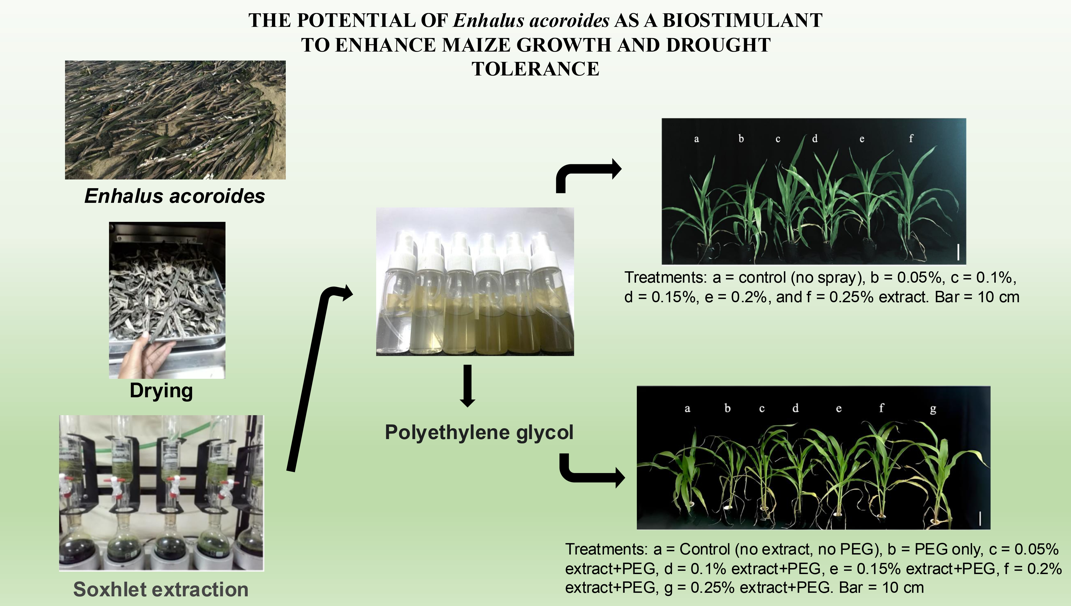
- Biostimulant Potential of Enhalus acoroides
- Positive Effects of E. acoroides on Maize Growth
- Reduction in H2O2 (Oxidative Stress) by Enhalus acoroides extract
ABSTRACT
Drought poses a significant challenge to crop productivity, with maize particularly vulnerable. Enhancing maize tolerance to drought stress is crucial, and one promising approach involves using biostimulants derived from natural sources. The seagrass Enhalus acoroides is a potential biostimulant due to its rich phytochemical composition, including phenols, tannins, flavonoids, and pigments such as chlorophyll, lutein, pheophytin, and beta-carotene. These compounds exhibit antioxidant activity, suggesting their potential role in enhancing plant resilience to drought stress. This study evaluated the effects of E. acoroides extract on maize growth under drought conditions during the seedling phase and analyzed biochemical changes in maize plants treated with the extract. The extract was prepared using 10% dried E. acoroides leaves with a chloroform-to-ethanol solvent ratio of 9:1 (v/v) and subsequently dissolved in distilled water for final concentrations of 0.05%, 0.1%, 0.15%, 0.2%, and 0.25%. The results demonstrated that E. acoroides extract enhanced plant height, increased shoot and root fresh and dry weights. Additionally, plants sprayed with E. acoroides extract exhibited higher total sugar and protein content in the shoots as compared to non-sprayed plants. Under 20% polyethylene glycol (PEG)-induced drought stress, control plants showed severe leaf wilting, whereas extract-treated plants only had mild wilting. The chlorophyll, reducing sugar, total N, and tocopherol contents were also higher in extract-treated plants under PEG stress than in untreated controls. These findings indicate the potential of E. acoroides extract as a biostimulant for improving drought tolerance in maize.
INTRODUCTION
Maize (Zea mays L.) is a vital cereal crop belonging to the Poaceae family, serving as a major source of nutrients and phytochemicals with significant health benefits (Shah et al., 2016). In regions such as Africa, Latin America, and Asia, maize contributes more than 20% of the daily caloric intake (Shiferaw et al., 2011). Compared to wheat and rice, maize is highly versatile, with applications in food, animal feed, industrial processing, and bioenergy production (Grote et al., 2021). Maintaining stable maize production is essential, given its diverse roles in agricultural and food systems.
In Indonesia, maize production has fluctuated, with dried maize kernel production (14% moisture content) reaching 14.77 million tonnes in 2023, representing a 10.61% decline from 16.53 million tonnes in 2022 (Statistik, 2023). Climate change, particularly prolonged drought periods linked to global warming, is a major factor affecting maize productivity (Herlina & Prasetyorini, 2020). Drought stress significantly hampers maize growth, primarily due to inadequate water availability in the root zone and excessive transpiration from leaves, where water loss outpaces absorption (Nieves-Cordones et al., 2019). Physiologically, drought stress disrupts cell division and differentiation, reduces turgor pressure, alters enzymatic activity, impairs photosynthetic energy production, and leads to the accumulation of reactive oxygen species (ROS) (Jothimani & Arulbalachandran, 2020). The seedling and flowering stages are particularly sensitive to drought stress.
Research has shown that photosynthesis rates in maize significantly decrease when soil moisture levels drop to 50% of field capacity. Furthermore, soil moisture measurements have indicated that levels close to the wilting threshold point (22.2% soil moisture) can severely stress the plant (Unknown Author, 2021).
Sustainable agricultural technologies are needed to mitigate the adverse effects of drought. Biostimulants, organic substances applied to plants, seeds, or soil, have emerged as a promising solution to enhance nutrient efficiency, improve stress tolerance, and promote plant growth (Bulgari, 2019); (Melo et al., 2020). Biostimulants are derived from various sources, including microorganisms, such as bacteria, yeasts, and fungi, either as live organisms or as metabolites (Rouphael, 2020). Additionally, plant-derived biostimulants can be extracted from different plant parts, such as seeds, leaves, and roots, across various botanical families, including Amaryllidaceae, Brassicaceae, Ericaceae, Fabaceae, Fagaceae, Moringaceae, Plantaginaceae, Poaceae, Rosaceae, Solanaceae, Theaceae, and Vitaceae (Yakhin et al., 2017).
Marine-derived biostimulants, particularly macroalgae extracts, have also shown promising results. For example, water extracts from Ulva rigida enhance wheat growth when applied as a foliar spray (Latique et al., 2021). Likewise, extracts from Ascophyllum nodosum improve drought tolerance by increasing proline levels, a key non-enzymatic antioxidant (Rasul et al., 2021). Polyphenols, fucoidans, and alginates found in macroalgae exhibit strong antioxidant activity, which helps mitigate ROS damage under drought conditions (Wang et al., 2020). Using biostimulants also promotes sustainable agriculture by enhancing crop productivity while reducing reliance on chemical fertilizers (Xu & Geelen, 2018).
Despite the growing interest in plant and algal biostimulants, seagrasses remain an underexplored resource. Seagrasses are marine flowering plants that contribute to primary productivity, carbon sequestration, and habitat formation for marine life (Jalaludin et al., 2020). Among them, Enhalus acoroides is widely distributed in Indonesia and is characterized by its long leaf blades. Seagrasses thrive in intertidal zones, providing ecological benefits, such as carbon sequestration and nutrient cycling, which help mitigate the effects of global warming (Stankovic et al., 2021).
A recent study highlighted the bioactive potential of E. acoroides. Extracts obtained from its leaves using a chloroform-to-ethanol solvent (9 : 1) contain phenolic compounds, tannins, flavonoids, and pigments such as chlorophyll, lutein, pheophytin, and beta-carotene (Pharmawati & Wrasiati, 2020). These compounds possess strong antioxidant properties, suggesting their possible role in plant stress tolerance. The potential of E. acoroides extract as a biostimulant for drought tolerance in maize remains unexplored.
This study assessed the effects of E. acoroides extract on maize growth under drought stress during the seedling phase and analyzed biochemical changes induced by extract application, providing insights into its potential role as a drought-tolerance biostimulant.
MATERIALS AND METHODS
Sample Collection and Extraction
Leaves of E. acoroides were collected from Semawang Beach, Bali. They were washed, air-dried, and then oven-dried at 50 °C for 24 hours. The dried leaves were ground and sieved through a 60-mesh sieve. A 20 g sample of the powdered leaves was extracted using a Soxhlet extractor (Pyrex®) with 200 mL of chloroform : ethanol (9 : 1) for 3 hours. The extract was filtered, and the filtrate was evaporated using a rotary evaporator (IKA®RV10). Soxhlet extraction was performed following the method of (Abubakar & Haque, 2020) with modifications, using chloroform : ethanol as the solvent, as chloroform extracts from various plant species have been reported to exhibit significant antioxidant activities (Uddin et al., 2015); (Syamkumar et al., 2023). The resulting crude extract (100%) was diluted in distilled water to prepare concentrations of 0.05%, 0.1%, 0.15%, 0.2%, and 0.25%. The extracts were stored in a refrigerator until use.
The effectiveness of E. acoroides extract was evaluated in two separate experiments. The first experiment assessed its effect on maize growth at the vegetative stage, while the second examined its potential as a drought mitigation agent. Both experiments were conducted in the greenhouse of the Biology Study Program, Faculty of Mathematics and Natural Sciences, Udayana University, Bali, Indonesia from June to September 2024.
Experiment 1: Enhalus acoroides Treatment
Commercial hybrid maize seeds (Pertiwi variety) were purchased from an agricultural store in Denpasar, Bali. The seeds were sterilized by soaking in 10% sodium hypochlorite for 10 minutes, then rinsed with water and soaked for 12 hours. Germination was carried out in trays containing rockwool media and commercial hydroponic A and B liquid nutrients. After 7 days, uniform seedlings were selected and transferred to a hydroponic system with perlite media and AB mix nutrients for an additional 7-day acclimatization period.
Following acclimatization, seedlings were sprayed with E. acoroides extract at the specified concentrations (5 mL per plant), while control plants received distilled water. Treatments were applied twice weekly for four weeks. At the end of the experiment, plants were harvested. The experiment was conducted using a randomized block design with four replications.
Data Collection
Plant height was measured at harvest (four weeks after the first E. acoroides treatment). Fresh and dry weights of both aboveground and belowground plant parts were recorded. Reducing sugars content was determined by preparing a glucose standard curve using 0, 20, 40, 60, 80, and 100 ppm anhydrous glucose. For each concentration, 1 mL of glucose was mixed with 1 mL of Nelson’s reagent, heated for 10 minutes, cooled, and treated with 1 mL of arsenomolybdate solution. After adding 7 mL of distilled water, absorbance was measured at 540 nm. For plant samples, 1 g of tissue was dissolved in 100 mL of distilled water, filtered, and processed similarly. Reducing sugars content was calculated based on (Apriyantono et al., 1989).
Nitrogen content was measured using the Kjeldahl method. A 0.1 g sample was hydrolyzed with 0.5 g of Kjeldahl tablet and 5 mL of H₂SO₄ in a heat block. After cooling, 25 mL of distilled water, 25 mL of 50% NaOH, and three drops of phenolphthalein were added. The mixture was distilled, and the distillate was collected in 10 mL of 3% boric acid. Titration was performed using 0.1 N HCl until the solution changed from blue to light yellow. The volume of HCl used was recorded, and nitrogen content was calculated following (Sudarmadji & Suhardi, 1989).
Experiment 2: PEG treatment
Two weeks after acclimatization, seedlings were sprayed with 5 mL of E. acoroides extract at concentrations of 0.05%, 0.1%, 0.15%, 0.2%, and 0.25%. Treatments were applied twice weekly for three weeks. Subsequently, the nutrient solution was replaced with a 20% PEG6000 solution to induce drought stress, while spraying with E. acoroides extract continued twice weekly for an additional week.
Data Collection
At the end of the experiment, plants were harvested, and chlorophyll content was analyzed using spectrophotometry. Leaves were ground in 100% acetone, and chlorophyll a, chlorophyll b, and total chlorophyll concentrations were measured at 647 nm and 664 nm, following the method of (Lichtenthaler et al., 2001).
Reducing sugars and total protein contents of the shoots were analyzed using previously described methods. Tocopherol content was determined using the method described by (Wong et al., 1988). A 0.5 g sample was dissolved in 5 mL of toluene and filtered. To 2 mL of the filtrate, 0.5 mL of toluene, 1.75 mL of 2,2-bipyridine (0.07% w/v in 95% ethanol), and 0.25 mL of FeCl₃·6H₂O (0.2% w/v in 96% ethanol) were added. Ethanol was added to bring the total volume to 5 mL. Absorbance was measured at 520 nm using a spectrophotometer. A tocopherol standard curve was prepared using concentrations ranging from 100 ppm to 1,500 ppm in toluene.
Antioxidant activity (IC50) was determined following the method of (Amin & Lee, 2005). A stock solution of 4 g 1,1-Diphenyl-2-picrylhydrazyl (DPPH) in 100 mL methanol was prepared. A 1 mL aliquot was mixed with 1 mL of ethanol and incubated for 30 minutes, after which absorbance was measured at 517 nm. For plant extracts, a 0.03 g sample was dissolved in 5 mL of methanol. Serial dilutions (10, 20, 30, 40, and 50 µL) were prepared in test tubes and adjusted to 1,000 µL with methanol. Each solution was mixed with 1,000 µL of DPPH, vortexed, and incubated for 30 minutes. Absorbance was measured at 517 nm, and the inhibition percentage was calculated as described by (Amin & Lee, 2005).
In vivo detection of H2O2 in roots was performed using histochemical 3,3’-diaminobenzidine (DAB) staining, following (Daudi & O'Brien, 2012). Roots were immersed in a 1 mg/mL DAB solution (pH 3.8) and incubated under light at 25 °C for 8 hours before decolorization by immersion in 96% ethanol. The presence of H2O2 was indicated by deep brown coloration resulting from the reaction of DAB with H2O2 catalyzed by plant peroxidases.
Data Analysis
All data were statistically analyzed using analysis of variance (ANOVA) in MINITAB 20. Mean differences were evaluated using Tukey’s comparison test at a significance level of P < 0.05.
RESULTS AND DISCUSSION
Spraying with E. acoroides extract promoted significant increases in maize plant height. As shown in Figure 1, differences in plant appearance are evident between control plants and those treated with various extract concentrations after four weeks of application (at 5 weeks old).
Quantitative analysis revealed that E. acoroides extract significantly influenced plant height difference (P < 0.01). Heights were significantly greater (P < 0.05) in plants treated with 0.1%, 0.15%, 0.2%, and 0.25% compared to the control, with the 0.15% concentration producing the tallest plants Figure 2.
Foliar application of E. acoroides extract also significantly increased shoot and root fresh and dry weights. Figure 3 shows that fresh shoot weight was higher in plants treated with as little as 0.05% extract, while fresh root weight significantly increased at 0.15%, 0.2%, and 0.25% concentrations (P < 0.05). A similar trend was observed for dry shoot weight Figure 4, while dry root weight was significantly greater in plants treated with 0.1%, 0.15%, and 0.25% extract compared to dry root weight in control plants.
Figure 1.Visual comparison of five-week-old maize plants after four weeks of treatment with varying concentrations of E. acoroides extract
Figure 2.Plant height of five-week-old maize plants after four weeks of treatment with varying concentrations of E. acoroides extract
Figure 3.Shoot and root fresh weights of five-week-old maize plants after four weeks of treatment with varying concentrations of E. acoroides extract
Figure 4.Shoot and root dry weights of five-week-old maize plants after four weeks of treatment with varying concentrations of E. acoroides extract
Concentration (%) |
Reducing sugars (%) |
N (%) |
|---|---|---|
| 0 | 14.40 ± 0.386b | 15.86 ± 0.180c |
| 0.05 | 15.14 ± 0.239ab | 16.37 ± 0.259bc |
| 0.1 | 15.65 ± 0.307a | 17.00 ± 0.233ab |
| 0.15 | 15.75 ± 0.269a | 17.82 ± 0.612a |
| 0.2 | 15.78 ± 0.164a | 17.45 ± 0.476ab |
| 0.25 | 15.55 ± 0.239a | 16.78 ± 0.228b |
The observed improvements on plant height and biomass may be attributed to bioactive compounds and nutrients in the seagrass extract. Like seaweed extracts, E. acoroides likely promotes growth by releasing plant growth hormones. Previous studies have shown that extracts from various seaweed species contain auxins, cytokinins, and abscisic acid (Yalçın et al., 2019) and have even been shown to upregulate genes involved in auxin biosynthesis in Beta vulgaris, thereby enhancing lateral root development and nutrient uptake (Unknown Author, 2023).
Table 1 summarizes the effects of E. acoroides extract on reducing sugars and total N content in maize shoots. Both parameters began to increase at the 0.1% extract concentration, indicating enhanced metabolic activity and nutrient assimilation in treated plants. Reducing sugars are key products of photosynthesis and serve as the primary energy source for plant cells. Glucose has been reported to influence the expression of genes that promote the activity of nitrate reductase, a key enzyme in the nitrogen assimilation pathway (Unknown Author, 2023). Increased nitrogen availability supports the synthesis of enzymes involved in carbohydrate metabolism, thereby promoting sugar utilization and energy generation(Zhang et al., 2021).
The increase in reducing sugars and nitrogen content is comparable to effects observed with seaweed extracts. For example, an aqueous extract of Sargassum johnstonii increased reducing sugars levels in Lycopersicon esculentum when applied at concentrations above 0.1% (Jothimani & Arulbalachandran, 2020). Although research on seagrass-derived biostimulants is limited, seaweed extracts have been studied extensively and are known to enhance seed germination, biomass yield, and overall plant quality (Abubakar & Haque, 2020) (Jalaludin et al., 2020). The phenolic compounds, tannins, and flavonoids present in E. acoroides likely contribute to these observed benefits.
Polyethylene glycol (PEG) induces drought stress by reducing root water uptake. In the PEG treatment, plants pre-treated with E. acoroides extract for three weeks exhibited faster growth and less severe drought symptoms. During the one-week PEG treatment (with continued extract application twice weekly), treated plants maintained less desiccation compared to the controls, which leaves became dry and curled Figure 5.
Figure 5.Visual comparison of six-week-old maize plants sprayed after three weeks of twice-weekly treatment with varying concentrations of E. acoroides extract followed by one week of PEG-induced drought stress
Figure 6.Maize roots of six-week-old maize plants sprayed after three weeks of twice-weekly treatment with varying concentrations of E. acoroides extract followed by one week of PEG-induced drought stress
Figure 7.H2O2 accumulation in roots and leaves of six-week-old maize plants sprayed after three weeks of twice-weekly treatment with varying concentrations of E. acoroides extract followed by one week of PEG-induced drought stress
The increase in reducing sugars and nitrogen content is comparable to effects observed with seaweed extracts. For example, an aqueous extract of Sargassum johnstonii increased reducing sugars levels in Lycopersicon esculentum when applied at concentrations above 0.1% (Kumari et al., 2011). Although research on seagrass-derived biostimulants is limited, seaweed extracts have been studied extensively and are known to enhance seed germination, biomass yield, and overall plant quality (Ali et al., 2016); (Kumar et al., 2020). The phenolic compounds, tannins, and flavonoids present in E. acoroides likely contribute to these observed benefits.
| Treatment |
Chlorophyll a (µg/cm2) |
Chlorophyll b (µg/cm2) |
Total chlorophyll (µg/cm2) |
|---|---|---|---|
| Control | 28.25 ± 0.821cd | 19.83 ± 1.844ab | 48.08 ± 2.448bc |
| PEG only | 23.21 ± 1.575d | 14.95 ± 0.431b | 38.15 ± 1.754d |
| 0.05%+PEG | 28.02 ± 2.408cd | 14.16 ± 0.840b | 42.18 ± 1.966cd |
| 0.1%+PEG | 35.28 ± 2.278ab | 26.05 ± 2.032a | 61.34 ± 3.050a |
| 0.15%+PEG | 30.36 ± 0.909bc | 24.45 ± 4.816a | 54.80 ± 3.911ab |
| 0.2%+PEG | 30.08 ± 2.244bc | 19.14 ± 2.798ab | 49.22 ± 1.389bc |
| 0.25%+PEG | 39.44 ± 2.964a | 20.26 ± 1.382ab | 59.69 ± 3.508a |
Polyethylene glycol (PEG) induces drought stress by reducing root water uptake. In the PEG treatment, plants pre-treated with E. acoroides extract for three weeks exhibited faster growth and less severe drought symptoms. During the one-week PEG treatment (with continued extract application twice weekly), treated plants maintained less desiccation compared to the controls, which leaves became dry and curled Figure 5. The PEG treatment reduced lateral root development, resulting in smaller root systems and root browning Figure 6. This damage is likely due to tissue dehydration and osmotic stress-induced cell death (Saepudin et al., 2017). In vivo H₂O₂ detection revealed higher oxidative stress in PEG-only-treated plants than the control and the E. acoroides-treated plants Figure 7. The extract may enhance root development, thus improving nutrient uptake and reducing oxidative stress by increasing tocopherol levels and internal antioxidant activity. This antioxidant effect has also been observed with Sargassum wightii extract applications to Abelmoschus esculentus under salt stress (Unknown Author, 2022).Table 2 presents the chlorophyll content in control plants (no extract, no PEG) and PEG-treated plants (sprayed and non-sprayed with E. acoroides extract). Maize plants treated with PEG alone exhibited 17.8%, 24.61%, and 20.65% declines in chlorophyll a, chlorophyll b, and total chlorophyll, respectively. Studies have reported that PEG-induced osmotic stress significantly decreases chlorophyll levels, negatively affecting photosynthesis and overall plant growth (Nio et al., 2019); (Rao et al., 2017). Spraying PEG-treated plants with E. acoroides extract increased chlorophyll content, with significant effects starting with the 0.1% extract.Table 3 presents the levels of reducing sugars, total N, tocopherol, and IC50 in control and PEG-treated maize plants, with and without E. acoroides extract application. The PEG-only treatment decreased reducing sugars content, consistent with the findings in Phaseolus vulgaris, where PEG-induced osmotic stress decreased reducing sugars levels (Torres-Hernández et al., 2022). This reduction may be attributed to the inactivation of α-amylase, the enzyme responsible for starch hydrolysis (Torres-Hernández et al., 2022). However, spraying E. acoroides extract three weeks before and during PEG treatment increased reducing sugars levels. Significant increases (P < 0.05) started at the 0.1% extract concentration, suggesting that E. acoroides extract helps counteract the adverse effects of PEG-induced stress.Total N levels were the highest in plants treated with 0.2% and 0.25% E. acoroides extract under PEG-induced drought stress. Tocopherol content significantly increased in plants sprayed with the highest extract concentration (0.25%+PEG). The increase in tocopherol content in plants sprayed with E. acoroides extract can be driven by the bioactive compounds present in the extract. Bioactive compounds, such as flavonoids and polyphenols, exhibit strong antioxidant properties, which can protect tocopherols from oxidative degradation, thereby increasing their stability and bioavailability (Domínguez-Valencia et al., 2023). Plant extracts can enhance tocopherol production through elicitation, which stimulates the plant's defense mechanisms, leading to increased biosynthesis of tocopherols (Almagro et al., 2021).
| Treatment | Reducing sugars (%) | N (%) |
Tocopherol (%) |
IC50 |
|---|---|---|---|---|
| Control | 12.08 ± 0.067f | 1.03 ± 0.002c | 608.67 ± 60.762b | 8344.80 ± 64.614ab |
| PEG only | 11.60 ± 0.059e | 0.97 ± 0.020c | 615.32 ± 29.237b | 8398.81 ± 9.354a |
| 0.05%+PEG | 12.32 ± 0.032de | 1.03 ± 0.003c | 640.89 ± 5.7207ab | 8303.19 ± 31.677bc |
| 0.1%+PEG | 12.46 ± 0.017cd | 1.04 ± 0.002c | 681.54 ± 36.270ab | 8270.85 ± 10.106bc |
| 0.15%+PEG | 12.69 ± 0.187bc | 1.06 ± 0.006c | 671.03 ± 17.083ab | 8246.06 ± 24.023c |
| 0.2%+PEG | 12.80 ± 0.126b | 1.14 ± 0.076b | 713.11 ± 37.127ab | 8031.64 ± 9.440d |
| 0.25%+PEG | 13.91 ± 0.068a | 1.31 ± 0.139a | 724.02 ± 37.754a | 7939.72 ± 30.218e |
The IC50 value, which represents the concentration required to reduce oxidative stress by 50%, significantly decreased with increasing extract concentration from 0.15% to 0.25% E. acoroides extract, suggesting that E. acoroides extract helps mitigate abiotic stress by enhancing antioxidant activity. This reduced stress lowers ROS (reactive oxygen species) accumulation, as indicated by lower H₂O₂ levels Figure 7. A previous study on Zostera marina, another seagrass species, found that its aqueous extract increased the activity of antioxidant enzymes in salt-stressed tomato plants (Vinoth et al., 2017). The bioactive compounds in E. acoroides, phenolics, flavonoids, and pigments, likely increased plant growth by exerting hormonal effects similar to those of seaweed extracts.
CONCLUSION
Spraying Enhalus acoroides extract significantly enhanced maize growth by increasing plant height and shoot and root biomass, as well as by improving reducing sugars and total N contents. Under PEG-induced drought stress, E. acoroides extract alleviated stress-related damage. Enhalus acoroides-treated plants exhibited higher chlorophyll levels and reduced oxidative stress, as indicated by lower H₂O₂ accumulation. Additionally, spraying with E. acoroides extract increased reducing sugars, total nitrogen, and tocopherol levels, suggesting improved stress tolerance. These findings highlight the potential of E. acoroides extract as a biostimulant for enhancing plant growth and drought resilience in maize cultivation. Further research is needed to explore its applicability across different crops and environmental conditions.
References
- Abubakar A.R., Haque M.. Preparation of medicinal plants: Basic extraction and fractionation procedures for experimental purposes. J Pharm Bioallied Sci. 2020; 12(1):1-10. DOI
- Ali N., Farrell A., Ramsubhag A., Jayaraman J.. The effect of Ascophyllum nodosum extract on the growth, yield and fruit quality of tomato grown under tropical conditions. J Appl Psychol. 2016; 28:1353-62. DOI
- Almagro L., Sabater-Jara A.B., Belchí-Navarro S., Pedrenõ M.A.. Recent trends in the biotechnological production of tocopherols using in vitro cultures. Phytochem Rev. 2021; 20:1193-1207. DOI
- Amin I., Lee W.Y.. Effect of different blanching times on antioxidant properties in selected cruciferous vegetables. J Sci Food Agr. 2005; 85:2314-20. DOI
- Apriyantono A., Fardiaz D., Puspitasari N.L., Yasni S., Budijanto S.. Pusat Antar Universitas Pangan dan Gizi, Institut Pertanian Bogor: Bogor (ID; 1989.
- Statistik Badan Pusat. Luas panen dan produksi jagung di Indonesia 2023. [Harvest area and maize production in Indonesia. Berita Resmi Statistik. 2023; 69/10/ThPublisher Full Text
- Brown seaweed extract (BSE) application influences auxin- and ABA-related gene expression, root development, and sugar yield in Beta vulgaris L. Plants. 2023; 12(4)DOI
- Bulgari R.. Effects of two doses of organic extract-based biostimulant on greenhouse lettuce grown under increasing NaCl concentrations. Front Plant Sci. 2019; 9(1870)DOI
- Daudi A., O'Brien J.A.. Detection of hydrogen peroxide by DAB staining in Arabidopsis leaves. Bio-Protocol. 2012; 2(18)Publisher Full Text
- Domínguez-Valencia R., Cittadini A., Pateiro M., Munekata P.E.S., Lorenzo J.M.. Elderberry lipophilic and hydrophilic bioactive compounds: Characterization and extract encapsulation. Foods. 2023; 12(4233)DOI
- Grote U., Fasse A., Nguyen T.T., Erenstein O.. Front Sustain Food Syst 4:617009. 2021. DOI
- Herlina N., Prasetyorini A.. Effect of climate change on planting season and productivity of maize (Zea mays L.) in Malang Regency. J Ilmu Pertanian Indonesia. 2020; 25(1):118-28. DOI
- Jalaludin M., Octaviyani I.N., Putri A.N.P., Octaviyani W., Aldiansyah I.. Padang lamun sebagai ekosistem penunjang kehidupan biota laut di Pulau Pramuka, Kepulauan Seribu, Indonesia. [Seagrass beds as supporting ecosystems for marine life in Pramuka Island, Thousand Islands. Indonesia]. J Geografi Gea. 2020; 20(1):44-53. Publisher Full Text
- Jothimani K., Arulbalachandran D.. Physiological and biochemical studies of black gram (Vigna mungo (L.) Hepper) under polyethylene glycol induced drought stress. Biocatal Agric Biotechnol. 2020; 29(101777)DOI
- Sargassum wightii aqueous extract improved salt stress tolerance in Abelmoschus esculentus by mediating metabolic and ionic rebalance. Front Mar Sci. 2022; 9(853272)DOI
- Kumar Y., Singhal S., Tarafdar A., Pharande A., Ganesan M., P.C Badgujar. Ultrasound assisted extraction of selected edible macroalgae: Effect on antioxidant activity and quantitative assessment of polyphenols by liquid chromatography with tandem mass spectrometry (LC-MS/MS. Algal Res. 2020; 52(102114)DOI
- Kumari R., I. Kaur, Bhatnagar A.K.. Effect of aqueous extract of Sargassum johnstonii Setchell & Gardner on growth, yield and quality of Lycopersicon esculentum Mill. J Appl Phycol. 2011; 23(3):623-33. DOI
- Latique S., Mrid R.B., Kabach I., Yasri A., Kchikich A., Nhiri M.. The effect of foliar application of Ulva rigida extract on the growth and biochemical parameters of wheat plants. E3S Web of Conferences 234:00103. 2021. DOI
- Lichtenthaler K.H., Buschmann C., Wrolstad R.E., Acree T.E., An H., Decker E.A., Penner M.H., Reid D.S., Schwartz S.J., Shoemaker C.F., Sporns. John Wiley & Sons Inc: New York (US; 2001.
- Linking glucose signaling to nitrogen utilization by the OsHXK7-ARE4 complex in rice. Dev Cell. 2023; 58(16):1489-1501. DOI
- Melo P., Abreu C., Bahcevandziev K., Araujo G., Pereira L.. Biostimulant effect of marine macroalgae bioextract on pepper grown in greenhouse. Appl Sci. 2020; 10(11)DOI
- Nieves-Cordones M., García-Sánchez F., Pérez-Pérez J.G., Colmenero-Flores J.M., Rubio F., Rosales M.A.. Coping with water shortage: an update on the role of K+, Cl-, and water membrane transport mechanisms on drought resistance. Front Plant Sci. 2019; 10(1619)DOI
- Nio S.A., Pirade M., Ludong D.P.M.. Leaf chlorophyll content in North Sulawesi (Indonesia) local rice cultivars subjected to polyethylene glycol (PEG) 8000-induced water deficit at the vegetative phase. Biodiversitas. 2019; 20(9):2462-67. DOI
- Pharmawati M., Wrasiati L.P.. Phytochemical screening and ftir spectroscopy on crude extract from, Enhalus acoroides. MJAS. 2020; 24(1):70-77. Publisher Full Text
- Rao S., Groach R., Singh S., Singh N.. Efficacy of polyethylene glycol (PEG) induced drought ongermination indices and photosynthetic pigments of sweet corn var. NSC-901B. Asian J Biosci. 2017; 12(2):1015740122185-188.
- Rasul F., Gupta S., Olas J.J., Gechev T., Sujeeth N., Mueller-Roeber B.. Priming with a seaweed extract strongly improves drought tolerance in Arabidopsis. Int J Mol Sci. 2021; 22(3)DOI
- Rouphael Y.. Metabolomic responses of maize shoots and roots elicited by combinatorial seed treatments with microbial and non-microbial biostimulants. Front Microbiol. 2020; 11(664)DOI
- Saepudin A., Khumaida N., Sopandie D., Ardi S.W.. In vitro selection of four soybean genotypes using PEG for drought tolerance. J Agron Indonesia. 2017; 45(1):14-22.
- Shah T.R., Prasad K., Kumar P.. Maize—A potential source of human nutrition and health: A review. Cogent Food and Agric. 2016; 2(1166995)DOI
- Soil water deficit suppresses development of maize ear by altering metabolism and photosynthesis. Environ Exp Bot. 2021; 192DOI
- Shiferaw B., Prasanna B.M., Hellin J., Bänziger M.. Crops that feed the world 6. Past successes and future challenges to the role played by maize in global food security. Food Secur. 2011; 3:307-27. DOI
- Stankovic M., Carli F., Galon F.. Quantification of blue carbon in seagrass ecosystems of Southeast Asia and their potential for climate change mitigation. Sci Total Environ. 2021; 783(146858)DOI
- Sudarmadji Haryono B., Suhardi. Liberty: Yogyakarta (ID; 1989.
- Syamkumar T.S., Geethalakshmi S., Augustine A.. Study of pharmacological profile of chloroform leaf extract of Ludwigia perennis - A wetland plant. European J Med Plants. 2023; 34(8):41-53. DOI
- Torres-Hernández L., Sosa-del Castillo M., Pérez-Hernández Y., Rodríguez-Izquierdo L., Cortés-Martínez Y., Liriano-González R.. Effect of polyethylene glycol-6000 on germination and early growth of Phaseolus vulgaris L. cv. 'Delicias'. Cult Trop. 2022; 43(2)DOI
- Uddin M.N., Afrin R., Uddin M.J., Uddin M.J., Alam A.H.M.K., Rahman A.A., Sadik G.. Vanda roxburghii chloroform extract as a potential source of polyphenols with antioxidant and cholinesterase inhibitory activities: Identification of a strong phenolic antioxidant. BMC Complement Altern Med. 2015; 15(195)DOI
- Vinoth S., Sundari Gurusaravanan, P Sivakumar, S Siva, G Kumar, GPJayabalan N.. Evaluation of seagrass liquid extract on salt stress alleviation in tomato plants. Asian J Plant Sci. 2017; 16:172-83. DOI
- Wang L., Jayawardena T.U., Yang H.W., Lee H.G., Kang M.C., Sanjeewa K.K.A., Oh J.Y., Jeon Y.-J.. Isolation, characterization, and antioxidant activity evaluation of a fucoidan from an enzymatic digest of the edible seaweed, Hizikia fusiforme. Antioxidants. 2020; 9(5)DOI
- Wong W.L., Timms R.E., Goh E.M.. Colorimetric determination of total tocopherols in palm oil, olein, and stearin. J Am Oil Chem Soc. 1988; 65:258-61. DOI
- Xu L., Geelen D.. Developing biostimulants from agro-food and industrial by-products. Front Plant Sci. 2018; 9(1567)DOI
- Yakhin O.I., Lubyanov A.A., Yakhin I.A., Brown P.H.. Biostimulants in plant science: A global perspective. Front Plant Sci. 2017; 7(2049)DOI
- Yalçın S., Okudan E.S., Karakaş Ö., Önem A.N., Başkan K.S.. Identification and quantification of some phytohormones in seaweeds using UPLC-MS/MS. J Liq Chromatogr Relat Technol. 2019; 42:475-84. DOI
- Zhang L., Sun S., Liang Y., Li B., Ma S., Wang Z., Ma B., Li M.. Nitrogen levels regulate sugar metabolism and transport in the shoot tips of crabapple plants. Front Plant Sci. 2021; 12DOI
Ali N, Farrell A, Ramsubhag A, Jayaraman, J. 2016. The effect of Ascophyllum nodosum extract on the growth, yield and fruit quality of tomato grown under tropical conditions. J Appl Psychol 28: 1353–1362. DOI: 10.1007/s10811-015-0608-3 DOI: https://doi.org/10.1007/s10811-015-0608-3
Amin I, Lee WY. 2005. Effect of different blanching times on antioxidant properties in selected cruciferous vegetables. J Sci Food Agr, 85:2314–2320. DOI: 10.1002/jsfa.2261 DOI: https://doi.org/10.1002/jsfa.2261
Apriyantono A, Fardiaz D, Puspitasari NL, Yasni S, Budijanto S. 1989. Petunjuk Laboratorium Analisis Pangan. [Food Analysis Laboratory Guidelines]. Pusat Antar Universitas Pangan dan Gizi, Institut Pertanian Bogor.
Badan Pusat Statistik. 2023. Luas panen dan produksi jagung di Indonesia 2023. [Harvest area and maize production in Indonesia]. Berita Resmi Statistik. No. 69/10/Th. XXVI. Available from: https://www.bps.go.id/id/pressrelease/2023/10/16/2049/luas-panen-dan-produksi-jagung-di-indonesia-2023--angka-sementara-.html
Bertoldo G, Chiodi C, Della Lucia MC, Borella M, Ravi S, Baglieri A, Lucenti P, Ganasula BK, Mulagala C, Squartini A et al. 2023. Brown seaweed extract (BSE) application influences auxin- and ABA-related gene expression, root development, and sugar yield in Beta vulgaris L. Plants, 12(4): 843. DOI: 10.3390/plants12040843 DOI: https://doi.org/10.3390/plants12040843
Bulgari R. 2019. Effects of two doses of organic extract-based biostimulant on greenhouse lettuce grown under increasing NaCl concentrations. Front Plant Sci 9: 1870. DOI: 10.3389/fpls.2018.01870 DOI: https://doi.org/10.3389/fpls.2018.01870
Daudi A, O'Brien JA. 2012. Detection of hydrogen peroxide by DAB staining in Arabidopsis leaves. Bio-Protocol 2(18):e263. Available from: https://pmc.ncbi.nlm.nih.gov/articles/PMC4932902/ DOI: https://doi.org/10.21769/BioProtoc.263
Grote U, Fasse A, Nguyen TT, Erenstein O. 2021. Food security and the dynamics of wheat and maize value chains in Africa and Asia. Front Sustain Food Syst 4:617009. DOI: 10.3389/fsufs.2020.617009 DOI: https://doi.org/10.3389/fsufs.2020.617009
Herlina N, Prasetyorini A. 2020. Effect of climate change on planting season and productivity of maize (Zea mays L.) in Malang Regency. J Ilmu Pertanian Indonesia 25(1):118–28. DOI: 10.18343/jipi.25.1.118 DOI: https://doi.org/10.18343/jipi.25.1.118
Jalaludin M, Octaviyani IN, Putri ANP, Octaviyani W, Aldiansyah I. 2020. Padang lamun sebagai ekosistem penunjang kehidupan biota laut di Pulau Pramuka, Kepulauan Seribu, Indonesia. [Seagrass beds as supporting ecosystems for marine life in Pramuka Island, Thousand Islands, Indonesia]. J Geografi Gea 20(1):44–53. Available from: https://ejournal.upi.edu/index.php/gea/article/view/22749/11823 DOI: https://doi.org/10.17509/gea.v20i1.22749
Jothimani K, Arulbalachandran D. 2020. Physiological and biochemical studies of black gram (Vigna mungo (L.) Hepper) under polyethylene glycol induced drought stress. Biocatal Agric Biotechnol 29, 101777. DOI:10.1016/j.bcab.2020.101777 DOI: https://doi.org/10.1016/j.bcab.2020.101777
Khan Z, Gul H, Rauf M, Arif M, Hamayun M, Ud-Din A, Sajid Z.A, Khilji SA, Rehman A, Tabassum A, Parveen Z, Lee I-J. 2022. Sargassum wightii aqueous extract improved salt stress tolerance in Abelmoschus esculentus by mediating metabolic and ionic rebalance. Front Mar Sci 9:853272. DOI:10.3389/fmars.2022.853272 DOI: https://doi.org/10.3389/fmars.2022.853272
Kumar Y, Singhal S, Tarafdar A, Pharande A, Ganesan, M., Badgujar P.C. 2020. Ultrasound assisted extraction of selected edible macroalgae: Effect on antioxidant activity and quantitative assessment of polyphenols by liquid chromatography with tandem mass spectrometry (LC-MS/MS) Algal Res 52:102114. DOI: 10.1016/j.algal.2020.102114. DOI: https://doi.org/10.1016/j.algal.2020.102114
Kumari R, Kaur I., Bhatnagar AK. 2011. Effect of aqueous extract of Sargassum johnstonii Setchell & Gardner on growth, yield and quality of Lycopersicon esculentum Mill. J Appl Phycol 23(3): 623-633. DOI:10.1007/s10811-011-9651-x DOI: https://doi.org/10.1007/s10811-011-9651-x
Latique S, Mrid RB, Kabach I, Yasri A, Kchikich A, Nhiri M. 2021. The effect of foliar application of Ulva rigida extract on the growth and biochemical parameters of wheat plants. E3S Web of Conferences 234, 00103. DOI: 10.1051/e3sconf/202123400103 DOI: https://doi.org/10.1051/e3sconf/202123400103
Lichtenthaler KH, Buschmann C. 2001. Chlorophylls and carotenoids: Measurement and characterization by UV-VIS spectroscopy. In: Current Protocols in Food Analytical Chemistry. 1st ed. John Wiley & Sons Inc, p. F4.2.1-F4.2.6. DOI: https://doi.org/10.1002/0471142913.faf0403s01
Melo P, Abreu C, Bahcevandziev K, Araujo G, Pereira L. 2020. Biostimulant effect of marine macroalgae bioextract on pepper grown in greenhouse. Appl Sci 10(11). DOI: 10.3390/app10114052 DOI: https://doi.org/10.3390/app10114052
Nieves-Cordones M, García-Sánchez F, Pérez-Pérez JG, Colmenero-Flores JM, Rubio F, Rosales MA. 2019. Coping with water shortage: an update on the role of K+, Cl-, and water membrane transport mechanisms on drought resistance. Front Plant Sci 10. DOI: 10.3389/fpls.2019.01619 DOI: https://doi.org/10.3389/fpls.2019.01619
Nio SA, Pirade M, Ludong DPM. 2019. Leaf chlorophyll content in North Sulawesi (Indonesia) local rice cultivars subjected to polyethylene glycol (PEG) 8000-induced water deficit at the vegetative phase. Biodiversitas, 20(9): 2462-2467. DOI:10.13057/biodiv/d200905 DOI: https://doi.org/10.13057/biodiv/d200905
Pharmawati M, Wrasiati LP. 2020. Phytochemical screening and ftir spectroscopy on crude extract from, Enhalus acoroides. MJAS 24(1): 70-77. Available from: https://mjas.analis.com.my/mjas/v24_n1/pdf/Pharmawati_24_1_8.pdf
Rao S, Groach R, Singh S, Singh N 2017. Efficacy of polyethylene glycol (PEG) induced drought ongermination indices and photosynthetic pigments of sweet corn var. NSC-901B. Asian J Biosci 12(2): 185-188. DOI : 10.15740/HAS/AJBS/12.2/185-188 DOI: https://doi.org/10.15740/HAS/AJBS/12.2/185-188
Rasul F, Gupta S, Olas JJ, Gechev T, Sujeeth N, Mueller-Roeber B. 2021. Priming with a seaweed extract strongly improves drought tolerance in Arabidopsis. Int J Mol Sci 22(3), 1469. DOI: 10.3390/ijms22031469 DOI: https://doi.org/10.3390/ijms22031469
Rouphael Y. 2020. Metabolomic responses of maize shoots and roots elicited by combinatorial seed treatments with microbial and non-microbial biostimulants. Front Microbiol 11:664. DOI: 10.3389/fmicb.2020.0066 DOI: https://doi.org/10.3389/fmicb.2020.00664
Saepudin A, Khumaida N, Sopandie D, Ardi SW. 2017. In vitro selection of four soybean genotypes using PEG for drought tolerance. J Agron Indonesia 45(1):14-22. DOI: 10.24831/jai.v45i1.13749 DOI: https://doi.org/10.24831/jai.v45i1.13749
Shah TR, Prasad K, Kumar P. 2016. Maize—A potential source of human nutrition and health: A review. Cogent Food and Agric 2: 1166995. DOI:10.1080/23311932.2016.1166995 DOI: https://doi.org/10.1080/23311932.2016.1166995
Shiferaw B, Prasanna BM, Hellin J, Bänziger M. 2011. Crops that feed the world 6. Past successes and future challenges to the role played by maize in global food security. Food Secur 3: 307–27. DOI: doi.org/10.1007/s12571-011-0140-5 DOI: https://doi.org/10.1007/s12571-011-0140-5
Stankovic M, Carli F, Galon F. 2021. Quantification of blue carbon in seagrass ecosystems of Southeast Asia and their potential for climate change mitigation. Sci Total Environ 783. DOI: 10.1016/j.scitotenv.2021.146858. DOI: https://doi.org/10.1016/j.scitotenv.2021.146858
Sudarmadji, Suhardi, Haryono, B. 1989. Analisa Bahan Makanan dan Pertanian [Food and Agriculture Analyses]. Liberty, Yogyakarta
Torres-Hernández L, Sosa-del Castillo M, Pérez-Hernández Y, Rodríguez-Izquierdo L, Cortés-Martínez Y, Liriano-González R. 2022. Effect of polyethylene glycol-6000 on germination and early growth of Phaseolus vulgaris L. cv. 'Delicias'. Cult Trop 43(2), e06. DOI: 10.1234/ct.v43i2.1657
Vinoth S, Sundari, Gurusaravanan P, Sivakumar S, Siva G, Kumar GP, Manju, Velmurugan K, Lakshminarayana V, Jayabalan N. 2017. Evaluation of seagrass liquid extract on salt stress alleviation in tomato plants. Asian J Plant Sci 16:172-183. DOI: 10.3923/ajps.2017.172.183 DOI: https://doi.org/10.3923/ajps.2017.172.183
Wang L, Jayawardena TU, Yang HW, Lee HG, Kang MC, Sanjeewa KKA, Oh, JY, Jeon Y-J. 2020. Isolation, characterization, and antioxidant activity evaluation of a fucoidan from an enzymatic digest of the edible seaweed, Hizikia fusiforme. Antioxidants 9(5):363. DOI: 10.3390/antiox9050363 DOI: https://doi.org/10.3390/antiox9050363
Wong WL, Timms RE, Goh EM. 1988. Colorimetric determination of total tocopherols in palm oil, olein, and stearin. J Am Oil Chem Soc 65: 258-261. DOI:10.1007/BF02636412 DOI: https://doi.org/10.1007/BF02636412
Xu L, Geelen D. 2018. Developing biostimulants from agro-food and industrial by-products. Front Plant Sci 9:1567. DOI:10.3389/fpls.2018.01567. DOI: https://doi.org/10.3389/fpls.2018.01567
Yakhin OI, Lubyanov AA, Yakhin IA, Brown PH. 2017. Biostimulants in plant science: A global perspective. Front Plant Sci 7:2049. DOI:10.3389/fpls.2016.02049. DOI: https://doi.org/10.3389/fpls.2016.02049
Yalçın S, Okudan ES, Karakaş Ö, Önem AN, Başkan KS. 2019. Identification and quantification of some phytohormones in seaweeds using UPLC-MS/MS. J Liq Chromatogr Relat Technol 42: 475-484. DOI:10.1080/10826076.2019.1625374 DOI: https://doi.org/10.1080/10826076.2019.1625374
Copyright (c) 2025 Made Pharmawati, Luh Putu Wrasiati, I Made Anom Sutrisna Wijaya, Kadambot.H.M.Siddique

This work is licensed under a Creative Commons Attribution-NonCommercial-NoDerivatives 4.0 International License.
Authors who publish with this journal agree with the following terms:
- Authors retain copyright and grant the journal right of first publication, with the work 1 year after publication simultaneously licensed under a Creative Commons attribution-noncommerical-noderivates 4.0 International License that allows others to share, copy and redistribute the work in any medium or format, but only where the use is for non-commercial purposes and an acknowledgement of the work's authorship and initial publication in this journal is mentioned.
- Authors are able to enter into separate, additional contractual arrangements for the non-exclusive distribution of the journal's published version of the work (e.g., post it to an institutional repository or publish it in a book), with an acknowledgement of its initial publication in this journal.
- Authors are permitted and encouraged to post their work online (e.g., in institutional repositories or on their website) prior to and during the submission process, as it can lead to productive exchanges, as well as earlier and greater citation of published work (See The Effect of Open Access).