LICHEN SPECIES DIVERSITY AS BIOINDICATOR OF AIR QUALITY IN THE GUNUNG BIBI FOREST, MOUNT MERAPI NATIONAL PARK

ARTICLE HIGLIGHTS
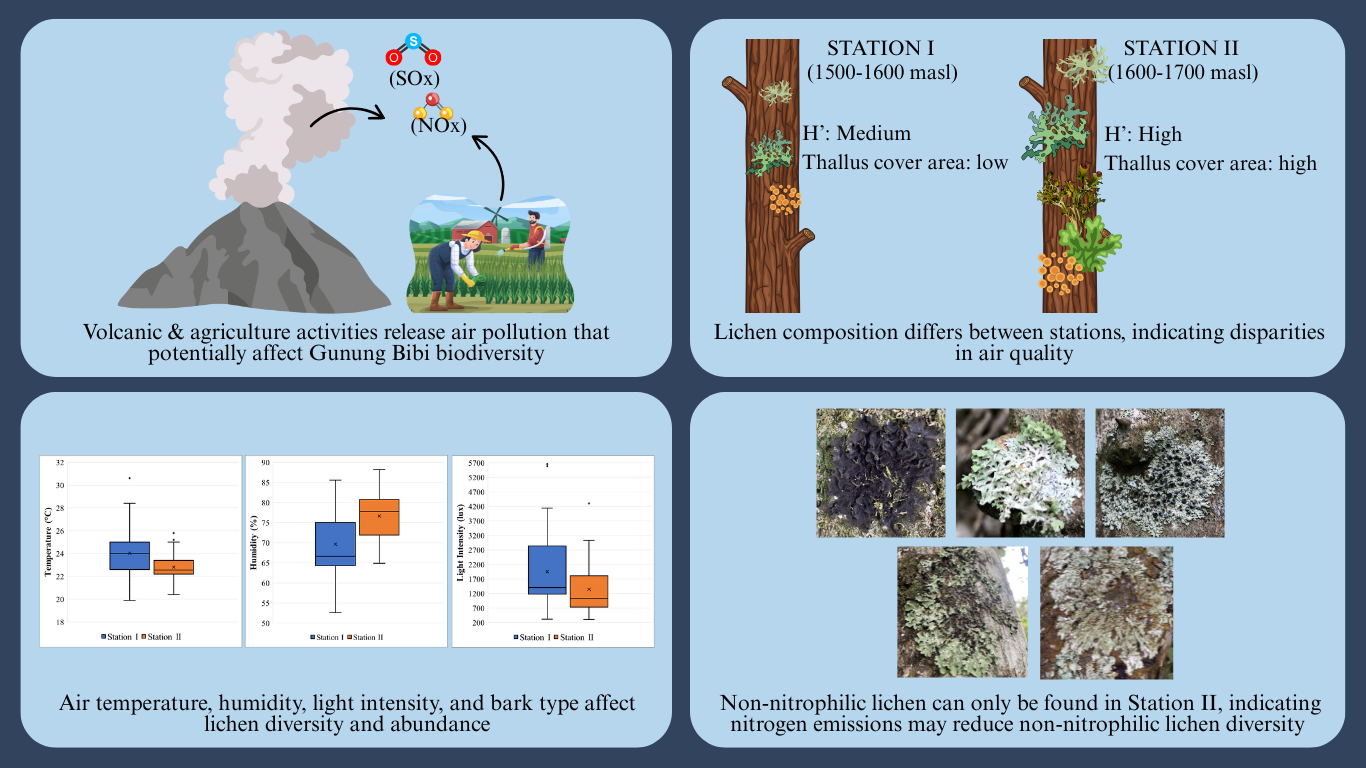
- The study identified 36 lichen species from 14 different families.
- The lichen composition differed between stations, indicating disparities in air quality.
- Station II (1600-1700 masl) had better air quality than Station I (1600-1700 masl), which had a higher diversity index value and more lichen coverage.
- Nitrogen emissions from farming may reduce the non-nitrophilic lichen diversity and abundance.
- The diversity and abundance of lichen is affected by air temperature, humidity, light intensity, and the type of bark.
ABSTRACT
The Mount Merapi ecosystem is distinguished by its considerable biodiversity potential, which has led to its designation as a national park and the protection of its unique ecological characteristics. A notable example of the Mount Merapi ecosystem is the Gunung Bibi forest, which has been designated as a Sanctuary Zone within the Mount Merapi National Park, with the primary objectives of biodiversity conservation, habitat preservation, and ecosystem protection. However, the Gunung Bibi forest is susceptible to the repercussions of volcanic eruptions and the pressure of agricultural activities from the surrounding area, which may potentially impact its air quality. Given the geographical area of the forest, the most efficient method for air quality monitoring is the use of lichens diversity as bio-indicators. This study aims to analyze the relationship between lichen species diversity and air quality in the Gunung Bibi forest area of Mount Merapi National Park, and the factors that influence it. Data collection was carried out by dividing the area into two research stations based on altitude. Data collection was carried out using a purposive sampling method with analysis including lichen abundance, lichen thallus cover area, and Shannon-Wiener Diversity Index measurement. Based on the research conducted, the results of lichen species diversity found at the research site include 36 species from 13 different families. The lichen composition at the two stations differs, indicative of disparities in air quality. Station II (1600-1700 masl) exhibited indications of better air quality in comparison to Station I (1500-1600 masl), which was distinguished by a higher diversity index value, as well as a greater lichen thallus covering area. The difference in air quality between the two research stations is probably due to nitrogen emissions from agricultural activities, which limit the diversity and abundance of non-nitrophilic lichen species Environmental factors affecting lichen species diversity and abundance are air temperature, humidity, light intensity, and bark type of lichen substrate.
INTRODUCTION
Mount Merapi is one of tropical rainforest ecosystems in Indonesia, characterized by its high biodiversity, which is considered to be a significant source of germplasm (Wijayati & Rijanta, 2020). The unique characteristics of Mount Merapi ecosystem has led this area to be designated as a national park, with the objective of protecting its unique ecological features. Mount Merapi National Park (MMNP) was established in 2014 based on the (Forestry, 2014), with one of the main objectives to protect the habitat and biodiversity of flora and fauna living in the area (Wijayati & Rijanta, 2020).
However, Mount Merapi is one of the most active volcanoes in the world, with a short eruption period of 2 - 7 years(Wismaya et al., 2016). The high volcanic activity of Mount Merapi can have various impacts on the surrounding environment. Volcanic activity can release ash and gases into the atmosphere, which can be a source of air pollution. This volcanic ash and gas can affect the biogeochemical cycles of carbon, sulphur, and halogens in the ecosystem (Delmelle et al., 2015). This is exacerbated by anthropogenic activities emanating from the slopes of Mount Merapi. Therefore, air pollution monitoring is becoming increasingly important.
To monitor environmental pollution, organisms, such as lichens, can be used as bioindicator to conduct biomonitoring. Lichen is an organism resulting from the mutual symbiosis between algae and fungi (Untari, 2024). Lichen obtains its nutrients from the surrounding air, so it is sensitive to the quality of the surrounding air, therefore, can be used as a bioindicator organism for monitoring air quality (Bukabayeva et al., 2023). Lichen is a long-lived and slow-growing organism with an unchanging morphology, no roots and no protective structure, so it can passively absorb substances from the atmosphere throughout its life cycle (Zarabska-Bożejewicz, 2020).
Lichens can be used as bioindicators of air pollution in the form of heavy metals, organic compounds, and even radioactive elements (Bukabayeva et al., 2023). Monitoring using lichens is simple and informative because it can assess the ecological state of the environment along with the response of the organisms, it allows for a wider study area, and it is more effective and cost-effective (Matos et al., 2019).
This research was carried out in Gunung Bibi Forest of Mount Merapi National Park. Administratively, Gunung Bibi is located in Wonodoyo Village, Cepogo Subdistrict, Boyolali Regency, Central Java Province, Indonesia. Gunung Bibi Forest is included in the Sanctuary Zone, with functions to protect biodiversity, habitats, and ecosystems in the Mount Merapi National Park area. Therefore, ecosystems in the core zone are unaffected by human influence and anthropogenic activities. As an area included in the core zone, Gunung Bibi Forest has a high biodiversity value which is typical of the Mount Merapi ecosystem (Wijayati & Rijanta, 2020).
Despite the highly valued biodiversity, Gunung Bibi Forest is located in the area mostly affected by the eruption of Mount Merapi, with an air quality index category classified as unhealthy (Nugroho et al., 2023), and surrounded by areas having a high level of agricultural activities, predominantly involving agriculture and cattle farming, which serve as the primary means of subsistence for the local community (Statistik, 2023). Both conditions have the potential to affect the air quality on Gunung Bibi, therefore, air quality monitoring is recommended.
Given the remote location of Gunung Bibi, characterized by rugged topography and limited access to power supplies, the utilization of lichen as bioindicator for air quality monitoring could offer certain advantages in terms of efficiency when compared with instrumented monitoring techniques (Blett et al., 2003). As demonstrated by the lichen data collected, there are regions of particular concern, which make the data useful for further, more extensive and instrumented monitoring studies (Blett et al., 2003).
Notwithstanding the rich biodiversity of Gunung Bibi, there has never been a comprehensive study of lichens diversity as a bioindicator in this area. Previous research on lichens in Gunung Bibi was limited to the identification of lichens species, such as the initial report on corticolous lichens by (Susilawati, 2013) and a subsequent study on the characterization of fruticose and foliose lichens by (Susilawati, 2017). Similar studies in other regions have demonstrated that lichens diversity is closely related to air pollution levels, particularly the presence of sulfur, nitrogen, and atmospheric heavy metals from both natural and anthropogenic activities (Agnan et al., 2017)(Zarabska-Bożejewicz, 2020)(Bukabayeva et al., 2023). However, no report has yet been found that addressed the question of a possible correlation between diversity in lichens samples and air quality in the studied area, to establish the possibility of lichens as air quality bioindicator. Therefore, to answer this question, a research was conducted to analyze the relationship between lichens species diversity and air quality in Gunung Bibi Forest of Mount Merapi National Park, and the factors influencing the air quality. The findings from this research are expected to provide deeper insights into the potential of lichens as environmental bioindicators in conservation areas, while serving as a basis for monitoring strategies and mitigating the impacts of air pollution in this region.
MATERIALS AND METHODS
Study Area
This study was conducted in Gunung Bibi Forest area, located in the Musuk-Cepogo Region National Park Management Resort, Mount Merapi National Park. The study area Figure 1 started from the forest entrance of Gunung Bibi in Kedung Pedut, located at 7°31’17.8968’’ S and 110°28’20.8308’’ E with an altitude of 1,514 meters above sea level (masl).
Data Collection
Data collection was carried out using the cruising method and purposive sampling at two research stations based on altitude. Station I was located at an altitude of 1,500 – 1,600 masl adjacent to agricultural areas, while Station II was located at 1,600 – 1,700 masl relatively further away from agricultural areas. Data on lichens diversity were collected on host trees with a diameter of more than 15 cm. The host tree sites were geotagged with a Garmin 64s GPS (Garmin, USA) to determine the coordinates of the sites.
Lichens abundance data were collected by placing a 20 x 20 cm clear plastic plot on the side of the trunk of the host tree with the highest lichens coverage area, approximately 1 m above the ground. Lichens found in the plots were counted for abundance, and lichens silhouettes were drawn to calculate thallus coverage area. Environmental parameters recorded included air temperature, humidity and light intensity. The host trees on which the lichens were growing were also recorded and identified. Lichens found were then documented and collected for identification in the laboratory.
Identification was based on morphological, anatomical and secondary metabolite analysis using the spot test method of (Hale, 1961). The spot test was performed by making a cross-section of the lichens thallus and adding K (10% Potassium Hydroxide (KOH) in aquadest), P (5% Paraphenylenediamine (C6H4(NH2)2) in 95% alcohol) and C (10% Calcium Hypoclorite (Ca(ClO)2) in aquadest) reagents. Color changes in the medulla layer were observed under a stereomicroscope. The identification of the studied lichens specimens was conducted using reference materials, including the Key to the Lichen Genera of Bogor, Cibodas and Singapore (Sipman, 2003) and Macrolichens of the Pacific Northwest (McCune & Geiser, 2009) . Additional sources consulted included the Consortium of Lichen Herbaria website (www.lichenportal.org), the British Lichen Society (www.britishlichensociety.org.uk), and other relevant publications.
Figure 1.Study area in the Gunung Bibi Forest, Mount Merapi National Park
Data Analysis
The data obtained were analyzed to obtain the Importance Value Index (IVI) by calculating the values of Relative Frequency (RF), Relative Density (DR), and Relative Dominance (RDo) according to (Garrido et al., 2021) by the following formula.
(1) \documentclass{article} \usepackage{amsmath} \begin{document} \displaystyle \text{Relative Frequency (RF)} = \frac{\text{number of plot in which lichen species occurred}}{\text{total number of plot}} \end{document}
(2) \documentclass{article} \usepackage{amsmath} \begin{document} \displaystyle \text{Relative Density (RD)} = \frac{\text{number of lichen colony}}{\text{total number of lichen colony}} \end{document}
(3) \documentclass{article} \usepackage{amsmath} \begin{document} \displaystyle \text{Relative Dominance (RDom)} = \frac{\text{thallus surface area of lichen species}}{\text{total thallus surface area of all lichens species}} \end{document}
The species diversity was analyzed using the Shannon-Wiener Diversity Index to compare lichens species diversity at each station. The Shannon-Wiener Diversity Index was analyzed according to (Yulianti et al., 2022) by the following formula.
(4) \documentclass{article} \usepackage{amsmath} \begin{document} \displaystyle H' = - \sum (n_1/N) \cdot \log (n_1/N) \end{document}
where:
H’ = Shannon-Wiener diversity index
Ni = Number of individuals of a certain species
N = Total number of individuals of all species
The value of the Shannon-Wiener Diversity Index is categorized into three categories as follows (Yulianti et al., 2022).
H ≤ 1 = Low species diversity in the area
H’ 1 ≤ H’ ≤ 3 = Medium species diversity in the area
H’ ≥ 3 = High species diversity in the area
The calculation of lichens thallus area was performed using Image J 1.54g software (National Institutes of Health, USA) which automatically measured the area of a photographic image by counting the number of pixels per area (Aragón-Sánchez et al., 2017). Data processing and visualization were performed using Microsoft Excel software (Microsoft, USA).
RESULTS AND DISCUSSION
A total of 61 individual trees were sampled for lichens species at the 2 research stations, resulting in a total of 36 lichen species from 13 different families Table 1.
Parmeliaceae was the predominant family, with a total of 11 species, followed by Pertusariaceae (5 species), Physciaceae (4 species), Stereocaulaceae (3 species), Lecanoraceae (2 species), Graphidaceae (2 species), Phlyctidaceae (2 species), Monoblastiaceae (1 species), Chrysotrichaceae (1 species), Arthoniaceae (1 species), Collemataceae (1 species), Megalosporaceae (1 species), and Ramalinaceae (1 species).
Parmeliaceae is the most diverse group of lichens in the world, consisting of 2,765 species and 77 genera (Lücking et al., 2017), with a wide distribution. A study by (Karmacharya et al., 2022) showed similar results that Parmeliaceae is also the most dominant family in the Kathmandu Valley area, consisting of 8 genera and 20 species. In our study, the species that exhibited the highest Importance Value Index (IVI) values at Station I were Graphis scripta (72.01), Phlyctis argena (69.42), and Flavoparmelia caperata (34.16). Conversely, the highest IVI values at Station II were observed in Phlyctis argena (80.56), Cryptothecia striata (19.00), and Parmotrema perlatum (18.67). This finding indicated clear disparities in the prevalent lichens species at the two research stations, suggesting variations in lichens composition between the stations. Furthermore, G. scripta and P. argena are cosmopolitan lichens that demonstrate a high level of resistance to various environmental conditions, including atmospheric metal pollution (Agnan et al., 2017), thus explaining their dominance at both Station I and Station II. Both species also have a broad global distribution, G. scripta (Figure 2 a) has a distribution in tropical to subtropical areas, while P. argena (Figure 2 b.) has a distribution in Africa, Europe, North America, and Asia (Nash et al., 2002).
| Location | Taxonomic category |
Number of individual |
Number of colonies |
Lichens thallus coverage area (cm2) |
IVI |
|---|---|---|---|---|---|
| Station I | Family Parmeliaceae | ||||
Hypotrachyna afrorevoluta (Krog & Swinscow) Krog & Swinscow |
1 | 1 | 15.33 | 3.02 | |
Flavoparmelia caperata (L.) Hale |
5 | 28 | 252.74 | 34.16 | |
Parmelina tiliacea (Hoffm.) Hale |
1 | 4 | 66.17 | 6.36 | |
Parmotrema perlatum (Huds.) M.Choisy |
4 | 14 | 395.72 | 28.22 | |
Punctelia perreticulata (Räsänen) G.Wilh. & Ladd |
1 | 3 | 33.26 | 4.76 | |
Ramalina fraxinea (L.) Ach. |
1 | 1 | 25.35 | 3.33 | |
Usnea glabrescens (Nyl. ex Vain.) Vain. |
2 | 2 | 5.07 | 5.27 | |
Usnea subfloridana Stirt. |
2 | 2 | 36.67 | 6.23 | |
| Family Stereocaulaceae | |||||
Lepraria elobata Tønsberg |
2 | 12 | 304.74 | 20.34 | |
Lepraria incana (L.) Ach. |
1 | 1 | 25.87 | 3.34 | |
Lepraria lobificans Nyl. |
2 | 2 | 81.77 | 7.60 | |
| Family Pertusariaceae | |||||
Pertusaria amara (Ach.) Nyl. |
1 | 1 | 88.04 | 5.24 | |
Pertusaria multipuncta (Turner) Nyl. |
1 | 1 | 37.50 | 3.70 | |
| Family Physciaceae | |||||
Heterodermia diademata (Taylor) D.D.Awasthi |
1 | 3 | 126.19 | 7.59 | |
Physcia sorediosa (Vain.) Lynge |
1 | 1 | 11.43 | 2.90 | |
| Family Lecanoraceae | |||||
Lecanora barkmaniana Aptroot & Herk |
1 | 1 | 34.97 | 3.62 | |
Lecanora compallens Herk & Aptroot |
1 | 1 | 3.33 | 2.66 | |
| Family Graphidaceae | |||||
Graphis scripta (L.) Ach. |
9 | 53 | 749.53 | 72.01 | |
| Family Phlyctidaceae | |||||
Phlyctis argena (Ach.) Flot. |
12 | 32 | 881.94 | 69.42 | |
| Family Chrysotrichaceae | |||||
Chrysothrix candelaris (L.) J.R.Laundon |
2 | 5 | 110.29 | 10.25 | |
| Total | 51 | 168 | 3,285.9 | ||
| Station II | Family Parmeliaceae | ||||
Hypotrachyna britannica (D.Hawksw. & P.James) Coppins |
2 | 3 | 51.79 | 6.54 | |
Hypotrachyna revoluta (Flörke) Hale |
1 | 1 | 43.01 | 3.32 | |
Flavoparmelia caperata (L.) Hale |
3 | 4 | 146.01 | 11.24 | |
Parmeliopsis ambigua (Hoffm.) Nyl. |
1 | 1 | 20.23 | 2.71 | |
Parmotrema perlatum (Huds.) M.Choisy |
5 | 5 | 303.27 | 19.00 | |
Parmotrema xanthinum (Müll.Arg.) Hale |
1 | 7 | 46.33 | 8.29 | |
Punctelia perreticulata (Räsänen) G.Wilh. & Ladd |
1 | 4 | 33.94 | 5.52 | |
Ramalina fraxinea (L.) Ach. |
2 | 2 | 4.78 | 4.46 | |
| Family Pertusariaceae | |||||
Pertusaria albescens (Huds.) M.Choisy & Werner |
3 | 3 | 142.09 | 10.32 | |
Pertusaria amara (Ach.) Nyl. |
1 | 1 | 11.50 | 2.47 | |
Pertusaria leioplaca (Ach.) DC. |
1 | 1 | 25.03 | 2.84 | |
Pertusaria multipuncta (Turner) Nyl. |
3 | 4 | 80.32 | 9.47 | |
Pertusaria pertusa (L.) Tuck. |
3 | 3 | 215.98 | 12.32 | |
| Family Physciaceae | |||||
Heterodermia diademata (Taylor) D.D.Awasthi |
4 | 6 | 111.30 | 13.28 | |
Physcia adscendens H.Olivier |
1 | 1 | 6.24 | 2.33 | |
Physcia stellaris (L.) Nyl. |
2 | 8 | 119.33 | 12.42 | |
| Family Stereocaulaceae | |||||
Lepraria elobata Tønsberg |
1 | 1 | 21.89 | 2.75 | |
Lepraria incana (L.) Ach. |
3 | 1 | 247.53 | 11.54 | |
Lepraria lobificans Nyl. |
1 | 1 | 90.21 | 4.60 | |
| Family Graphidaceae | |||||
Diorygma hieroglyphicum (Pers.) Staiger & Kalb |
1 | 1 | 4.12 | 2.28 | |
Graphis scripta (L.) Ach. |
4 | 5 | 156.54 | 13.69 | |
| Family Lecanoraceae | |||||
Lecanora compallens Herk & Aptroot |
2 | 6 | 103.13 | 10.36 | |
| Family Phlyctidaceae | |||||
Phlyctis argena (Ach.) Flot. |
17 | 31 | 1,201.03 | 80.56 | |
Phlyctis boliviensis Nyl. |
1 | 1 | 93.88 | 4.70 | |
| Family Arthoniaceae | |||||
Cryptothecia striata |
4 | 8 | 250.63 | 18.67 | |
| Family Chrysotrichaceae | |||||
Chrysothrix candelaris G.Thor |
2 | 7 | 136.61 | 12.08 | |
| Family Collemataceae | |||||
Collema subflaccidum Degel. |
1 | 1 | 12.48 | 2.50 | |
| Family Fuscideaceae | |||||
Fuscidea lightfootii (Sm.) Coppins & P.James |
1 | 1 | 13.58 | 2.53 | |
| Family Megalosporaceae | |||||
Megalospora atrorubicans (Nyl.) Zahlbr. |
1 | 1 | 4.12 | 2.28 | |
| Family Monoblastiaceae | |||||
Anisomeridium biforme (Schaer.) R.C.Harris |
1 | 4 | 11.84 | 4.92 | |
| Total | 74 | 123 | 3,708.7 | ||
Figure 2.Species with the highest IVI at each station
Station I recorded 20 lichens species from 8 different families, while Station II recorded 30 lichens species from 13 different families Table 1. The Shannon-Wiener Diversity Index showed that Station I had a level of lichens diversity in the "medium" category with a value of 2.557. Station II, on the other hand, had a level of lichens diversity in the "high" category with a value of 3.003. The observed discrepancy in the diversity of lichens samples collected from the two stations indicated a potential difference in the quality of ambient air at these locations.
In the early stages of exposure to air pollution, there will be an increase in the concentration of pollutants in the lichens thallus; as the pollution levels increase lichens may disappear completely, creating a condition known as 'lichens desert' (Bukabayeva et al., 2023). Therefore, the higher the air pollution in an environment, the lower the lichens diversity found in the environment (Muvidha, 2020).
In this particular instance, Station II exhibited a better air quality, as proven by the higher level of lichens diversity compared to that at Station I. In addition, Station I was characterized by a greater total number of lichens colonies; however, it has a comparatively lower lichens thallus coverage area compared to Station II Table 1.
Lichens thallus coverage area can be used as an indicator to assess the suitability of environmental conditions in which lichens live. Good environmental conditions allow lichens to grow optimally, so that lichens can be found intact with a large area of thallus coverage. The accumulation of air pollution in the thallus of lichens causes physiological and morphological changes in the lichens, resulting in a decrease in thallus coverage area and even fragmentation of originally intact thallus parts (Nasriyati et al., 2018). The reduction in thallus coverage area is one of the lichens responses to ambient air pollution (Nasriyati et al., 2018). This result strengthened the previous indication that Station II had a better air quality than that at Station I, which was indicated by higher lichens thallus coverage area at Station II.
The poor air quality at Station I may have been caused by anthropogenic activities since the location of Station I is closer to residential areas and the agricultural land of the residents, which heightened the impact of agricultural activities to air quality at Station I. Agricultural activities, such as the use of organic and mineral fertilizers and the burning of organic materials, can release nitrogen compounds into the air, for example in the form of ammonia (NH₃), which can increase the pH of tree bark when deposited (Zarabska-Bożejewicz, 2020).
Furthermore, high atmospheric nitrogen levels lead to changes in lichens diversity and abundance, such as an increase in nitrophilic lichens species and a decrease in the abundance of non-nitrophilic species (Zarabska-Bożejewicz, 2020). In non-nitrophilic species, excessive nitrogen exposure leads to a decrease in chlorophyll A and ergosterol (Zarabska-Bożejewicz, 2020).
Most of the people in Cepogo Subdistrict work as farmers. According to (Statistik, 2023), Cepogo Subdistrict is the subdistrict with the largest number of individual agricultural businesses in Boyolali District, which includes food crops, horticulture, plantations, and livestock farming.
As for the livestock subsector, there are a total of 9,478 households that raise livestock, including beef cattle, dairy cattle, and goats (Statistik, 2023), which makes Cepogo Subdistrict one of the largest contributors to cattle farming in Boyolali Regency. In the management of livestock waste, there are still farmers who do not treat the wastes, but directly dispose the wastes in the backyard of the house, in the river around the settlements, or even directly dispose the wastes in their gardens and fields without prior treatment (Pertiwi et al., 2022). The activity of disposing agricultural wastes without treatment can produce gas emissions that can pollute the environment, such as ammonia (NH3), hydrogen sulfide (H2S), carbon dioxide (CO2), and methane gas (CH4) (Pertiwi et al., 2022).
Aerobic organic wastes treatment (composting) is one of the sources of NH3 emissions (Zarabska-Bożejewicz, 2020). The deposition rate of ammonia (NH3) is rapid, causing most of ammonia to be easily distributed close to the emission source. About 10% of NH3 can be found within 100 m of the emission source, and when dissolved in water and ionized to NH4+,ammonia can be transported as far as 1,000 km (Zarabska-Bożejewicz, 2020). Therefore, ammonia resulted from agricultural activity is highly potential to contribute to air pollution.
Based on their adaptation ability to the deposition level and the availability of atmospheric nitrogen, lichens can be grouped into three types: oligotrophs, mesotrophs, and eutrophs. Oligotrophs are lichens that grow only in nutrient-poor environments, mesotrophs have intermediate nutrient requirements, and eutrophs are lichens that thrive in nutrient-rich environments (McCune & Geiser, 2009).
Oligotrophs are most abundant in areas with average N deposition of 0.5 - 4.2 kg N/ha/year and become less abundant as N deposition increases above 4.2 kg N/ha/year, mesotrophic lichens prefer areas with N deposition of 4.2 - 8.0 kg N/ha/year, and eutrophic lichens can tolerate N deposition up to 8.0 kg N/ha/year (Service, 2025).
Eutrophic lichens species are also known as nitrophilus species which are characterized by being nitrogen-tolerant species that benefit from nitrogen eutrophication (Zarabska-Bożejewicz, 2020). This categorization is generally applied to the macrolichens group, which consists of foliose, fruticose, and larger squamulose lichens (McCune & Geiser, 2009). Macrolichens are often used as bioindicator species for air quality due to their large surface area, easiness for observation, and greater sensitivity than microlichens, such as crustose lichens (Pasaribu et al., 2023).
In the study area, a total of 17 macrolichens species were found Table 2. There were six eutrophic lichens species, four of which were found at both stations (Flavoparmelia caperata, Parmotrema perlatum, Punctelia perreticulata, Ramalina fraxinea), and two species were found at only one each at one of the stations (Usnea subfloridana at Station I and Parmotrema xanthinum at Station II). As for mesotrophic and oligotrophic lichens species, a total of six species were found. Out of six species, five of them were found only at Station II (Collema subflaccidum, Physcia adscendens, Physcia stellaris, Hypotrachyna revoluta, Parmeliopsis ambigua), and there was only one species found at Station I (Usnea glabrescens).
Our study showed that there were differences in lichens composition between the two research stations. These results suggested that there was a decrease in the diversity of non-nitrophilic lichens species at Station I, which was thought to be caused by high nitrogen emissions from agricultural activities. However, further research is needed to confirm this finding.
| No. | Species | Growth forms | Category | Location | |
|---|---|---|---|---|---|
| Station I | Station II | ||||
| 1 | Collema subflaccidum | Foliose | Oligotropha | - | ✓ |
| 2 | Heterodermia diademata | Foliose | Unknown | ✓ | ✓ |
| 3 | Physcia adscendens | Foliose | Mesotropha | - | ✓ |
| 4 | Physcia sorediosa | Foliose | Unknown | ✓ | - |
| 5 | Physcia stellaris | Foliose | Mesotrophb | - | ✓ |
| 6 | Hypotrachyna afrorevoluta | Foliose | Unknown | ✓ | - |
| 7 | Hypotrachyna britannica | Foliose | Unknown | - | ✓ |
| 8 | Hypotrachyna revoluta | Foliose | Oligotropha | - | ✓ |
| 9 | Flavoparmelia caperata | Foliose | Eutropha | ✓ | ✓ |
| 10 | Parmelina tiliacea | Foliose | Unknown | ✓ | - |
| 11 | Parmeliopsis ambigua | Foliose | Oligotrophb | - | ✓ |
| 12 | Parmotrema perlatum | Foliose | Eutropha | ✓ | ✓ |
| 13 | Parmotrema xanthinum | Foliose | Eutropha | - | ✓ |
| 14 | Punctelia perreticulata | Foliose | Eutrophb | ✓ | ✓ |
| 15 | Ramalina fraxinea | Fruticose | Eutrophc | ✓ | ✓ |
| 16 | Usnea glabrescens | Fruticose | Mesotropha | ✓ | - |
| 17 | Usnea subfloridana | Fruticose | Eutrophb | ✓ | - |
Nitrophilus species were mostly found at both stations, Station I and II. This result indicated that both stations had high atmospheric nitrogen deposition. The high nitrogen deposition may have been caused by agricultural activities in the vicinity of the research site.
Conversely, nitrogen levels at Station II may tend to be lower than at Station I, which was indicated by the presence of oligotrophic and mesotrophic lichens species at Station II, such as Collema subflaccidum, Physcia adscendens, Physcia stellaris, Hypotrachyna revoluta, and Parmeliopsis ambiguaFigure 3. These species were only found at Station II, so it is noteworthy that some of these species were used as bioindicator species in this study. Of the five species, Physcia stellaris (Figure 3 c) was the species having the highest IVI value of 12.42% Table 1, making it the strongest candidate for bioindicator species in this study. Physcia stellaris was also used as a bioindicator species in a study by (Susan et al., 2017) in the Midwest area of the United States to investigate the levels of contaminant elements in the area.
Thallus morphology of the lichens found at the research site can be categorized into 3 types, namely crustose, foliose and fruticose. Crustose lichens have thallus morphology such as a layer of crust that lives firmly attached to the surface of the substrate. Foliose lichens have a leaf-like thallus morphology, composed of thallus that will develop into lobes, and are equipped with rhizine structures functioning as attachment and food absorption apparatus. Fruticose lichens have a shrub-like thallus morphology with ribbon-like branches (Muvidha, 2020); (Untari, 2024).
In Stations I and II, crustose lichens were found to be the most dominant category, followed by foliose and fruticose lichens Figure 4. Crustose lichens are the most resistant to environmental influences because they require less water and can store water optimally due to their strong attachment to the substrate (Pasaribu et al., 2023). The strong and tight attachment also makes crustose lichens resistant to environmental stresses, such as temperature, drought, UV radiation, pollution and herbivores (Pasaribu et al., 2023). Foliose and fruticose lichens are more susceptible to environmental stresses. Foliose lichens can only be found under certain environmental conditions, for example in still natural habitats (Pasaribu et al., 2023). On the other hand, fruticose lichens are the most sensitive to environmental conditions, including air pollution (Roziaty, 2016). A study by (Sujetoviene, 2010) showed that foliose and fruticose lichens are commonly found in areas with low levels of pollution, while crustose lichens are found in areas with high levels of pollution.
Figure 3.Oligotrophic and mesotrophic macrolichens found at station II
Figure 4.Thallus morphology and number of lichens species
| Host tree | Local name | Number of lichens individuals | |
|---|---|---|---|
| Station I | Station II | ||
| Pinus merkusii Jungh. & de Vriese | Pinus | 12 | 8 |
| Altingia excelsa Noronha | Rasamala | 4 | 0 |
| Engelhardtia spicata Lechen ex Blume | Klewer | 13 | 38 |
| Syzygium cumini (L.) Skeels | Duwet | 1 | 0 |
| Glochidion arborescens Blume | Dempul | 3 | 4 |
| Erythrina lithosperma Blume | Dadap Duri | 7 | 13 |
| Aglaia odoratissima Blume | Pancal Kijang | 5 | 0 |
| Symplocos javanica Kurz | Ladok | 2 | 0 |
| Casuarina junghuhniana Miq. | Cemara Gunung | 2 | 0 |
| Lithocarpus elegans (Blume) Hatus. | Pasang | 1 | 1 |
| Castanopsis argentea (Blume) A.DC. | Sarangan | 1 | 4 |
| Schima wallichii (DC.) Korth. | Puspa | 0 | 3 |
| Acacia decurrens Willd. | Akasia | 0 | 3 |
Figure 5.Environmental parameter measurement in the study area
The most abundant lichens found at Stations I and II was lichens attached to Klewer tree (Engelhardtia spicata) with a total of 51 occurrences Table 3. The bark type of Klewer tree which is classified as rough with furrows of < 1 cm in size seems to be an easier substrate for lichens to grow on compared to other trees having a smoother bark type. Lichens propagules are more easily trapped and grow on trees having rough bark-texture with shallow and small furrows (Susilawati & Kasiamdari, 2021). Bark type with deep cracks causes the bark to be unstable and fragile, so that it peels off easily, for example in Pinus merkusii (Susilawati & Kasiamdari, 2021). However, our study demonstrated a relatively high prevalence of lichens growing on the bark of Pinus merkusii tree (12 thalli at Station I and 8 thalli at Station II).
This finding suggested that bark exfoliation may impede lichens growth, yet it does not entirely preclude it. This phenomenon can be attributed to the fact that deep cracks in the bark are capable of maintaining adequate moisture levels in the substrate, thereby facilitating the penetration of rhizines in foliose lichen (Susilawati & Kasiamdari, 2021). This, in turn, provides a foundation for the growth of crustose, foliose, and fruticose lichens.
Lichens diversity and abundance are influenced by environmental parameters, such as air temperature, humidity, light intensity, and nutrients in the place where lichens live (Pasaribu et al., 2023). Our study observed that Station I had a higher range of air temperature (19.9 - 30.6 °C) with an average of 24.0 °C, while Station II had a lower range of air temperature (20.4 - 25.8 °C) with an average of 22.8 °C Figure 5.
According to (Murningsih & Mafazaa, 2016), the optimal temperature for lichens growth is below 40 °C. Air temperature above 45 °C can damage the chlorophyll pigment contained in the lichens, thus disrupting the photosynthetic process of the lichens. Nonetheless, the mean air temperature measurements obtained from Stations I and II in our study were consistently lower than the maximum temperature threshold that could be tolerated by lichens.
Humidity is one of the factors that greatly affects the ability of lichens to absorb water, nutrients and pollutants contained in the air (Murningsih & Mafazaa, 2016). (K et al., 1996) stated that lichens can still grow and photosynthesize in habitat conditions classified as very humid, with humidity reaching 85%. Humidity more than 85% can reduce the efficiency of lichens photosynthesis by 35 - 49% (Hadiyati et al. 2017). Station I exhibited a lower range of humidity, ranging from 52.6 - 85.6% with an average of 69.66%, while station II demonstrated a higher range, ranging from 64.9 - 88.2% with an average of 76.65% Figure 5. The humidity measurements between the two stations showed an average humidity that is below the maximum tolerance of lichens. However, Station II relatively had a consistent higher humidity that influence lichens growth.
Light intensity is the factor influencing the ability of lichens phycobionts to perform photosynthesis. Lichens require the lowest light intensity of 1,025 lux to be able to photosynthesize (Murningsih & Mafazaa, 2016). Station I exhibited a higher range of light intensity (313 - 5,655 lux) with an average of 1,956.8 lux, while station II demonstrated a lower range (306 - 4,297 lux) with an average of 1,343.20 lux Figure 5. This finding indicated that the average light intensity at these two stations exceeded the minimum tolerance level of the lichens. The relationship between nitrogen-sensitivity and lichens species suggested that the lichens species found in our study are more likely to be well-adapted to habitats with higher levels of sun exposure (Zarabska-Bożejewicz, 2020). Therefore, conditions involving lower humidity, higher temperatures and higher light availability may be beneficial for nitrophilic lichens species and limit the growth of non-nitrophilic species (Pinho et al., 2012).
The disparities in air temperature, humidity, and light intensity measurements between the two research stations can be attributed to the distinct vegetation composition observed at each location. Station II had vegetation with higher tree density and denser canopy cover, resulting in lower light intensity, lower air temperature, and higher air humidity. According to (Yulianti et al., 2022), areas with open canopies are known to produce higher light intensity, higher air temperature, and lower air humidity, which in turn affects lichens richness. Furthermore, the disparity in environmental parameters between the two stations can be attributed to altitude differences. Higher altitude is associated with lower temperatures and higher relative humidity. Research of (Ismail et al., 2024) on lichens diversity and richness across varying altitudes indicated that higher elevations are more conducive to lichens growth, owing to the fact that low temperatures and high humidity prevent desiccation.
CONCLUSION
The diversity of lichens species found in the study area consists of 36 species from 13 different families. Lichens composition at the two stations differs, indicating disparities in air quality between the two stations. Station II (1,600 – 1,700 masl) exhibited indications of better air quality in comparison to Station I (1,500 – 1,600 masl), which was distinguished by a higher diversity index value, as well as a greater lichens thallus coverage area. The difference in air quality between the two research stations may have been caused by nitrogen emissions from agricultural activities that limit the diversity and abundance of non-nitrophilic lichens species. Lichens species diversity and abundance are influenced by environmental factors, such as air temperature, humidity, light intensity and host tree bark type.
References
- Agnan Y., Probst A., Séjalon-Delmas N.. Evaluation of lichen species resistance to atmospheric metal pollution by coupling diversity and bioaccumulation approaches: A new bioindication scale for French forested areas. Ecol Indic. 2017; 72:99-110. DOI
- Aragón-Sánchez J., Quintana-Marrero Y., Aragón-Hernández C., Hernández-Herero M.J.. Imagej: A free, easy, and reliable method to measure leg ulcers using digital pictures. Int J Low Extrem Wounds. 2017; 16(4):269-73. DOI
- Blett T., Geiser L., Porter E.. National Park Service Air Resources Division: Oregon (US; 2003.
- Statistik B.P.S.] Badan Pusat. Hasil Sensus Pertanian 2023 Kecamatan Cepogo [Agricultural Census Results 2023 Cepogo Subdistrict. 2023.
- Bukabayeva Z., Abiyev S., Silybayeva B., Assanova U., Sagdatkyzy Sharipkhanova A., B.. Epiphytic epigeal lichens as bioindicators of air pollution in the Burabay National Park, Kazakhstan. Biodiversitas. 2023; 24(5):2701-09. DOI
- Curtis J.T., Mcintosh R.P.. The interrelations of certain analytic and synthetic phytosociological characters. Ecology. 1950; 31(3):434-55.
- Delmelle P., Maters E., Oppenheimer C.. The Encyclopedia of Volcanoes. Academic Press: Academic Press; 2015:881-93. DOI
- Garrido A., Pérez-Molina J.P., Ramírez-Alán Ó., Chávez J.L., Cordero-S R.A.. Lichen community structure and richness in three mid-elevation secondary forests in Costa Rica. Revista de Biología Tropical. 2021; 69(2):688-99.
- Hale M.E.. Smithsonian Institution: Washington (USA; 1961.
- Ismail A., Azian A.N.N., Abd Hakim N.S., Pardi F., Radzun K.A., Buyong F., Ikhsan N.A.K.. Inventory list of epiphytic lichens inhabiting low and high altitude environment. Proceedings of the International Conference on Science Technology and Social Sciences-Biology (ICONTAS-BIO 2023. 2024;210-31. DOI
- Karmacharya N., Upreti D.K., Chettri M.K.. Distribution pattern of corticolous lichens in different areas of Kathmandu valley, Nepal. Banko Janakari. 2022; 32(2):3-18.
- Lewis J.E.J.. Bio-monitoring for atmospheric nitrogen pollution using epiphytic lichens and bryophytes. 2012.
- Lücking R., Hodkinson B.P., Leavitt S.D.. The 2016 classification of lichenized fungi in the Ascomycota and Basidiomycota–Approaching one thousand genera. The Bryologist. 2017; 119(4):361-416. DOI
- Matos P., Vieira J., Rocha B., Branquinho C., Pinho P.. Modeling the provision of air-quality regulation ecosystem service provided by urban green spaces using lichens as ecological indicators. Sci Total Environ. 2019; 665(1):521-30. DOI
- McCune B., Geiser L.. Oregon State University Press: Oregon (US; 2009.
- Forestry Ministry. 2014.
- Murningsih M., Mafazaa H.. Jenis-jenis lichen di Kampus Universitas Diponegoro Semarang [Types of lichen in Universitas Diponegoro Semarang campus. Bioma. 2016; 18(2):20-9.
- Muvidha A.. Lichen di Jawa Timur. 2020.
- Nash T.H., Ryan B.D., Gries C., Bungartz F.. Arizona State University Lichen Herbarium: Arizona (US; 2002.
- Nasriyati T., Murningsih M., Utami S.. Morfologi talus lichen Dirinaria Picta (Sw.) Schaer. Ex Clem pada tingkat kepadatan lalu lintas yang berbeda di Kota Semarang. 2018.
- Nugroho M.I.A., Pangastuti A.I., Akbar M.F., Nasik D.H., Saputra A.H.. Sleman and Boyolali Districts based on ISPU: Case study of Mount Merapi eruption on. 2023.
- Pasaribu N., Atni O.K., Siregar J.P.. Diversity species composition of lichens across altitudinal range in the Batang Toru Forest, North Sumatra, Indonesia. Biodiversitas. 2023; 24(4):2171-78. DOI
- Pertiwi S.P., Muryani C., Utomowati R.. Hubungan kondisi sosial ekonomi peternak sapi terhadap kesadaran lingkungan di Kecamatan Musuk dan Kecamatan Tamansari Kabupaten Boyolali Tahun 2019 [The relationship between socioeconomic conditions of cattle farmers and environmental awareness in Musuk and Tamansari Subdistricts of Boyolali District in 2019. Indonesian Journal of Environment and Disaster. 2022; 1(1):47-59.
- Pinho P., Bergamini A., Carvalho P., Branquinho C., Stofer S., Scheidegger C., Máguas C.. Lichen functional groups as ecological indicators of the effects of land-use in Mediterranean ecosystems. Ecol Indic. 2012; 15(1):36-42. DOI
- Roziaty E.. Kajian lichen: Morfologi, habitat, dan bioindikator kualitas udara ambien akibat polusi kendaraan bermotor [Lichen assessment: Morphology, habitat, and bioindicator of ambient air quality due to motor vehicle pollution. Bioeksperimen. 2016; 2(1):54-66.
- Sipman H.. Berlin Dahlem Freie Universität: Berlin (DE; 2003.
- Sujetoviene G.. Road traffic pollution effects on epiphytic lichens. Ekologija. 2010; 5(1):64-71.
- K Sundberg B.Palmvqist, PA Essen, KE Renhorn. Growth and vitality of epiphytic lichens: Modelling of carbon gain using field and laboratory data. J Oecologia. 1996; 2(109):10-8.
- Susan W.W., Jovan S., Amacher M.C.. Lichen elements as pollution indicators: Evaluation of methods for large monitoring programmes. The Lichenologist. 2017; 49(4):415-24.
- Susilawati P.R.. & De Vr. and Engelhardtia spicata Blume at Bukit Bibi, Mount Merapi National Park. 2013. Publisher Full Text
- Susilawati P.R.. Fruticose dan foliose lichen di Bukit Bibi, Taman Nasional Gunung Merapi [Fruticose and foliose lichen in Bukit Bibi, Mount Merapi National Park. Jurnal Penelitian. 2017; 21(1):12-21.
- Susilawati P.R., Kasiamdari R.S.. Karakteristik kulit batang pohon inang lichen di Bukit Bibi, Taman Nasional Gunung Merapi [The bark characteristics of lichen host tree in Bukit Bibi, Taman Nasional Gunung Merapi. Bioeksperimen. 2021; 7(2):130-42.
- Untari L.F.. John Wiley & Sons Inc: New Jersey (US; 2024. DOI
- Service U.S.F.S.] United States Forest. Air pollution sensitivity ratings for macrolichens in the Eastern US. 2025. Publisher Full Text
- Wijayati D., Rijanta R.. Evaluasi zonasi Taman Nasional Gunung Merapi. Evaluation of Mount Merapi National Park zonation]. Jurnal Litbang Sukowati. 2020; 3(2):92-106.
- Wismaya Y.G., Anjasmara I.M., Sulistiyani S.. Analisis deformasi Gunung Merapi berdasarkan data pengamatan GPS Februari-Juli 2015. Deformation analysis of Mount Merapi based on GPS observation data in February-July 2015]. Jurnal Teknik ITS. 2016; 5(2):427-31.
- Yulianti S.D., Mulyaningrum E.R., Rahayu P.. Species diversity distribution area of lichen in Baturraden Botanical Garden, Banyumas. Journal of Biotechnology Natural Science. 2022; 2(1):1-9.
- Zarabska-Bożejewicz D.. The impact of nitrogen pollution in the agricultural landscape on lichens: A review of their responses at the community, species, biont physiological levels. Agronomy. 2020; 10(12):1-19.
Agnan Y, Probst A, Séjalon-Delmas N. 2017. Evaluation of lichen species resistance to atmospheric metal pollution by coupling diversity and bioaccumulation approaches: A new bioindication scale for French forested areas. Ecol Indic 72:99-110. DOI: 10.1016/j.ecolind.2016.08.006 DOI: https://doi.org/10.1016/j.ecolind.2016.08.006
Aragón-Sánchez J, Quintana-Marrero Y, Aragón-Hernández C, Hernández-Herero MJ. 2017. Imagej: A free, easy, and reliable method to measure leg ulcers using digital pictures. Int J Low Extrem Wounds 16(4):269-73. DOI: 10.1177/1534734617744951 DOI: https://doi.org/10.1177/1534734617744951
Blett T, Geiser L, Porter E. 2003. Air pollution-related lichen monitoring in national parks, forests, and refuges: Guidelines for studies intended for regulatory and management purposes. Oregon (US): National Park Service Air Resources Division. p. 10-12.
[BPS] Badan Pusat Statistik (Central Bureau of Statistics). 2023. Hasil Sensus Pertanian 2023 Kecamatan Cepogo [Agricultural Census Results 2023 Cepogo Subdistrict]. Boyolali (ID): Badan Pusat Statistik (BPS) Kabupaten Boyolali.
Bukabayeva Z, Abiyev S, Silybayeva B, Assanova U, Sharipkhanova A. Sagdatkyzy B. 2023. Epiphytic epigeal lichens as bioindicators of air pollution in the Burabay National Park, Kazakhstan. Biodiversitas 24(5):2701-09. DOI: 10.13057/biodiv/d240523 DOI: https://doi.org/10.13057/biodiv/d240523
Curtis JT, Mcintosh RP. 1950. The interrelations of certain analytic and synthetic phytosociological characters. Ecology 31(3):434-55. DOI: https://doi.org/10.2307/1931497
Delmelle P, Maters E, Oppenheimer C. 2015. Volcanic influences on the carbon, sulfur, halogen biogeochemical cycles. In: The Encyclopedia of Volcanoes. Massachusetts (USA): Academic Press. p. 881-93. DOI: 10.1016/B978-0-12-385938-9.00050-X DOI: https://doi.org/10.1016/B978-0-12-385938-9.00050-X
Garrido A, Pérez-Molina JP, Ramírez-Alán Ó, Chávez JL, Cordero-S RA. 2021. Lichen community structure and richness in three mid-elevation secondary forests in Costa Rica. Revista de Biología Tropical 69(2):688-99. DOI: https://doi.org/10.15517/rbt.v69i2.46162
Hale, ME. 1961. Lichen handbook: A guide to the lichens of eastern North America. Washington (USA): Smithsonian Institution.
Ismail A, Azian ANN, Abd Hakim NS, Pardi F, Radzun KA, Buyong F, Ikhsan NAK. 2024. Inventory list of epiphytic lichens inhabiting low and high altitude environment. Proceedings of the International Conference on Science Technology and Social Sciences-Biology (ICONTAS-BIO 2023). Selangor (MY): Atlantis Press. p. 210-31. DOI: 10.2991/978-94-6463-536-2_19 DOI: https://doi.org/10.2991/978-94-6463-536-2_19
Karmacharya N, Upreti DK, Chettri MK. 2022. Distribution pattern of corticolous lichens in different areas of Kathmandu valley, Nepal. Banko Janakari 32(2):3-18. DOI: https://doi.org/10.3126/banko.v32i2.50892
Lewis JEJ. 2012. Bio-monitoring for atmospheric nitrogen pollution using epiphytic lichens and bryophytes. [Dissertation]. [Internet]. Available from: University of Nottingham Repository (https://eprints.nottingham.ac.uk/13573/).
Lücking R, Hodkinson BP, Leavitt SD. 2017. The 2016 classification of lichenized fungi in the Ascomycota and Basidiomycota–Approaching one thousand genera. The Bryologist 119(4): 361-416. DOI: 10.1639/0007-2745-119.4.361 DOI: https://doi.org/10.1639/0007-2745-119.4.361
Matos P, Vieira J, Rocha B, Branquinho C, Pinho P. 2019. Modeling the provision of air-quality regulation ecosystem service provided by urban green spaces using lichens as ecological indicators. Sci Total Environ 665(1):521-30. DOI: 10.1016/j.scitotenv.2019.02.023 DOI: https://doi.org/10.1016/j.scitotenv.2019.02.023
McCune B, Geiser L. 2009. Macrolichens of the Pacific Northwest. Oregon (US): Oregon State University Press. p. 24-39. DOI: https://doi.org/10.1353/book83965
Ministry of Forestry. 2014. Keputusan Menteri Kehutanan No. SK.3627/Menhut-VII/KUH/2014 [Minister of Forestry Decree No. SK.3627/Menhut-VII/KUH/2014]. Jakarta (ID): Ministry of Forestry of the Republic of Indonesia.
Murningsih M, Mafazaa, H. 2016. Jenis-jenis lichen di Kampus Universitas Diponegoro Semarang [Types of lichen in Universitas Diponegoro Semarang campus]. Bioma 18(2):20-9. DOI: https://doi.org/10.14710/bioma.18.2.20-29
Muvidha, A. 2020. Lichen di Jawa Timur. [Lichen in East Java]. Tulungagung (ID): Akademia Pustaka.
Nash TH, Ryan BD, Gries C, Bungartz F. 2002. Lichen flora of the Greater Sonoran Desert Region Volume 1. Arizona (US): Arizona State University Lichen Herbarium.
Nasriyati T, Murningsih M, Utami S. 2018. Morfologi talus lichen Dirinaria Picta (Sw.) Schaer. Ex Clem pada tingkat kepadatan lalu lintas yang berbeda di Kota Semarang. [Morphology of thallus lichen Dirinaria Picta (Sw.) Schaer. Ex Clem at different traffic density levels in Semarang City.] Jurnal Akademika Biologi 7(4):20-7.
Nugroho MIA, Pangastuti AI, Akbar MF, Nasik DH, Saputra AH. 2023. Pengukuran parameter kualitas udara (SO2) di Kabupaten Sleman dan Boyolali berbasis ISPU: Studi kasus erupsi Gunung Merapi tanggal 3 Maret 2020 [Measurement of air quality parameters (SO2) in Sleman and Boyolali Districts based on ISPU: Case study of Mount Merapi eruption on 3 March 2020]. Jurnal Widya Climago 5(1):91-9.
Pasaribu N, Atni OK, Siregar JP. 2023. Diversity species composition of lichens across altitudinal range in the Batang Toru Forest, North Sumatra, Indonesia. Biodiversitas 24(4): 2171-78. DOI: 10.13057/biodiv/d240429 DOI: https://doi.org/10.13057/biodiv/d240429
Pertiwi SP, Muryani C, Utomowati R. 2022. Hubungan kondisi sosial ekonomi peternak sapi terhadap kesadaran lingkungan di Kecamatan Musuk dan Kecamatan Tamansari Kabupaten Boyolali Tahun 2019 [The relationship between socioeconomic conditions of cattle farmers and environmental awareness in Musuk and Tamansari Subdistricts of Boyolali District in 2019]. Indonesian Journal of Environment and Disaster 1(1):47-59. DOI: https://doi.org/10.20961/ijed.v1i1.63
Pinho P, Bergamini A, Carvalho P, Branquinho C, Stofer S, Scheidegger C, Máguas C. 2012. Lichen functional groups as ecological indicators of the effects of land-use in Mediterranean ecosystems. Ecol Indic 15(1):36-42. DOI: 10.1016/j.ecolind.2011.09.022 DOI: https://doi.org/10.1016/j.ecolind.2011.09.022
Roziaty E. 2016. Kajian lichen: Morfologi, habitat, dan bioindikator kualitas udara ambien akibat polusi kendaraan bermotor [Lichen assessment: Morphology, habitat, and bioindicator of ambient air quality due to motor vehicle pollution]. Bioeksperimen 2(1):54-66. DOI: https://doi.org/10.23917/bioeksperimen.v2i1.1632
Sipman H. 2003. Key to the lichen genera of Bogor, Cibodas, and Singapore. Berlin (DE): Berlin Dahlem Freie Universität.
Sujetoviene G. 2010. Road traffic pollution effects on epiphytic lichens. Ekologija 5(1):64-71. DOI: https://doi.org/10.2478/v10055-010-0009-5
Sundberg B. Palmvqist K, Essen PA, Renhorn KE. 1996. Growth and vitality of epiphytic lichens: Modelling of carbon gain using field and laboratory data. J Oecologia 2(109):10-8. DOI: https://doi.org/10.1007/s004420050052
Susan WW, Jovan S, Amacher MC. 2017. Lichen elements as pollution indicators: Evaluation of methods for large monitoring programmes. The Lichenologist 49(4):415-24. DOI: https://doi.org/10.1017/S0024282917000299
Susilawati PR. 2013. Keanekaragaman corticolous lichen dan preferensi inangnya dengan Erythrina lithosperma Miq., Pinus merkusii Jungh. & De Vr. dan Engelhardtia spicata Blume di Bukit Bibi, Taman Nasional Gunung Merapi [Diversity of corticolous lichen and its host preference with Erythrina lithosperma Miq., Pinus merkusii Jungh. & De Vr. and Engelhardtia spicata Blume at Bukit Bibi, Mount Merapi National Park]. [Thesis]. Available from: https://etd.repository.ugm.ac.id/penelitian/detail/59876#filepdf
Susilawati, PR. 2017. Fruticose dan foliose lichen di Bukit Bibi, Taman Nasional Gunung Merapi [Fruticose and foliose lichen in Bukit Bibi, Mount Merapi National Park]. Jurnal Penelitian 21(1):12-21.
Susilawati PR, Kasiamdari RS. 2021. Karakteristik kulit batang pohon inang lichen di Bukit Bibi, Taman Nasional Gunung Merapi [The bark characteristics of lichen host tree in Bukit Bibi, Taman Nasional Gunung Merapi). Bioeksperimen 7(2):130-42. DOI: https://doi.org/10.23917/bioeksperimen.v7i2.11355
Untari LF. 2024. The biology of lichen. In: Das AK, Sharma A, Kathuria D, Ansari MJ, Bhardwaj G (Editors). Chemistry, biology and pharmacology of lichen. New Jersey (US): John Wiley & Sons Inc. DOI: 10.1002/9781394190706.ch2 DOI: https://doi.org/10.1002/9781394190706.ch2
[USFS] United States Forest Service. 2025. Air pollution sensitivity ratings for macrolichens in the Eastern US. Washington DC(US): United States Forest Service. [Internet]. [Accessed on 2 February 2025]. Available from: https://gis.nacse.org/lichenair/?page=e_sensitivity
Wijayati D, Rijanta R. 2020. Evaluasi zonasi Taman Nasional Gunung Merapi. [Evaluation of Mount Merapi National Park zonation]. Jurnal Litbang Sukowati 3(2):92-106. DOI: https://doi.org/10.32630/sukowati.v3i2.93
Wismaya YG, Anjasmara IM, Sulistiyani S. 2016. Analisis deformasi Gunung Merapi berdasarkan data pengamatan GPS Februari-Juli 2015. [Deformation analysis of Mount Merapi based on GPS observation data in February-July 2015]. Jurnal Teknik ITS 5(2):427-31. DOI: https://doi.org/10.12962/j23373539.v5i2.17226
Yulianti SD, Mulyaningrum ER, Rahayu P. 2022. Species diversity distribution area of lichen in Baturraden Botanical Garden, Banyumas. Journal of Biotechnology Natural Science 2(1):1-9. DOI: https://doi.org/10.12928/jbns.v2i1.5226
Zarabska-Bożejewicz D. 2020. The impact of nitrogen pollution in the agricultural landscape on lichens: A review of their responses at the community, species, biont physiological levels. Agronomy 10(12):1-19. DOI: https://doi.org/10.3390/agronomy10121852
Copyright (c) 2025 Irfan Agus Nugroho, Laila Nurul Ilma, Ananda Briliana Romadhona, Christabel Reviana Septianingtyas, Ari Satia Nugraha, Pairah, Ludmilla Fitri Untari, Andhika Puspito Nugroho

This work is licensed under a Creative Commons Attribution-NonCommercial-NoDerivatives 4.0 International License.
Authors who publish with this journal agree with the following terms:
- Authors retain copyright and grant the journal right of first publication, with the work 1 year after publication simultaneously licensed under a Creative Commons attribution-noncommerical-noderivates 4.0 International License that allows others to share, copy and redistribute the work in any medium or format, but only where the use is for non-commercial purposes and an acknowledgement of the work's authorship and initial publication in this journal is mentioned.
- Authors are able to enter into separate, additional contractual arrangements for the non-exclusive distribution of the journal's published version of the work (e.g., post it to an institutional repository or publish it in a book), with an acknowledgement of its initial publication in this journal.
- Authors are permitted and encouraged to post their work online (e.g., in institutional repositories or on their website) prior to and during the submission process, as it can lead to productive exchanges, as well as earlier and greater citation of published work (See The Effect of Open Access).