CHARACTERISTICS OF GOLDEN APPLE SNAIL BIOSTIMULANTS AND AGRONOMIC EFFECTIVENESS TESTS ON THE COFFEE SEEDLINGS

Downloads
ARTICLE HIGLIGHTS
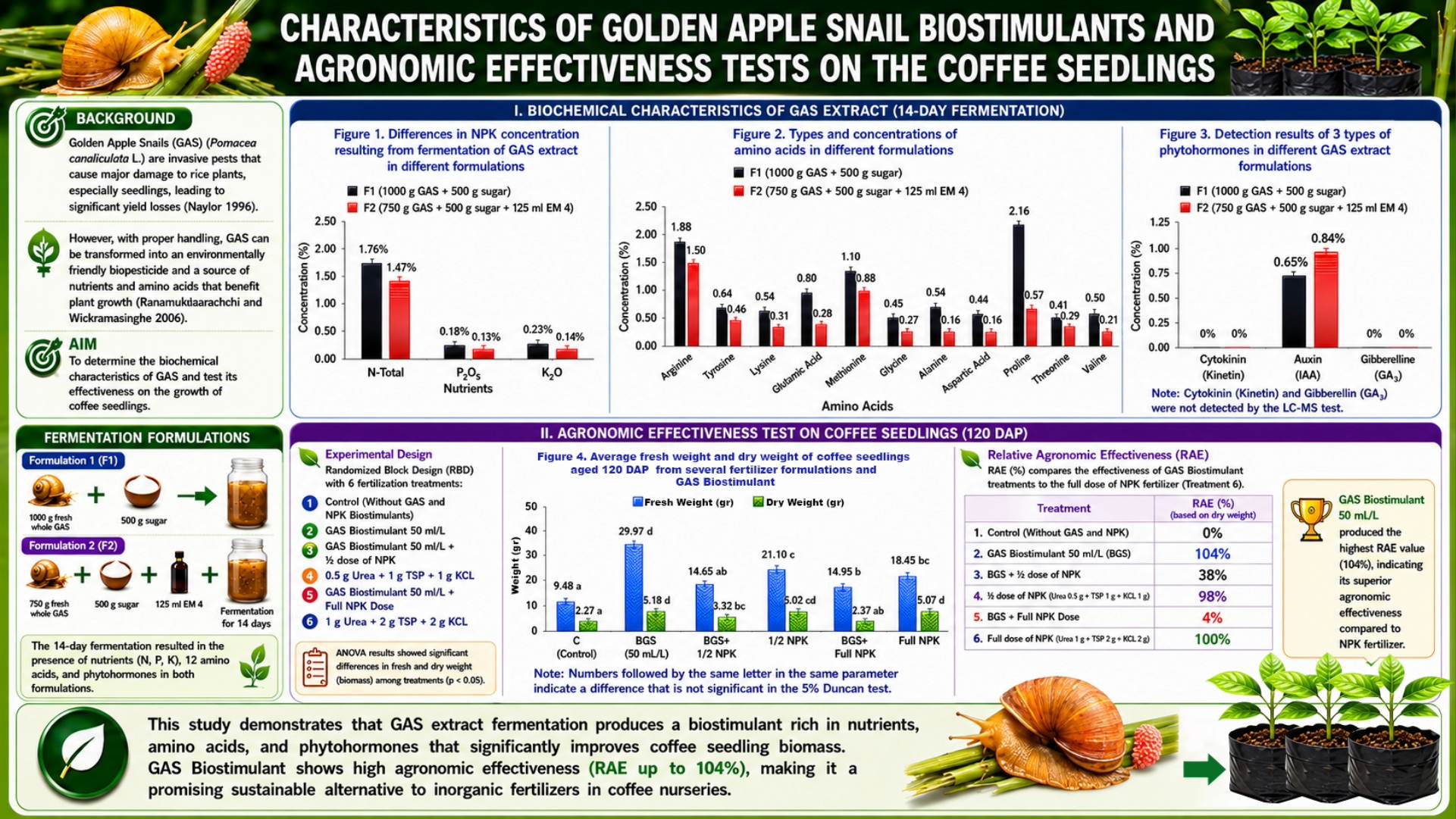
- Golden apple snail extract was successfully developed into a biostimulant containing NPK nutrients, 12 amino acids, and indole-3-acetic acid (IAA).
- The biostimulant significantly enhanced coffee seedling growth, including plant height, root length, leaf area, chlorophyll content, and biomass.
- Golden apple snail biostimulant achieved the highest Relative Agronomic Effectiveness (RAE) of 104%, outperforming conventional NPK fertilization.
- Formulation without EM4 retained higher concentrations of macronutrients and amino acids, whereas EM4 supplementation increased IAA production.
- Utilizing an invasive golden apple snail as a plant biostimulant provides a sustainable alternative to inorganic fertilizers for coffee nurseries.
ABSTRACT
The use of Golden Apple Snail (GAS), an invasive species, as a potential biostimulant source represents an innovation, particularly in sustainable agriculture and waste management. Therefore, this study aimed to determine the biochemical characteristics of GAS and assess its effectiveness on coffee seedling growth. The first test, detecting biochemical characteristics, was conducted using two formulations, i.e., 1) Formulation 1 = 1,000 g of fresh whole GAS extract + 500 g of sugar and 2) Formulation 2 = 750 g of fresh whole GAS extract + 500 g of sugar + 125 mL of EM 4. The results of the 14-day fermentation showed the presence of nutrients N, P, K, 12 amino acids, and phytohormones. Formulation 1 had a total amount of N-Total (1.76%), P2O5 (0.18%) and K2O (0.29%) and a higher amino acid content than those in Formulation 2. In phytohormone detection, IAA was present in both formulations. The results of this test were used for further tests on the growth of Robusta coffee seedlings. The second test of agronomic effectiveness was carried out using a Randomized Block Design, with 6 types of fertilization treatments: 1) Control (Without GAS and NPK Biostimulants); 2) GAS Biostimulant 50 mL/L; 3) GAS Biostimulant 50 mL/L + ½ dose of NPK; 4) 0.5 g Urea + 1 g TSP + 1 g KCL; 5) GAS Biostimulant 50 mL/L + Full NPK Dose; 6) 1 g Urea + 2 g TSP + 2 g KCL. Each treatment was divided into 3 groups having two plants in each group. Observation data at the age of 4 months were tested using ANOVA and showed that there were significant differences in all morphological observation variables, including plant height, root length, number of leaves, chlorophyll content, leaf area, fresh weight, and dry weight or biomass. Based on the dry weight data, a Relative Agronomic Effectiveness (RAE) test was also conducted, which showed that the GAS Biostimulant treatment produced the highest RAE value, namely 104%, compared to the use of NPK fertilizer, showing agronomic effectiveness of GAS Biostimulant as an alternative to inorganic fertilizers in coffee nurseries.
Abdelkader M, Voronina L, Puchkov M, Shcherbakova N, Pakina E, Zargar M, Lyashko M. 2023. Seed priming with exogenous amino acids improves germination rates and enhances photosynthetic pigments of onion seedlings (Allium cepa L.). Horticulturae 9(1). DOI: 10.3390/horticulturae9010080. DOI: https://doi.org/10.3390/horticulturae9010080
Ariole CN, Ilega E. 2013. Alkaline protease production by Pseudomonas aeruginosa isolated from the gut of Pila ovata. J Glob Biosci 2(5):126–131.
Asmono SL, Rahmawati R, Arifiana NB. 2025. Pengaruh biostimulan keong mas terhadap pertumbuhan bibit kopi robusta dan arabika fase siap tanam pada kondisi cekaman kekeringan [Effect of golden apple snail biostimulant on robusta and arabica coffee seedling growth under drought stress]. Agrikultura 36(2):252–260. DOI: https://doi.org/10.24198/agrikultura.v36i2.64419
Baqer HAA-R, Zeboon N, Al-Behadili A. 2019. The role and importance of amino acids within plants : A review. Plant Arch 19:1402–1410.
Canellas LP, Canellas NA, Val F, Spaccini R, Mazzei P, Olivares FL. 2024. Changes in amino acids profile and uptake on maize seedlings treated with protein hydrolysates and humic substances. Nitrogen 5(2):439–454. DOI: 10.3390/nitrogen5020028. DOI: https://doi.org/10.3390/nitrogen5020028
Chaski C, Petropoulos SA. 2022. The effects of biostimulant application on growth parameters of lettuce plants grown under deficit irrigation conditions. Biol Life Sci Forum 16(1). DOI: 10.3390/IECHo2022-12499. DOI: https://doi.org/10.3390/IECHo2022-12499
Colla G, Rouphael Y, Canaguier R, Svecova E, Cardarelli M. 2014. Biostimulant action of a plant-derived protein hydrolysate produced through enzymatic hydrolysis. Front Plant Sci 5:448. DOI: https://doi.org/10.3389/fpls.2014.00448
Dalorima T, Khandaker M, Zakaria A, Hasbullah M. 2018. Impact of organic fertilizations in improving bris soil conditions and growth of watermelon (Citrullus lanatus). Bulg J Agric Sci 24:112–118.
Direktorat Jenderal Perkebunan. 2014. Pedoman teknis budidaya kopi yang baik [Technical guidelines for good coffee cultivation]. Jakarta(ID): Kementerian Pertanaian Republik Indonesia.
Ellyzatul AB, Yusoff N, Mat N, Khandaker MM. 2018. Effects of fish waste extract on the growth, yield and quality of Cucumis sativus L. J Agrobiotechnology 9(1S):250–259.
Fathi A. 2022. Role of nitrogen (N) in plant growth, photosynthesis pigments, and N use efficiency. Agrisost 28:1–8.
Hildebrandt TM, Nesi AN, Araújo WL, Braun H-P. 2015. Amino acid catabolism in plants. Mol Plant 8(11):1563–1579. DOI: https://doi.org/10.1016/j.molp.2015.09.005
Istiqomah I, Aini LQ, Abadi AL. 2017. Kemampuan Bacillus subtilis dan Pseudomonas fluorescens dalam melarutkan fosfat dan memproduksi hormon IAA (Indole Acetic Acid) untuk meningkatkan pertumbuhan tanaman tomat [Phosphate-solubilizing and IAA-producing abilities of Bacillus subtilis and Pseudomonas fluorescens for enhancing tomato growth]. Buana Sains 17(1):75–84. DOI: https://doi.org/10.33366/bs.v17i1.580
Du Jardin P. 2015. Plant biostimulants: Definition, concept, main categories and regulation. Sci Hortic 196:3–14. DOI: https://doi.org/10.1016/j.scienta.2015.09.021
Khan S, Yu H, Li Q, Gao Y, Sallam BN, Wang H, …, Jiang W. 2019. Exogenous application of amino acids improves the growth and yield of lettuce by enhancing photosynthetic assimilation and nutrient availability. Agronomy 9(5). DOI: 10.3390/agronomy9050266. DOI: https://doi.org/10.3390/agronomy9050266
Khandaker M, Rohani F, Dalorima T, Mat N. 2017. Effects of different organic fertilizers on growth, yield and quality of Capsicum annuum L. var. kulai (Red Chilli Kulai). Biosci Biotechnol Res Asia 14:185–192. DOI: 10.13005/bbra/2434. DOI: https://doi.org/10.13005/bbra/2434
Kieliszek M, Pobiega K, Piwowarek K, Kot AM. 2021. Characteristics of the proteolytic enzymes produced by lactic acid bacteria. Molecules 26(7). DOI: 10.3390/molecules26071858. DOI: https://doi.org/10.3390/molecules26071858
Kocira S, Szparaga A, Hara P, Treder K, Findura P, Bartoš P, Filip M. 2020. Biochemical and economical effect of application biostimulants containing seaweed extracts and amino acids as an element of agroecological management of bean cultivation. Sci Rep 10(1):17759. DOI: 10.1038/s41598-020-74959-0. DOI: https://doi.org/10.1038/s41598-020-74959-0
Mackay AD, Syers JK, Gregg PEH. 1984. Ability of chemical extraction procedures to assess the agronomic effectiveness of phosphate rock materials. New Zeal J Agric Res 27(2):219–230. DOI: https://doi.org/10.1080/00288233.1984.10430424
Mañas P, Castro E, de las Heras J. 2009. Quality of maritime pine (Pinus pinaster Ait.) seedlings using waste materials as nursery growing media. New For 37:295–311. DOI: https://doi.org/10.1007/s11056-008-9125-4
Meliani A, Bensoltane A, Benidire L, Oufdou K. 2017. Plant growth-promotion and IAA secretion with Pseudomonas fluorescens and Pseudomonas putida. Res Rev J Bot Sci 6(2):16–24.
Naylor R. 1996. Invasions in agriculture: Assessing the cost of the golden apple snail in asia. Ambio 25(7):443–448. [accessed 2 Jul 2024]. Available from : http://www.jstor.org/stable/4314515.
Nurshanti DF, Defrian D, Novriani N. 2021. Growth and yield of okra using bio-stimulant of golden apple snails extracts and fertilizer on ultisol. J Lahan Suboptimal 10(1):37–45. DOI: https://doi.org/10.36706/JLSO.10.1.2021.515
Parrado J, Bautista J, Romero EJ, García-Martínez AM, Friaza V, Tejada M. 2008. Production of a carob enzymatic extract: Potential use as a biofertilizer. Bioresour Technol 99(7):2312–2318. DOI: 10.1016/j.biortech.2007.05.029. DOI: https://doi.org/10.1016/j.biortech.2007.05.029
Pertiwi MP, Saputri DD. 2020. Golden apple snail (Pomacea canaliculata) as an alternative protein source in Pasupati catfish (Pangasius sp.) fish feed. Nusant Biosci 12(2). DOI: https://doi.org/10.13057/nusbiosci/n120212
Prabowo RY, Rahmadwati R, Mudjirahardjo P. 2018. Classification of nitrogen content based on leaf color through color clustering using the Fuzzy C means method and Hybrid PSO K-Means. J EECCIS (Electrics, Electron Commun Control Informatics, Syst) 12(1):1–8.
Puspitasari FD, Shovitri M, Kuswytasari ND. 2012. Isolation and characterization of proteolytic aerobic bacteria from septic tanks. J Sains dan Seni ITS 1(1):E1--E4.
Putra RC, Pamungkas AS. 2022. Increasing the effectiveness of single inorganic fertilizer by providing humic acid in rubber plant nurseries. In: Prosiding Seminar Nasional Pembangunan dan Pendidikan Vokasi Pertanian 3:655–669. DOI: https://doi.org/10.47687/snppvp.v3i1.344
Radkowski A, Radkowska I, Godyn D. 2018. Effects of fertilization with an amino acid preparation on the dry matter yield and chemical composition of meadow plants. J Elem 23(3). DOI: https://doi.org/10.5601/jelem.2017.22.4.1511
Ranamukhaarachchi S, Wickramasinghe S. 2006 Jan 1. Golden apple snails in the world: Introduction, impact, and control measures. Glob Adv Ecol Manag of Golden Apple Snails:133–152.
Rusmini MRR, Daryono. 2016. Physical and chemical properties of local microorganism of gold snail with different amount of materials. In: Seminar Nasional Masyarakat Biodiversitas Indonesia (MBI), Samarinda. Vol. 26.
Sari RR, Marliah A, Hereri AI. 2019. Pengaruh komposisi media tanam dan dosis NPK terhadap pertumbuhan bibit kopi robusta (Coffea chanephora L.) [Effects of growing media composition and npk fertilizer dose on robusta coffee seedling growth (Coffea chanephora L.)]. J Agrium. 16(1):28–37. DOI: https://doi.org/10.29103/agrium.v16i1.1339
Sobarzo J, Jorquera M, Martínez O, Menezes-Blackburn D, Fernández MT, Marschner P, …, Mora ML. 2013. Indole acetic acid and phytase activity produced by Rhizosphere bacilli as affected by pH and metals. J Soil Sci Plant Nutr 11:1–12. DOI: 10.4067/S0718- 95162011000300001.
Sowmya R., Warke VG, Mahajan GB, Annapure US. 2023. Effect of amino acids on growth, elemental content, functional groups, and essential oils composition on hydroponically cultivated coriander under different conditions. Ind Crops Prod 197:116577. DOI: 10.1016/j.indcrop.2023.116577. DOI: https://doi.org/10.1016/j.indcrop.2023.116577
Stanghellini C, Van’t Ooster B, Heuvelink E. 2019. Greenhouse horticulture: Technology for optimal crop production. Wageningen (NL): Wageningen Academic. DOI: https://doi.org/10.3920/978-90-8686-879-7
Tahapary PR, Rehatta H, Kesaulya H. 2020. Effect of biostimulant application on lettuce growth and production (Lactuca sativa L.). J Budid Pertan 16(2):109–117. DOI: https://doi.org/10.30598/jbdp.2020.16.2.109
Tsotetsi T, Nephali L, Malebe M, Tugizimana F. 2022. Bacillus for plant growth promotion and stress resilience: What Have we learned? Plants 11(19). DOI: 10.3390/plants11192482. DOI: https://doi.org/10.3390/plants11192482
Wagi S, Ahmed A. 2019. Bacillus spp.: Potent microfactories of bacterial IAA. Peer J 7:e7258. DOI: https://doi.org/10.7717/peerj.7258
Wang D, Deng X, Wang B, Zhang N, Zhu C, Jiao Z, …, Shen Q. 2019. Effects of foliar application of amino acid liquid fertilizers, with or without Bacillus amyloliquefaciens SQR9, on cowpea yield and leaf microbiota. PLoS One 14(9):e0222048. DOI: 10.1371/journal.pone.0222048. DOI: https://doi.org/10.1371/journal.pone.0222048
Weiland M, Mancuso S, Baluska F. 2015. Signalling via glutamate and GLRs in Arabidopsis thaliana. Funct Plant Biol 43(1):1–25. DOI: https://doi.org/10.1071/FP15109
Wozniak E, Blaszczak A, Wiatrak P, Canady M. 2020. Biostimulant mode of action: impact of biostimulant on whole-plant level. In Geelen D, Xu L, Stevens CV (Editors), Chemical Biology of Plant Biostimulants. New Jersey (US): Wiley & Sons. p.:205–227. DOI: https://doi.org/10.1002/9781119357254.ch8
Yakhin OI, Lubyanov AA, Yakhin IA, Brown PH. 2017. Biostimulants in plant science: A global perspective. Front Plant Sci 7:238366. DOI: https://doi.org/10.3389/fpls.2016.02049
Copyright (c) 2026 Sepdian Luri Asmono, Rahmawati, Nisa Budi Arifiana, Dyah Nuning Erawati, Nurul Sjamsijah, N. Bambang Eko Sulistyono

This work is licensed under a Creative Commons Attribution-NonCommercial-NoDerivatives 4.0 International License.
Authors who publish with this journal agree with the following terms:
- Authors retain copyright and grant the journal right of first publication, with the work 1 year after publication simultaneously licensed under a Creative Commons attribution-noncommerical-noderivates 4.0 International License that allows others to share, copy and redistribute the work in any medium or format, but only where the use is for non-commercial purposes and an acknowledgement of the work's authorship and initial publication in this journal is mentioned.
- Authors are able to enter into separate, additional contractual arrangements for the non-exclusive distribution of the journal's published version of the work (e.g., post it to an institutional repository or publish it in a book), with an acknowledgement of its initial publication in this journal.
- Authors are permitted and encouraged to post their work online (e.g., in institutional repositories or on their website) prior to and during the submission process, as it can lead to productive exchanges, as well as earlier and greater citation of published work (See The Effect of Open Access).