
Jakarta’s Urban Green Spaces as Butterfly Habitats and Its Implications for Climate Mitigation
DOI:
https://doi.org/10.56060/bdv.2026.5.1.2857Abstract
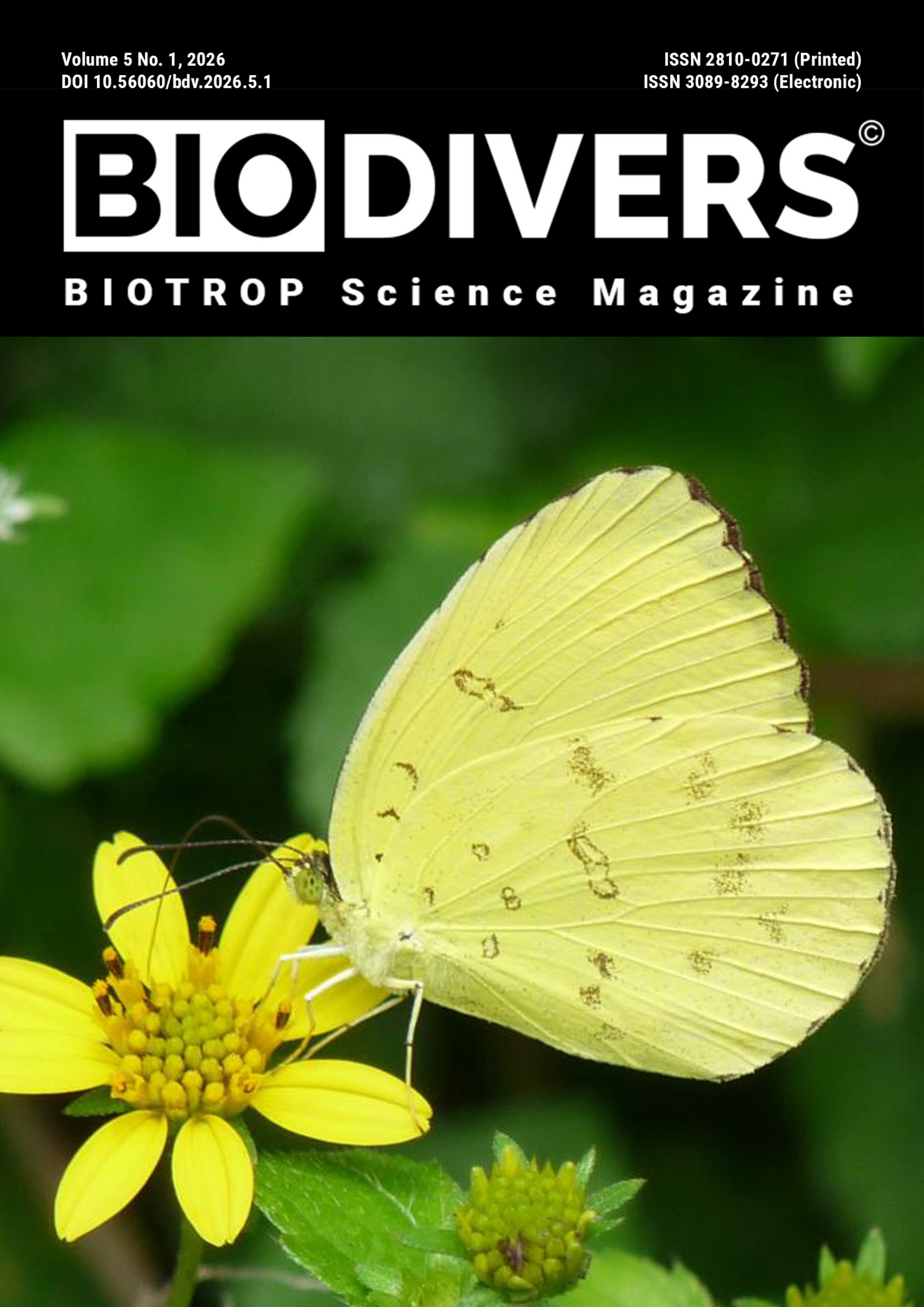
Jakarta’s urban green spaces are more than city parks. They are small ecosystems alive with pollinators that keep urban nature functioning. To understand how vegetation and human activity influence butterfly diversity, this study surveyed five parks across the city using standardized observation methods, namely the Pollard Walk and Point Count. A total of 157 butterflies representing 22 species were recorded, with Eurema sp. appearing most frequently. Parks with lush, layered vegetation like Penjaringan Urban Forest Park hosted the most species, while heavily urbanized areas had fewer. The findings reveal that preserving diverse plants and reducing disturbance can make cities more resilient to climate change, one butterfly at a time.
References
Aulia, R., Kaswanto, K., Arifin, H. S., Mosyaftiani, A., Syasita, N., Wahyu, A., & Wiyoga, H. (2023). Assessing the benefits and management of urban forest in supporting low Carbon City in Jakarta, Indonesia. Biodiversitas Journal of Biological Diversity, 24(11). https://doi.org/10.13057/biodiv/d241136
Azahra, S. D., Rushayati, S. B., & Destiana, D. (2022). Green open spaces as butterfly refuge habitat: Potential, issues, and management strategies for Butterfly Conservation in urban areas. BERKALA SAINSTEK, 10(4), 227. https://doi.org/10.19184/bst.v10i4.33123
Baró, F., & Gómez-Baggethun, E. (2017). Assessing the potential of regulating ecosystem services as nature-based solutions in urban areas. Theory and Practice of Urban Sustainability Transitions, 139–158. https://doi.org/10.1007/978-3-319-56091-5_9
Butt, N., Shanahan, D. F., Shumway, N., Bekessy, S. A., Fuller, R. A., Watson, J. E., Maggini, R., & Hole, D. G. (2018). Opportunities for biodiversity conservation as cities adapt to climate change. Geo: Geography and Environment, 5(1). https://doi.org/10.1002/geo2.52
Cohen, H., Philpott, S. M., Liere, H., Lin, B. B., & Jha, S. (2020). The relationship between pollinator community and pollination services is mediated by floral abundance in urban landscapes. Urban Ecosystems, 24(2), 275–290. https://doi.org/10.1007/s11252-020-01024-z
Han, D., Zhang, C., Wang, C., She, J., Sun, Z., Zhao, D., Bian, Q., Han, W., Yin, L., Sun, R., Wang, X., & Cheng, H. (2021). Differences in response of butterfly diversity and species composition in urban parks to land cover and local habitat variables. Forests, 12(2), 140. https://doi.org/10.3390/f12020140
Lim, V.-C., Sing, K.-W., Chong, K. Y., Jaturas, N., Dong, H., Lee, P.-S., Tao, N. T., Le, D. T., Bonebrake, T. C., Tsang, T. P., Chu, L., Brandon-Mong, G.-J., Kong, W.-L., Soga, M., & Wilson, J.-J. (2022). Familiarity with, perceptions of and attitudes toward butterflies of urban park users in megacities across East and Southeast Asia. Royal Society Open Science, 9(11). https://doi.org/10.1098/rsos.220161
Lin, Y., Huang, S., Fang, W., Huang, Y., Gao, C., Huang, Y., Zheng, R., & Fu, W. (2024). Impact of urban landscape patterns on Butterfly Diversity in Fuzhou city parks. Science of The Total Environment, 957, 177165. https://doi.org/10.1016/j.scitotenv.2024.177165
Maheng, D., Pathirana, A., & Zevenbergen, C. (2021). A preliminary study on the impact of landscape pattern changes due to urbanization: Case study of Jakarta, Indonesia. Land, 10(2), 218. https://doi.org/10.3390/land10020218
Pollard, E. (1977). A method for assessing changes in the abundance of butterflies. Biological Conservation, 12(2), 115–134. https://doi.org/10.1016/0006-3207(77)90065-9
Purohit, S. (2024). The role of urban green spaces in mitigating urban heat island effect amidst climate change. Research Journal of Chemistry and Environment, 29(1), 75–84. https://doi.org/10.25303/291rjce075084
Rushayati, S. B., & Azahra, S. D. (2024). Beyond concrete jungles: Managing urban green spaces as butterfly hotspot and their implications for ecotourism in Pontianak City, Indonesia. IOP Conference Series: Earth and Environmental Science, 1366(1), 012026. https://doi.org/10.1088/1755-1315/1366/1/012026
Vieira, J., Matos, P., Mexia, T., Silva, P., Lopes, N., Freitas, C., Correia, O., Santos-Reis, M., Branquinho, C., & Pinho, P. (2018). Green spaces are not all the same for the provision of air purification and climate regulation services: The case of urban parks. Environmental Research, 160, 306–313. https://doi.org/10.1016/j.envres.2017.10.006
Winarni, N. L., Nuruliawati, N., Anugra, B. G., Junaid, A. R., Widayanti, S., Aslan, A., Nugroho, A., Miga, I., Kurniawan, M. B., Liestanti, M., Lutfiani, R. A., & Wulandari, Y. (2023). Can cities provide butterfly-friendly habitats? Biodiversitas Journal of Biological Diversity, 24(4). https://doi.org/10.13057/biodiv/d240447
Downloads
Published
Issue
Section
License
Copyright (c) 2026 Andi Nazwa Aulia Maharani

This work is licensed under a Creative Commons Attribution-NonCommercial-NoDerivatives 4.0 International License.
Authors who publish with this journal agree with the following terms:
- Authors retain copyright and grant the journal right of first publication, with the work 1 year after publication simultaneously licensed under a Creative Commons attribution-noncommerical-noderivates 4.0 International License that allows others to share, copy and redistribute the work in any medium or format, but only where the use is for non-commercial purposes and an acknowledgement of the work's authorship and initial publication in this journal is mentioned.
- Authors are able to enter into separate, additional contractual arrangements for the non-exclusive distribution of the journal's published version of the work (e.g., post it to an institutional repository or publish it in a book), with an acknowledgement of its initial publication in this journal.
- Authors are permitted and encouraged to post their work online (e.g., in institutional repositories or on their website) prior to and during the submission process, as it can lead to productive exchanges, as well as earlier and greater citation of published work (See The Effect of Open Access).