
Bamboo Utilization in the Peleng Island: Unveiling Local Knowledge and Diverse Applications
DOI:
https://doi.org/10.56060/bdv.2024.3.1.2210Keywords:
Banggai Kepulauan, bamboo, local wisdom, Peleng IslandAbstract
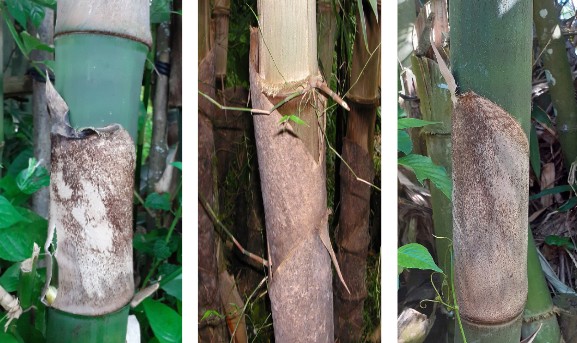
Bamboo is a useful plant that holds significant cultural and economic importance, particularly in small Indonesian islands like Peleng Island in Central Sulawesi. This paper explores bamboo utilization on Peleng Island, aiming to broaden our understanding of bamboo use on small Indonesian islands and shed light on local wisdom in bamboo utilization. The research was conducted on Peleng Island in 2019. Information on bamboo utilization was gathered through in-depth interviews with residents. Bamboo materials were collected and sent to the Herbarium Bogoriense for identification. The data were analysed descriptively. There are six bamboo species utilized on Peleng Island, namely Bambusa vulgaris, Dendrocalamus asper, Gigantochloa atter, Neololeba atra, Schizostachyum brachycladum, and Schizostachyum lima. Bamboo on Peleng Island is used for building materials (roofs, pillars, and wall weaving), cooking traditional foods like nasi jaha and bambu suman, and for various other uses (ornamental plants, water containers, stairs, poles for picking fruits/cloves, pest traps, and fish trap).
References
Ahmad, Z., Upadhyay, A., Ding, Y., Emamverdian, A., & Shahzad, A. (2021). Bamboo: origin, habitat, distributions and global prospective. In: Ahmad, Z., Ding, Y., & Shahzad, A. (eds). Biotechnological advances in bamboo. Singapore: Springer, Pp. 1-31.
BPKPPST (Badan Pemeriksa Keuangan Perwakilan Provinsi Sulawesi Tengah). (2015). Peta administrasi Kabupaten Banggai Kepulauan. Retrieved from: http://www.palu.bpk.go.id/?page_id=15160
Canavan, S., Richardson, D. M., Visser, V., Roux, J. J. L., Vorontsova, M. S., & Wilson, J. R. U. (2017). The global distribution of bamboos: Assessing correlates of introduction and invasion. AoB Plants, 9(1), plw078. https://doi.org/10.1093%2Faobpla%2Fplw078
Damayanto, I. P. G. P. (2018). Bamboo potential for foodstuff in Karimun Island and Karimun Anak Island, Kepulauan Riau Province, Indonesia. Proceeding of the International Symposium on Bioeconomics of Natural Resources Utilization. Bogor: Center for Plant Conservation Botanic Gardens, Indonesian Institute of Sciences. Bogor, 12‒14 October 2017. Pp. 120‒128.
Damayanto, I. P. G. P., & Fefirenta, A. D. (2021). Pola persebaran marga bambu di Indonesia. Prosiding Biologi Achieving the Sustainable Development Goals with Biodiversity in Confronting Climate Change, 7(1), 24-41. https://doi.org/10.24252/psb.v7i1.22233
Damayanto, I. P. G. P., & Rahmawati, K. (2020). Bamboos diversity in Banggai Kepulauan, Central Sulawesi, Indonesia. Jurnal Biodjati, 5(1), 1-14. https://doi.org/10.15575/biodjati.v5i1.6230
Dlamini, L. C., Fakudze, S., Makombe, G. G., Muse, S., & Zhu, J. (2022). Bamboo as a valuable resource and its utilization in historical and modern-day china. BioResources, 17(1), 1926-1938. https://doi.org/10.15376/biores.17.1.Dlamini
Dransfield, S., & Widjaja, E. A. (1995). Plant resources of South-East Asia no. 7. bamboos. Leiden: Backhuys.
Ervianti, D., Widjaja, E. A., & Sedayu, A. (2019). New species of climbing and scrambling bamboo from Sulawesi, Indonesia. Reinwardtia, 18(2), 115-132. http://dx.doi.org/10.55981/reinwardtia.2019.3774
Hsiung, W. (1987). Bamboo in China: new prospects for an ancient resource. Unasylva, 39(156), no pages.
Mohan, N., Dash, S. P., Boby, N. M., & Shetty, D. (2022). Study of bamboo as a building material – Construction & preservation techniques and its sustainability. Materials Today: Proceedings, 60(1), 100-114. https://doi.org/10.1016/j.matpr.2021.12.263
Muzakki, F. A. (2020). Keberagaman bambu marga Schizostachyum Nees di Jawa. MSc thesis. Bogor: Institut Pertanian Bogor.
Widiarti, A. (2013). Pengusahaan rebung bambu oleh masyarakat, studi kasus di Kabupaten Demak dan Wonosobo. Jurnal Penelitian Hutan dan Konservasi, 10(1), 51-61.
Widjaja, E. A. (1987). A revision of Malesian Gigantochloa (Poaceae-Bambusoideae). Reinwardtia, 10(3), 291-380. http://dx.doi.org/10.55981/reinwardtia.1987.274
Widjaja, E. A. (1997). New taxa in Indonesian bamboos. Reinwardtia, 11(2), 57-152. http://dx.doi.org/10.55981/reinwardtia.1997.588
Widjaja, E. A. (2001a). Identikit jenis-jenis bambu di Jawa. Bogor: Pusat Penelitian Biologi–LIPI.
Widjaja, E. A. (2001b). Identikit jenis-jenis bambu di Kepulauan Sunda Kecil. Bogor: Pusat Penelitian dan Pengembangan Biologi–LIPI.
Widjaja, E. A. (2019). The spectacular Indonesian bamboos. Jakarta: Polagrade.
Widjaja, E. A. (2020). Notes on Fimbribambusa Widjaja, with a new species from the Lesser Sunda Islands. Reinwardtia, 19(1), 55-59. http://dx.doi.org/10.55981/reinwardtia.2020.3838
Widjaja, E. A. (2023). Fimbribambusa jokowii Widjaja (Poaceae: Bambusoideae), a new scrambling bamboo from Flores, Indonesia. Advances in Bamboo Science, 4, 100033. https://doi.org/10.1016/j.bamboo.2023.100033
Widjaja, E. A., Astuti, I. P., Arinasa, I. B. K., & Sumantera, I. W. (2005). Identikit bambu di Bali. Bogor: Pusat Penelitian Biologi–LIPI.
Widjaja, E. A, Rahayuningsih, Y., Rahajoe, J. S., Ubaidillah, R., Maryanto, I., Walujo, E. B., & Semiadi, G. (2014). Kekinian keanekaragaman hayati Indonesia 2014. Jakarta: LIPI Press.
Downloads
Published
Issue
Section
License
Copyright (c) 2024 I Putu Gede P. Damayanto, Susila

This work is licensed under a Creative Commons Attribution-NonCommercial-NoDerivatives 4.0 International License.
Authors who publish with this journal agree with the following terms:
- Authors retain copyright and grant the journal right of first publication, with the work 1 year after publication simultaneously licensed under a Creative Commons attribution-noncommerical-noderivates 4.0 International License that allows others to share, copy and redistribute the work in any medium or format, but only where the use is for non-commercial purposes and an acknowledgement of the work's authorship and initial publication in this journal is mentioned.
- Authors are able to enter into separate, additional contractual arrangements for the non-exclusive distribution of the journal's published version of the work (e.g., post it to an institutional repository or publish it in a book), with an acknowledgement of its initial publication in this journal.
- Authors are permitted and encouraged to post their work online (e.g., in institutional repositories or on their website) prior to and during the submission process, as it can lead to productive exchanges, as well as earlier and greater citation of published work (See The Effect of Open Access).