
ETHNOBOTANICAL STUDY OF MEDICINAL PLANTS BASED ON LOCAL KNOWLEDGE IN SEDAYU VILLAGE, JUMANTONO, KARANGANYAR
DOI:
https://doi.org/10.56060/bdv.2024.3.1.2169Keywords:
medicinal plants, sedayu village, utilization and processing of medicinal plantsAbstract
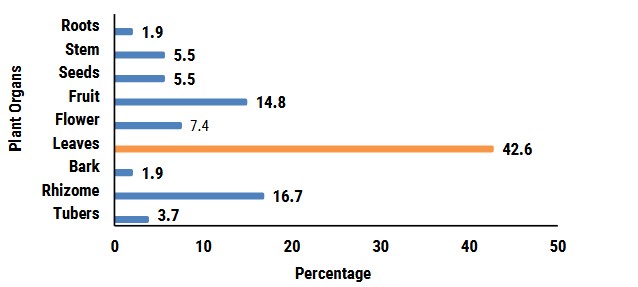
Medicinal plants are one of the important aspects of traditional medicine development. The utilization of medicinal plants is a very valuable local wisdom and a culture that needs to be investigated more thoroughly so that knowledge about it does not become extinct. The purpose of this study is to determine the plant species that were used, the parts of plants that were used, and how to process them. This research was conducted in May 2023 in Sedayu Village, Jumantono District, Karanganyar Regency. The informants of this research were the people of Sedayu Village. The method used was snowball sampling which focuses on the community of medicinal plant users. The collected data was descriptively qualitatively and quantitatively assessed. The results showed that there were 52 species of medicinal plants used by the Sedayu Village community including ginger, kencur, turmeric, red betel, and ciplukan. The most utilized part of medicinal plants was the leaves and the most common processing method was boiling and drinking. With this information, it can be a reference for the village government and the community regarding how important a type of plant as a medicine to be preserved.
References
Arisandi, Y., and Andriani, Y. (2011).Khasiat Berbagai Tanaman untuk Pengobatan Berisi 158 Jenis Tanaman Obat[Benefits of Various Plants for Medicine Contains 158 Types of Medicinal Plants]. Jakarta: Eska Media.
Arum, G.P.F., Retnoningsih, A., and Irsadi, A. (2012). Etnobotani Tumbuhan Obat di Desa Keseneng, Kecamatan Sumowono, Kabupaten Semarang [Ethnobotany of Medicinal Plants in Keseneng Village, Sumowono District, Semarang Regency]. Unnes Journal of Life Science, 1(2): 126-132.
Azmin N., Rahmawati A., and Hidayatullah, M.E. (2019). Uji kandungan fitokimia dan etnobotani tumbuhan obat tradisional berbasis pengetahuan lokal di Kecamatan Lambitu, Kabupaten Bima [Test the phytochemical and ethnobotanical content of traditional medicinal plants based on local knowledge in Lambitu District, Bima Regency].Florea: J Biol Pembelajarannya,6: 101- 113.
Dharmono, D. (2018). Kajian Etnobotani Tumbuhan Jalukap (Centella Asiatica L.)Di Suku Dayak Bukit Desa Haratai 1 Loksado [Ethnobotanical Study of Jalukap Plant (Centella Asiatica L.)In Dayak Hill Tribe of Haratai Village 1 Loksado]. BIOSCIENTIAE, 4(2).
Efremila, Evy, W., and Lolyta, S. (2015). Studi etnobotani tumbuhan obat oleh etnis suku Dayak di desa Kayu Tanam kecamatan Mandor kabupaten Landak [Ethnobotanical study of medicinal plants by Dayak ethnic tribe in Kayu Tanam village, Mandor sub-district, Landak regency]. Jurnal Hutan Lestari, 3(2), 234-246.
Fadilah, Lovadi, I., and Linda, R. (2015). Pemanfaatan Tumbuhan dalam Pengobatan Tradisional Masyarakat Suku Dayak Kanayatn di Desa Ambawang Kecamatan Kubu Kabupaten Kubu Raya [Utilization of Plants in Traditional Medicine of Dayak Kanayatn Tribe Community in Ambawang Village, Kubu District, Kubu Raya Regency]. Jurnal Protobiont, 4(3), 49-59.
Farhatul, B.W. (2013). Potensi Tumbuhan Obat di Area Kampus II UIN Alauddin Samata Gowa [The Potential of Medicinal Plants in the Campus II Area of UIN Alauddin Samata Gowa]. Teknosains: Media Informasi Sains dan Teknologi, 7(1), 111-119. Makasar: UIN Press.
Febrianti, Y., and Krisnawati, Y. (2021). Analisis Pengetahuan Masyarakat Tentang Pemanfaatan Tumbuhan Obat Famili Solanaceae Di Kecamatan Tugumulyo [Analysis of Community Knowledge on the Utilization of Solanaceae Family Medicinal Plants in Tugumulyo District]. Bioma: Jurnal Biologi Makassar, 6(2), 10-22.
Howay, M., Sinaga, N.I., and Kesaulija, E.M. (2003). Utilization of Plants as Traditional Medicines by Maibrat Tribe in Sorong. Beccariana, 5(1): 24-34.
Ismiyanti, N., Diana, A.M., Rizqiyah, S., and Syafiullah, A.M. (2021). Studi Etnofarmasi Tumbuhan Obat Di Desa Pecoro Kecamatan Rambipuji Kabupaten Jember [Ethnopharmaceutical Study of Medicinal Plants in Pecoro Village, Rambipuji District, Jember Regency]. VEKTOR: Jurnal Pendidikan IPA, 2(2), 106-116.
Lesmana, H., Alfianur, A., Utami, P.A., Retnowati, Y., and Darni, D. (2018). Pengobatan tradisional pada masyarakat Tidung kota Tarakan: study kualitatif kearifan lokal bidang Kesehatan [Traditional medicine in the Tidung community of Tarakan city: a qualitative study of local wisdom in the field of Health]. Medisains, 16(1), 31-41.
Linda, R., and Lovadi, I. (2013). Etnobotani Tumbuhan Obat oleh Suku Dayak Iban Desa Tanjung Sari Kecamatan Ketungau Tengah Kabupaten Sintang [Ethnobotany of Medicinal Plants by Iban Dayak Tribe, Tanjung Sari Village, Central Kemite District, Sintang Regency]. Jurnal Protobiont, 2(3).
Marwati, M., and Amidi, A. (2019). Pengaruh budaya, persepsi, dan kepercayaan terhadap keputusan pembelian obat herbal [The influence of culture, perceptions, and beliefs on herbal medicine purchasing decisions]. Jurnal Ilmu Manajemen, 7(2), 168-180.
Meliki, Riza, L., and Irwan, L. (2013). Etnobotani Tumbuhan Obat oleh Suku Dayak Iban Desa Tanjung Sari Kecamatan Ketungau Tengah Kabupaten Sintang [Ethnobotany of Medicinal Plants by Iban Dayak Tribe, Tanjung Sari Village, Central Kemite District, Sintang Regency]. Jurnal Protobiont, 2(3): 129-135.
Nulfitriani, Pitopang, R., and Yuniati, E. (2013). Pemanfaatan tumbuhan sebagai obat tradisional pada suku Tolitoli di desa Pinjan Sulawesi Tengah [The use of plants as traditional medicine in the Tolitoli tribe in Pinjan village, Central Sulawesi]. Biocelebes, 7(2), 1-8.
Rusmina, H.Z., Miswan, M., and Ramadhanil, R. (2015). Studi etnobotani tumbuhan obat pada masyarakat Suku Mandar di Desa Sarude Sarjo Kabupaten Mamuju Utara Sulawesi Barat [Ethnobotanical study of medicinal plants in the Mandar Tribe community in Sarude Sarjo Village, North Mamuju Regency, West Sulawesi]. Biocelebes, 9(1): 73-87.
Utomo, D.H. (2017). Etnobotani tumbuhan obat oleh perempuan suku Osing di Kecamatan Glagah Kabupaten Banyuwangi [Ethnobotany of medicinal plants by Osing tribal women in Glagah District, Banyuwangi Regency]. (Doctoral dissertation, Universitas Islam Negeri Maulana Malik Ibrahim).
Wulandara, F.D, Rafdinal, and Linda, R. (2018). Etnobotani Tumbuhan Obat Suku Melayu Desa Durian Sebatang Kecamatan Seponti Kabupaten Kayong Utara [Ethnobotany of Malay Medicinal Plants Durian Sebatang Village, Seponti District, North Kayong Regency]. Jurnal Protobiont, 7(3): 36-46.
Yaqin, A.A. (2020). Etnobotani Tumbuhan Obat oleh Masyarakat Kawasan Taman Nasional Baluran Kabupaten Situbondo [Ethnobotany of Medicinal Plants by the People of Baluran National Park Area, Situbondo Regency]. (Doctoral dissertation, Universitas Islam Negeri Maulana Malik Ibrahim).
Downloads
Published
Issue
Section
License
Copyright (c) 2024 Ana Agustina

This work is licensed under a Creative Commons Attribution-NonCommercial-NoDerivatives 4.0 International License.
Authors who publish with this journal agree with the following terms:
- Authors retain copyright and grant the journal right of first publication, with the work 1 year after publication simultaneously licensed under a Creative Commons attribution-noncommerical-noderivates 4.0 International License that allows others to share, copy and redistribute the work in any medium or format, but only where the use is for non-commercial purposes and an acknowledgement of the work's authorship and initial publication in this journal is mentioned.
- Authors are able to enter into separate, additional contractual arrangements for the non-exclusive distribution of the journal's published version of the work (e.g., post it to an institutional repository or publish it in a book), with an acknowledgement of its initial publication in this journal.
- Authors are permitted and encouraged to post their work online (e.g., in institutional repositories or on their website) prior to and during the submission process, as it can lead to productive exchanges, as well as earlier and greater citation of published work (See The Effect of Open Access).